

Microsoft’s short MSRC line that “Azure Linux includes this open‑source library and is therefore potentially affected” is correct — but it is a product‑scoped attestation, not a universal guarantee that no other Microsoft product can contain the same vulnerable btrfs code. Treat Azure Linux as a confirmed remediation priority, and treat every other Microsoft‑distributed Linux kernel artifact as unverified until you confirm it yourself or Microsoft explicitly attests it as affected or not affected.
CVE‑2025‑38260 is an upstream Linux kernel bug in the btrfs filesystem handling when mounted with the rescue=ibadroots option. The upstream description and multiple distro trackers explain the core problem: when a corrupted checksum (csum) tree root is encountered, code paths that should set a no‑checksums state (so the kernel avoids checksum lookups) can skip error handling and leave the csum root pointer NULL. Later btrfs code then dereferences that NULL pointer, producing kernel oopses and potential panics. The issue is reproducible with a syzbot reproducer and was assigned a CVSS v3 base score in the mid range driven by local attack vector and high availability impact.
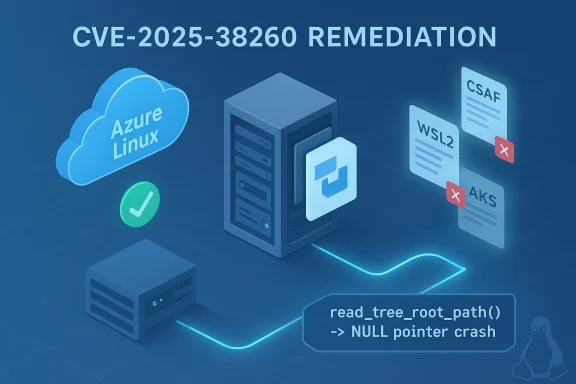
Independent vulnerability pages published by vendors and NVD summarize the same call trace and root cause, and show that the fix is small and surgical: ensure the error code from read_tree_root_path() is propagated so the post‑mount logic correctly flags the filesystem state and avoids dereferencing a missing csum root. Operators should therefore treat the defect primarily as an availability risk (kernel crashes and host instability) requiring kernel updates and appropriate mitigations.
Put plainly:
Source: MSRC Security Update Guide - Microsoft Security Response Center
 Background / Overview
CVE‑2025‑38260 is an upstream Linux kernel bug in the btrfs filesystem handling when mounted with the rescue=ibadroots option. The upstream description and multiple distro trackers explain the core problem: when a corrupted checksum (csum) tree root is encountered, code paths that should set a no‑checksums state (so the kernel avoids checksum lookups) can skip error handling and leave the csum root pointer NULL. Later btrfs code then dereferences that NULL pointer, producing kernel oopses and potential panics. The issue is reproducible with a syzbot reproducer and was assigned a CVSS v3 base score in the mid range driven by local attack vector and high availability impact.Independent vulnerability pages published by vendors and NVD summarize the same call trace and root cause, and show that the fix is small and surgical: ensure the error code from read_tree_root_path() is propagated so the post‑mount logic correctly flags the filesystem state and avoids dereferencing a missing csum root. Operators should therefore treat the defect primarily as an availability risk (kernel crashes and host instability) requiring kernel updates and appropriate mitigations.
What Microsoft actually published — and what that wording means
Microsoft’s Security Response Center (MSRC) entry for a number of Linux kernel CVEs — including the phrasing you quoted for CVE‑2025‑38260 — follows a consistent pattern: it explicitly states that Azure Linux (Microsoft’s maintained Linux distribution lineage) includes the implicated upstream component and is therefore potentially affected, and it states that Microsoft has begun publishing machine‑readable CSAF/VEX attestations (a phased rollout that began in October 2025) and will update iucts are identified. That is a product‑level inventory attestation, not an assertion of exclusivity.Put plainly:
- When MSRC says “Azure Linux includes this open‑source library,” it means Microsoft inspected Azure Linux artifacts (images and/or kernel packages) and fo which maps to the CVE. That makes Azure Linux a confirmed remediation target.
- When MSRC does not list other Microsoft products, that omission is an absence of attestation, not proof that those products are free of the vulnerable code. Microsoft has committed to expanding the CSAFl update CVE entries if additional products are identified.
Short answer — and why the nuance matters
- Short answer: No — Azure Linux is not necessarily the only Microsoft product that could include the vulnerable btrfs code referenced by CVE‑2025‑38260. Microsoft has publicly attested only Azure Linux so far; that attestation is authoritative for Azure Linux but does not provefacts are clean.
- Operational implication: If you run Azure Linux, prioritize patching or applying the vendor kernel update Microsoft publishes for that distribution. If you run other Microsoft‑supplied artifacts (WSL2 kernels, Linux kernels in Azure Marketplace images, AKS node images, custom Marketplace appliances, container base images, linux‑azure packages, etc.), you must verify those artifacts individually — do not assume safety from the absence of a product‑level attestation.
Technic38260 (what defenders need to know)
- Affected component: btrfs checksum tree handling when the filesystem is mounted with rescue=ibadroots. The code path can end up with a NULL checksum root pointer when tree reading fails, and later paths assume the root is present leading to a NULL dereference.
- Exploitability: Local (requires the ability to mount or interact with a btrfs image or device, or run code that triggers the problematic paths). The syzbot reproducer demonstrates reliable triggering in test harnesses. The primary impact is denial of service / availability (kernel oops/panic).
- Severity: vendors and NVD assigned a medium base score (CVSS ~5.5) with High availability impact in many trackers; practical risk is highest on hosts where untrusted or attacker-controlled block devices or images can be mounted, or on multi‑tenant hosts where a guest can trigger the kernel path.
- Fix: upstream kernel patches ensure the error return from read_tree_root_path() is propagated and that BTRFS state flags (such as BTRFS_FS_STATE_NO_DATA_CSUMS) are set appropriately so subsequent csum lookups are not attempted when the tree is invalid. The remedy is therefore a kernel change (applied to stable trees and backported by distributors).
Which Microsoft artifacts might be affected (beyond Azure Linux)
Do not treat the MSRC attestation as exhaustive. The following Microsoft artifacts are the realistic carriers wherrfs code might appear unless verified:- Azure Marketplace VM images (any Marketplace imax or another vendor image that includes btrfs support).
- **AKS node images / managed node OS ima‑azure or Azure Linux base.
- linux‑azure kernels and any other Microsoft‑maintained kernel packages shipped to VM SKUs.
- WSL2 kernel binaries distributed by Microsoft to Windows clikernel build was compiled from an upstream tree containing the pre‑fix btrfs code, it could be a carrier.
- **Container base images and curated runtime images (if derived from Azure Linux or CBL‑Mariner variants that include btrfs support).
- Partner / Marketplace appliances and third‑party images distributed through Microsoft channels — these are often assembled by external publishers and can include arbitrarat them as unverified unless the publisher attests otherwise.
How to verify exposure across a Microsoft‑centric estate — a prioritized checklist
The high‑level approach is: (A) treat Azure Linux as confirmed affected and patch it immediately; (B) inventory and verify other Microsoft artifacts using artifact‑level checks; (C) apply vendor or upstream kernel fixes where necessary.- Prioritize Azure Linux images
- Apply Microsoft’s published kernel updates for the affected Azure Linux release or replace images with patched variants. If Microsoft publishes CSAF/VEX that marks the ptheir instructions.
- Inventory Microsoft artifacts in your environment
- Enumerate VM images, AKS node pools, Marketplace appliances, WSL2 installations, and container bases that originate from Microsoft or Azure Marketplace.
- For each artifact, record the kernel package name and version (e.g., linux‑azure, kernel‑xyz) and th3. Artifact‑level verification (do this for each kernel/image)
- Check package/version metadata:
- On running systems: uname -r; query distro package for kernel build and changelog (e.g., apt changelog linux-image-... or rpm -q --changelog).
- Inspect container images: extract /boot, /lib/modules, or check image package database for kernel package versions.
- Inspect the kernel config and modules:
- Check for CONFIG_BTRFS or similar options in /proc/config.gz or /boot/config-$(uname -r). If btrfs is not built in and not available as a module, exposure could be lower.
ns/commits to upstream fixes: - Compare your kernel version to the fixed commits or stable patch IDs listed in upstream or distribution advisories (NVD, distro security pages, or the kernel stable commit logs). If your kernel predates the fix or lacks the backport, treat it as vulnerable.
- Static artifact checks (for images you cannot boot)
- Examine the filesystem image: look for btrfs userspace tools, kernel modules, or packages that suggest the kernel is configured with btrfs support.
- Use SBOMs or image manifest metadata where available — Microsoft’s CSAF/VEX and SBOMs (if published step.
- If you find a candidate carrier and cannot immediately patch
- Isolate the host or image, avoid mounting untrusted btrfs images on those hosts, and restrict local user access to prevent local triggering of mount/exec sequences that exercise the btrfs csum path.
- Monitor for OOPS and WARN messages in dmesg referencing btrfs_lookup_csum or similar traces. The syzbot reproducer yields a characteristic call trace useful for detection.
Recommended remediation and monitoring actions
- Patch promptly
- Apply the vendor/kernel update that includes the upstream fix. For distro or cloud images, use the distro package manager or update the Marketplace/AKS node images to patched variants. Ubuntu, Oracle Linux, and other vendors published advisories starting in July 2025; follow your vendor’s guidance for package and kernel names.
- Reboot where required
- Kernel fixes typically require a reboot to take effect. Schedule reboots for affected hosts, prioritizing multi‑tenant and high‑risk systems first.
- Monitor logs for symptomatic traces
- Look for kernel oops traces referencing btrfs_lookup_csum or btrfs_lookup_bio_sums and the rescue=ibadroots debug text. Configure centralized logging and alerting for kernel oops strings.
- Harden access and mount policies temporarily
- Until patching is complete, avoid mounting untrusted btrfs images and limit who can mount block devices or attach loopback devices on hosts that provide shared infrastructure.
- Use SBOMs, image manifests, and VEX/CSAF where available
- Leverage Microsoft’s published CSAF/VEX attestations for Azure Linux and any SBOMs or image metadata Microsoft provides to acceleMicrosoft artifacts. Remember: CSAF/VEX is only authoritative for artifacts it covers; keep validating your broader estate.
- Prepare forensic and recovery plans
- For hosts that experienced kernel panics, collect kernel crash dumps and dmesg output to support post‑incident analysis. Ensure backups and image snapshots exist prior to wide remediation operations.
Critical analysis: strengths of Microsoft’s approach — and the risks it leaves behind
Strengths- Transparency where it exists. Microsoft’s targeted attestation that Azure Linux contains the implicated code gives actionable certainty to Azure Linux customers; it enables automated workflows to pick up the CSAF/VEX data and trigger remediation. Publishing CSAFdable form (rollout started October 2025) is an important step for automation and defensible response.
- Product‑scoped accuracy. A product‑by‑product inventory process reduces false positives — when Microsoft says a named prnent, that assertion is an outcome of artifact inspection rather than guesswork.
- Perception vs. reality. A short single‑line attestation naming Azure Linux can create a false sense of safety for organizations that assume "Microsoft didn’t name my other product, so I’m sis unsafe: absence of attestation is not proof of safety.
- Phased coverage leaves residual exposure. Until Microsoft completes VEX/CSAF attestations across all product families and artifacts, every un‑attested Microsoft artifact must be verified independenoperational burden for large estates.
- Artifact heterogeneity multiplies verification needs. The same upstream code can be compiled into many kernels with different backports and configs. Automated CI/CD pipelines, container registries, and Marketplace images increase the places the code may appear, making complete coverage difficult w VEX investment.
Practical takeaways for IT/security teams
- If you run Azure Linux: treat the product as confirmed in‑scope for CVE‑2025‑38260 and apply Microsoft’s patch guidance immediately. Use the published CSAF/VEX attestation to automate tracking and remediation.
- Irosoft artifacts** (WSL2, AKS, Marketplace images, linux‑azure kernels, container bases): do not assume safety. Perform the artifact‑level checks above (kernel version → upstream fix mapping, kernel config, module presence) and patch or rebuild as needed.
- If you manage multi‑tenant or shared infrastructure, prioritize isolation and aggressive patch cadence — local kernel DoS bugs are especially damaging in shared settings.
Use SBOMs, image manifests, and VEX/CSAF data where available to accelerate verification, but treat them as complements to — not replacements for — a
Conclusion
Microsoft’s MSRC statement that “Azure Linux includes this open‑source library and is therefore potentially affected” is both accurate and actionable: it confirms Azure Linux images were inspected and must be prioritized for remediation. However, that product‑scoped attestation does not — and cannot logically — guarantee that other Microsoft products, images, or kernels are clean. The correct operational posture is to treat Azure Linux as a confirmed, immediate patch target while simultaneously applying artifact‑level verification across your estate for other Microsoft‑supplied artifacts (WSL kernels, linux‑azure images, AKS node images, Marketplace images, container bases, and any image that bundles a kernel or btrfs code). Use vendor CSAF/VEX attestations where available to accelerate steps, but rely on explicit checks (kernel versions, kernel config, SBOM/image manifests, and module presence) for comprehensive coverage. The technical fix for CVE‑2025‑38260 is a kernel change; apply vendor updates, monitor for the characteristic btrfs call traces, and restrict mounting of untrusted btrfs images until all affected artifacts are patched.Source: MSRC Security Update Guide - Microsoft Security Response Center
