

Microsoft’s brief public mapping for CVE-2025-38307 — “Azure Linux includes this open‑source library and is therefore potentially affected” — is accurate for the product it names, but it is a product‑scoped inventory attestation, not a technical guarantee that no other Microsoft product can contain the same upstream vulnerable code.
CVE‑2025‑38307 is a Linux kernel vulnerability fixed upstream in July 2025. The defect affects the ASoC (ALSA System on Chip) Intel AVS codepath: the helper parse_int_array() returns an integer array whose first element encodes the array length; if that length is zero, subsequent code that assumes more elements exist can dereference NULL and cause a kernel oops. The issue is a classic missing‑validation problem and has been patched in the upstream stable trees.
Microsoft’s Security Response Center (MSRC) published a concise FAQ line for the CVE that reads, in effect: “Azure Linux includes this open‑source library and is therefore potentially affected by this vulnerability,” and reiterated that it began publishing machine‑readable CSAF/VEX attestations in October 2025 and will update the CVE entry if other Microsoft products are found to ship the same upstream component. That wording — short but intentional — is the source of widespreaaux is the only Microsoft product at risk.
Important clarifications derived from Microsoft’s phrasing and from independent analysis:
Why that distinction matters technically:
Conclusion: Microsoft’s public statement naming Azure Linux is an actionable prompt — apply updates there now — but it is not a certificate that every other Microsoft product is unaffected. Security teams must combine vendor attestations, SBOMs, and proactive image/kernel scanning to ensure full coverage across their estates.
Source: MSRC Security Update Guide - Microsoft Security Response Center
 Background / Overview
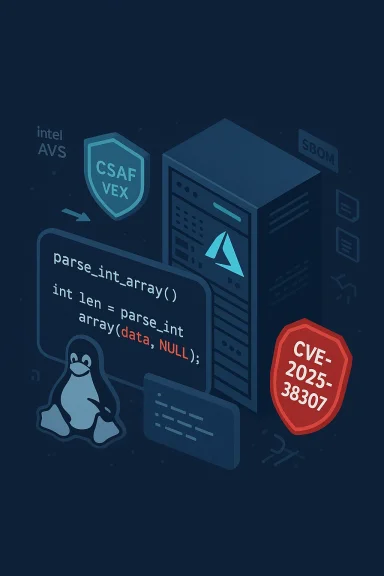
CVE‑2025‑38307 is a Linux kernel vulnerability fixed upstream in July 2025. The defect affects the ASoC (ALSA System on Chip) Intel AVS codepath: the helper parse_int_array() returns an integer array whose first element encodes the array length; if that length is zero, subsequent code that assumes more elements exist can dereference NULL and cause a kernel oops. The issue is a classic missing‑validation problem and has been patched in the upstream stable trees.Microsoft’s Security Response Center (MSRC) published a concise FAQ line for the CVE that reads, in effect: “Azure Linux includes this open‑source library and is therefore potentially affected by this vulnerability,” and reiterated that it began publishing machine‑readable CSAF/VEX attestations in October 2025 and will update the CVE entry if other Microsoft products are found to ship the same upstream component. That wording — short but intentional — is the source of widespreaaux is the only Microsoft product at risk.
What the CVE actually is: technical anatomy
The root cause in plain terms
- The vulnerable function is in the Intel AVS ASoC driver code in the Linux kernel.
- parse_int_array() returns an integer array where index 0 stores the reported element count. When that count is zero, callers that proceed to read or manipulate elements beyond index 0 can end up dereferencing a null pointer.
- Practically, the bug manifests as a kernel null‑pointer dereference (an “oops”) and is categorized as an availability/stability issue rather than a straightforward remote code‑execution primitive.
Where the fix landed and how upstream addressed it
Upstream kernel maintainers added checks to verify that parse_int_array() returned an array with a non‑zero length (or added defensive guards around callers) so the code no longer assumes spare elements exist. The upstream commits and stable backports are recorded in the kernel git history and mirrored in vulnerability aggregators. Administrators should consult package vendoring and kernel package changelogs to see which stable snapshots include the correction.What Microsoft said — and what that sentence means in practice
Microsoft’s declared line on multiple Linux CVE pages follows a consistent pattern: name the product Microsoft has inspected, confirm the presence of the implicated upstream component in that product’s published artifacts, and promise to expand the machine‑readable VEX/CSAF attestations over time. Forproduct mapping names Azure Linux (the Microsoft‑maintained Linux distribution used for specific Azure images).Important clarifications derived from Microsoft’s phrasing and from independent analysis:
- Authoritative for Azure Linux: The statement is an inventory confirmation that Microsoft’s Azure Linux builds contain the upstream component mapped to the CVE. For customers running Azure Linux images, this is ionable indicator: treat those artifacts as in‑scope and apply Microsoft’s published updates.
- Not an exclusivity claim: The MSRC line does not assert that no other Microsoft product contains the same vulnerable code. Absence of a similar attestation for another Microsoft product is an absence of attestation, not proof of absence. In plain operational terms, until Microsoft publishes a “Not Affected” or “Fixed” attestation for another product, that product’s status remains unverified.
- Phased rollout: Microsoft began publishing machine‑readable CSAF/VEX attestations in October 2025 and is rolling them out product‑by‑product. The practical consequence is that early attestations will name only those product families that Microsoft has completed inventorying; later attestations may add products when inventories are complete.
Is Azure Linux the only Microsoft product that includes the library?
Short answer: No — not necessarily. Azure Linux is the only Microsoft product Microsoft has publicly attested so far to include the implicated upstream component for CVE‑2025‑38307, but that attestation is product‑scoped and intentionally phased. Any Microsoft artifact that ships a Linux kernel build compiled from an upstream snapshot that predates the upstream fix — and that enabled or backported the Intel AVS codepath — could likewise contain the vulnerable code until Microsoft or another authoritative inventory declares it Not Affected orWhy that distinction matters technically:
- Kernel code presence depends on the exact kernel source tree, commit range, and kernel configuration used to build a given binary. Different Microsoft artifacts (Marketplace VM images, WSL kernels, AKS node images, appliance images, tooling images) may be built from different snapshots and configurations. Pres not logically exclude presence in others.
- Vendors frequently backport upstream fixes into stable kernel branches. A vendor build could include a fix in one artifact while another artifact — built earlier or from a different branch — still contains the vulnerable code. This is why artifact‑level verification is required.
Where the vulnerable code can hide inside the Microsoft ecosystem (practical blast radius)
When you move from abstract “presence in upstream” to operational risk, focus on artifact types that commonly embed or repackage Linux kernels or vendor packages:- Azure Marketplace VM images based on Microsoft‑maintained or third‑party distributions.
- Microsoft‑published kernel binaries (for example the WSL2 shipped kernel image when Microsoft distributes an updated kernel).
- AKS node images or other managed node images that include vendor kernels.
- Container base images and container registries published by Microsoft which may include distribution packages.
- Internal or partner images Microsoft distributes in the Marketplace or in managed services.
- Build images and CI/CD base images that developers use to compile kernels or userland that might vendor packages into final binaries.
Verification and mitigation checklist (actionable guide for admins)
If you operate in environments that use any Microsoft images, take the following prioritized steps to move from uncertainty to verified status:- Priority patching
- If you run Azure Linux images, treat those as confirmed in‑scope and apply Microsoft’s Azure Linux updates immediately. MicrosofAzure Linux the first remediation priority.
- Inventory and scanning
- Generate or obtain SBOMs for Microsoft images you run (Marketplace images, AKS node images, WSL kernels).
- Scan container images and VM images for kernel versions and for the presence of the Intel AVS module or source files.
- Use binary scanning to check kernel modules and symbol tables for the driver name and for compile‑time fingerprints.
- Kernel artifact inspection
- For distributed kernels (e.g., WSL2 kernel images), unpack the binary and check kernel config (CONFIG_ flags) and symbol exports to determine whether the avs driver or associated ASoC codec is present.
- If you have the ability, run strings and grep on Vmlinuz/initramfs to detect the driver path and commit metadata.
- Vendor attestations
- Watch MSRC VEX/CSAF attestations for additions; Microsoft has committed to updating CVE product mappings as inventories complete. Treat new attative when published.
- Defensive mitigations
- For systems where applying an updated kernel is delayed, consider disabling driver modules (modprobe blacklisting) when the driver is not required by your workload.
- For multi‑tenant cloud hosts, limit guest capabilities that can trigger the affected path (if the vulnerability requires local/guest access to exercise).
- Long‑term measures
- Incorporate artifact attestations (VEX/CSAF) into automated vulnerability response.
- Maintain a build‑time SBOM in CI/CD for any images you publish that consume Microsoft or other vendor packages.
- Track upstream kernel commits and stable backports relevant to your kernel families; those commits are the authoritative fix indicators.
Critical analysis: strengths, limitations, and risk trade‑offs of Microsoft’s attestation approach
Strengths and genuine benefits
- Practical transparency: Publishing product‑level attestations helps customers rapidly prioritize remediation for high‑exposure artifacts. Naming Azure Linux makes it straightforward for administrators who run that distribution to act promptly. Microsoft’s CSAF/VEve step for automation‑friendly vulnerability management.
- Machine‑readable signal: VEX/CSAF artifacts can be ingested by vulnerability orchestration tools and security platforms, improving speed and reducing ambiguity for large fleets.
- Commitment to update: Microsoft’s stated pledge to update CVE mappings if additional products are found to include the component is a necessary guardrail; it acknature of large‑scale inventory work.
Limitations and operational risks
- Phased coverage => temporary blind spots: Because MSRC is rolling attestations out product‑by‑product, customers who rely on other Microsoft images must not assume safety until an explicit attestation is published. The phased approach is operationally sensible but creates a window where customers must perform their own verification.
- Potential for false reassurance: A short product‑only line can be misread as “only Azure Linux is affected.” Numerous community posts and vendor trackers have highlighted misinterpretation risk; vendors must accompany attestations with clear guidance about artifact scanning and SBOM consumption.
- Artifact‑level variance in kernel builds: Microsoft and other large vendors distribute thousands of images and binaries. Kernel builds are not uniform; different images may be compiled from different trees or include different backports. This technical reality means canonical vulnerability status is per‑artifact, not per‑vendor.
Risk management tradeoffs
- Microsoft’s approach prioritizes rapid transparency for a manageable subset of products (Azure Linux first). That is operationally efficient and benefits a large cohort of customers quickly. However, organizations that consume a wide variety of Microsoft artifacts must not outsource artifact discovery to the vendor’s phased attestations alone — they must run independent verification tools and keep CI/CD SBOMs to close the remaining gaps.
How to read other vendor trackers and upstream references (what we verified)
To validate the technical claims and fix status we cross‑checked multiple independent sources:- National Vulnerability Database (NVD) and OSV summaries confirm the vulnerability description and mapping to the ASoC Intel AVS parse_int_array() problem.
- Distribution trackers (Debian security tracker, Red Hat advisories and third‑party aggregators) list the CVE, show vendor package mappings for affected kernels, and point to upstream kernel commits that implement the patch. These independent mappings are how operators can resolve whether a given package version is fixed.
- CISA and public vulnerability bulletins aggregated the kernel CVEs in the week when the fix landed and include CVE‑2025‑38307 in their weekly advisories. That provides an independent, government‑level corroboration that the issue was recognized and remediated upstream.
Recommended wording Microsoft (and other vendors) should use for future attestations
To reduce misinterpretation and help large customers triage rapidly, a short, suggested template for product attestations:- Confirmed carrier language: “We have inspected Product X and confirmed it contains Component Y (mapped to CVE‑Z).”
- Scope clarification: “This statement is product‑scoped and does not imply exhaustive inventory of all company artifacts.”
- Action: “If you run Product X, apply Update P (released Date). If you run other vendor images, consult the vendor SBOM or perform artifact scanning until a VEX/CSAF attestation is published.”
- Timetable: “We will publish updated attestations for additional product families as inventories complete; we expect [estimated cadencet family.”
Final takeaway — practical posture for defensive teams
- Trea confirmed, high‑priority target for remediation for CVE‑2025‑38307 because Microsoft has attested it as a carrier. Patch or replace affected kernels in Azure Linux images immediately.
- Do not assume other Microsoft products are clean just because they are not named. Absence of a VEX/CSAF attestation is absence of attestation, not proof of absence. Until Microsoft publishes attestations for other product families, perform artifact‑level verification (SBOMs, image scans, module inspections).
- Short term: prioritize patching and module blacklisting for systems you control; long term: integrate SBOM generation, image scanning and VEX/CSAF ingestion into your vulnerability orchestration pipeline so product attestations are automatically correlated with in‑house inventories.
Conclusion: Microsoft’s public statement naming Azure Linux is an actionable prompt — apply updates there now — but it is not a certificate that every other Microsoft product is unaffected. Security teams must combine vendor attestations, SBOMs, and proactive image/kernel scanning to ensure full coverage across their estates.
Source: MSRC Security Update Guide - Microsoft Security Response Center
