

Microsoft’s advisory that “Azure Linux includes this open‑source library and is therefore potentially affected” correctly reports the result of a targeted product inventory — but it is a scoped, product‑level attestation, not proof that no other Microsoft product could include the same vulnerable code; operators must treat the Azure Linux attestation as authoritative for those images while performing per‑artifact verification for all other Microsoft‑supplied images, kernels and binaries.
Source: MSRC Security Update Guide - Microsoft Security Response Center
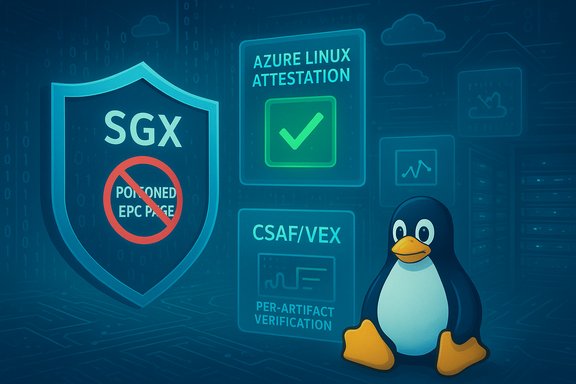 Background / Overview
What CVE‑2025‑38334 is, in plain terms
CVE‑2025‑38334 is a Linux kernel vulnerability that affects SGX (Software Guard Extensions) page reclaim logic on x86. The bug arises because the SGX EPC page reclaimer can attempt to process pages that have been marked as poisoned (epc_page->poison), and the reclaim path does not consistently check that flag before performing microcode-backed operations that read or otherwise touch enclave memory. Those SGX micro-operations (for example EWB and related instructions) do not gracefully handle machine check exceptions (MCE), meaning attempting to reclaim a poisoned EPC page can cause a core to enter a fatal state or trigger a kernel panic. Upstream maintainers fixed the behavior by ensuring poisoned EPC pages are removed from reclaim candidate lists so they are never offered to the normal SGX reclaimer.Why this matters operationally
The immediate impact is availability and integrity: an errant reclaim of a poisoned EPC page can lead to a core shutdown and then kernel panic, which in cloud or multi‑tenant contexts translates to host instability, service interruption, and potential loss of VM guests. The attack surface is narrow — it relies on conditions that mark EPC pages as poisoned and then the kernel reclaim path attempting to operate on them — but the consequence for hosts that perform enclave operations or host enclaves at scale can be severe. Multiple distro trackers, vendor advisories and open‑source vulnerability feeds mirror the same technical description and risk profile.Microsoft’s advisory and the VEX/CSAF context
What Microsoft actually published
Microsoft’s Security Response Center (MSRC) entry for this CVE contains the concise wording you quoted: Azure Linux “includes this open‑source library and is therefore potentially affected,” and Microsoft additionally explains that it began publishing machine‑readable CSAF/VEX attestations beginning in October 2025. The company has committed to update the CVE/VEX record if impact to additional Microsoft products is identified. That phrasing is deliberate and reflects a phased, product‑scoped inventory and attestation approach.- The VEX/CSAF model Microsoft adopted provides a deterministic, machine‑readable mapping between an upstream vulnerability and the specific product artifacts a vendor has checked.
- Microsoft’s public VEX pilot started with Azure Linux as the first product family to receive those attestations; the intent is to expand to additional SKUs over time as inventories are completed.
How to read the sentence “Azure Linux includes this open‑source library and is therefore potentially affected”
That sentence is an authoritative statement about Azure Linux only. It is the result of Microsoft’s artifact inventory for that product family: they checked Azure Linux images and found the upstream code that maps to the CVE, so Azure Linux is listed as a product that is potentially affected. It is not an attempt to assert that no other Microsoft product could ever include the same upstream code. The wording explicitly leaves open the possibility that other Microsoft products could be identified later and the CVE/VEX records updated to reflect that.Is Azure Linux the only Microsoft product that includes the vulnerable open‑source code?
Short, operational answer
No — not necessarily. Azure Linux is the only Microsoft product Microsoft has publicly attested (so far) to include the implicated upstream code mapped to CVE‑2025‑38334. That attestation is authoritative and actionable for Azure Linux customers. However, absence of an attestation for another Microsoft product is not proof that the product is free of the vulnerable component. Until Microsoft completes inventory for additional SKUs (or you verify artifacts yourself), other Microsoft images, kernels, or prebuilt binaries could still be carriers.Why the attestation does not imply exclusivity — technical reasons
- Build‑time variability: Microsoft produces multiple Linux‑related artifacts (Azure Linux images, linux‑azure kernels for some VM families, the WSL2 kernel binary distributed with Windows, curated Marketplace VM images, AKS node images, partner Marketplace appliances). Each artifact is a separate build pipeline with independent kernel configuration flags (CONFIG_* values), backport choices, module vs built‑in decisions, and packaging. A given upstream fix or source file may be present in some artifacts and absent in others depending on those build-time choices.
- Static linking and embedded binaries: Some vulnerable code may be embedded in statically‑linked userland binaries or bundled into container images. Updating a distribution package does not automatically remove those embedded, prebuilt, or statically linked copies; those artifacts must be rebuilt with a patched toolchain or the vulnerable component removed.
- Marketplace and partner images: Microsoft hosts and distributes many Marketplace images and partner appliances. Those are distinct inventory items that may be built on older base images or include independent third‑party binaries. Until those artifacts are checked and attested, they remain potential carriers.
Why Microsoft’s phrasing is a practical and defensible choice
Publishing VEX/CSAF attestations is an operationally heavy task that requires cross‑team inventory and build provenance checks. Microsoft started with Azure Linux as a pragmatic pilot to validate tooling and processes before scaling the program. The statement therefore reflects inventory completed to date, not an exhaustive denial of future findings. The company’s public commitment to update the CVE and VEX feed if other products are identified is important because it preserves the option to expand attestations as inventories complete.Technical verification and cross‑checks
To avoid relying on a single source, the technical description of CVE‑2025‑38334 and its operational consequences were cross‑checked with multiple independent, trusted trackers and vendor advisories:- NVD / MITRE summary and technical notes confirm the SGX reclaim, poisoned EPC page and EWB/MCE interaction described in the upstream fix.
- Distro and vendor trackers (Ubuntu Security Notice, Debian security tracker, SUSE advisory, OSV entries) record the same root cause and link to upstream kernel commits and distribution patches. These independent vendors also list patched package releases or backport advisories.
Critical analysis — benefits and limits of Microsoft’s VEX/CSAF approach
Notable strengths
- Deterministic product attestations. VEX/CSAF files let automation and security tools consume machine‑readable statements like Known Affected / Not Affected / Under Investigation / Fixed. That reduces noisy triage and speeds decision making for customers who run the attested product. Microsoft’s public rollout announcement makes this explicit.
- Transparency commitment. Publishing machine‑readable attestations and promising to update CVE records builds trust and enables customers to automate remediation workflows for the explicitly listed products. The blog announcing the VEX pilot and the MSRC advisory language both demonstrate intent to improve clarity.
- Pragmatic phased rollout. Starting with Azure Linux is operationally defensible — it’s a contained product family that Microsoft can inventory quickly and whose remediation actions can be tightly coordinated.
Potential risks and limitations
- Phased coverage creates “unknowns.” During rollout, many Microsoft images and artifacts remain un‑attested. Security teams that assume MSRC’s single attestation equates to universal coverage may be exposed. Absence of attestation is not evidence of absence.
- Artifact variability increases verification burden. Different kernels, packaging choices, and embedded binaries mean defenders cannot rely on a single vendor line item to prove safety across an estate. This increases operational overhead for large organizations that must scan many Microsoft artifacts.
- Static or embedded copies are easy to miss. Rebuilt or statically linked userland binaries compiled with vulnerable toolchains, or third‑party images in Marketplace, can retain vulnerable code long after distribution packages are patched. Those require rebuilds or redeployments, not just package upgrades.
- Timeliness and signal lag. Even when vendors publish VEX data, tooling and processes to consume and reconcile it with operational inventories must be in place to avoid blind spots. For teams without automated SBOM/SCA pipelines, a vendor attestation may arrive after exposure has already occurred.
Practical guidance — what to do now
Below are concrete, prioritized actions for operators who saw Microsoft’s Azure Linux attestation for CVE‑2025‑38334 and want to reduce risk across their estate.If you run Azure Linux images or kernels (highest priority)
- Apply Microsoft’s published updates for Azure Linux immediately for any images or VM families Microsoft lists as affected in their VEX/CSAF attestation. Treat the vendor attestation as definitive for those images.
- Reboot hosts as required by the kernel update to ensure the patched kernel is active.
- Verify patch via kernel version / changelog that includes the upstream fix (compare distro changelog entries to upstream commit text if you need exact proof).
If you run other Microsoft artifacts (WSL2, linux‑azure kernels, Marketplace images, AKS nodes, partner appliances)
- Do not assume “not affected.” Instead:
- Inventory every Microsoft‑supplied image and kernel you run.
- Extract SBOMs or run SCA scanning on VM images and container base layers to look for evidence of the vulnerable kernel source, module names, or implicated binaries.
- For kernels: check the kernel version and its vendor changelog for the upstream commit or patch that addresses the SGX reclaim logic. If the vendor changelog explicitly maps the CVE, use that as proof of remediation.
Quick technical checks and commands (examples)
- To check the running kernel version and build string:
- uname -a
- rpm -q --changelog kernel | head -n 20 (on RPM‑based systems)
- apt changelog linux-image-$(uname -r) (on Debian/Ubuntu where available)
- To scan container images for kernel artifacts or embedded toolchains:
- Use container scanning tools (Trivy, Clair, Anchore) against base layers and catalogs.
- Pull images and inspect /boot, /lib/modules, or search for compiled objects that suggest a kernel binary was included.
- For SBOM-based checks:
- Ingest vendor CSAF/VEX files (if your tooling supports them) and match VEX product identifiers to deployed artifacts.
- Match package names and versions (or kernel commit IDs) to known vulnerable ranges from NVD/OSV.
If you maintain or publish images in Azure Marketplace
- Rebuild images that embed third‑party binaries or toolchains to ensure they use patched upstream sources.
- Publish updated images and clearly communicate to customers about the rebuild and the fixed artifact.
Monitoring and detection
- Hunt for kernel oops or panic signatures referencing SGX, EWB, or epc_page functions in system logs and crash dumps. Sudden core shutdowns or machine check related traces on SGX‑capable hosts are high‑priority alerts after exposure windows.
- Subscribe to Microsoft’s CSAF/VEX feed and your distribution’s security advisories so you receive attestation updates automatically. Microsoft has publicly stated the VEX rollout began in October 2025; the company will publish attestation expansions there.
When a vendor says “we’ll update the CVE if we find more products” — what that practically means
Microsoft’s promise to update the CVE record if additional Microsoft products are identified is valuable but operationally limited by the time it takes to complete inventories. The statement should be read this way:- It guarantees Microsoft will expand its public attestations if/when additional artifacts are discovered to include the vulnerable component.
- It does not guarantee a particular timeline for discovery, nor does it relieve customers of the responsibility to verify the artifacts they actually run.
- For defensible security posture, treat vendor attestations as one authoritative input and combine them with independent artifact scanning, SBOM ingestion, and, where needed, rebuilds or redeployments.
Conclusion — practical, defensible takeaways
- Microsoft’s MSRC statement that “Azure Linux includes this open‑source library and is therefore potentially affected” is an accurate, product‑scoped attestation intended to give Azure Linux customers a deterministic signal to act on.
- Azure Linux is the only Microsoft product the company has publicly attested (so far) as including the component tied to CVE‑2025‑38334; that attestation is authoritative for Azure Linux only. It does not prove that other Microsoft products are free from the vulnerable code.
- Operators must combine vendor attestations with per‑artifact verification:
- Patch and reboot Azure Linux images per Microsoft guidance immediately.
- Inventory and scan other Microsoft images (WSL kernels, linux‑azure kernels, Marketplace images, AKS node images) for the implicated component; rebuild or redeploy artifacts that contain static or embedded vulnerable copies.
- Ingest VEX/CSAF data when available and match it to your actual deployed artifact identifiers.
- Independent sources (NVD, Ubuntu, Debian, SUSE, OSV) corroborate the technical details of the CVE and the appropriate upstream mitigation (skip or untrack poisoned EPC pages from reclaim lists), so the technical facts of the vulnerability and the needed fixes are verifiable.
Source: MSRC Security Update Guide - Microsoft Security Response Center
