

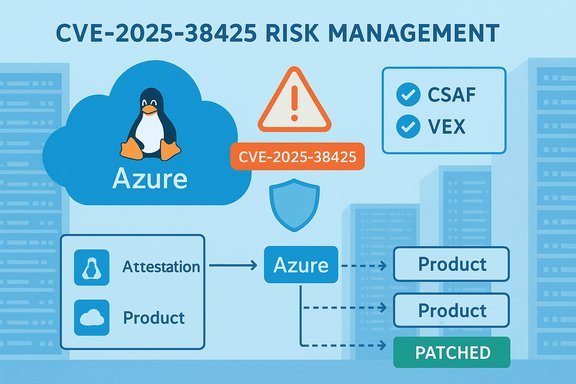
Microsoft’s MSRC advisory for CVE-2025-38425 states that “Azure Linux includes this open‑source library and is therefore potentially affected,” but that phrasing is a product‑level attestation — not an exclusive denial that other Microsoft products can or do include the same vulnerable code. The attestation is authoritative for Azure Linux images that Microsoft has inventoried, and Microsoft has pledged to expand machine‑readable CSAF/VEX attestations as it completes inventory for other product families; however, absence of an attestation for another Microsoft product is not proof that the product is unaffected.
CVE‑2025‑38425 is a Linux kernel vulnerability described as “i2c: tegra: check msg length in SMBUS block read.” The upstream fix adds explicit checks so that SMBUS block reads do not proceed when the device reports a length of 0 or a length larger than the allowed maximum, preventing out‑of‑bounds reads and related kernel faults. The vulnerability was recorded publicly in July 2025 and has been tracked across distribution advisories and vulnerability databases. Microsoft’s Security Response Center (MSRC) entry for this CVE makes two linked claims: a positive, product‑scoped attestation for Azure Linux; and a process commitment that Microsoft will update CVE mappings as additional product inventories are completed and any further impact is discovered. That combination is deliberate: it tells Azure Linux customers what to act on immediately, while promising to expand transparency as more inventories finish.
Long answer: Microsoft has attested that Azure Linux images include the implicated upstream component and are therefore potentially affected. That attestation is authoritative and actionable for Azure Linux customers. However, whether other Microsoft products include the same code is an artifact‑level question that depends on kernel version, kernel configuration (CONFIG_ flags), and packaging decisions. Microsoft’s VEX rollout is phased; until Microsoft publishes attestations for additional products, those other artifacts should be treated as unknown* and verified by operators.
Key clarifications:
Security teams must therefore prioritize patching Azure Linux as Microsoft advises, but they must also inventory and verify every other Microsoft‑supplied kernel artifact they use (WSL2 kernels, linux‑azure kernels, Marketplace images, AKS/VM images, and appliance images). Treat Microsoft’s VEX stream as an essential input, but do not let it substitute for artifact‑level verification and timely patching across the estate.
Source: MSRC Security Update Guide - Microsoft Security Response Center
 Background / Overview
CVE‑2025‑38425 is a Linux kernel vulnerability described as “i2c: tegra: check msg length in SMBUS block read.” The upstream fix adds explicit checks so that SMBUS block reads do not proceed when the device reports a length of 0 or a length larger than the allowed maximum, preventing out‑of‑bounds reads and related kernel faults. The vulnerability was recorded publicly in July 2025 and has been tracked across distribution advisories and vulnerability databases. Microsoft’s Security Response Center (MSRC) entry for this CVE makes two linked claims: a positive, product‑scoped attestation for Azure Linux; and a process commitment that Microsoft will update CVE mappings as additional product inventories are completed and any further impact is discovered. That combination is deliberate: it tells Azure Linux customers what to act on immediately, while promising to expand transparency as more inventories finish.What Microsoft actually said — and what it does not mean
The attestation: definitive for Azure Linux
When MSRC says “Azure Linux includes this open‑source library and is therefore potentially affected,” it is reporting the results of an inventory Microsoft completed for that product family. For Azure Linux images and kernels that Microsoft maintains, that is an authoritative signal: customers running those images should treat them as in‑scope for remediation and apply vendor updates accordingly.The procedural line: VEX/CSAF rollout
Microsoft started publishing machine‑readable CSAF/VEX attestations in October 2025 and is using that mechanism to provide per‑product vulnerability status (Known Affected, Not Affected, Under Investigation, Fixed, etc.. The MSRC statement for this CVE couples a product attestation for Azure Linux with a promise to update the VEX/CSAF record for other Microsoft products if additional carriers are discovered. That is an operationally useful approach — but it is not the same as a blanket, company‑wide negative assertion.What the wording does not mean
The wording does not mean “no other Microsoft product contains the vulnerable library.” It means Microsoft has finished inventory for Azure Linux and is reporting the result for that product. Large vendors publish attestations product‑by‑product; until an artifact is inventoried and attested, silence equals “not yet attested,” not “guaranteed safe.” Security teams should not treat the Azure Linux attestation as proof that WSL kernels, Marketplace images, linux‑azure kernels, AKS node images, partner appliances, or other Microsoft‑distributed kernel artifacts are unaffected.Technical context: what CVE‑2025‑38425 actually is
- The vulnerability is located in the Linux kernel I2C/Tegra SMBUS block‑read path and was fixed with defensive length checks that stop reading when the reported length is 0 or exceeds allowed bounds.
- Distribution trackers (Ubuntu, Debian, Red Hat, and others) have mapped the CVE to kernel updates and issued security notices and package advisories; operators should monitor their distro channels for fixed kernel packages.
- Public vulnerability aggregators and vendor trackers record the bug and reference upstream kernel commits; the practical attack surface is any Linux kernel build that includes the affected Tegra I2C driver.
Is Azure Linux the only Microsoft product that includes the library (short answer and nuance)
Short answer: No — not necessarily.Long answer: Microsoft has attested that Azure Linux images include the implicated upstream component and are therefore potentially affected. That attestation is authoritative and actionable for Azure Linux customers. However, whether other Microsoft products include the same code is an artifact‑level question that depends on kernel version, kernel configuration (CONFIG_ flags), and packaging decisions. Microsoft’s VEX rollout is phased; until Microsoft publishes attestations for additional products, those other artifacts should be treated as unknown* and verified by operators.
Key clarifications:
- An attestation names the product family that has been inventoried; it does not enumerate every binary Microsoft ships globally.
- Different Microsoft kernel artifacts are produced in separate build pipelines (Azure Linux images, linux‑azure kernels used by some VM SKUs, WSL2 kernel binaries, Marketplace VM images, AKS node images, appliance images). Each artifact’s kernel configuration determines whether a given driver is present.
- Absence of a VEX/CSAF entry for a product is “not yet verified,” not “not affected.” Microsoft has said it will update CVE records if additional products are identified to ship the component.
How to verify whether your Microsoft‑supplied artifact includes the vulnerable driver
Inventory and artifact verification are the only reliable ways to know whether a specific Microsoft image or binary carries the vulnerable code. The following pragmatic checks help identify carriage and exposure.On running Linux hosts (VMs, images, WSL)
- Check whether the Tegra I2C driver is present as a module or built‑in:
- lsmod | egrep 'tegra|i2c'
- grep -R "tegra" /lib/modules/$(uname -r)/kernel
- Inspect the kernel configuration for relevant I2C/Tegra options:
- zgrep CONFIG_I2C /proc/config.gz || grep CONFIG_I2C /boot/config-$(uname -r)
- zgrep CONFIG_I2C_TEGRA /proc/config.gz || grep CONFIG_I2C_TEGRA /boot/config-$(uname -r)
- Confirm the kernel package changelog or distro advisory mentions the CVE or the upstream commits that fix it:
- On Debian/Ubuntu: apt changelog linux-image-$(uname -r) | grep -i 38425
- On RPM systems: rpm -q --changelog kernel | egrep -i '38425|tegra|i2c'
- For WSL2, check the WSL kernel config and modules shipped with the WSL kernel or any custom kernel the organization supplies; the default Microsoft WSL kernel may disable many sensor drivers, but that is a per‑build property.
Offline image or build verification
- Mount the image and inspect /lib/modules/<kernelversion> for the driver or extract the kernel config file (/boot/config-*) to check build flags.
- Use software composition analysis (SCA) or SBOM tooling to detect whether the upstream I2C/Tegra source file or commit ranges are included in the kernel sources used to build the artifact.
Remediation: what to do now
- Prioritize patching Azure Linux images first, because Microsoft has attested those images contain the component. Apply vendor kernel updates and reboot instances as required.
- For any other Microsoft‑supplied images or kernel artifacts you use:
- Inventory the artifact (see verification steps above).
- If the driver is present on your running systems, apply vendor/distro kernel updates that include the upstream fix.
- If you cannot patch immediately, apply compensating controls: restrict access to device nodes (udev rules), limit module loading (modprobe blacklist), restrict unprivileged users from interacting with device paths, and isolate workloads that might exercise the SMBUS paths.
- Consume vendor machine‑readable VEX/CSAF feeds in your vulnerability management pipeline so you receive updates automatically if Microsoft expands attestations to other products.
- Blacklist a module temporarily:
- echo "blacklist i2c_tegra" | sudo tee /etc/modprobe.d/blacklist-tegra.conf
- update-initramfs -u (Debian/Ubuntu) or dracut -f (RHEL/CentOS) if required
- Audit kernel logs for oops/warnings:
- journalctl -k --no-pager | egrep -i 'tegra|i2c|SMBUS|oops|WARN_ON'
Critical analysis: strengths and risks of Microsoft’s approach
Strengths — transparency and machine‑readable signals
- Microsoft’s use of CSAF/VEX machine‑readable attestations is a meaningful operational improvement: it provides deterministic, automatable signals for customers running the attested product (Azure Linux), allowing vulnerability management systems to triage quickly without manual inspection. That helps reduce false negatives and speeds remediation for cloud images Microsoft manages.
- Publishing a clear, product‑scoped attestation for Azure Linux gives customers one authoritative source to act on, which is particularly useful for automated pipelines in large fleets.
Risks and limitations — perception vs. reality
- The main risk is misinterpretation: customers and operators may take Microsoft’s attestation for Azure Linux as an implicit statement about all Microsoft artifacts. That would be incorrect and could produce unpatched exposures in other artifacts (WSL kernels, linux‑azure kernels for certain VM SKUs, Marketplace images, AKS node images, partner appliances). Microsoft’s attestation model is product‑by‑product and therefore inherently phased.
- Operational risk lies in the long tail: embedded or appliance kernels and vendor forks often lag on patching, and their kernel configuration may include the driver even when mainstream server images do not. A single vendor attestation does not reach into third‑party Marketplace images or partner appliances that Microsoft does not inventory.
How to mitigate the communication risk
- Vendors should accompany a product attestation with clear, explicit guidance that explains the attestation’s scope and the expectation that other artifacts must be verified independently. Microsoft’s advisory language does this in part, but organizations must operationalize that nuance in their vulnerability management playbooks.
Recommendations for security teams and operations
- Treat Microsoft’s Azure Linux attestation as an authoritative, high‑priority remediation target and patch Azure Linux images immediately.
- Inventory all Microsoft‑provided artifacts you consume:
- linux‑azure kernels used by Azure VM SKUs
- WSL2 kernels (default Microsoft kernel or custom kernels)
- Azure Marketplace images and partner‑published images
- AKS node images, appliance images, and any Microsoft‑managed kernel bundles
Each of these is a separate artifact and must be verified independently. - Integrate MSRC VEX/CSAF feeds into your vulnerability management automation and subscribe to MSRC updates for the CVE so you get notified if Microsoft expands the product mapping.
- If patch rollout is delayed, apply mitigations (module blacklist, device access controls, containment) and monitor kernel logs for relevant errors and device activity.
- Maintain SBOMs for your images and use SCA tooling to detect the presence of specific upstream components across container images and VM images. This is the only reliable way to detect cross‑artifact presence of a vulnerable upstream component.
Verification and cross‑checks
This article’s technical descriptions and remediation guidance align with upstream and distribution advisories. Independent verification points include:- NVD and other public CVE trackers list the CVE description and reference upstream fixes.
- Distribution advisories from Ubuntu and Debian list the kernel updates and classify the CVE and associated packages; operators should use their distro channels for package updates.
- Kernel upstream commits and patch references are cataloged in public kernel trees and aggregators (referenced in vulnerability databases). This is the authoritative technical record for the code changes that fix the defect.
Conclusion
Microsoft’s MSRC attestation that Azure Linux includes the open‑source library implicated in CVE‑2025‑38425 is an authoritative, helpful signal for customers who run Azure Linux images. It enables automated triage and prioritization and is a clear operational win in vendor transparency. At the same time, it is not a company‑wide guarantee that other Microsoft artifacts are safe. The presence of upstream kernel code in any Microsoft‑distributed kernel artifact remains an artifact‑level question determined by kernel version, build configuration, and packaging choices.Security teams must therefore prioritize patching Azure Linux as Microsoft advises, but they must also inventory and verify every other Microsoft‑supplied kernel artifact they use (WSL2 kernels, linux‑azure kernels, Marketplace images, AKS/VM images, and appliance images). Treat Microsoft’s VEX stream as an essential input, but do not let it substitute for artifact‑level verification and timely patching across the estate.
Source: MSRC Security Update Guide - Microsoft Security Response Center
