

A kernel-level Bluetooth defect identified as CVE-2025-38473 is a null-pointer dereference in l2cap_sock_resume_cb that was reported by automated testing (syzbot) and patched upstream by adding a defensive check to avoid accessing a socket that has already been killed; operators should treat this as a stability/availability fix and apply vendor or upstream kernel updates promptly.
The vulnerability was publicly recorded in late July 2025 and is described as a NULL pointer dereference inside the L2CAP socket resume callback, l2cap_sock_resume_cb, in the Linux kernel Bluetooth subsystem. Automated sanitizer infrastructure produced KASAN traces showing a write to an address near zero inside net/bluetooth/l2cap_sock.c, which is the canonical symptom of a null-pointer dereference that can cause an oops, panic, or system instability. This issue joins a string of recent Bluetooth kernel fixes where race conditions or lifecycle-ordering errors in socket and device teardown paths led to crashes under real workloads and sanitizer runs. The upstream patch approach is deliberately minimal: avoid touching a socket pointer that can be cleared by l2cap_sock_kill by validating the channel’s data pointer before use. The change is small, straightforward to backport, and classed operationally as an availability-first bug rather than a confirmed privilege‑escalation vector.
Recommended prioritized actions:
Source: MSRC Security Update Guide - Microsoft Security Response Center
 Background / Overview
The vulnerability was publicly recorded in late July 2025 and is described as a NULL pointer dereference inside the L2CAP socket resume callback, l2cap_sock_resume_cb, in the Linux kernel Bluetooth subsystem. Automated sanitizer infrastructure produced KASAN traces showing a write to an address near zero inside net/bluetooth/l2cap_sock.c, which is the canonical symptom of a null-pointer dereference that can cause an oops, panic, or system instability. This issue joins a string of recent Bluetooth kernel fixes where race conditions or lifecycle-ordering errors in socket and device teardown paths led to crashes under real workloads and sanitizer runs. The upstream patch approach is deliberately minimal: avoid touching a socket pointer that can be cleared by l2cap_sock_kill by validating the channel’s data pointer before use. The change is small, straightforward to backport, and classed operationally as an availability-first bug rather than a confirmed privilege‑escalation vector. Why this matters: the operational impact
Kernel null-dereferences and similar memory-safety failures are almost always denial‑of‑service problems in practice: the kernel will log a fault (often under KASAN in test builds), and production systems can panic or reboot. For endpoints and devices that rely on continuous availability — gateways, embedded appliances, multi‑tenant hosts, and Bluetooth-enabled testbeds — an unexpected kernel crash can cascade into service outages, data-collection gaps, and recovery overhead. Two operational characteristics make this class of Bluetooth bug particularly significant:- Many embedded platforms and IoT devices use UART-based or stack-integrated Bluetooth transports where the L2CAP socket paths are active and reachable during device initialization, increasing the chance a race will be exercised in field hardware.
- Long‑lived, rarely-updated kernel builds (common in appliances and certified firmware) form a long tail of exposure because even a tiny one-line fix upstream can remain absent from shipped images for months or years.
Technical anatomy — what went wrong
The failing trace published in the public advisories shows a KASAN report in instrumented atomic write and clear_bit calls, with the immediate context being l2cap_sock_resume_cb+0xb4 in net/bluetooth/l2cap_sock.c. The stack culminates in Bluetooth HCI receive and authentication completion event handlers, which means the bug was exposed by processing HCI events and then entering the L2CAP socket resume callback in a workqueue context. At a conceptual level the root cause is a lifecycle-order race between operations that kill or remove a socket (l2cap_sock_kill) and the resume callback that can still access per‑channel data pointers (chan->data or equivalent). If the kill path cleared or freed the socket object while the resume callback was running on a worker thread, the resume callback could dereference a now-NULL pointer, causing the observed KASAN message. The upstream remedy checks whether the channel data pointer is NULL before attempting to use it in the resume callback, eliminating the crash primitive. This pattern mirrors other recent Bluetooth kernel hardenings where defensive precondition checks or synchronized cancellation of delayed work removed the window in which callbacks could touch freed memory. Those earlier fixes demonstrate that small, well-scoped changes in teardown and resume paths are the conservative, correct response.The upstream fix — what changed in the code
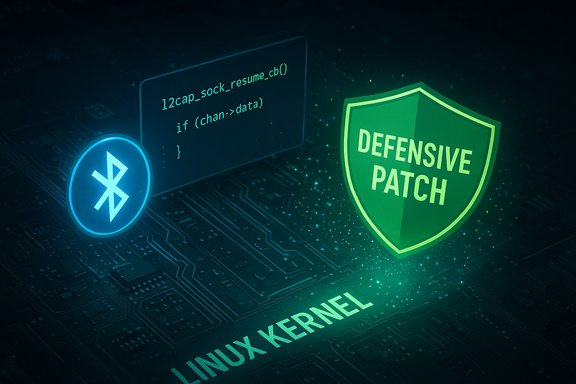
The accepted upstream correction is intentionally minimal and conservative: before accessing the per‑channel socket pointer inside l2cap_sock_resume_cb, the code now verifies that the channel’s data pointer is non-NULL — effectively ensuring the resume routine does not touch a socket that has been killed. This mirrors a prior change intended to fix a related use‑after‑free in lock_sock_nested, and the same defensive pattern is applied consistently across L2CAP teardown/resume logic. Why that fix is correct and low-risk:- It enforces a clear precondition (channel data exists) and converts an unsafe dereference into a no-op or safe return when the socket has already been cleared.
- It introduces no API changes, no heavy synchronization primitives, and no behavioral changes for typical, correct code paths — only corner cases alter behavior.
- The small patch can be backported cleanly into stable kernel branches and vendor trees with minimal regression surface.
Affected systems and scope
The vulnerability is in the upstream Linux kernel Bluetooth L2CAP socket code. Exposure depends on whether a given build includes the vulnerable L2CAP codepath and whether the host uses Bluetooth functions that exercise the resume callback. Practical populations of concern include:- Embedded Linux devices and IoT gateways with Bluetooth radios, especially those with custom/long-lived kernels.
- Developer boards and test hosts used for Bluetooth development, where the HCI/L2CAP stacks are active.
- Laptops and desktops with Bluetooth enabled — but those are often less exposed unless the kernel shipped by the distribution predates the fix or backport.
Exploitability — practical attack model
The public record and the KASAN-based diagnostics point to an availability failure (kernel crash) rather than a confirmed escalation vector. Key exploitability considerations:- Attack vector: local or radio-proximity. The bug is triggered by Bluetooth HCI/L2CAP activity — a remote attacker would need means to deliver crafted Bluetooth traffic or cause a device locally to trigger the sequence.
- Privileges: low to moderate local privileges in some contexts; a malicious local process or a proximate malicious Bluetooth peer could exercise the code paths depending on system configuration.
- RCE potential: no public proof-of-concept shows that this specific null‑dereference can be escalated into code execution. Turning such an availability primitive into RCE would generally require additional allocator manipulation or other memory-corruption primitives. Treat RCE claims cautiously unless a credible PoC emerges.
Detection and hunting guidance
Security teams and system administrators can use several practical steps to triage exposure and detect potential hits:- Inventory: identify systems with Bluetooth/L2CAP support enabled:
- uname -r to determine the running kernel build.
- lsmod | grep -i bluetooth to see loaded Bluetooth modules.
- If building from source, search the kernel tree for l2cap_sock_resume_cb or the presence of defensive checks around chan->data in net/bluetooth/l2cap_sock.c.
- Logs and crash traces:
- Inspect kernel logs for KASAN or oops traces containing l2cap_sock_resume_cb or net/bluetooth/l2cap_sock.c.
- Example commands: journalctl -k | grep -i l2cap_sock_resume_cb ; dmesg | grep -i l2cap
- Centralize kernel oops and KASAN output with persistent logging or kdump to preserve traces for forensic validation.
- Reproducibility for test labs:
- Boot an unpatched kernel build in a controlled lab (KASAN-enabled kernels are useful for diagnosis).
- Exercise HCI/L2CAP flows (authentication, connection events, resumes) and monitor for the same KASAN report and stack trace described in public advisories.
- Confirm that patched kernels no longer reproduce the KASAN null‑deref.
- Telemetry rules: add alerts for kernel oopses that reference L2CAP/HCI functions or contain the exact callsite names mentioned in the advisories.
Mitigation and remediation strategy
The definitive remediation is to install a kernel update that contains the upstream patch or a vendor backport and then reboot into the patched kernel. For devices where immediate patching is difficult (embedded appliances, certified hardware), operators can apply compensating controls while they schedule firmware updates.Recommended prioritized actions:
- Patch-first (preferred)
- Apply vendor- or distribution-supplied kernel updates that include the backport of the upstream fix. Reboots are required for kernel-level fixes to take effect. Confirm the package changelog or vendor advisory maps the kernel package to the CVE/commit.
- Short-term compensations (when patching is delayed)
- Disable Bluetooth services if not needed: systemctl stop bluetooth; systemctl mask bluetooth.
- Unload Bluetooth kernel modules where possible: modprobe -r bluetooth (module names vary).
- If the vulnerable code is built-in (non-modular), unloading won’t help — a reboot to a patched kernel is necessary.
- Restrict local access to device nodes that can deliver unexpected HCI/L2CAP inputs; tighten file permissions, use SElinux/AppArmor or containerization to limit untrusted processes from manipulating Bluetooth endpoints.
- For embedded/OEM vendors
- Backport the upstream patch to product kernel trees, rebuild, test on device-specific hardware, and publish firmware/kernel updates.
- Validate early initialization and teardown sequences to ensure the fix removes reproducer KASAN traces.
- Monitoring and post-patch validation
- After patching, run Bluetooth operation testcases and confirm absence of the prior KASAN stack traces.
- Maintain crash collection for a reasonable window after rollout to detect any residual issues.
- Identify Bluetooth-capable endpoints.
- Check vendor advisories and kernel package changelogs for CVE-2025-38473.
- Schedule and apply kernel updates; test on representative hardware first.
- If patching is delayed, disable Bluetooth and monitor kernel logs.
- Re-enable Bluetooth after validation and monitor for anomalies.
Vendor and distribution response — what trackers report
Multiple distribution and vulnerability trackers recorded CVE-2025-38473 and the upstream fix. For example, the NVD entry and distribution advisories summarise the KASAN trace and remediation approach; Ubuntu and Debian recorded the CVE and flagged the issue with medium priority. Oracle’s CVE listing and Amazon’s ALAS listing also captured the advisory and show how different vendors categorized severity. Notably, some vendor/aggregator entries include CVSS values that differ modestly — Amazon’s ALAS listed CVSSv3 = 7.0 while Debian’s advisory recorded a lower operational severity for packaged kernels; such discrepancies reflect differing scoring methodologies and local impact assumptions. Operators should rely on their vendor’s package mapping and priority guidance rather than a single CVSS number.Why the minimal patch model is preferred
This CVE illustrates a recurring theme in kernel maintenance: the safest, most practical fixes for race/lifecycle bugs are tiny defensive checks or precise synchronization points that eliminate the crash primitive without broad refactors. Reasons to prefer minimal, surgical patches:- They reduce regression risk and are easier to backport into stable kernel trees and vendor kernels.
- They are quick to review and integrate, which reduces time-to-patch for devices in the field.
- They preserve expected behavior for non-error paths while neutralizing the conditions that cause a crash.
Risks and limitations — what defenders should keep in mind
- Absence of public exploit code does not mean the risk is zero. Localized attackers or sophisticated multi-stage campaigns could, in theory, combine primitives to elevate impact; therefore, availability-impacting bugs require prompt attention, particularly in critical systems.
- Even a correct small patch must be validated against vendor kernel configurations and hardware — some devices require careful backporting and testing due to unique drivers or out-of-tree code.
- Workarounds that disable Bluetooth protect availability but may break expected device functions; plan mitigation steps to minimize business disruption.
Practical recommendations for WindowsForum readers (operators and hobbyists)
- If you run mixed environments (developer laptops, VMs with Bluetooth passthrough, WSL2 images, or networked testbeds), confirm whether the Linux kernels you interact with include the CVE-mapped commits. Do not assume a CVE affecting upstream kernel always maps to WSL2 or Microsoft-maintained images unless the vendor explicitly declares it.
- For hobbyist boards (Raspberry Pi, custom SBCs) with Bluetooth enabled, check distribution kernel package updates and apply patched kernels as they become available.
- For home labs or test rigs that exercise Bluetooth stacks, stagger patch windows and isolate Bluetooth radio domains during update windows to reduce blast radius.
Conclusion
CVE-2025-38473 is a concrete example of how small lifecycle or synchronization lapses in kernel Bluetooth code produce real-world availability problems. The defect — a null pointer dereference in l2cap_sock_resume_cb observed by syzbot and KASAN — was fixed upstream by adding a defensive check to avoid accessing killed sockets. The patch is small, low-risk, and straightforward to backport, which makes the remediation path clear: install vendor kernel updates or apply the upstream fix for custom builds and reboot. Operators should prioritize patching on always‑on Bluetooth-enabled gateways, embedded devices, and lab/test infrastructure; where immediate updates are impractical, temporarily disabling Bluetooth services and modules reduces exposure while vendors prepare backports. Vigilant log monitoring for KASAN/oops traces, centralized crash collection, and coordinated firmware rollouts will minimize operational risk while maintaining service availability.Source: MSRC Security Update Guide - Microsoft Security Response Center
