

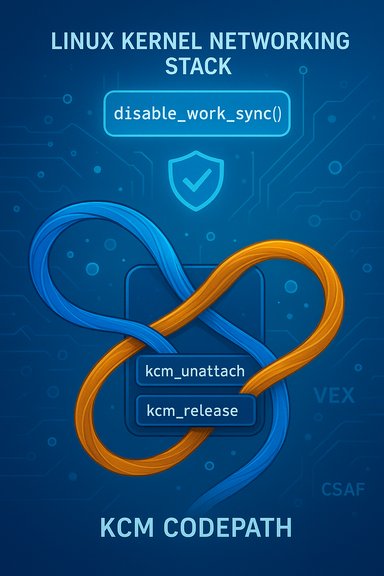
CVE-2025-38717 is a recently published Linux-kernel vulnerability that fixes a subtle race condition in the kernel’s KCM (Kernel Connection Multiplexor) codepath — specifically in net/kcm’s kcm_unattach — and has set off the usual downstream triage: upstream patches are available, distributions are rolling fixes, and vendors are mapping their product inventories to determine exposure. Microsoft’s public advisory for the CVE calls out its Azure Linux distribution as a product that “includes this open‑source library and is therefore potentially affected,” and Microsoft has committed to update that mapping if additional Microsoft products are found to ship the same component.
Background / overview
The defect tracked as CVE‑2025‑38717 is a synchronization/race problem inside the Linux kernel networking subsystem, in the KCM code that coordinates connection multiplexing. The upstream report and the patch notes explain the root cause: kcm_unattach failed to use a robust synchronization primitive before queueing work, allowing a rare interleaving between kcm_unattach(psock) and kcm_release(kcm) that could requeue tx_work immediately before the kcm object is freed. The upstream repair removes an error‑prone flag and replaces the logic with disable_work_sync to ensure the workqueue is reliably drained before the structure can be destroyed. Public vulnerability databases and distribution trackers classify this as a moderate‑severity, local bug that is primarily a stability/availability issue rather than an immediate remote code‑execution primitive. That classification is consistent across Linux kernel announcements, NVD, and multiple distro advisories.What Microsoft has said (the precise wording and meaning)
Microsoft’s Security Response Guide page for the CVE makes two important, deliberate statements: first, that Azure Linux includes the open‑source library in question and is therefore potentially affected, and second, that Microsoft began publishing CSAF/VEX machine‑readable attestations in October 2025 and will update the CVE/VEX mapping if additional Microsoft products are identified as carriers. That phrasing is an inventory attestation — a product‑scoped statement of what Microsoft has validated so far — not an absolute guarantee that no other Microsoft product uses the same upstream component.Microsoft’s approach is increasingly common among large vendors: publish a deterministic, machine‑readable VEX/CSAF attestation for a given product family when the vendor has completed the mapping for that family, and then expand the scope as additional inventories are completed. The practical effect is that Azure Linux customers have an authoritative, automatable signal; operators running other Microsoft artifacts must still verify those artifacts individually.
Technical clarity: what the CVE actually is
The bug in plain terms
- Component: net/kcm (Kernel Connection Multiplexor) inside the Linux kernel networking tree.
- Fault: race condition between kcm_unattach(psock) and kcm_release(kcm). kcm_unattach did not check or use a robust synchronization primitive prior to scheduling kcm->tx_work, which allowed work to be requeued while kcm was being released and then freed.
- Fix: remove the problematic kcm->tx_stopped flag logic and use disable_work_sync to guarantee the workqueue is disabled and drained before freeing the structure.
Impact profile
- Vector: local code paths that exercise the KCM interfaces; not a remote, unauthenticated network worm.
- Primary effect: reliability/availability problems — kernel warnings, crashes, memory use after free conditions in specific interleavings.
- Exploitability: low to moderate in the wild given the specific conditions required; distributors and cloud vendors have treated it as worthy of backporting and patching.
Is Azure Linux the only Microsoft product that includes the library?
Short answer: No — not necessarily in principle — but yes, Azure Linux is the only Microsoft product Microsoft has publicly attested as including the affected upstream component at the time of the advisory.This distinction matters. Microsoft’s public VEX/CSAF attestation and the MSRC update‑guide entry are authoritative for the product families they enumerate; for CVE‑2025‑38717 Microsoft has mapped the upstream kernel component to Azure Linux and has said it will expand the mapping if other Microsoft products are found to include it. In other words, Azure Linux is the only product Microsoft has finished inventorying and declared in this particular attestation; that does not equate to a technical impossibility that other Microsoft artifacts might carry the same code.
Why the nuance is important
- Microsoft maintains multiple Linux kernel artifacts: the Azure Linux (CBL‑Mariner lineage/azl3) images, the linux‑azure kernel used on certain VM families, and the Windows Subsystem for Linux (WSL) kernel builds, among other artifacts. Each kernel artifact is a separate build with its own kernel configuration and may therefore include or omit a given subsystem (for example, KCM) depending on CONFIG_* flags and packaging choices. Presence is a per‑artifact, build‑time property.
- Microsoft’s VEX rollout started with Azure Linux as a practical first target; subsequent attestations for WSL, Azure Marketplace images, or other Microsoft packages may follow once inventories are completed. That is a product‑management and process detail, not a technical statement that the rest of Microsoft is “safe by default.”
Do other Microsoft products ship a Linux kernel that could include KCM?
In practice, several Microsoft products or artifacts can contain Linux kernels compiled from the upstream source and therefore could include KCM if enabled:- Windows Subsystem for Linux (WSL2): Microsoft publishes the WSL2 kernel sources and a Microsoft kernel configuration (Microsoft/config-wsl) on GitHub and ships WSL kernels as part of Windows updates or via the WSL kernel releases. Whether a particular WSL kernel build includes KCM depends on the kernel config used for that build. Community and Microsoft documentation show WSL kernel sources and config are public and buildable, so administrators can inspect or rebuild with their own config if necessary.
- CBL‑Mariner / Azure Linux lineage: Azure Linux (the distro Microsoft refers to in its attestation) is the canonical Microsoft‑maintained distro lineage for cloud tooling; Microsoft explicitly tied Azure Linux (CBL‑Mariner lineage) to its initial VEX outputs. If Microsoft’s Azure Linux kernels include KCM — which the vendor’s attestation states for this CVE — that product is in scope.
- Azure Marketplace images, AKS node images, and curated container images: Many of these are built from vendor or partner kernels; their inclusion or omission of a given kernel subsystem is a per‑image question. Microsoft’s attestation for Azure Linux does not automatically cover third‑party or partner images hosted in Azure; those images remain the responsibility of the image publisher or the distro vendor.
How to verify exposure in your environment (practical checklist)
Operators and security teams should treat Microsoft’s Azure Linux attestation as authoritative for Azure Linux images, and should verify other Microsoft artifacts directly:- Identify the exact artifact you run:
- Azure Linux VM (Microsoft‑published): consult Microsoft’s VEX/CSAF for that CVE and the azl3 kernel component status.
- WSL2 instances: run uname -r inside the WSL shell and inspect /proc/config.gz or /boot/config-<release> to see if KCM is built in or available as a module. Microsoft publishes the WSL kernel config publicly.
- Marketplace images, custom images, containers: inspect the image manifest, check included packages, and search the image for kernel modules or kernel‑config artifacts.
- On Linux hosts, check the running kernel config and loaded modules:
- zcat /proc/config.gz | grep -i KCM or grep -i kcm /boot/config-$(uname -r)
- lsmod | grep kcm
- If KCM is built as a module, examine whether it is loadable or loaded.
- Map kernel releases to upstream commits:
- Use distro security trackers, NVD, and the linux-cve-announce posts to determine which kernel versions contain the upstream fix and whether the fix has been backported to your kernel line.
- If you run Azure Linux: follow Microsoft’s published remediation path (apply the updated kernel packages or backports) and consult the VEX/CSAF attestation for the fixed status of the specific azl3 component.
Mitigation and remediation guidance
- Primary remediation: apply vendor/kernel updates that include the upstream disable_work_sync change (the kernel commits are publicly available). Update and reboot into the patched kernel. Upstream kernel commits and vendor backports are the canonical fix path; avoid cherry‑picking unrelated patches.
- Short‑term mitigation (if a patch cannot be applied immediately):
- If KCM is compiled as a module and is not required, blacklist the module to prevent it from loading (for example, add blacklist kcm to /etc/modprobe.d/ and rebuild initramfs). Validate that no services depend on KCM before blacklisting. This is a defensive stopgap and not a substitute for the upstream fix.
- Inventory automation:
- Use Microsoft’s VEX files and vendor CSAF artifacts (when available) to automate product mapping for Azure Linux. For other images, inspect SBOMs or create an artifact inventory and scan for kernel configs or included modules.
- For WSL users:
- If you use the default Microsoft kernel, track the WSL kernel releases and apply Windows updates or custom kernel updates as provided. If you run a custom WSL kernel, rebuild it from Microsoft’s WSL kernel repo with the upstream fix applied or with a kernel config that excludes KCM if not needed.
Strengths in the vendor response — and remaining risks
Notable strengths
- Machine‑readable attestations (VEX/CSAF): Microsoft publishing product‑level attestations for Azure Linux gives customers an authoritative starting point for triage and automation; this speeds up prioritization for operators running Microsoft‑published artifacts.
- Small, surgical upstream fix: The kernel patch is narrowly scoped (workqueue synchronization change) and has been integrated into the stable kernel trees, which makes vendor backporting practical and lower risk for regressions.
Residual risks and caveats
- Phase‑based disclosure is not universal coverage: Microsoft’s statement that it will update the CVE mapping if other products are identified is good, but in the interim there is a window of uncertainty for other Microsoft artifacts that may or may not include the component. Operators must not assume “unattested = safe.”
- Custom and long‑tail images: Marketplace images, partner images, or customer‑built images running in Azure may include vulnerable kernels even when Azure Linux images are patched; those remain the publisher’s or customer’s responsibility.
- Static binaries and embedded kernels: In other classes of vulnerabilities (e.g., Go stdlib or userland libraries), static linking or embedding can create a carrier picture that is not fixed by updating the system package. While CVE‑2025‑38717 is kernel code, the operational lesson is the same: inventory the actual artifact that runs in production.
Practical takeaways for WindowsForum readers and administrators
- Treat Microsoft’s Azure Linux attestation as authoritative for Azure Linux images and use it to prioritize patches for any Azure Linux systems you run. Microsoft has explicitly published this mapping and will update it if the scope expands.
- For every other Microsoft artifact you run (WSL, Marketplace images, custom kernels in Azure), perform artifact‑level verification: check kernel configs, loaded modules, and package changelogs. Do not treat the absence of a Microsoft attestation as proof of absence.
- Prioritize rolling kernel updates and reboots for systems flagged as “known affected.” If you cannot patch immediately, consider module blacklisting (where applicable) or other host‑level mitigations while you complete triage.
Conclusion
CVE‑2025‑38717 is a kernel‑level race condition in the net/kcm subsystem that has a clear upstream fix and a moderate operational impact profile. Microsoft’s public attestation names Azure Linux as the Microsoft product that includes the affected upstream component and therefore as the known‑affected product at the time of disclosure; Microsoft also pledged to expand that attestation if it discovers additional Microsoft products shipping the same component. That approach gives Azure Linux customers an authoritative machine‑readable signal to act upon, but it does not automatically absolve other Microsoft images, WSL kernels, or marketplace artifacts — those must be verified on a case‑by‑case basis by inspecting kernel configurations, SBOMs, or the running artifact. Operators should apply upstream or vendor‑provided kernel updates, verify product inventories, and use Microsoft’s evolving VEX/CSAF outputs as part of an automated triage and patching workflow.Source: MSRC Security Update Guide - Microsoft Security Response Center
