

Microsoft’s short advisory that “Azure Linux includes this open‑source library and is therefore potentially affected” is correct — but it is a product‑scoped attestation, not a technical guarantee that no other Microsoft product can carry the same vulnerable code.
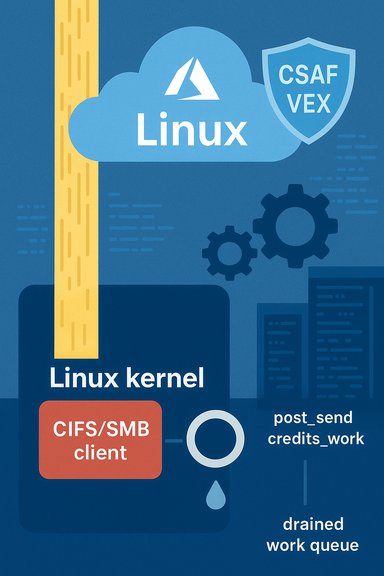
CVE‑2025‑39932 is a Linux‑kernel bug in the SMB client code (the kernel’s CIFS/SMB client implementation). The upstream fix makes a small but important change: call disable_work_sync(&info->post_send_credits_work) from smbd_destroy so the kernel waits for the delayed work item to be drained before freeing the structure. Upstream advisories and distribution trackers describe the problem as a lifetime/synchronization issue that can lead to kernel warnings, oopses, and memory use‑after‑free conditions under specific timing and driver interactions. This is a kernel‑space client implementation (the
Put plainly:
Which Microsoft artifacts to pay attention to:
From an engineering perspective, the onus is on teams running Microsoft‑provided kernels (or Microsoft‑supplied images) to verify whether their kernels include the
However, the VEX model is phased: Microsoft will expand attestations as its internal inventory mapping completes for other product families. Until a product is attested, customers must not assume it is unaffected — they must verify their own artifacts. This operational nuance is exactly what Microsoft’s advisory text encodes: an attestation for Azure Linux now, with a commitment to update the CVE record if more Microsoft products are found to ship the same component.
However, Azure Linux is not necessarily the only Microsoft artifact that could include the same vulnerable kernel code. The presence (or absence) of the
Immediate action items for operators:
Source: MSRC Security Update Guide - Microsoft Security Response Center
 Background / Overview
CVE‑2025‑39932 is a Linux‑kernel bug in the SMB client code (the kernel’s CIFS/SMB client implementation). The upstream fix makes a small but important change: call disable_work_sync(&info->post_send_credits_work) from smbd_destroy so the kernel waits for the delayed work item to be drained before freeing the structure. Upstream advisories and distribution trackers describe the problem as a lifetime/synchronization issue that can lead to kernel warnings, oopses, and memory use‑after‑free conditions under specific timing and driver interactions. This is a kernel‑space client implementation (the cifs/fs/smb/client code) that implements SMB2/SMB3 client VFS behavior from inside the Linux kernel. It is not the Samba userspace daemon (smbd from the Samba project), though the names can confuse non‑kernel engineers; the CVE text refers to smbd_destroy inside the kernel client code and the associated post_send_credits_work work item. Multiple distro advisories and CVE trackers describe the same change and the log traces that exposed the race. Why this matters: any product that ships a Linux kernel build containing the affected fs/smb/client code — either built‑in or as a loadable module — may carry the vulnerability until it ships a kernel that contains the upstream patch or a backport patch from the vendor.What Microsoft actually said — and what that wording means
Microsoft’s published guidance (the MSRC entry you quoted) states that Azure Linux includes the implicated open‑source library and is therefore potentially affected and adds that Microsoft began publishing CSAF/VEX machine‑readable attestations in October 2025 and will update the CVE entry if additional Microsoft products are identified. That phrasing is an inventory attestation — essentially a product‑scoped statement of what Microsoft has validated so far.Put plainly:
- The MSRC statement is an authoritative “yes” for Azure Linux — Microsoft checked the Azure Linux artifacts and found the upstream component in the builds it reviewed. Treat Azure Linux as in‑scope for triage and patching based on that attestation.
- That statement is not a technical proof that no other Microsoft product includes the same upstream kernel code. Microsoft explicitly promises to update VEX/CSAF records if additional internal products are discovered to ship the component; the wording implies a phased rollout of attestations rather than a one‑time, exhaustive scan.
Are other Microsoft products likely to include the same code?
Short answer: technically yes — Azure Linux is the only Microsoft product Microsoft has publicly attested as including the component so far, but several other Microsoft artifacts are plausible carriers and should be verified.Which Microsoft artifacts to pay attention to:
- WSL2 (Windows Subsystem for Linux) — Microsoft ships a Linux kernel for WSL2 (the WSL2 kernel sources and configuration are public on GitHub), and WSL kernels can include or omit subsystems depending on the WSL kernel config. That means the WSL2 kernel could include the
cifssubsystem if the kernel config enables it or if the module set shipped with WSL includes it. Microsoft documents how the WSL kernel is built and serviced and publishes the configuration used for WSL. - linux‑azure and Azure VM kernels — Azure hosts and some Marketplace images use Azure‑tuned kernels or specific
linux‑azurekernel package builds that Microsoft or the distro maintainers provide. Those kernels are separate artifacts from Azure Linux images and must be checked individually for the presence of the affected code. - Azure Marketplace images, AKS node images, and other Azure‑supplied images — marketplace items and managed images may carry kernels or kernel modules built by Microsoft or partners; presence of the vulnerable component is an artifact‑level question for each image.
- Other Microsoft Linux artifacts — any Microsoft product that bundles a Linux kernel binary (for example, specialized VM images, appliance images, or other cloud‑hosted components) needs its own inventory check.
From an engineering perspective, the onus is on teams running Microsoft‑provided kernels (or Microsoft‑supplied images) to verify whether their kernels include the
fs/smb/client subsystem and whether a patched kernel is available.Technical impact and exploitability
- Nature of the bug: a synchronization/work‑queue lifetime bug in the kernel SMB client path that can result in warnings, KASAN traces, oopses, or memory use‑after‑free conditions when the affected code is exercised in specific racey interleavings. Upstream trackers characterize the issue as a stability/reliability flaw rather than a straightforward remote code‑execution vector.
- Attack surface: local or guest‑adjacent code paths that exercise the CIFS/SMB client — for example, code mounting and using SMB shares, or drivers (RDMA, rxe) that interact with the path that triggered the original trace. The public disclosures and distro advisories mark exploitability as constrained by preconditions and timings.
- Severity classification by trackers: many vulnerability trackers initially list the CVE with medium priority and advise backporting the upstream stable fix to affected kernel branches. The practical remediation is to run a kernel that includes the upstream fix or to install a vendor backport.
Concrete steps for operators — triage and remediation (ordered)
- Identify Microsoft Linux artifacts in your estate.
- Inventory images, VMs, WSL installs, AKS node pools, marketplace appliances and any Microsoft‑supplied binary that embeds or ships a kernel. Treat each artifact as a separate product to verify. Microsoft’s VEX/CSAF feed is authoritative for the artifacts it lists (currently Azure Linux); use it where available.
- Check if the running kernel contains the CIFS/SMB client code.
- Check the kernel config:
grep -i CONFIG_CIFS /boot/config-$(uname -r)(or check the.configused to build the kernel artifact). - Check for a module or loaded module:
lsmod | grep cifsandmodinfo cifs(module present) orzgrep CONFIG_CIFS /proc/config.gzon systems that expose/proc/config.gz. - If the feature is built‑in,
CONFIG_CIFS=y; if compiled as a module it will beCONFIG_CIFS=mand acifs.komodule will appear in/lib/modules/$(uname -r). Kernel documentation explains the CONFIG_CIFS option and the resulting modulecifs.ko. - Map your kernel version to upstream commits or vendor advisories.
- Consult vendor advisories (Ubuntu, Debian, RHEL, Amazon Linux, etc. and the upstream commit ranges in the CVE entries to determine if your kernel version contains the vulnerable code or the fix. The NVD and multiple distro trackers have ingested CVE‑2025‑39932 and list the affected ranges and remediation guidance.
- Apply vendor patches or kernel updates where provided.
- For Azure Linux: follow Microsoft’s guidance and the Azure Linux security updates for patched kernel packages (Microsoft has attested Azure Linux in its VEX feed). Prioritize patching Azure Linux hosts that are listed in the VEX as “potentially affected.”
- For WSL: ensure the WSL kernel is updated through Microsoft Update (or use a patched custom kernel if you manage a custom WSL kernel). Microsoft documents the WSL kernel servicing process and the mechanism to supply a custom kernel.
- If immediate patching is not possible, consider mitigations.
- Unload or prevent use of the CIFS module if the host does not require SMB client functionality.
- Disable module autoload for
cifswhere feasible. - At the network or file‑share level, enforce stronger SMB dialect policies and avoid legacy/SMB1 dialects; Microsoft and Azure guidance recommend disabling SMB1 for improved security posture.
- Verify after remediation.
- After installing a patched kernel package or vendor backport, confirm the new kernel contains the upstream fix either by checking the vendor changelog or by examining the kernel package version and build‑time metadata against the upstream commit(s) that fixed the issue.
- Monitor for KASAN/OOPS/warn traces in
dmesgor system journals that match the earlier trace patterns.
How to prioritize in mixed Windows + Linux estates
- If you run Azure Linux (the product Microsoft attested) — treat it as a top priority for triage and patching because Microsoft’s attestation is an explicit “known affected / potentially affected” signal for that product family. Use Microsoft’s CSAF/VEX machine output to automate triage where possible.
- If you run WSL2 on Windows endpoints — check whether your WSL kernel (the one shipped by Microsoft or your custom kernel) includes
CONFIG_CIFSor acifs.komodule. If it does, apply the appropriate kernel update or swap to a patched kernel. WSL kernel updates flow through Microsoft Update or can be replaced by a custom kernel configured by the.wslconfigkernel path. - If you run Azure Marketplace images, AKS nodes, or linux‑azure kernels — treat each image and kernel artifact as a separate inventory item and check for the affected code. Marketplace images and managed node images may rely on a vendor‑supplied kernel that needs its own vendor advisory mapping.
Why Microsoft’s CSAF/VEX approach is valuable — and its limits
Microsoft’s decision to publish CSAF/VEX attestations (machine‑readable statements of product status for individual CVEs) is a meaningful improvement in transparency: it gives operators a deterministic signal for the specific Microsoft products Microsoft has inventory‑checked (Azure Linux among them) and reduces noisy, ambiguous triage steps for those products. The VEX attestation is especially useful for automation in large fleets.However, the VEX model is phased: Microsoft will expand attestations as its internal inventory mapping completes for other product families. Until a product is attested, customers must not assume it is unaffected — they must verify their own artifacts. This operational nuance is exactly what Microsoft’s advisory text encodes: an attestation for Azure Linux now, with a commitment to update the CVE record if more Microsoft products are found to ship the same component.
Practical verification checklist (copyable)
- Inventory: list all Microsoft‑supplied Linux kernels and images you run (Azure Linux, WSL2, AKS node images, Marketplace VMs).
- For each host/image:
- Run
uname -rto get the kernel release. - Check kernel config:
grep -i CONFIG_CIFS /boot/config-$(uname -r)orzgrep CONFIG_CIFS /proc/config.gz. - Check modules:
lsmod | grep cifsandmodinfo cifsor inspect/lib/modules/$(uname -r)/kernel/fs/smb/or/lib/modules/$(uname -r)/kernel/fs/smb/client/. - Compare kernel/version against vendor advisories (Ubuntu, Debian, RHEL, Microsoft VEX) and upstream commit ranges for CVE‑2025‑39932.
- Patch and reboot as vendor guidance indicates; prioritize Azure Linux hosts (MSRC attestation) and any host where CIFS/SMB client functionality is required.
Critical assessment — strengths and risks
- Strengths:
- Microsoft’s CSAF/VEX rollout provides machine‑readable signals and an authoritative product mapping for Azure Linux, which is excellent for automation and reducing triage ambiguity. Azure Linux customers now have a clear vendor statement to act upon.
- The CVE itself is well described in upstream and distro advisories; the technical fix is a targeted synchronization call that is straightforward to backport and deploy. Distro maintainers and major trackers have already ingested the fix and are issuing updates.
- Risks and caveats:
- Vendor attestations are phased; absence of an attestation for a Microsoft product does not mean absence of the vulnerable component. Large vendors ship many kernel artifacts with different configs, so artifact‑level verification remains necessary. Treat attestations as authoritative only for the artifacts they name.
- WSL, linux‑azure kernels, Marketplace images and partner appliances are plausible carriers depending on kernel config. Organizations with mixed estates (Windows endpoints with WSL, Azure VMs, and on‑prem Linux) need coordinated triage across teams.
- The practical exploitability is limited by required conditions; however, kernel crashes and host instability are meaningful — especially in multi‑tenant or production cloud hosts where a kernel panic can affect many tenants. Treat availability risks seriously and patch promptly.
Conclusion
Microsoft’s MSRC statement that Azure Linux includes the implicated open‑source library and is therefore potentially affected is accurate and actionable for Azure Linux customers — it reflects a completed inventory mapping and a published VEX/CSAF attestation for that product family.However, Azure Linux is not necessarily the only Microsoft artifact that could include the same vulnerable kernel code. The presence (or absence) of the
fs/smb/client code is a build‑time property that varies by kernel configuration and packaging; other Microsoft‑supplied kernels — notably WSL2 kernels, linux‑azure artifacts, marketplace images, and other Linux kernel binaries Microsoft ships or maintains — may include the same code and therefore should be verified independently. Microsoft has stated it will expand CSAF/VEX attestations as it completes inventory checks for additional products, and operators should use those attestations where available while continuing to perform artifact‑level verification across their estates.Immediate action items for operators:
- Treat Azure Linux hosts as high priority for patching in this case (per Microsoft attestation).
- Inventory and check WSL kernels, AKS node images, Marketplace images and any Microsoft‑provided kernels for
CONFIG_CIFSorcifs.ko, and apply patched kernels or vendor backports as appropriate.
Source: MSRC Security Update Guide - Microsoft Security Response Center
