

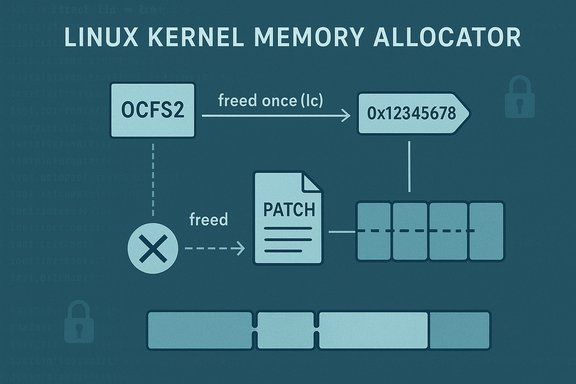
A small change in the OCFS2 kernel code — setting a freed pointer to NULL — resolved a formally assigned CVE but highlights a perennial class of Linux kernel risks: double‑free memory corruption that can destabilize hosts, complicate multi‑tenant environments, and, in some cases, provide a local exploit primitive. The vulnerability tracked as CVE‑2025‑40055 fixes a double‑free in the OCFS2 user_cluster_connect / user_cluster_disconnect error path; maintainers patched the code upstream and backported the surgical fix to stable kernel series within weeks of reporting.
OCFS2 (Oracle Cluster File System version 2) is a clustered filesystem used on Linux to allow shared block devices to be mounted simultaneously by multiple nodes. Because OCFS2 includes user‑space control paths and kernel components that manage cluster connections, bugs in its connection and teardown code run in kernel context and therefore carry systemic risk. The recent CVE describes a double‑free during cluster connection handling: the disconnect path frees a per‑connection private pointer and then, under error handling, frees it again — a textbook double‑free that the patch prevents by setting that pointer to NULL after the first free. This is not a theoretical fix: upstream maintainers produced a focused patch, and the change was propagated into the stable kernel trees and the -mm branch for inclusion in linux-next, demonstrating the standard kernel workflow for low‑risk corrective patches. Several stable series (including recent 5.15, 6.6 and 6.12 branches) received review patches and backports, signaling rapid acceptance and low regression risk.
Why this is preferred upstream:
Operators running OCFS2 should treat this as a targeted kernel patching task: verify exposure, stage a kernel update, reboot the node into the patched kernel, and monitor for residual instability. For environments without OCFS2, the risk is irrelevant — but the broader lesson endures: even tiny memory‑management oversights in kernel code can have outsized operational consequences, and disciplined patching and backport checking remain essential.
Source: MSRC Security Update Guide - Microsoft Security Response Center
 Background
OCFS2 (Oracle Cluster File System version 2) is a clustered filesystem used on Linux to allow shared block devices to be mounted simultaneously by multiple nodes. Because OCFS2 includes user‑space control paths and kernel components that manage cluster connections, bugs in its connection and teardown code run in kernel context and therefore carry systemic risk. The recent CVE describes a double‑free during cluster connection handling: the disconnect path frees a per‑connection private pointer and then, under error handling, frees it again — a textbook double‑free that the patch prevents by setting that pointer to NULL after the first free. This is not a theoretical fix: upstream maintainers produced a focused patch, and the change was propagated into the stable kernel trees and the -mm branch for inclusion in linux-next, demonstrating the standard kernel workflow for low‑risk corrective patches. Several stable series (including recent 5.15, 6.6 and 6.12 branches) received review patches and backports, signaling rapid acceptance and low regression risk. What exactly went wrong (technical overview)
At the heart of the issue are two kernel functions that cooperate when a user requests a cluster connection:- user_cluster_connect: allocates and initializes connection state, including a pointer stored in conn->cc_private (referred to in the patch as "lc").
- user_cluster_disconnect: tears down the connection and frees conn->cc_private when appropriate.
Timeline and distribution propagation
- Patch posted to kernel mailing lists and associated maintainers in late September 2025; the patch author and reviewers used normal kernel review channels.
- The change was added to the -mm tree and prepared for linux-next integration as part of the usual upstream flow.
- Stable backports were submitted and reviewed for multiple kernel maintenance branches (examples include 5.15, 6.6, 6.12), with stable patch review posts from maintainers indicating readiness for backport.
- The CVE record (CVE‑2025‑40055) was published and mirrored by vulnerability trackers such as OSV and CVE aggregators shortly after the upstream commits. Public vulnerability databases list the fix and include links to the stable commits.
Severity and exploitability: realistic expectations
- Primary impact: memory corruption. The immediate and most likely operational impact is a kernel panic or oops (denial of service) if the double‑free is triggered repeatedly or in specific timing windows. Many kernel double‑free bugs principally manifest as availability issues.
- Remote exploitation: unlikely from the information published. The bug requires local interaction with OCFS2 cluster connection logic — typically, an attacker would need local code execution or the ability to craft input that reaches the afflicted kernel path. Public trackers that indexed CVE‑2025‑40055 did not list active exploitation or a public PoC at the time of initial publication.
- Escalation potential: feasible in extreme cases. Double‑free vulnerabilities can corrupt kernel allocator metadata in ways that skilled attackers have, historically, leveraged into arbitrary write/execute primitives. But converting a kernel double‑free into reliable privilege escalation generally requires precise heap manipulation and often platform‑specific allocator behavior. Treat the possibility seriously, but prioritize on observed exposure and local threat model.
Who is affected
- Any Linux kernel build that includes the vulnerable commit range in fs/ocfs2/stack_user.c prior to the stable fix is potentially affected. This includes some distribution kernels and vendor forks that have the OCFS2 code enabled.
- Systems that do not use OCFS2 (for example, hosts using ext4, XFS, Btrfs, or F2FS exclusively) are not affected by this specific CVE.
- Embedded, vendor, or OEM kernels: these builds are the most likely to remain vulnerable longer because maintainers of custom kernels sometimes lag upstream backports. Appliances that include OCFS2 or older kernel bases require vendor confirmation that the updated kernel or a backport has been applied.
- Check if OCFS2 module is loaded: lsmod | grep ocfs2
- Check mounted filesystems: findmnt -t ocfs2
- Check kernel version: uname -r
What maintainers changed (the patch in plain language)
The patch author identified an error path in user_cluster_connect/user_cluster_disconnect where cleanup code freed the same pointer twice. The fix is one explicit defensive step: after freeing the per‑connection private pointer (lc), assign NULL to that pointer before any subsequent error handling that might attempt to free it again. This prevents double free without altering the overall connection semantics.Why this is preferred upstream:
- Low‑risk: the logical behavior for correct inputs is unchanged.
- Minimal lines of code: makes review and backporting trivial.
- Reversible semantics: no API changes, no broader refactor required.
Remediation — practical, prioritized playbook
- Inventory
- Search for OCFS2 usage across your fleet: check for module load, mounts, and packages that build in OCFS2 support.
- Query configuration management databases for kernel versions and vendor‑provided kernel packages.
- Identify fixed packages or upstream commits
- Confirm whether your distribution’s kernel package includes the upstream stable commit(s) that apply this fix. Look for stable commit hashes referenced in vendor advisories or package changelogs. Public references to the stable commits exist and were used to backport the change.
- Patch and reboot (definitive fix)
- Where OCFS2 is present, schedule a kernel update that includes the stable backport and plan for a reboot. Kernel fixes require kernel reload to take effect.
- Test the patched kernel in a small pilot ring (especially for storage nodes, clustered systems, or nodes with vendor drivers).
- Compensating controls (if immediate patching is impossible)
- Prevent untrusted users from creating cluster connections or from accessing mechanisms that trigger user_cluster_connect/disconnect paths.
- Isolate OCFS2 hosts in restricted networks and strengthen access control to management interfaces.
- Monitor kernel logs for OCFS2 errors and repeated oops/panic traces; increase telemetry for hosts that serve multiple tenants.
- Post‑patch validation
- Confirm kernel changelogs reference the fix or upstream commit IDs.
- Reboot hosts into the patched kernel and run smoke tests that exercise cluster connect/disconnect paths under controlled conditions.
Detection and monitoring guidance
Kernels manifest double‑free errors in several operational ways:- Kernel oops or panic with stack traces referencing ocfs2 functions.
- Repeated OCFS2 connection or disconnect failures in system logs (dmesg, journalctl).
- Unexpected system instability or reboots on nodes that manage cluster connections.
- Add search rules to your log aggregation system for kernel oops messages that contain ocfs2 or stack_user.c traces.
- Alert when OCFS2‑related errors spike across a group of hosts or when a storage node restarts unexpectedly.
- If you suspect exploitation, preserve live memory and kernel logs for forensic analysis before rebooting — a post‑crash snapshot may capture artifacts useful to determine intentional triggering versus accidental failure.
Risk analysis — strengths and residual caveats
Strengths of the public fix:- Minimal footprint: The fix is a one‑line defensive change that does not change higher‑level behavior, lowering regression risk.
- Quick backportability: Small fixes are easier for distribution maintainers to apply across multiple stable branches. This led to rapid stable branch patches being posted.
- Vendor lag: Embedded vendors and appliances may not apply the backport promptly; confirm with OEMs whether their kernel forks include the fix.
- Local attack vector: The vulnerability is exploitable only via local interaction with OCFS2 connection code, which makes it lower immediate remote risk but higher impact if untrusted local actors (multi‑tenant workloads, containers, CI runners) can reach the code path.
- Exploit unpredictability: While no public proof‑of‑concept was available at the time of initial disclosure, double‑free primitives can be weaponized by skilled attackers; treat claims of full exploitation carefully and prioritize patching where exposure is real.
Developer and maintainer takeaways
- Defensive pointer handling still matters. Simple nullification after free remains one of the most effective short‑term mitigations for double‑free paths exposed via complex cleanup and error handling.
- Small surgical fixes are preferred for correctness errors to minimize regressions and simplify backports across stable branches.
- Rapid, transparent upstream review and stable tree promotion help distributors and vendors map upstream commits to package updates more reliably; operators should map kernel package changelogs to the upstream commits in vendor advisories rather than relying only on CVE strings.
Short checklist for administrators (concise)
- Verify whether hosts run OCFS2: lsmod | grep ocfs2; findmnt -t ocfs2.
- If OCFS2 present: identify kernel package versions and consult your distro security tracker for packages that mention CVE‑2025‑40055 or include the upstream stable commit hashes.
- Apply vendor kernel updates that include the stable backport; reboot during maintenance windows.
- If you cannot patch immediately: reduce local attack surface, restrict who can perform cluster operations, and enable kernel log monitoring and alerts for ocfs2 oops messages.
- After patching: confirm kernel changelogs and test cluster connect/disconnect routines in a staging environment.
Final assessment
CVE‑2025‑40055 is a classic example of a small, high‑leverage kernel correctness fix. The underlying problem — a double free in OCFS2 connection teardown — is conceptually simple but potentially dangerous when triggered in production cluster environments. Fortunately, the fix is minimal, low risk, and quickly backportable; the critical operational work is in identifying exposed hosts and applying vendor or distribution updates followed by validation.Operators running OCFS2 should treat this as a targeted kernel patching task: verify exposure, stage a kernel update, reboot the node into the patched kernel, and monitor for residual instability. For environments without OCFS2, the risk is irrelevant — but the broader lesson endures: even tiny memory‑management oversights in kernel code can have outsized operational consequences, and disciplined patching and backport checking remain essential.
Source: MSRC Security Update Guide - Microsoft Security Response Center
