

A recently disclosed Linux-kernel flaw tracked as CVE-2025-40064 fixes a use-after-free in the SMC networking code — and Microsoft’s MSRC advisory has drawn attention by explicitly saying that Azure Linux “includes this open‑source library and is therefore potentially affected.” That statement is important, actionable, and correct for the named product, but it is not a guaranteed exclusion for other Microsoft products or images. This feature unpacks the technical details of CVE‑2025‑40064, explains precisely what Microsoft’s wording means, cross‑checks the public evidence, and lays out a practical verification and mitigation playbook for operators running Microsoft-supplied artifacts (Azure VM images, WSL2, AKS nodes, Marketplace appliances, and others).
CVE‑2025‑40064 is a kernel vulnerability fixed upstream in the SMC code path, triggered by a use‑after‑free in __pnet_find_base_ndev. Upstream reports and automated bug finders (syzbot / KASAN traces) show the defect arises when the code reads a net_device pointer that has already been freed during a connect path, producing kernel warnings, KASAN reports, and potential host instability. The NVD entry and open-source vulnerability databases summarize the same root cause and remediation approach. Microsoft’s Security Response Center (MSRC) entry for this CVE includes a short product attestation: Azure Linux includes the implicated open‑source component and is therefore potentially affected — and Microsoft says it will update CVE/VEX/CSAF records if other Microsoft products are later found to ship the same upstream code. That phrasing is a product‑level inventory statement that vendors increasingly use to allow automated triage and remediation, but it must be read carefully to avoid misinterpretation.
Why that distinction matters:
Caveat: if you need a definitive “no other Microsoft product is affected” answer, that can only come from (a) verified attestations for each product (VEX/CSAF mappings that explicitly say “Not Affected”) or (b) direct artifact inspection (SBOM, kernel config, package changelog). Microsoft’s current attestation is not a universal exclusion; it is a snapshot of inventory work.
For defenders, the operational takeaway is straightforward and urgent:
Source: MSRC Security Update Guide - Microsoft Security Response Center
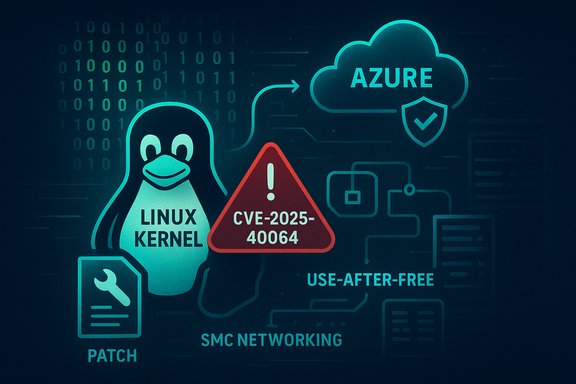 Background / Overview
CVE‑2025‑40064 is a kernel vulnerability fixed upstream in the SMC code path, triggered by a use‑after‑free in __pnet_find_base_ndev. Upstream reports and automated bug finders (syzbot / KASAN traces) show the defect arises when the code reads a net_device pointer that has already been freed during a connect path, producing kernel warnings, KASAN reports, and potential host instability. The NVD entry and open-source vulnerability databases summarize the same root cause and remediation approach. Microsoft’s Security Response Center (MSRC) entry for this CVE includes a short product attestation: Azure Linux includes the implicated open‑source component and is therefore potentially affected — and Microsoft says it will update CVE/VEX/CSAF records if other Microsoft products are later found to ship the same upstream code. That phrasing is a product‑level inventory statement that vendors increasingly use to allow automated triage and remediation, but it must be read carefully to avoid misinterpretation.What CVE‑2025‑40064 actually is — technical summary
- Component: Linux kernel SMC (Shared Memory Communications) networking code, specifically the pnet base network-device lookup in net/smc/smc_pnet.c.
- Fault: a use‑after‑free where code paths call __pnet_find_base_ndev without holding the device reference count (refcnt) while control is passed between functions that acquire RTNL or otherwise manipulate the dst->dev pointer. The bug was reported by syzbot and reproduced as a KASAN trace.
- Impact: availability and reliability — kernel warnings, KASAN traces, oops/panic, or a local crash that could disrupt networked services on the host. There is no public indication this yields a reliable remote code execution or privilege escalation primitive without local access.
- Attack surface: primarily local or tenant‑adjacent actions that can cause the affected connect path to run (for instance, local processes or orchestration systems that create or manipulate SMC connections). The public technical traces and patch descriptions point to an object‑lifetime and refcounting fix rather than a complex remote exploit chain.
Parsing Microsoft’s wording: “Azure Linux includes this open‑source library and is therefore potentially affected”
Microsoft chose an attestation approach: publish machine‑readable VEX/CSAF artifacts to indicate product‑level status for specific CVEs. In that model:- A statement that Azure Linux includes the library is an authoritative inventory result for the Azure Linux product family (formerly CBL‑Mariner). It means Microsoft inspected the Azure Linux artifacts, confirmed the upstream component was present in the builds they ship, and marked it as potentially affected accordingly.
- The wording is procedural — Microsoft started publishing CSAF/VEX attestations with Azure Linux first and committed to updating CVE records if additional Microsoft products are later found to include the same upstream component. That commitment is public and procedural, not a technical guarantee that other Microsoft products are clean.
So, is Azure Linux the only Microsoft product that could be affected?
Short answer: No — not necessarily, but Azure Linux is the only Microsoft product Microsoft has publicly attested as carrying the vulnerable code at the time of the advisory.Why that distinction matters:
- Whether a particular Microsoft product/image runs the vulnerable kernel code is an artifact‑level property. It depends on:
- The exact kernel version and upstream commit range used to build the kernel.
- Kernel configuration flags (CONFIG_*), which determine whether a driver or subsystem is built‑in, built as a module, or omitted entirely.
- Packaging choices and whether the vulnerable files are included in an image or static binary.
- Microsoft distributes (or influences) multiple Linux artifacts that are plausible carriers, depending on build choices:
- WSL2 kernel (Windows Subsystem for Linux) — Microsoft builds and ships a WSL kernel binary and publishes related sources/configs. If a given WSL kernel build includes the affected SMC code, that WSL instance would be a candidate for verification.
- linux‑azure / Azure‑tuned kernels used for VM images — these are separate builds and may or may not include the same kernel subsystems.
- Azure Marketplace images, AKS node images, partner appliances — image authors may use older base kernels or different configs; Marketplace artifacts are separate inventory items and must be checked individually.
Cross‑checking the public record (independent verification)
Key claims in this article were verified across independent sources:- The technical nature of CVE‑2025‑40064 (SMC use‑after‑free in __pnet_find_base_ndev is described in NVD and mirrored by OSV and CVE tracker summaries. These sources reproduce the KASAN trace and syzbot context that led to the upstream fix.
- Microsoft’s product‑attestation wording, and the rollout of CSAF/VEX attestations starting with Azure Linux, has been explained publicly by MSRC and is reflected in multiple independent analyses and advisories that examined Microsoft’s VEX commitments. Those vendor‑focus analyses make the same distinction: attestation = inventory result for the named product; absence of attestation ≠ proven absence of vulnerable code.
Caveat: if you need a definitive “no other Microsoft product is affected” answer, that can only come from (a) verified attestations for each product (VEX/CSAF mappings that explicitly say “Not Affected”) or (b) direct artifact inspection (SBOM, kernel config, package changelog). Microsoft’s current attestation is not a universal exclusion; it is a snapshot of inventory work.
Practical verification: runbook for administrators (artifact‑level inspection)
Operators should confirm exposure at the artifact level. The following steps are practical, automatable, and prioritized:1. Immediate triage (two‑minute checks)
- On any running Linux host or VM image provided by Microsoft (including Azure Linux images): run uname -r to capture kernel version and vendor.
- Inspect the running kernel config: zgrep or grep for a config file (e.g., /proc/config.gz or /boot/config-$(uname -r). Look for SMC-related flags in the networking stack if they exist.
- Check for the presence of the SMC module or object files: use lsmod, modinfo, or search /lib/modules/$(uname -r) for smc-related modules.
2. Artifact inspection (images, Marketplace items, offline kernels)
- Extract the kernel image or boot artifacts and inspect /boot/config- (or the build .config) for CONFIG_ flags that enable the SMC subsystem. If the SMC code is not built in or present as a module, the artifact is not carrying the vulnerable code.
- Search package changelogs for CVE‑2025‑40064 or for the upstream commit IDs referenced in vendor/stable kernel trees. On Debian/Ubuntu: apt changelog linux-image-$(uname -r) | grep -i 40064. On RPM systems: rpm -q --changelog kernel | grep -i 40064.
3. WSL2-specific checks
- WSL2 uses a Microsoft-distributed kernel binary; confirm the WSL kernel version and the public WSL kernel repo/config used to produce the binary. If you run a custom WSL kernel, inspect that kernel’s config and module set. If the Microsoft WSL kernel is updated in response to CVE‑2025‑40064, Microsoft will publish the kernel change; otherwise, treat the WSL kernel as an artifact to verify.
4. AKS, Marketplace, and partner images
- Treat each Marketplace image or partner appliance as an independent item. Extract and inspect the kernel artifacts inside the image, or request an SBOM/VEX attestation from the image provider. Marketplace images authored by third parties often diverge from vendor base images and require independent verification.
5. Automation recommendations
- Integrate Microsoft’s CSAF/VEX outputs (for Azure Linux and future attestations) into your vulnerability triage pipeline. When Microsoft updates a CVE’s VEX mapping to include additional products, automated ingestion allows immediate re‑triage.
Mitigations and remediation
- If you run Azure Linux images: apply Microsoft’s published updates immediately; treat Microsoft’s attestation as authoritative for those images. Microsoft has published patches and VEX/CSAF artifacts for Azure Linux as the initial product scope.
- For other Microsoft artifacts (WSL2, linux‑azure, Marketplace images, AKS nodes): perform the artifact verification runbook above. If an artifact contains the vulnerable SMC code and you cannot patch immediately:
- Isolate or limit local access to hosts that could trigger the connect code paths.
- Limit untrusted user access and orchestrator operations that might run the SMC connection sequences.
- Apply network or host-level compensating controls where feasible.
- Maintain patching discipline for distribution kernels in your VMs (Debian/Ubuntu/RHEL/CentOS): most distributors have incorporated the upstream fix into kernel updates; map your kernel version to distro advisories to confirm fixed status.
Risks and tradeoffs: what defenders must understand
- False reassurance risk — Interpreting Microsoft’s Azure Linux attestation as “only Azure Linux is affected” is dangerous. Absence of attestations for other Microsoft artifacts is unknown status, not proof of absence. That ambiguity is the single biggest operational risk in multi‑artifact estates.
- Automation vs completeness tradeoff — VEX/CSAF attestation is highly valuable for automation and deterministic triage, but large vendors often roll out attestations in phases (product families first, then broader mappings). Treat VEX signals as authoritative for covered products and incomplete for unlisted ones.
- Local attack surface — Kernel use‑after‑free bugs typically require local or tenant‑adjacent actions to trigger. In cloud settings, a multi‑tenant hypervisor or container host could be abused by a tenant to create disproportionate impact on the host. That makes rapid patching and host isolation important even for non‑remote RCE kernel bugs.
- Supply‑chain exposures — Statically bundled or vendor‑compiled binaries, third‑party Marketplace images, and appliances can carry older kernels or copies of source files; these are easy to overlook without SBOMs or image inspection. Marketplace images are distinct artifacts and must be verified individually.
How to interpret Microsoft’s promise to “update the CVE if additional products are identified”
Microsoft’s public commitment — that it will expand its CSAF/VEX mapping and update a CVE entry if other Microsoft products are discovered to ship the same upstream component — is a procedural pledge. It promises future transparency as inventory work proceeds, but it does not retroactively assert absence for any artifact that has not yet been inventoried. In operational terms:- Take Microsoft’s attestation as an immediate, vendor‑backed remediation priority for the product it names (Azure Linux).
- Continue to verify other Microsoft artifacts you run: WSL2 kernels, AKS/VM images, Marketplace appliances, custom images. Do not assume they are safe until attested or inspected.
Recommended operator playbook (prioritized)
- Patch Azure Linux images immediately according to Microsoft guidance. Azure Linux is the product Microsoft has attested as including the vulnerable code.
- Run the artifact inspection runbook against all Microsoft-supplied artifacts in your estate (WSL2, linux‑azure kernels, AKS node images, Marketplace images). Automate these checks where possible.
- Ingest Microsoft’s CSAF/VEX files into your vulnerability management pipeline to receive machine‑readable updates when Microsoft expands attestation coverage.
- If you find an unremediated artifact that carries the vulnerable SMC code and cannot be patched immediately, apply compensating controls: isolate the host, restrict access to local/tenant features, and monitor for anomalous connect or kernel warnings.
- Request SBOMs or VEX attestations from vendors for Marketplace and partner images; treat each image as a distinct artifact until verified.
Final analysis and conclusion
CVE‑2025‑40064 is a valid, upstream Linux kernel fix for a use‑after‑free in the SMC connect path; the technical root cause and remediation are well documented in public vulnerability trackers and upstream kernel commits. Microsoft’s MSRC statement that Azure Linux includes the open‑source component and is therefore potentially affected is a correct, product‑scoped attestation: Azure Linux customers must act on Microsoft’s guidance. However, that wording does not equate to a universal assurance about all other Microsoft products. Large vendors commonly roll out VEX/CSAF attestations in phases; absence of an attestation for a product is not evidence that the product is free of the vulnerable code. Administrators must therefore verify other Microsoft artifacts (WSL2, linux‑azure, AKS nodes, Marketplace appliances) at the artifact level — via SBOMs, kernel config inspection, package changelogs, or the vendor’s own VEX attestation — until those artifacts are explicitly attested as “Not Affected” or patched.For defenders, the operational takeaway is straightforward and urgent:
- Treat Microsoft’s Azure Linux attestation as authoritative and patch those images immediately.
- For everything else Microsoft supplies, do the artifact inspection runbook; automate ingestion of VEX/CSAF; and apply compensating controls where verification or patching is delayed.
Source: MSRC Security Update Guide - Microsoft Security Response Center
