

A newly assigned Linux-kernel vulnerability, CVE-2025-40281, fixes a potential shift-out-of-bounds in the SCTP transport code — a rare but real correctness bug discovered by syzbot that could cause kernel instability when unexpectedly large sysctl parameters are processed by sctp_transport_update_rto.
SCTP (Stream Control Transmission Protocol) is a transport-layer protocol used in telecom stacks, signalling systems, clustered applications, and some specialized network appliances. The Linux kernel's SCTP implementation lives under net/sctp and is subject to the same defensive-hardening discipline as other kernel networking code. In early December 2025, syzbot reported a UBSAN (Undefined Behavior Sanitizer) finding that identified a possible shift exponent too large for the 32‑bit unsigned type in net/sctp/transport.c, which manifests in the function sctp_transport_update_rto. Public vulnerability records summarize the technical root cause succinctly: a recently introduced commit had defined rto_alpha_max and rto_beta_max with values (1000) that, combined with certain runtime conditions, allowed a shift operation with an exponent outside the safe range for an unsigned int on 32‑bit arithmetic. The upstream remedy both bounds the test at runtime and annotates the sysctl reads with READ_ONCE to avoid races as the sysctl values can change concurrently. This is a correctness and robustness fix rather than a memory‑corruption or arbitrary‑code‑execution remediation. The likely impact is an availability event (kernel oops/panic) under specific, unusual runtime inputs rather than data exfiltration or privilege escalation in the wild. Multiple independent trackers and the NVD entry document the same high‑level finding and link to the upstream stable-kernel commits that implement the fix.
Recommended actions, in priority order:
This fix is an example of the kernel community’s steady, conservative approach to defensive hardening: identify the UB via automated testing, apply a minimal runtime guard, and propagate the change through stable trees to vendors. The engineering result is correct and low risk; the operational challenge is ensuring the change reaches every kernel instance in a mixed estate.
Source: MSRC Security Update Guide - Microsoft Security Response Center
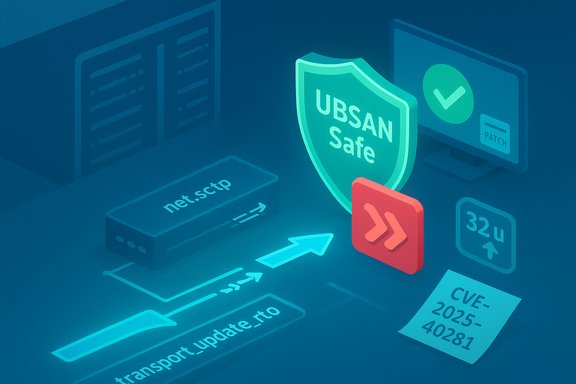 Background / Overview
SCTP (Stream Control Transmission Protocol) is a transport-layer protocol used in telecom stacks, signalling systems, clustered applications, and some specialized network appliances. The Linux kernel's SCTP implementation lives under net/sctp and is subject to the same defensive-hardening discipline as other kernel networking code. In early December 2025, syzbot reported a UBSAN (Undefined Behavior Sanitizer) finding that identified a possible shift exponent too large for the 32‑bit unsigned type in net/sctp/transport.c, which manifests in the function sctp_transport_update_rto. Public vulnerability records summarize the technical root cause succinctly: a recently introduced commit had defined rto_alpha_max and rto_beta_max with values (1000) that, combined with certain runtime conditions, allowed a shift operation with an exponent outside the safe range for an unsigned int on 32‑bit arithmetic. The upstream remedy both bounds the test at runtime and annotates the sysctl reads with READ_ONCE to avoid races as the sysctl values can change concurrently. This is a correctness and robustness fix rather than a memory‑corruption or arbitrary‑code‑execution remediation. The likely impact is an availability event (kernel oops/panic) under specific, unusual runtime inputs rather than data exfiltration or privilege escalation in the wild. Multiple independent trackers and the NVD entry document the same high‑level finding and link to the upstream stable-kernel commits that implement the fix. Technical anatomy: what went wrong
The immediate symptom reported by UBSAN was a "shift-out-of-bounds" warning in net/sctp/transport.c at a line that performs a shift operation using values derived from SCTP RTO adjustment parameters (rto_alpha, rto_beta). The issue arises when a very large exponent — either from an unexpected runtime value or from a pathological combination of fields — is used in a left-shift on a 32‑bit unsigned integer type. On 32‑bit platforms or in code that assumes 32‑bit width, such an operation is undefined and can be caught by UB sanitizers. Two engineering choices made the situation visible:- A commit introduced static maxima (rto_alpha_max and rto_beta_max set to 1000) to cap user-provided sysctl inputs.
- The runtime code assumed the shift exponent would always be within the safe range for the target integer type, and there were no hard runtime guards to force a safe behavior when an extreme value slipped through.
Patch and upstream response
Upstream maintainers treated the report as a correctness regression and applied a small, surgical change: perform the exponent bound check at runtime and mark the sysctl reads with READ_ONCE so concurrent updates cannot cause inconsistent values during the arithmetic. The patches were merged into the stable kernel trees and referenced by multiple stable-commit IDs in public vulnerability trackers. The change is intentionally minimal — it does not alter SCTP protocol semantics or the normal fast paths; it merely forces a safe code path in the presence of extreme sysctl settings. Why that approach matters: minimal diffs are easier to backport into stable vendor kernels and significantly reduce the risk of regression while restoring correctness. Kernel maintainers prefer localized, defensive edits that convert undefined behavior into sane, predictable error handling. The upstream response followed this pattern.Scope, affected systems, and severity
- Affected component: Linux kernel SCTP implementation (net/sctp), specifically the sctp_transport_update_rto routine.
- Affected versions: any upstream Linux kernel and downstream distribution or vendor kernels that contain the vulnerable pre-fix code. Distribution advisories and OSV/NVD entries map the fix to specific stable commits or package versions; operators should consult their distro security trackers for precise package numbers.
- Attack vector: local or benignly invoked network state — the bug is triggered by the SCTP state machine when processing certain SACK/outqueue flows; syzbot hit the path by fuzzing. There is no public indication of an unauthenticated remote RCE vector for this defect.
- Primary impact: availability — potential kernel oops or panic when the unsafe shift occurs; this is a DoS-like impact rather than confidentiality or integrity compromise in most plausible threat models.
Why administrators should care (even on Windows-dominant estates)
Many Windows-focused networks run Linux components in mixed estates: VMs and guests, container hosts, WSL2 instances used for dev workflows, virtual appliances, telecom gateways, and cloud images. A kernel oops in any of those elements can disrupt services and automation that are Windows-hosted or managed. Even if a Windows host’s own networking stack is unaffected, Linux guests or appliances used for signalling, monitoring, or IP transit can become single points of failure. The practical guidance — inventory and patch — is therefore relevant to Windows administrators who operate hybrid environments.Detection, mitigation, and operational remediation
Immediate detection signals
- Kernel oops traces in system logs that reference net/sctp symbols or that include "shift out of bounds" / "ubsan" text. Search journalctl -k and dmesg for SCTP stack traces.
- Unexplained reboots, watchdog restarts, or kernel crash dumps coincident with SCTP traffic or ticketed activity for network control plane processes.
Short-term mitigations (if you cannot patch immediately)
- Unload or blacklist the SCTP kernel module on hosts that do not need SCTP:
- Unload: sudo rmmod sctp
- Blacklist: echo "blacklist sctp" | sudo tee /etc/modprobe.d/blacklist-sctp.conf
- Caution: unloading/blacklisting will break legitimate SCTP-dependent services.
- Block SCTP at the network edge or with host firewall rules on systems that do not require it:
- iptables: sudo iptables -A INPUT -p sctp -j DROP
- nftables: nft add rule inet filter input ip protocol sctp drop
- Caveat: firewalling prevents network-exposed triggers but not local misuse by unprivileged processes.
- Restrict untrusted local execution: tighten container policies, reduce unprivileged capabilities, and limit access to raw sockets to reduce the chance a local process can drive the vulnerable path.
Long-term remediation
- Identify hosts running kernels that predate the stable commit(s) addressing CVE-2025-40281 by running uname -r and mapping that to your distro’s security tracker.
- Apply vendor-supplied kernel updates that reference the upstream fix or include the CVE in their changelog.
- Reboot hosts to activate the patched kernel; kernel changes are not effective until a reboot.
- Post‑patch validation: monitor dmesg/journalctl -k for residual oops traces and exercise representative SCTP flows if your environment uses SCTP.
Exploitability and real‑world risk assessment
Public evidence and tracking emphasize that CVE-2025-40281 is a UBSAN-detected arithmetic/shift problem that yields undefined behavior and potential kernel oops. Key points:- The bug is not documented as enabling remote code execution in the public CVE metadata. The maintainers’ edits are correctness checks rather than mitigations for an exploitation primitive.
- The practical exploit outcome is an availability event — a kernel crash or oops that can take down a host or virtual machine. Availability attacks can be severe in multi‑tenant and carrier-grade contexts even if they do not expose data.
- The absence of a public proof‑of‑concept does not imply the issue is harmless. Local DoS primitives are straightforward to trigger in some contexts, and robustness regressions in the kernel are taken seriously because of the catastrophic operational impact of kernel panics.
Patch quality, maintainability, and downstream backporting
The upstream change is intentionally small and defensive: runtime bounds checks, READ_ONCE annotations, and a safe fallback behavior. That conservative approach has several operational advantages:- Minimal surface area: few lines touched, low likelihood of regressions in unrelated paths.
- Easy backport: small diffs are straightforward for distribution maintainers to apply to stable branches.
- Preserves semantics: the fix does not change SCTP behavior for valid user settings, only preventing pathological UBSAN-triggering inputs.
Practical checklist for system owners (prioritized)
- Inventory: run uname -r on every Linux guest, container host, or appliance in your environment to determine kernel versions and identify potential exposure.
- Detect SCTP presence: lsmod | grep sctp or modinfo sctp to see if SCTP is a module or compiled-in.
- Consult vendor advisories: confirm whether your vendor has released a kernel package that lists CVE-2025-40281 as fixed.
- Schedule updates and reboots: apply kernel updates in a staged manner, with reboots to activate the patched kernels.
- Validate and monitor: post-patch, watch dmesg/journalctl -k for oops or UBSAN-related traces and exercise SCTP workloads if relevant.
- Compensating controls: if you must delay patching, consider unloading/blacklisting SCTP and firewalling SCTP traffic for hosts that do not require it.
Strengths and limitations of the fix — critical analysis
Strengths- Surgical remediation: The fix is deliberately small and defensive, reducing regression risk and easing downstream adoption. That aligns with the kernel project’s best practices for safety-critical fixes.
- Preserves semantics: The patch does not change expected protocol behavior for valid parameter ranges; it only hardens against pathological or simultaneous sysctl changes.
- Backportable: Small diffs are easy for distribution and vendor maintainers to backport to stable kernels and appliance images.
- Vendor lag: embedded devices, network appliances, and vendor kernels often lag upstream. Having a small upstream fix does not guarantee timely propagation to every device, so operational exposure can persist.
- Visibility: kernel oops can be transient and lost after a reboot unless centralized logging and crash-dump collection (kdump/vmcore) are in place. Lack of telemetry can hide real attacks or accidental triggers.
- Operational friction: because remediation requires a kernel update plus reboot, large fleets may need staged rollouts; this adds scheduling and availability burdens for critical production systems.
Cross-checks and verification notes
Key claims in this writeup were verified against multiple independent sources:- The NVD entry documents the UBSAN discovery, trace, and the file/line (net/sctp/transport.c:509) and lists upstream kernel.org stable commits as references.
- OSV and other vulnerability aggregators mirror the NVD description and publication timestamps and reference the same stable commits and distro mappings.
- Vendor/tracker pages (for example SUSE and other distro trackers) repeat the same technical summary and link to the patches; SUSE’s advisory records the description and the lack of assigned severity at the time of publication.
- Independent analysis and operational guidance (kernel patch notes, distro tracker writeups) were consulted to assemble practical mitigation steps and detection guidance.
Final assessment and recommended next steps
CVE-2025-40281 is a kernel-level correctness fix for SCTP that eliminates a potential shift-out-of-bounds condition detected by UBSAN. The upstream fix is small, low risk, and already merged into the kernel stable trees; the practical operational risk is availability (kernel oops/panic) rather than remote code execution. Administrators should treat this as a medium-priority kernel patch for hosts that actually run or expose SCTP workloads, and as a higher priority for multi‑tenant, cloud, telecom, and appliance environments where a kernel panic has disproportionate impact.Recommended actions, in priority order:
- Inventory exposed and potentially affected systems (Linux VMs, containers, WSL2, appliances).
- Confirm vendor/distro package versions that include the stable backport and schedule kernel updates.
- Reboot into the patched kernel and validate with post-patch checks (dmesg/journalctl).
- If immediate patching is not possible, consider unloading/blacklisting SCTP and firewalling SCTP traffic as temporary controls.
- Improve telemetry: centralize kernel logs and enable crash-dump collection to retain evidence if an oops occurs.
This fix is an example of the kernel community’s steady, conservative approach to defensive hardening: identify the UB via automated testing, apply a minimal runtime guard, and propagate the change through stable trees to vendors. The engineering result is correct and low risk; the operational challenge is ensuring the change reaches every kernel instance in a mixed estate.
Source: MSRC Security Update Guide - Microsoft Security Response Center
