

Microsoft’s terse MSRC note — “Azure Linux includes this open‑source library and is therefore potentially affected” — is accurate as far as it goes, but it should not be read as a categorical statement that only Azure Linux can possibly carry the vulnerable MySQL component tracked as CVE‑2025‑50081.
CVE‑2025‑50081 is a vulnerability reported against the MySQL Client (the mysqldump component) in Oracle’s MySQL family. The flaw was disclosed in Oracle’s July 2025 Critical Patch Update and is recorded in national vulnerability databases with a CVSS v3.1 base score of 3.1 (Low). The practical technical picture recorded by vendors is that exploitation is difficult: it requires high privileges, network access, and user interaction, and its primary impacts are limited to low confidentiality and integrity loss for a subset of client‑accessible data.
Affected upstream version ranges (as reported by Oracle and mirrored by NVD and major distributions) include:
Why this matters to defenders: while the base score is low, the vulnerability affects a tool that is commonly used for backups, data migration and automation (mysqldump). Any compromise of those client workflows can lead to unauthorized data reads or manipulations where the attacker meets the prerequisites — so operators must treat this as an operational risk rather than a purely theoretical one.
Why that is the correct technical framing:
Conclusion
Microsoft’s single‑line MSRC guidance that “Azure Linux includes this open‑source library and is therefore potentially affected” is actionable for customers who run Azure Linux images — but it is not a safety blanket for all Microsoft products. Until Microsoft’s CSAF/VEX coverage matures across every product family, customers must perform artifact‑level verification (SBOMs, package queries, and image scans), apply the vendor fixes (upgrade to the patched MySQL client releases), and harden privileged mysqldump workflows. That combined approach — vendor attestations plus customer verification and rapid patching — is the only practical defense against supply‑chain and client‑tool vulnerabilities such as CVE‑2025‑50081.
Source: MSRC Security Update Guide - Microsoft Security Response Center
 Background / Overview
CVE‑2025‑50081 is a vulnerability reported against the MySQL Client (the mysqldump component) in Oracle’s MySQL family. The flaw was disclosed in Oracle’s July 2025 Critical Patch Update and is recorded in national vulnerability databases with a CVSS v3.1 base score of 3.1 (Low). The practical technical picture recorded by vendors is that exploitation is difficult: it requires high privileges, network access, and user interaction, and its primary impacts are limited to low confidentiality and integrity loss for a subset of client‑accessible data.Affected upstream version ranges (as reported by Oracle and mirrored by NVD and major distributions) include:
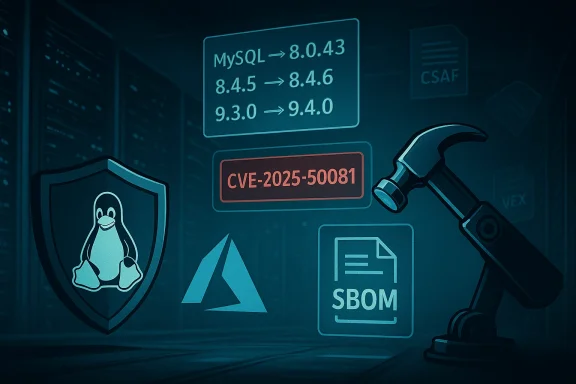
- MySQL Client 8.0.0 – 8.0.42
- MySQL Client 8.4.0 – 8.4.5
- MySQL Client 9.0.0 – 9.3.0
Why this matters to defenders: while the base score is low, the vulnerability affects a tool that is commonly used for backups, data migration and automation (mysqldump). Any compromise of those client workflows can lead to unauthorized data reads or manipulations where the attacker meets the prerequisites — so operators must treat this as an operational risk rather than a purely theoretical one.
What Microsoft actually stated — and why the phrasing matters
Microsoft’s public MSRC guidance for this CVE includes an FAQ line that reads, in effect: “Azure Linux includes this open‑source library and is therefore potentially affected by this vulnerability.” That sentence communicates two distinct facts:- It is an authoritative attestation that Microsoft’s Azure Linux distribution (the Azure‑published Linux images the company maintains) contains the upstream component mapped to the CVE and therefore those images are in scope for remediation.
- It is not an implicit guarantee that no other Microsoft product or image could include the vulnerable code; rather, MSRC is declaring what it has inventory‑checked and attested so far. Microsoft has explicitly said it began publishing machine‑readable CSAF/VEX attestations starting in October 2025 and that it will update VEX/CVE entries if additional Microsoft products are found to ship the same component. That commitment is meaningful but incremental: attestation is a phased process.
Can other Microsoft products include the vulnerable mysqldump component?
Short answer: Yes — other Microsoft artifacts could include the vulnerable component — but you cannot assume they do until they are inventoried and attested.Why that is the correct technical framing:
- The vulnerable code lives in MySQL’s client libraries and tools. Those tools are distributed upstream and are commonly packaged into many Linux distributions, VM images, container images, and third‑party appliances. Any Microsoft product that ships a Linux image, container base layer, or appliance image could — in principle — include the same upstream MySQL client package and therefore carry CVE‑2025‑50081. Examples of artifact families that might include the client are:
- Azure VM images (marketplace images built from distro snapshots)
- Azure Marketplace appliances and partner images
- Azure container base images or curated container images distributed by Microsoft
- Windows Subsystem for Linux (WSL) images that use Linux userland packages
- Managed services that incorporate MySQL tooling for backup, migration, or admin (for example, the engineering operations behind a managed MySQL service may use mysqldump internally, although managed services often apply different mitigations)
- Third‑party ISV images sold through Microsoft channels
- Microsoft’s MSRC inventory process is product‑by‑product. Saying “Azure Linux includes the library” means Microsoft checked that distribution; it does not mean the company has completed inventory for every product family and image it publishes. The company’s VEX/CSAF rollout is intended to automate and accelerate that disclosure over time, but the rollout is phased, not instantaneous.
How to verify whether your Microsoft artifacts are affected (practical steps)
If you run Microsoft‑published artifacts (images, VMs, managed services, WSL, containers, marketplace appliances), follow this prioritized checklist to determine exposure and remediate quickly.- Inventory first (fast wins)
- Identify all artifact sources you run that include Linux userland packages: Azure VM images, WSL distributions, Marketplace images, container base images, and partner appliances.
- For each artifact, record the OS distribution and the package versions for mysql, mariadb, or any MySQL client package.
- Use package tools to check installed versions:
- Debian/Ubuntu: dpkg -l | grep -E 'mysql|mariadb'
- RHEL/Fedora/CentOS/Amazon Linux: rpm -qa | grep -E 'mysql|mariadb'
- Container images: run a quick container shell and query package manager metadata, or use static image scanners (Trivy, Clair) to extract package lists.
- Verify mysqldump specifically
- On hosts: run mysqldump --version to get the exact client version string.
- In images: inspect package metadata or image SBOMs (if available) for the mysql client package version.
- Consult vendor attestations and SBOM/VEX artifacts
- Check Microsoft’s CSAF/VEX attestations for the product(s) you use (MSRC has announced VEX/CSAF publication beginning October 2025). If you see a VEX record declaring Not Affected, you can rely on that only after confirming the artifact ID and timestamp match your deployed image.
- Where Microsoft has not published VEX for a product you run, require artifact‑level verification by scanning or examining the SBOM.
- Check package updates and apply the vendor fix
- If the installed version falls within the vulnerable ranges (8.0.0–8.0.42, 8.4.0–8.4.5, 9.0.0–9.3.0), plan updates to the fixed package lines (8.0.43+, 8.4.6+, 9.4.0+).
- Follow your distribution’sand use their fixed packages when available rather than only relying on upstream tarballs. Major distros and vendors (Debian/Ubuntu, RHEL, Amazon Linux, etc.) published fixed package releases shortly after Oracle’s advisory.
- Managed services and platform features
- If you use Azure Database for MySQL or other Microsoft managed offerings, consult service advisories and support channels. Managed services often apply server‑side mitigations on your behalf but may use separate tooling for backups and migrations — confirm whether mysqldump is used and whether the provider has applied mitigations. If you are uncertain, open a support ticket and cite the CVE to obtain an explicit statement.
Patching and mitigation guidance
Patching is the reliable fix. Oracle and distribution maintainers published patches and new package releases; the MySQL 8.0.43 release family contains the upstream fixes and distribution maintainers have released backports for their package naming schemes. Practical guidance:- Patch priority: Because CVE‑2025‑50081 requires high privileges and user interaction, it does not pose the same immediate, wormable risk as an unauthenticated network RCE. Still, because mysqldump is used in automated workflows and by privileged users, treat the bug as a high priority for systems that run mysqldump as root, in cron jobs, or in automation pipelines.
- Upgrade targets:
- Upstream MySQL: upgrade to 8.0.43 or later (8.4.6+, 9.4.0+ for other branches) where the fix is included.
- Distribution packages: install the vendor-supplied fixed package (check Debian/Ubuntu/RHEL advisories for their exact package versions). Debian and other distros list fixed package releases such as mysql‑8.0 8.0.43‑1 in their trackers.
- If you cannot patch immediately:
- Restrict access to hosts that run mysqldump: firewall the management plane, restrict SSH and API access, and limit who can run the tool.
- Audit and rotate credentials used by backup scripts — reduce privileges where feasible.
- Disable or remove mysqldump from images used in multi-tenant or exposed contexts if it is not required at runtime.
- Monitor for anomalous usage of mysqldump (see detection section below).
Detection and hunting — what to look for
Because this vulnerability affects a client tool and requires privileges and user interaction, detection focuses on anomalous or unauthorized use of the client rather than raw exploitation signatures.- Audit logs and command histories:
- Search for sudden or out‑of‑hours invocations of mysqldump, especially when invoked by automated processes or the root account.
- Look for unusual destination endpoints (remote storage, unknown SCP/SFTP targets, or unexpected S3/API uploads immediately following a dump).
- Process and network telemetry:
- Monitor for mysqldump processes spawning in unusual contexts (CI/CD runners, build servers, or container entrypoints).
- Network flow logs should be reviewed for large outbound transfers coincident with mysqldump runs.
- File system and retention behavior:
- Detect creation of large SQL dump files in temporary directories or unexpected paths; dumps written to shared filesystems or moved to external endpoints can be a red flag.
- IDS/IPS and host IDS:
- While there may be no public exploit PoC for direct exploitation of the mysqldump flaw, host IDS rules that flag suspicious mysqldump usage, unusual command line flags, or unexpected environment variables are useful.
- Correlate with cloud provider logs:
- For Azure customers, correlate VM/Container host logs with Azure Activity Logs and Storage account logs to detect suspicious copies of dump artifacts.
Operational risks and the supply‑chain angle
There are two related risks to be mindful of:- Supply‑chain opacity: When vendors publish per‑product attestations instead of a single universal inventory, customers must bridge the gap by validating the artifacts they actually run. Microsoft’s VEX/CSAF rollout aims to r time, but today many organizations still run a mix of third‑party images and old builds where vendor attestations are incomplete. Until VEX coverage is comprehensive, expect to do artifact‑level scanning and SBOM inspection yourself.
- Privileged tool exposure: Tools like mysqldump are commonly used in privileged automation. A vulnerability that requires high privileges still threatens privileged workflows (backup systems, migration scripts, CI runners). Attackers who can influence or social‑engineer high‑privilege users remain a practical threat vector, so hardening these workflows is essential even for low‑CVSS client bugs.
Clear, actionable recommendations (for security teams and Microsoft customers)
- For security teams (operators, IR, SRE):
- Treat Microsoft’s MSRC attestation as an authoritative indicator for Azure Linux images only until you see additional product attestations. Do not infer exclusivity from that line.
- Run an immediate artifact inventory and scan for vulnerable mysql client package versions across images and hosts.
- Patch to the fixed package versions (8.0.43+, 8.4.6+, 9.4.0+) as provided by Oracle or your distribution vendor; prioritize hosts that run mysqldump automatically or with elevated privileges.
- Harden backup and migration automation: restrict who can execute mysqldump, store dumps in access‑controlled repositories, and centralize logging for every dump operation.
- If you use Azure managed offerings, request explicit vendor statements about whether the managed control plane or backup tooling uses mysqldump and whether it has been patched.
- For Microsoft (recommended product/engineering improvements):
- Accelerate VEX/CSAF coverage across more product families and make artifact IDs and SBOMs easily machine‑queryable tning burden. The October 2025 VEX start was the right move; expand scope and cadence.
- Publish per‑image SBOMs for Azure Marketplace images and common container base images and ensure those SBOMs are kept in sync with image updates.
- Provide a clear mapping between managed service functions (backup/migration internals) and CVE coverage statements so customers understand where exposures may exist beyond image-level attestations.
Strengths, limitations, and closing analysis
Strengths of Microsoft’s approach:- The decision to publish machine‑readable VEX/CSAF attestations is a material improvement for automation and customer clarity. It moves MSRC beyond prose advisories to a format security automation tools can consume, which reduces false positives and allows customers to make faster decisions.
- An attestation limited to Azure Linux does not absolve customers who run other Microsoft artifacts. In many environments customers run a mix of marketplace images, custom images, containers, and managed services — all of which need explicit artifact verification. The MSRC phrase "Azure Linux includes this library" is therefore useful but incomplete until other product inventories are completed.
- Operationally, the primary risk from CVE‑2025‑50081 is the compromise of privileged workflows (backups, migrations). The low CVSS score can lull organizations into deprioritizing fixes; that would be a mistake for systems where mysqldump runs with elevated rights or where dumps are moved to external stores.
Conclusion
Microsoft’s single‑line MSRC guidance that “Azure Linux includes this open‑source library and is therefore potentially affected” is actionable for customers who run Azure Linux images — but it is not a safety blanket for all Microsoft products. Until Microsoft’s CSAF/VEX coverage matures across every product family, customers must perform artifact‑level verification (SBOMs, package queries, and image scans), apply the vendor fixes (upgrade to the patched MySQL client releases), and harden privileged mysqldump workflows. That combined approach — vendor attestations plus customer verification and rapid patching — is the only practical defense against supply‑chain and client‑tool vulnerabilities such as CVE‑2025‑50081.
Source: MSRC Security Update Guide - Microsoft Security Response Center
