

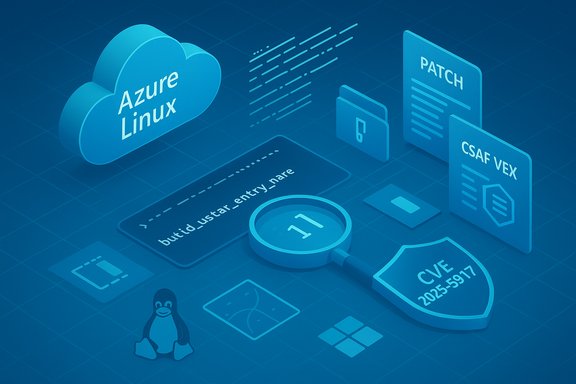
Microsoft’s public advisory around CVE‑2025‑5917 correctly narrows the company’s validated scope to its Azure Linux distribution for this particular libarchive flaw, but that attestation is a statement of what Microsoft has finished inventorying — not a technical guarantee that no other Microsoft product can include the same open‑source library or be affected.
Background / Overview
CVE‑2025‑5917 is an off‑by‑one bug in libarchive’s ustar/PAX handling (the function build_ustar_entry_name in archive_write_set_format_pax.c) that can produce a one‑byte write past the intended buffer. Upstream and distribution advisories describe this as a 1‑byte write overflow that can corrupt adjacent memory and in some contexts enable crashes or other reliability problems; maintainers issued a fix in libarchive’s release stream and vendors began packaging updates. Microsoft’s MSRC advisory (the text you quoted) states that Azure Linux “includes this open‑source library and is therefore potentially affected” and reminds customers Microsoft has started publishing machine‑readable CSAF/VEX attestations (beginning with Azure Linux) and will update the CVE record if additional Microsoft products are identified as carriers of the vulnerable component. That is the vendor’s declared process: publish what has been validated, then expand as inventorying completes.Why this matters: libarchive’s footprint and risk model
Libarchive is a widely used, multi‑format archive and compression library that powers bsdtar/bsdcpio and supports a long list of archive formats (tar/pax, zip, 7z, rar, etc.. It appears both as a packaged library in Linux distributions and as a bundled/static component in many applications that consume or produce archives. The library’s ubiquity means a vulnerability in libarchive has a broad potential blast radius: OS packages, packaged binaries, container images, developer toolchains, and user‑facing applications can all be carriers. Two practical consequences follow:- A vendor attestation that a given product (for example, Azure Linux) includes an affected library is very useful for customers running that product; it makes automated triage possible.
- That attestation is not exhaustive for all vendor products, and compiled / statically linked binaries or separate product images may still be carriers even if not yet listed in the vendor’s VEX/CSAF outputs.
Microsoft’s statement: what it says — and what it does not
Microsoft’s text answers one narrowly defined question: “Has Microsoft validated that Azure Linux includes the named open‑source library and is therefore potentially affected?” For CVE‑2025‑5917 the answer Microsoft published is yes — Azure Linux has been validated and attested. The advisory explicitly promises to update the CVE mapping if further Microsoft products are discovered to ship the vulnerable component.Important clarifications:
- The attestation is a product‑level inventory result for Azure Linux at the time of publication, not a universal statement about every Microsoft image, service, or binary.
- The absence of other Microsoft products from the attestation should be read as “not (yet) attested” rather than “proven absent.” Microsoft’s approach is phased: publish what’s validated first, update as mapping completes.
Cross‑checking the technical facts (what independent trackers show)
Multiple independent sources confirm the technical vulnerability and remediation status:- The NVD entry summarizes the defect as an off‑by‑one write overflow in libarchive’s ustar/PAX write code and lists the CVE details.
- Distribution trackers and vendor advisories (Debian, SUSE, Red Hat, Amazon Linux) ingested the CVE, mapped affected package versions, and published fixes or backports for their respective distributions. For example, Debian flagged libarchive packages and SUSE published a security update addressing CVE‑2025‑5917 in its libarchive patch advisory.
- Upstream libarchive development activity (pull requests and release notes) shows a focused change set to address the ustar/PAX name handling; maintainers included the fix in the project release line that distributions then consumed.
Is Azure Linux the only Microsoft product that ships libarchive? The short, technical answer
No, Azure Linux is not necessarily the only Microsoft product that can include libarchive. What Microsoft has published is that Azure Linux is the only Microsoft product it has validated and attested for CVE‑2025‑5917 at disclosure time. The vendor has committed to update the attestation if more Microsoft products are found to include the vulnerable library. Treat the Azure Linux attestation as authoritative and actionable for Azure Linux customers, and treat the attestation’s limited scope as a prompt to verify other artifacts in your estate.Why that pragmatic answer is necessary — concrete examples
- Microsoft historically ships components derived from or built with libarchive functionality. Windows includes bsdtar/bsdcpio shipped as part of the platform (and Microsoft has previously had libarchive‑related CVEs reported under Microsoft product IDs in earlier years), showing that libarchive code has been embedded in Microsoft products before. That prior history means other Microsoft products can be carriers in principle.
- Microsoft publishes and maintains multiple artifact families that are independent build surfaces:
- Azure Linux images and kernels (the product explicitly attested in MSRC VEX/CSAF).
- Windows platform components (File Explorer, built‑in archive handlers).
- Windows Subsystem for Linux (WSL) kernels and distro images.
- Azure Marketplace images, curated container images (for example, images used by Azure Machine Learning), and various agent/runtime artifacts.
Each artifact family has independent build provenance; a library present in one artifact may not appear in another or may appear in a different version. That variability is why Microsoft’s phased attestation model begins with Azure Linux and expands as inventories complete.
Practical verification steps for administrators and developers
To move from vendor attestation to operational assurance, perform a focused inventory and mitigation exercise.1. Inventory and detection (quick checks)
- On Linux servers and images (including Azure VMs and custom images):
- rpm -qa | grep libarchive
- dpkg -l | grep libarchive
- For containers: inspect base image packages (docker history / skopeo inspect / image manifests).
- On Windows hosts:
- Check whether shipped bsdtar/bsdcpio or other libarchive‑powered utilities are present and their versions.
- Search installed program manifests and bundled binaries for libarchive symbols or filename patterns.
- For static/embedded binaries:
- Use strings and ldd / objdump on Linux binaries, and Dependency Walker / dumpbin on Windows, to spot linked archive libraries or known bsdtar strings.
- Search container and VM images for known libarchive file names (libarchive.so*, bsdtar.exe).
2. Prioritize by exposure
- High priority: services or pipelines that unpack or process untrusted archives (CI/CD runners, container image registries, ingestion pipelines, automated extractors).
- Medium priority: tools used by developers but not exposed to untrusted input.
- Low priority: internal tools with strictly controlled input sources; still plan to update.
3. Patch, rebuild, and redeploy
- If your OS package manager shows a patched libarchive release from your distro vendor, apply it and restart affected services.
- If you use static binaries or vendor images that bundle libarchive, rebuild those artifacts with the patched upstream release or obtain updated vendor images.
- For containerized services, rebuild images from base images that include patched libarchive packages and rotate registry tags.
4. Temporary mitigations (when patching is delayed)
- Restrict or gate upload endpoints with validators or sandboxed unpacking services that run patched stacks.
- Rate‑limit and authenticate archive ingestion entry points to reduce attacker leverage.
- Isolate processes that unpack untrusted archives into dedicated, ephemeral execution contexts.
5. Monitor vendor VEX/CSAF updates
- Subscribe to MSRC CVE pages and the machine‑readable VEX/CSAF outputs; Microsoft will update product coverage if additional internal products are identified as carriers. Treat new attestations as triggers for re‑inventory.
Assessment of remediation status and vendor response
- Upstream: libarchive maintainers merged a targeted fix into the project and included it in release(s) that distributors can consume.
- Distributions: major Linux distributors (Debian, SUSE, Red Hat, Amazon Linux) have ingested and mapped the CVE to their package trees and are shipping fixes or guidance for affected package versions. Those vendor tracking pages and advisories are the authoritative source for distro package updates.
- Microsoft: published a product‑level attestation for Azure Linux and has committed to update its CVE product mapping if more Microsoft products are found to ship the vulnerable library. That practice reduces uncertainty for Azure Linux customers while recognizing that other Microsoft artifacts may require separate verification.
Strengths in the ecosystem response
- Upstream response was surgical and fast: small, focused patches made it practical for vendors to backport or package without large regressions.
- Distribution vendors moved to map, package, and publish advisories quickly, giving operators a clear remediation path.
- Microsoft’s adoption of machine‑readable VEX/CSAF attestations (starting with Azure Linux) is a positive transparency step: it provides automation‑friendly, authoritative signals for the specific product family Microsoft has validated to date.
Residual risks and caveats (why “Azure Linux only” is an operational nuance)
- Static and compiled binaries: Go, Rust, C, and other compiled languages often produce statically linked consumers of archive logic. Updating the system package will not fix a statically linked binary; it must be rebuilt with a patched libarchive or replaced. Many third‑party images and appliances contain static binaries that are infrequently rebuilt — these are a remediation blind spot.
- Marketplace and curated images: Azure Marketplace images, partner images, and Microsoft‑curated runtime images may contain older base layers or third‑party artifacts. Those images are separate inventory items and should be verified independently of the Azure Linux attestation.
- Incomplete attestations are not proof of absence: Microsoft’s attestation model is phased. Until a product is mapped and declared “not affected” or “fixed” in CSAF/VEX, assume the artifact may require verification.
- Historical embedding: Microsoft itself has previously shipped libarchive‑based functionality in Windows components (bsdtar/bsdtcpio) and has previously tracked libarchive CVEs under Windows product IDs; prior history means other product families could contain libarchive in other versions. Cross‑check product inventories rather than assuming a vendor attestation covers all SKUs.
How to ask the right question of vendors and supply‑chain partners
When you contact a vendor or a cloud provider about component impact, ask for:- A machine‑readable VEX/CSAF attestation or a clear product mapping for the CVE that lists product IDs and component versions.
- Confirmation whether any static or bundled binaries under that product family contain the vulnerable library, including curated images.
- The specific patched package version or the upstream commit used to remediate the problem so you can map it to your artifacts.
Microsoft has published VEX/CSAF artifacts for Azure Linux and indicated it will update the mapping as further inventorying completes; use that VEX output to automate checks for Azure Linux, and use manual artifact checks elsewhere.
Conclusion — operational verdict
Microsoft’s public wording for CVE‑2025‑5917 is technically accurate but purposely scoped: Azure Linux is the Microsoft product Microsoft has validated and attested as including the affected libarchive component at the time of publication. That attestation is a valuable, machine‑readable signal for Azure Linux customers and should be acted on immediately where relevant.However, that statement is not the same as a universal guarantee that no other Microsoft product ships libarchive. The historical record shows Microsoft has previously shipped libarchive functionality in Windows components and other artifacts, and major distributions and upstream libarchive maintainers have already published fixes for CVE‑2025‑5917. The safe operational posture is to treat Microsoft’s attestation as authoritative for Azure Linux while performing targeted inventory, detection, and remediation across other Microsoft images, your locally built artifacts, and any third‑party images you run. Cross‑check upstream commits and distribution advisories for patched versions, rebuild or replace static binaries if necessary, and monitor MSRC VEX/CSAF updates for expanded product coverage.
Source: MSRC Security Update Guide - Microsoft Security Response Center
