

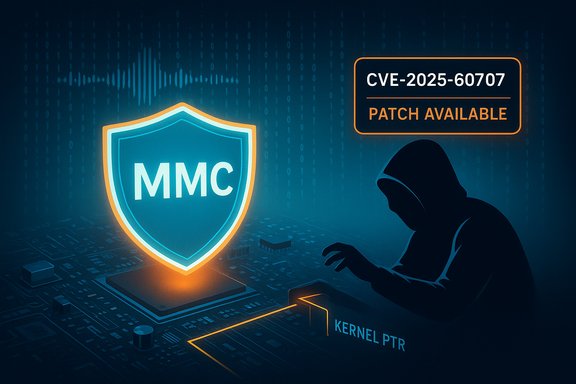
Microsoft has published an advisory today for CVE-2025-60707, a use‑after‑free vulnerability in the Multimedia Class Scheduler Service (MMCSS) that can be abused by an authorized local attacker to gain elevated privileges on a Windows host; Microsoft has released security updates addressing the issue and administrators should treat this as a high‑priority local elevation‑of‑privilege (EoP) risk and apply vendor fixes immediately.
The Multimedia Class Scheduler Service (MMCSS) is a long‑standing Windows component that gives multimedia applications prioritized access to CPU and I/O resources so time‑sensitive audio/video workloads avoid glitches. MMCSS is used by Windows Audio, media players, and other time‑sensitive subsystems; the service lives in kernel/driver space (mmcss.sys and related components) and interacts with user applications via specific APIs (AvSetMmThreadCharacteristics, AvSetMmThreadPriority). Because MMCSS executes privileged scheduling work on behalf of user applications, defects in its driver or kernel interfaces are attractive for attackers trying to escalate a low‑privilege local foothold into SYSTEM‑level control. CVE‑2025‑60707 is described by Microsoft as a use‑after‑free in the MMCSS driver that can be triggered by an authenticated local actor. The public technical summary available so far describes a classic UAF memory‑safety flaw where a freed object is later referenced, allowing an attacker to gain control of code paths or data that execute in a higher privilege context. Vendor‑supplied remediation is available as of November 11, 2025.
Immediate operational steps:
High‑value telemetry to collect and monitor:
If you manage patching for endpoints or servers, begin the CVE→KB mapping and pilot test immediately; if you operate critical shared hosts (VDI, RDP servers, media servers), move them to the front of the patch queue and increase monitoring for local privilege escalation artifacts in the days immediately after this disclosure.
Source: MSRC Security Update Guide - Microsoft Security Response Center
 Background / Overview
The Multimedia Class Scheduler Service (MMCSS) is a long‑standing Windows component that gives multimedia applications prioritized access to CPU and I/O resources so time‑sensitive audio/video workloads avoid glitches. MMCSS is used by Windows Audio, media players, and other time‑sensitive subsystems; the service lives in kernel/driver space (mmcss.sys and related components) and interacts with user applications via specific APIs (AvSetMmThreadCharacteristics, AvSetMmThreadPriority). Because MMCSS executes privileged scheduling work on behalf of user applications, defects in its driver or kernel interfaces are attractive for attackers trying to escalate a low‑privilege local foothold into SYSTEM‑level control. CVE‑2025‑60707 is described by Microsoft as a use‑after‑free in the MMCSS driver that can be triggered by an authenticated local actor. The public technical summary available so far describes a classic UAF memory‑safety flaw where a freed object is later referenced, allowing an attacker to gain control of code paths or data that execute in a higher privilege context. Vendor‑supplied remediation is available as of November 11, 2025. What the vulnerability is — technical summary
The defect class: use‑after‑free (UAF)
A use‑after‑free occurs when code frees an object or buffer but later continues to use the pointer to that memory. In kernel or driver code that runs with elevated privileges, a UAF can allow an attacker to:- Replace freed memory with attacker‑controlled data,
- Redirect function pointers or vtables,
- Cause out‑of‑bounds reads or writes that leak kernel state or corrupt execution flow,
- Ultimately convert a controlled memory corruption into code execution or token manipulation.
Attack vector and preconditions
- Attack vector: Local (AV:L). The attacker must be able to run code or interact with the vulnerable interface on the target host.
- Privileges required: Low — a standard (non‑admin) local account is generally sufficient to trigger the condition in reported UAF scenarios.
- User interaction: None required once local code execution is available.
- Impact: Elevation of privilege to SYSTEM or equivalent, with full confidentiality/integrity/availability consequences. The community CVSS vector recorded by early trackers is AV:L/AC:L/PR:L/UI:N/S:U/C:H/I:H/A:H, with a base around 7.8 (High).
Why MMCSS flaws matter
Kernel‑mode scheduling and streaming code touches core OS facilities and often runs with demonstrably high privileges. Small memory‑safety mistakes in drivers are routinely turned into full host compromises by attackers because they provide reliable local primitives: leaking kernel pointers (defeating KASLR), corrupting token structures, or hijacking callback routines. MMCSS is a piece of that attack surface because it mediates between user apps and privileged scheduling logic; that makes a UAF here especially valuable for post‑compromise escalation.What Microsoft has published and what to verify
Microsoft’s Security Update Guide entry for CVE‑2025‑60707 is the authoritative mapping for which OS builds and KB articles contain fixes. The vendor has issued updates as part of today’s security release; administrators must map their exact Windows builds to the KBs Microsoft lists before deploying. Public trackers and aggregators (which mirror the MSRC entry) show the vulnerability as fixed in November 11, 2025 updates. Do not treat a CVE string alone as a substitute for vendor KB/build verification. Note: Microsoft frequently omits low‑level exploit details in advisory text to reduce the risk of rapid weaponization. That means community reconstructions are useful for operational planning, but exact IOCTL names, exploit sequences, or proof‑of‑concept artifacts may not be published by Microsoft. Treat third‑party technical writeups as helpful context and verify any exploit details in a controlled lab before treating them as definitive.Affected systems and patching guidance
Early vendor and tracker aggregation identifies this as an issue in MMCSS driver components present across modern Windows client and server builds. The precise KB/build mapping varies by servicing branch; confirm using Microsoft’s Security Update Guide for your exact SKU and OS build.Immediate operational steps:
- Inventory: Query Windows Update, WSUS, SCCM/ConfigMgr, Intune or your patch management tool for the KB(s) Microsoft lists for CVE‑2025‑60707. Do not assume all releases apply — the KB mapping is SKU‑ and build‑specific.
- Test: Stage the update in a pilot group (recommended 24–72 hours for servers; shorter windows for endpoints that can be quickly rolled back) and validate service/functionality that depends on MMCSS (audio, media, any custom multimedia/AV software).
- Deploy: Roll out in priority order — servers and shared multi‑user hosts (VDI, RDP hosts) first, then desktops. Verify post‑patch build strings and KB installed state programmatically.
- Temporarily restrict local interactive access to high‑value hosts (tighten RDP, limit VPN access).
- Enforce least privilege: remove local admin rights where not required.
- Harden with host mitigations (below) until the patch is deployed.
Detection, telemetry, and hunting recommendations
Because CVE‑2025‑60707 is a local EoP, direct exploit signatures are unlikely to be visible in network traffic. Instead, hunt for post‑exploit artifacts and anomalous behavior typical of privilege escalation chains.High‑value telemetry to collect and monitor:
- Process creation and parent/child lineage where non‑privileged processes spawn SYSTEM shells (cmd.exe, powershell.exe) or services.
- Unexpected service behavior or crashes of MMCSS‑related binaries/drivers (driver load/unload events, WER crashes referencing mmcss.sys).
- Event ID patterns tied to token manipulation or service creation by non‑admin users.
- Kernel crash dumps or BSODs referencing mmcss.sys — capture and preserve for analysis.
- Sudden changes to local groups (ex: non‑admin user added to Administrators).
- Alert on process spawn where parent process is a user process and the child requests SYSTEM‑level privileges.
- Alert on attempts to call documented MMCSS APIs from non‑standard binaries.
- Correlate MMCSS driver crashes with nearby process launches and dropped artifacts.
Mitigations and hardening (short‑term and medium‑term)
Short‑term (until patch applied)- Apply principle of least privilege: reduce interactive logon rights and eliminate unnecessary local admin accounts.
- Isolate high‑value hosts: restrict network access, limit RDP and local USB access, and place sensitive machines on segmented networks.
- Enforce application control (WDAC / AppLocker) to prevent untrusted binaries from running.
- Increase EDR logging and retention for process and kernel events.
- Enable HVCI / Memory Integrity where hardware allows (Windows Hypervisor‑based Code Integrity). This raises the bar for many kernel‑level exploits by hardening driver loading and preventing unsigned code from gaining kernel execution.
- Adopt Microsoft’s Vulnerable Driver Blocklist (where supported) to block historically risky drivers and reduce the attack surface of kernel drivers.
- Enforce driver signing policies and restrict use of unsigned third‑party drivers in managed environments.
- Implement robust patch management automation tied back to vendor KB mapping and CSAF feeds, but keep a manual verification step before mass deployment.
Exploitability, likelihood, and attacker model — critical analysis
Strengths (why defenders can be somewhat reassured)- Microsoft has published a vendor fix in today’s update cycle, which means the vulnerability is known, triaged, and patched through official channels; an available patch reduces the long‑term exploitation window.
- The attack vector is local; environments that reduce local footholds (no local admin, locked down RDP endpoints, strong endpoint protection) lower immediate exploitation likelihood.
- Vendor advisories intentionally avoid publishing exploit‑enabling details, which can slow early public weaponization.
- The vulnerability is a kernel/driver UAF in MMCSS — a high‑value primitive for attackers. Once weaponized, it can convert a low‑privilege presence to SYSTEM and is therefore commonly incorporated into multi‑stage attacks.
- The base CVSS (reported ~7.8) reflects high confidentiality/integrity/availability impact, so the operational consequences of exploitation are severe.
- Public PoCs often follow vendor disclosures quickly for memory‑safety bugs; the window between disclosure and public PoC publication can be short. If a PoC appears in public repos or underground feeds, exploitation pressure will spike.
- At time of publication there is limited public technical detail beyond Microsoft’s advisory summary and tracker aggregations. Claims about exact IOCTL names, exploit sequences or reliable exploit code are not yet independently verifiable and should be treated as speculative until validated by multiple researchers in a controlled environment. Do not run untrusted PoC code on production systems.
Recommended immediate action checklist (concise)
- Identify hosts affected by CVE‑2025‑60707 (map CVE→KB→build using Microsoft Security Update Guide).
- Patch pilot group of endpoints/servers with the vendor KBs and validate critical multimedia and AV workflows.
- After pilot validation, schedule rapid staged rollout prioritized by criticality and exposure.
- While rolling out patches, increase EDR/forensic telemetry for MMCSS driver crashes and suspicious privilege escalation signals.
- If you cannot patch immediately, reduce local interactive access, enforce WDAC/least‑privilege, and consider enabling HVCI/Memory Integrity on vulnerable hosts.
Impact scenarios (what a successful exploit enables)
A successful CVE‑2025‑60707 exploitation can be converted into:- Full SYSTEM token acquisition and arbitrary code execution in kernel or system context.
- Disabling or bypassing endpoint protections and persistence via service creation or driver loading.
- Lateral movement in enterprise networks once host control is gained.
- Data exfiltration or destructive outcomes (ransomware, data tampering), due to SYSTEM‑level capabilities.
Longer‑term lessons and risk reduction
- Drivers and kernel interfaces remain high‑impact attack surfaces; invest in endpoint hardening that reduces kernel attackability (HVCI, signed drivers, strict driver policies).
- Improve telemetry coverage of kernel/driver events — many privilege escalations are detected first by post‑exploit behavior rather than a network signature.
- Make the CVE→KB mapping step a formal part of your patch automation pipeline: ingest vendor update feeds but require a verified KB→build match before mass deployment to avoid mismatches that can break rollouts.
- Maintain canary/pilot groups that mirror production but are safe for functional verification of security updates, especially where drivers and audio/video stacks are sensitive to regressions.
Final assessment and closing summary
CVE‑2025‑60707 is a use‑after‑free in the Multimedia Class Scheduler Service (MMCSS) driver that Microsoft has addressed in today’s security updates. The flaw is a local elevation‑of‑privilege that, if exploited, can enable SYSTEM‑level control. The vendor has published fixes; administrators should immediately verify KB→build mappings and deploy updates in a prioritized, tested manner. In parallel, ramp up EDR hunting for post‑exploit indicators, enforce least‑privilege policies, and enable host mitigations (HVCI, driver blocklists, application control) where feasible. Public technical specifics and PoC artifacts are sparse at the moment — treat unverified exploit claims cautiously and avoid running untrusted proof‑of‑concepts on production systems.If you manage patching for endpoints or servers, begin the CVE→KB mapping and pilot test immediately; if you operate critical shared hosts (VDI, RDP servers, media servers), move them to the front of the patch queue and increase monitoring for local privilege escalation artifacts in the days immediately after this disclosure.
Source: MSRC Security Update Guide - Microsoft Security Response Center
