

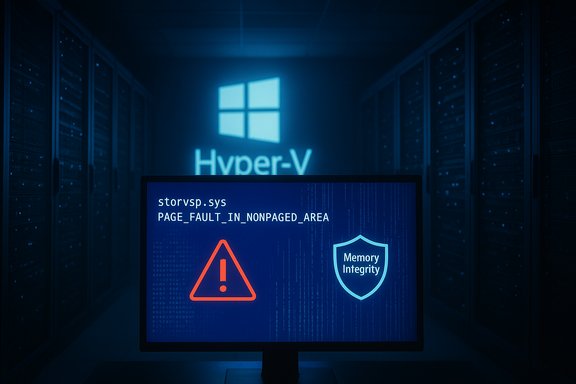
Microsoft has confirmed a denial‑of‑service flaw in the Storvsp.sys storage Virtualization Service Provider (VSP) driver — tracked as CVE‑2025‑60708 — that allows a locally authorized attacker to trigger a kernel‑mode crash by exploiting an untrusted pointer dereference in the driver, and Microsoft has released updates to address the issue.
Storvsp.sys is the Windows Storage VSP driver used in Hyper‑V root (host) partitions to provide storage services to guest partitions; as a kernel‑mode VSP it implements privileged, low‑level storage I/O paths and is a critical component of Hyper‑V storage plumbing. The public advisory for CVE‑2025‑60708 (the Microsoft Security Update Guide entry) lists the defect as an untrusted pointer dereference that can be triggered by an authorized local attacker to cause a denial of service (system crash). Vendor pages for dynamically rendered advisories typically omit exploit‑level detail; at disclosure Microsoft’s summary and the aggregated tracker reporting provide the canonical description and the remediation path (security updates). Why this matters: kernel‑mode drivers like Storvsp.sys run with SYSTEM privileges and mediate device and I/O operations. A simple crash in a VSP driver can take hosts offline, disrupt many virtual machines, and create urgent availability and operational continuity problems for hypervisor hosts, clusters, and cloud/hosting providers. Similar driver crashes in the past have produced wide‑ranging outages and required emergency patching and reboots.
Exploitation notes:
Acknowledgement of sources and verification notes: Microsoft’s Security Update Guide entry is the authoritative vendor record for CVE‑2025‑60708 and the associated KB mappings; independent aggregator coverage (for example, aggregator trackers and security feeds) corroborates the high‑level classification and the availability of vendor updates at disclosure time. Defenders should verify KB→build mappings in the Microsoft Update Catalog before automating rollouts. Conclusion: treat CVE‑2025‑60708 as a high operational priority for Hyper‑V hosts and multi‑tenant environments — patch promptly, test broadly, and harden host access and kernel integrity features to reduce the risk of disruptive denial‑of‑service events.
Source: MSRC Security Update Guide - Microsoft Security Response Center
 Background / Overview
Storvsp.sys is the Windows Storage VSP driver used in Hyper‑V root (host) partitions to provide storage services to guest partitions; as a kernel‑mode VSP it implements privileged, low‑level storage I/O paths and is a critical component of Hyper‑V storage plumbing. The public advisory for CVE‑2025‑60708 (the Microsoft Security Update Guide entry) lists the defect as an untrusted pointer dereference that can be triggered by an authorized local attacker to cause a denial of service (system crash). Vendor pages for dynamically rendered advisories typically omit exploit‑level detail; at disclosure Microsoft’s summary and the aggregated tracker reporting provide the canonical description and the remediation path (security updates). Why this matters: kernel‑mode drivers like Storvsp.sys run with SYSTEM privileges and mediate device and I/O operations. A simple crash in a VSP driver can take hosts offline, disrupt many virtual machines, and create urgent availability and operational continuity problems for hypervisor hosts, clusters, and cloud/hosting providers. Similar driver crashes in the past have produced wide‑ranging outages and required emergency patching and reboots. Technical summary — what we know
- Vulnerability: Untrusted pointer dereference in storvsp.sys leading to kernel crash (Denial of Service).
- CVE: CVE‑2025‑60708 (vendor advisory published, MSRC Update Guide entry available).
- Attack vector: Local — attacker must be able to run code or supply inputs on the affected host.
- Privileges required: Low / authorized local user (Microsoft’s short description uses “authorized”, indicating local interaction is required).
- Impact: Availability — crash or system‑wide denial of service on affected hosts.
- Patch status: Microsoft has published security updates to mitigate the flaw; administrators should apply the vendor updates per Microsoft’s Update Guide.
Context: Where Storvsp fits and why VSP bugs hurt
Storvsp.sys role and attack surface
Storvsp.sys is the host‑side Virtualization Service Provider for Hyper‑V storage (its guest counterpart is storvsc.sys). It implements storage I/O paths, parses storage descriptors, and handles requests that propagate between guest partitions and the host. Because Storvsp operates in the root partition with kernel privileges, any logic errors or unchecked inputs there can produce host‑level consequences, not just guest impacts. Kernel drivers are sensitive to:- malformed descriptor parsing (e.g., virtual disk metadata),
- unbounded or unchecked length/offset arithmetic,
- pointer dereferences without NULL/bounds checking,
- race conditions that can cause use‑after‑free or stale pointer access.
Real‑world operational risk
The main operational concerns for organizations are:- Host availability (BSODs on Hyper‑V hosts can stop many VMs).
- Support and remediation friction (kernel patches often require reboots and driver compatibility checks).
- Multi‑tenant exposure (hosting and VDI platforms amplify local vulnerabilities into broad disruption).
What defenders need to know now
Confirmed facts (vendor / aggregator view)
- Microsoft lists CVE‑2025‑60708 in its Security Update Guide and published updates on 2025‑11‑11 that address the flaw.
- Aggregators record the issue as an untrusted pointer dereference in storvsp.sys with a primary impact of denial of service; no public proof‑of‑concept or in‑the‑wild exploitation has been reported at the time of disclosure.
Short‑term action checklist (0–72 hours)
- Query the Microsoft Security Update Guide and the Microsoft Update Catalog for CVE‑2025‑60708 → KB mapping for every Windows SKU in your estate; do not rely solely on CVE strings in third‑party feeds.
- Test the Microsoft security update(s) in a canary/pilot ring that includes representative Hyper‑V hosts and storage stacks. Confirm host stability, VM compatibility, and backup/replication jobs.
- Deploy patches to production hosts in a prioritized wave: hypervisor hosts, VDI clusters, cloud or tenant hosts, and administrative jump boxes. Schedule reboots in maintenance windows.
- If patching is delayed, limit local access to Hyper‑V hosts (reduce interactive logons), restrict ability to attach or mount untrusted VHD/VHDX images, and harden host access with least privilege.
Medium‑term mitigations and hardening
- Enable Memory Integrity (HVCI) / virtualization‑based security where hardware supports it — this raises the cost of kernel‑level exploitation and can mitigate some driver integrity attacks.
- Enforce driver signing and Vulnerable Driver Blocklist policies; restrict loading of unsigned or legacy kernel drivers in your environment.
- Harden host configuration: restrict who can mount or attach virtual disks, and apply network segmentation for management interfaces.
Detection and incident response guidance
What to hunt for
- Sudden host or VM kernel crashes with stack traces referencing storvsp.sys or related storage VSP i/o paths.
- Unexpected host reboots or service interruptions correlated to storage attach/detach or live migration events.
- Local processes that attempted unusual DeviceIoControl/IOCTL interactions with virtualization storage device objects shortly before a crash.
Emergency containment if exploitation is suspected
- Isolate affected host(s) from the production network and stop further VM migrations that could spread impact.
- Preserve volatile evidence: capture memory images, WER minidumps, Windows Event Logs, driver lists (driverquery), and recent device attach logs.
- Avoid further reboots until forensic captures are complete; kernel‑state artifacts are valuable for triage.
- Rotate and reissue any credentials that might have been active on the affected host if you have reason to suspect adversary presence beyond a simple DoS.
Technical analysis and exploitation considerations
Pointer dereference patterns
An untrusted pointer dereference typically means the code used a pointer which could be NULL, stale, or attacker‑controlled without validating it. In kernel mode, a dereference fault yields an immediate exception that is often unrecoverable and results in a BSOD.Exploitation notes:
- The vulnerability is described as local — an attacker must be able to run code on the host or deliver crafted inputs that the host processes locally (for example, by attaching a specially crafted virtual disk).
- Denial of Service is the canonical impact; turning the condition into a privilege‑escalation or remote code execution primitive would require additional vulnerabilities or a different flaw class (e.g., use‑after‑free or an arbitrary write). Microsoft’s advisory does not claim escalation — it reports DoS from pointer dereference.
Where attack paths typically come from
- Guest‑to‑host interactions: malformed VHD/VHDX or storage descriptors presented by a guest to the host can exercise driver parsing code paths.
- Local process interactions: administrative tools or scripts that enumerate or manipulate virtual storage device objects may be able to trigger the faulty path.
- Live migration or attach/detach events in cluster scenarios can surface edge cases in storage provider code.
Strengths and limitations of available information
Strengths
- Microsoft has recorded and published the advisory in the Security Update Guide and provided vendor updates to remediate the issue, giving administrators an authoritative remediation path.
- Independent aggregators and vulnerability trackers have indexed the CVE and corroborated the high‑level technical classification (pointer dereference → DoS), which helps defenders prioritize.
Limitations and risks
- Microsoft’s public advisory for CVE‑2025‑60708 is intentionally concise and omits low‑level exploit mechanics, IOCTL names, or code diffs. That reduces immediate risk of mass weaponization but also means defenders must act on vendor updates rather than wait for detailed IOCs.
- At disclosure time there is no widely published proof‑of‑concept or public exploitation report; absence of PoC does not equal absence of risk — especially for multi‑stage or targeted attacks that may weaponize DoS for cover or diversion.
- Third‑party vulnerability feeds sometimes lag or mis‑index MSRC dynamic pages; always confirm KB‑to‑build mappings directly with Microsoft Update Catalog before mass deployment.
Operational playbook — step‑by‑step
- Inventory: map Hyper‑V hosts, cluster nodes, and admin jump boxes that run Hyper‑V/VSP services.
- Query MSRC: pull CVE‑2025‑60708 in the Microsoft Security Update Guide and note the KB IDs for each Windows SKU. Confirm via the Microsoft Update Catalog.
- Pilot: apply the patch to a small pilot set of Hyper‑V hosts; verify VM stability, snapshot/backup jobs, and storage replication. Check for any driver compatibility regressions.
- Stage: roll out updates to production hosts in prioritized waves (hosting → VDI → admin servers).
- Verify: confirm KB installation (Get‑HotFix/WindowsUpdate logs), complete reboots, and monitor for reoccurrence of storvsp/sys crashes.
- Harden: enable Memory Integrity (HVCI) where feasible; enforce driver signing and vulnerable‑driver blocklist policies; restrict local mount privileges for untrusted users.
- Did you extract KB IDs from MSRC for each OS build? (Yes/No)
- Did you run the patched host through typical storage‑heavy workloads? (Yes/No)
- Were any third‑party storage drivers observed to fail with the patch? (Yes/No)
- Is Memory Integrity enabled on hosts that support it? (Yes/No)
Longer‑term recommendations for Windows and Hyper‑V operators
- Maintain a strict patch cadence for hypervisor hosts; kernel/driver fixes should be treated as high‑urgency for hosting environments.
- Minimize the attack surface: restrict who can attach VHD/X images to hosts, limit use of preview or automatic mounting on hosts that accept guest images, and apply least‑privilege to service accounts that manage VM life cycles.
- Monitor driver stability and WER dumps centrally; automated alerting on repeated storvsp.sys stack traces allows faster detection and remediation.
- Include Hyper‑V and storage drivers in your regular security testing and fuzzing programs — complex kernel drivers continue to be a reliable source of high‑impact vulnerabilities.
Final assessment — strengths, gaps, and residual risk
CVE‑2025‑60708 is a classic kernel‑mode denial‑of‑service vulnerability in a privileged Hyper‑V host driver. Microsoft’s advisory and supplied updates give operators a clear remediation path; applying those updates is the practical and authoritative fix. Strengths:- Vendor acknowledgement and published updates reduce exposure when applied promptly.
- The vulnerability class is well understood and defenders can apply mature mitigations (patching, HVCI, access restrictions).
- The absence of public details and PoC reduces immediate mass‑exploitation risk but leaves defenders with limited telemetry and detection indicators.
- Multi‑tenant and hosting environments remain most at risk due to the amplifying effect of a single host outage.
- Third‑party drivers and complex storage stacks can complicate patch rollouts; test widely before broad deployment.
- Immediately: map affected hosts → query MSRC for KBs → pilot patch.
- Short term: roll out patches to prioritized hosts; enable Memory Integrity where possible.
- Ongoing: centralize WER/driver crash telemetry; restrict mount/attach privileges; verify driver compatibility.
Acknowledgement of sources and verification notes: Microsoft’s Security Update Guide entry is the authoritative vendor record for CVE‑2025‑60708 and the associated KB mappings; independent aggregator coverage (for example, aggregator trackers and security feeds) corroborates the high‑level classification and the availability of vendor updates at disclosure time. Defenders should verify KB→build mappings in the Microsoft Update Catalog before automating rollouts. Conclusion: treat CVE‑2025‑60708 as a high operational priority for Hyper‑V hosts and multi‑tenant environments — patch promptly, test broadly, and harden host access and kernel integrity features to reduce the risk of disruptive denial‑of‑service events.
Source: MSRC Security Update Guide - Microsoft Security Response Center
