

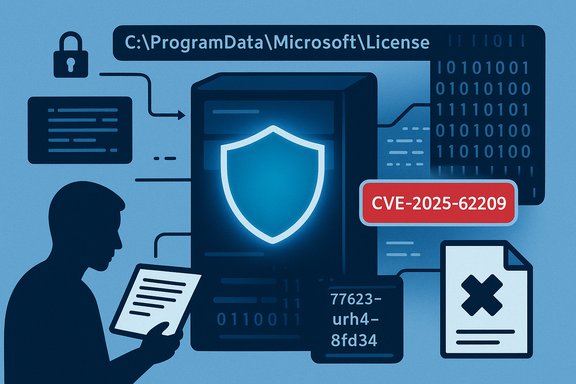
Microsoft has recorded CVE‑2025‑62209 — an information disclosure vulnerability in the Windows License Manager — and issued a security update on November 11, 2025 to address it; public trackers rate the flaw as CVSS v3.1 5.5 (Medium) with a local attack vector and a confidentiality‑only impact.
Windows License Manager (the platform component that manages product activation and licensing state on Windows clients and servers) writes and manages a variety of runtime and diagnostic artifacts under system context. Vulnerabilities that expose log files, cached state or runtime artifacts from that service can leak information that is valuable for later privilege escalation or reconnaissance. Microsoft’s advisory entry for CVE‑2025‑62209 lists the issue as an information disclosure in Windows License Manager and maps the CVE to vendor updates released on November 11, 2025; independent aggregators similarly summarize the impact as local information disclosure via log files. Because Microsoft’s public advisories for this class of issues are typically concise and focused on remediation rather than full exploitation recipes, defenders must combine the vendor metadata with conservative threat models and practical detection guidance while awaiting third‑party technical write‑ups. This pattern — terse MSRC advisories plus community inference about likely root causes (uninitialized buffers, over‑reported lengths, or log‑file permissions) — is common across recent Windows information‑disclosure CVEs.
High‑risk contexts for CVE‑2025‑62209 include:
Typical technical patterns for log‑ or state‑based information disclosure include:
Source: MSRC Security Update Guide - Microsoft Security Response Center
 Background / Overview
Windows License Manager (the platform component that manages product activation and licensing state on Windows clients and servers) writes and manages a variety of runtime and diagnostic artifacts under system context. Vulnerabilities that expose log files, cached state or runtime artifacts from that service can leak information that is valuable for later privilege escalation or reconnaissance. Microsoft’s advisory entry for CVE‑2025‑62209 lists the issue as an information disclosure in Windows License Manager and maps the CVE to vendor updates released on November 11, 2025; independent aggregators similarly summarize the impact as local information disclosure via log files. Because Microsoft’s public advisories for this class of issues are typically concise and focused on remediation rather than full exploitation recipes, defenders must combine the vendor metadata with conservative threat models and practical detection guidance while awaiting third‑party technical write‑ups. This pattern — terse MSRC advisories plus community inference about likely root causes (uninitialized buffers, over‑reported lengths, or log‑file permissions) — is common across recent Windows information‑disclosure CVEs.What the advisory actually says (plain language)
- The vulnerability is recorded as CVE‑2025‑62209 and is classified as an information disclosure affecting Windows License Manager.
- The attack vector is Local (AV:L) and the privileges required are low (PR:L); a low‑privileged, authenticated local user can access the relevant interface or filesystem objects.
- The CVSS v3.1 base score widely reported for this CVE is 5.5 (Medium) with the vector approximated as AV:L/AC:L/PR:L/UI:N/S:U/C:H/I:N/A:N.
- Microsoft published a remediation patch on November 11, 2025; administrators should treat the MSRC Security Update Guide entry as authoritative for the exact KB and build mappings.
Why this matters: operational impact and threat model
An information‑disclosure bug in a licensing service is not merely an annoyance — it can be a powerful reconnaissance primitive for attackers who already have local access. Leaked artifacts from License Manager logs or runtime state can include:- Cached tokens or session fragments that assist impersonation.
- Configuration strings, GUIDs, or memory addresses that defeat address‑space randomization and make later local exploits reliable.
- Paths and filenames that reveal other installed components or privileged scripts that can be targeted for follow‑on abuse.
High‑risk contexts for CVE‑2025‑62209 include:
- Multi‑user desktops, VDI/RDS hosts and shared build machines where unprivileged users can run code.
- Developer laptops and CI runners that may store signing keys, build tokens or other credentials.
- Systems where local accounts are used by helpdesk tools, scheduled tasks, or automation services.
Technical analysis — plausible root causes and exploitation model
Microsoft’s public metadata for CVE‑2025‑62209 is intentionally high‑level: the entry classifies the issue as information disclosure tied to Windows License Manager and points administrators to patches rather than disclosing line‑level details. That means defenders must work from defensible, historically grounded patterns for how these leaks commonly occur.Typical technical patterns for log‑ or state‑based information disclosure include:
- Unrestricted file writes or logs written with world‑readable permissions so low‑privileged users can read system logs that contain secrets or tokens.
- Diagnostic or debug output that persists sensitive data in cleartext rather than redacting or encrypting it.
- Race conditions or incomplete sanitization where ephemeral sensitive values are written to disk and remain accessible for too long.
- Incorrect use of APIs that return more bytes than populated, causing stale memory contents to be exposed.
- An attacker obtains a low‑privileged local account or convinces an internal user to run untrusted code.
- The attacker reads License Manager log files or queries a local API that exposes the leaked data.
- Harvested artifacts (tokens, file paths, or pointers) are then used to craft a follow‑on exploit that escalates privileges or bypasses mitigations.
What we can and cannot verify right now
Verified, high‑confidence points- Microsoft has recorded CVE‑2025‑62209 in the Security Update Guide and published a remedial update on November 11, 2025.
- Multiple reputable aggregators list the CVSS rating as roughly 5.5 and summarize the impact as local information disclosure via License Manager logs.
- Microsoft’s advisory does not (at the time of writing) include line‑level patch diffs, function names, or proof‑of‑concept exploit code; this omission is a common vendor practice to reduce exploitability during initial disclosure. Treat any technical claims about exact IOCTLs, function names, or memory regions as speculative until confirmed by MSRC or independent researchers.
Patching, mitigation and detection (practical guidance)
The single most important step is to apply the Microsoft update that addresses CVE‑2025‑62209. Microsoft’s Security Update Guide entry is the authoritative mapping from CVE to KB and per‑SKU package; verify the exact KB for each Windows build before deployment. Immediate prioritized actions (first 72 hours)- Apply vendor updates
- Identify affected hosts via inventory and apply the KB recommended in Microsoft’s Security Update Guide for your SKUs. Test in a staging ring before broad rollout.
- Restrict local read access to License Manager artifacts
- Harden filesystem ACLs on License Manager log directories and any temporary directories used by licensing services.
- Rotate high‑value secrets that may have been exposed
- If build servers or admin workstations were impacted, rotate keys, tokens and certificates that might have been present on those hosts.
- Monitor and hunt for suspicious local access
- Use EDR/endpoint logs to detect unusual local reads of license‑related files, unexpected use of the License Manager service account, or new processes accessing licensing storage.
- Tighten least‑privilege and segmentation
- Limit interactive logons on high‑value hosts, segregate developer/build machines, and restrict local account creation.
- Unusual file read operations of licensing logs by non‑privileged processes.
- Unexpected use of system APIs or services tied to licensing in user contexts.
- New or altered scheduled tasks that access license directories.
- Elevated privilege attempts following local file reads (possible sign of chain exploitation).
- Remove read permission for non‑admin users on license log directories.
- Temporarily disable services that are not required and touch license artifacts on shared systems.
- Enforce endpoint hardening (application allowlisting, disk encryption, EDR containment).
Detection playbook (step‑by‑step for SOCs and sysadmins)
- Inventory hosts where Windows License Manager is present:
- Query SCCM/Intune/asset inventory for licensemanager.dll, licmgr10.dll or the License Manager service presence.
- Identify recent file access patterns:
- Search endpoint telemetry for reads to typical license log directories (e.g., ProgramData\Microsoft\License) in the 30 days prior to the patch date.
- Flag anomalous processes:
- Alert on non‑standard processes opening License Manager files (PowerShell, scripts, background tools, or userland apps).
- Correlate with lateral movement indicators:
- If local reads precede suspicious privilege escalation attempts or unexpected scheduled tasks, treat as high priority.
- Contain and remediate:
- Quarantine implicated endpoints, collect forensic artifacts (file copies, memory snapshots), rotate impacted credentials, and patch.
Why administrators should not deprioritize a “local” information disclosure
It’s tempting to deprioritize issues that require local access; however, practical breach data shows attackers repeatedly rely on local reconnaissance primitives to complete attacks. Information leaks are often the reconnaissance step that enables reliable privilege escalations and sandbox escapes, especially in multi‑user environments and shared build hosts. Accordingly:- Prioritize patching on multi‑user hosts, developer build machines, jumpboxes and VDI hosts.
- Treat local read‑accessible logs that may contain tokens or paths as sensitive assets.
- Assume that an attacker with local foothold will attempt to combine this weakness with other primitives.
Communication checklist for IT managers
- Confirm which SKUs and builds are affected in your environment using Microsoft’s Security Update Guide and the exact KB mapping.
- Schedule a staged update rollout: test in pilot rings, then deploy to high‑value hosts, and finally to general endpoints.
- Notify relevant teams: developers (for build servers), desktop support (for shared workstations), and security operations (for detection and response hunts).
- Execute secret rotation and credential auditing if any high‑value artifacts were present on affected hosts.
Critical analysis — strengths, limits and risks in the public record
Strengths in the current public record- Microsoft has recorded the CVE and shipped a remediation, which gives organizations a clear operational path to mitigate risk.
- Multiple independent aggregators have reflected consistent CVSS scoring and attack vector summaries, which helps triage prioritization.
- Microsoft’s advisory is terse and does not include low‑level technical details (function names, code diffs, IOCTLs or example triggers); this reduces immediate exploit risk but also leaves defenders guessing about precise exposure. Treat any claimed exploitation mechanics as provisional until third‑party technical write‑ups appear.
- Public PoC code was not available at initial disclosure; absence of a PoC reduces immediate mass‑exploit risk but is not a guarantee — PoCs for similar Windows leaks frequently appear after vendor updates.
- Patch mapping can be subtle across Windows SKUs; automated feeds sometimes lag the MSRC Security Update Guide, so rely on MSRC/Update Catalog when validating remediation.
Final recommendations (concise)
- Apply Microsoft’s November 11, 2025 security update that addresses CVE‑2025‑62209 immediately on high‑value and multi‑user hosts.
- Harden file ACLs for License Manager log and runtime directories and rotate secrets on potentially impacted machines.
- Run targeted hunts for unexpected reads of license artifacts and escalate any sequences that show reads followed by privilege escalation activity.
- Use the MSRC Security Update Guide as the authoritative KB→CVE mapping, and do not rely solely on third‑party mirrors for automating patch rollouts.
Conclusion
CVE‑2025‑62209 is a medium‑scored, local information disclosure affecting Windows License Manager that Microsoft patched on November 11, 2025; while it does not enable remote compromise by itself, the leaked artifacts it exposes can materially lower the bar for local privilege escalation and post‑compromise activity. Apply the vendor update, harden access to license artifacts, and run the detection playbook on shared and developer systems — those steps convert a vendor advisory into practical defense and materially reduce the risk that this disclosure will be weaponized in follow‑on attacks.Source: MSRC Security Update Guide - Microsoft Security Response Center
