

Microsoft’s security bulletin for November 11, 2025 added a new entry to the growing list of developer-facing vulnerabilities: CVE-2025-62214, a command-injection / remote code execution flaw in Visual Studio that can be triggered by malicious prompt content interacting with Visual Studio’s AI assistant features. Microsoft lists the vulnerability in its Update Guide and has released fixes for affected Visual Studio 2022 builds; independent analysis from security teams indicates the exploit chain requires a sequence of prompt injection → Copilot/agent interaction → build or command execution, making exploitation non-trivial but still consequential for developer endpoints and build systems.
AI assistants and “agentic” features—GitHub Copilot Chat, Copilot Agents, and similar integrations—are now embedded into mainstream developer tools. They can run contextual commands, help scaffold code, and even orchestrate local toolchains. That convenience changes the attack surface: prompt injection and command-injection flaws in AI agents turn benign developer actions (opening a repo, reviewing a PR, building) into potential execution events. The class of attacks that weaponize AI assistants has already produced several CVEs in 2025, and CVE-2025-62214 connects that pattern directly to Visual Studio’s environment. Why this matters: developer machines and build agents hold keys, tokens, signing secrets, and privileged workflows. A successful attack inside an IDE can be turned into artifact tampering, supply-chain sabotage, or lateral escalation inside a corporate network. The November 2025 update that introduced CVE-2025-62214 also bundled multiple other RCE and privilege-elevation fixes, underlining that developer tooling is a frequent target for high-impact attacks.
CVE-2025-62214 should be handled as a high-priority item for teams that run Visual Studio 2022 and that use Copilot/agent features; remediation is available and must be combined with hardened policies for AI-driven actions, tighter secrets management, and detectable audit trails for any IDE-initiated commands.
Source: MSRC Security Update Guide - Microsoft Security Response Center
 Background / Overview
AI assistants and “agentic” features—GitHub Copilot Chat, Copilot Agents, and similar integrations—are now embedded into mainstream developer tools. They can run contextual commands, help scaffold code, and even orchestrate local toolchains. That convenience changes the attack surface: prompt injection and command-injection flaws in AI agents turn benign developer actions (opening a repo, reviewing a PR, building) into potential execution events. The class of attacks that weaponize AI assistants has already produced several CVEs in 2025, and CVE-2025-62214 connects that pattern directly to Visual Studio’s environment. Why this matters: developer machines and build agents hold keys, tokens, signing secrets, and privileged workflows. A successful attack inside an IDE can be turned into artifact tampering, supply-chain sabotage, or lateral escalation inside a corporate network. The November 2025 update that introduced CVE-2025-62214 also bundled multiple other RCE and privilege-elevation fixes, underlining that developer tooling is a frequent target for high-impact attacks. What CVE-2025-62214 actually is
The vulnerability in plain terms
- At its core, CVE-2025-62214 is a command-injection (improper neutralization of special elements used in a command) affecting Visual Studio’s AI-enabled components. It allows an attacker with local access to craft prompt or project content that, when processed by the AI agent inside Visual Studio, can lead the agent to invoke shell or build commands that execute attacker-controlled code.
- Microsoft’s public Update Guide lists the CVE and points to available updates; the vendor’s advisory is the authoritative remediation source even when the advisory page requires JavaScript to render. Independent security groups confirm a patch was released for Visual Studio 2022.
CVSS and impact summary
- The emerging consensus across public feeds assigns a CVSS v3.1 base score around 6.7 for CVE-2025-62214, with a vector that maps to: Attack Vector: Local (AV:L), Attack Complexity: High (AC:H), Privileges Required: Low (PR:L), User Interaction: Required (UI:R), Scope: Unchanged, Confidentiality/Integrity/Availability: High (C:H/I:H/A:H). That scoring signals a high-impact vulnerability that’s not trivially weaponized from remote networks, but is dangerous in environments where attackers can induce a developer or agent to process crafted content.
The attack chain (high level)
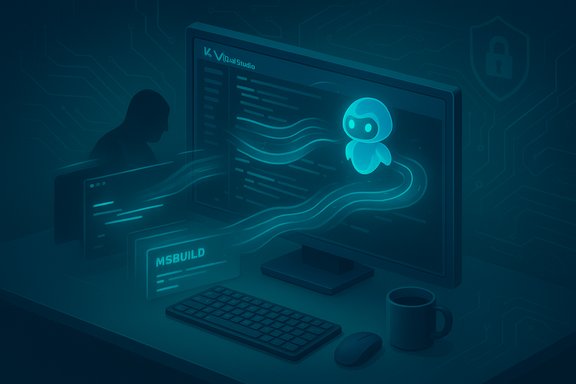
- An attacker plants or delivers crafted content — this could be a malicious repository, a trojanized NuGet package, a PR, or a file that a developer will open or review.
- Visual Studio’s AI assistant (Copilot or the integrated agent) processes the content and is influenced by prompt injection or malformed prompt material.
- The agent issues a command or a build-triggering action (for example, a post-load MSBuild target, task, or direct process invocation) that is insufficiently sanitized.
- The command executes under the context of the user (or a less-isolated Copilot/agent environment), producing code execution, data exfiltration, or downstream tampering.
Confidence in the technical details — what the metric means here
Security practitioners often rely on a confidence metric that describes how much faith to place in the advertised vulnerability details: reported-only, vendor-listed, corroborated by researchers, or actively exploited in the wild. In the case of CVE-2025-62214 the evidence stack aligns as follows:- Vendor acknowledgement and fixes: Microsoft lists the CVE in its Update Guide and has published updates for Visual Studio 2022. That vendor acknowledgement and shipping of patches constitutes high confidence in the vulnerability’s existence and location.
- Independent corroboration: Trusted security groups and industry blogs (Cisco Talos) described the vulnerability in the November 2025 bulletin and summarized the attack path as involving AI prompt injection and agent interaction—this provides an independent corroborating datapoint.
- Public exploit code: as of publication there is no widely accepted public proof‑of‑concept (PoC) demonstrating a trivial remote exploit for CVE-2025-62214; the exploitability is considered lower for mass exploitation, but still meaningful for targeted attacks.
Technical analysis — why this is both novel and familiar
Novelty: AI agents change the threat model
Traditional command-injection bugs arise from poor input validation in command construction functions. CVE-2025-62214 adds a new wrinkle: the agent is a decision-making layer. That means malicious instructions may be conflated with legitimate code-context instructions, manipulating the agent into producing commands that a standard static sanitizer would not catch. This makes prompt injection a first-class component of the exploit chain and elevates the importance of strict boundaries between AI-generated suggestions and actions that run on the host.Familiar mechanics: build systems and MSBuild targets
Attackers have long abused MSBuild targets, post-build steps, and project-file scripting to run arbitrary commands under a developer’s account. Visual Studio’s integration with MSBuild and task systems is a known attack surface; what changes here is that an AI assistant can automatically propose or initiate these operations when prompted or tricked by crafted content. The underlying mechanics (Exec tasks, custom targets, inline scripts) remain the same attack primitives defenders have studied for years.Practical exploitation considerations
- Privilege model: exploitation typically yields code execution under the interactive user account (not SYSTEM), so the most immediate risks are credential theft, source-code tampering, and propagation to CI/CD infrastructure if credentials or tokens are exposed.
- Complexity: exploit chains will often require the attacker to get malicious content into the developer’s workflow and to bypass any explicit prompts asking for command confirmation. The involvement of agents and interactive prompts increases attack complexity, which is why public exploitation to date has been limited in scale.
Real-world impact and likely targets
- Developer workstations. A malicious repo clone, PR, or sample code that a developer opens is the most realistic vector. IDEs are trusted, interactive environments with access to local secrets, environment variables, and automated build triggers—exactly the resources an attacker wants.
- Build agents and CI runners. If build agents have AI features or if malicious artifacts are merged into source branches, pipeline execution can be abused to inject backdoors into artifacts or packages. Even if the agent isn’t present in the CI runner, compromised developer machines that push signed artifacts create supply-chain risk.
- Shared developer environments and training labs. Multi-user environments raise additional hazards because one compromised user can influence shared resources or images.
- High-value individuals and teams. Attackers will prioritize developers with access to signing keys, cloud credentials, or privileged deployment pipelines.
Practical remediation — immediate steps for administrators and developers
- Inventory and prioritize
- Identify Visual Studio 2022 installations and any developer endpoints that have Copilot or agent features enabled.
- Flag build agents and CI images that include Visual Studio components or that run MSBuild tasks.
- Patch now
- Apply the Microsoft updates addressing CVE-2025-62214 for Visual Studio 2022 in your environment. For enterprise rollouts, follow a staged deployment: pilot → validate → broad deployment. The vendor’s Update Guide is authoritative for KB and installer references.
- Triage short-term mitigations
- Where immediate patching is impractical, disable Copilot Chat/agent features on sensitive developer hosts and build agents, or restrict agent network access to known-good services.
- Enforce least privilege on developer workstations: avoid running day-to-day development under domain admin or SYSTEM-equivalent tokens.
- Harden project and package handling
- Treat incoming repos, third-party packages, and sample code as untrusted. Scan project files (.csproj/.vbproj/MSBuild tasks) for suspicious Exec calls and inline tasks.
- Block or quarantine CI artifacts from unvetted contributors until cleared by code review.
- Rotate and protect secrets
- Rotate signing keys and tokens that might have been accessible to developer endpoints, and move any long-lived keys into hardware-backed key stores or vaults.
- Detection and monitoring
- Add hunts for unusual child processes spawned by Visual Studio (devenv.exe) or Copilot agents, unexpected MSBuild tasks that execute external commands, and network connections from developer hosts to suspicious domains.
- EDR/AV telemetry should alert on suspicious PowerShell downloads and processes initiated by IDEs.
Detection playbook — what to look for
- Unexpected MSBuild invocations or new Targets/Exec steps in repository histories.
- Visual Studio process (devenv.exe) spawning cmd.exe, powershell.exe, or unexpected processes, particularly shortly after a solution load.
- Copilot/Copilot-Agent processes issuing build commands or creating/modifying configuration files like .vscode/tasks.json, .csproj, or CI-trigger files.
- Network indicators: developer hosts issuing outbound fetch/downloads immediately following a build step, especially to IPs/domains not normally used by your org.
Risk trade-offs and cautionary notes
- Don’t assume patching is the complete answer. Agent and AI workflows create subtle trust boundaries; vendors can patch the input processing but defender teams must also reexamine when and how agents are permitted to perform actions on behalf of users.
- Avoid over-broad lockouts. Disabling AI features is sometimes necessary as an emergency mitigation but carries productivity costs. Prefer a measured rollout: patch, then selectively re-enable agents with hardened settings and strict confirmation prompts.
- Watch for follow‑on CVEs and vendor updates. As researchers analyze fixes, they often publish PoCs or additional details that increase exploitability. Maintain a short feedback loop for applying follow-up fixes and mitigations.
Why the confidence metric matters to defenders
The “degree of confidence” in a CVE’s public details guides triage. When vendor acknowledgement is paired with a shipped fix, defenders should treat the risk as real and actionable—even in the absence of wide exploitation. This is especially true for local EoP and agent-in-the-loop bugs because attackers love chaining low-complexity local escalations with remote footholds. Use a confidence rubric to prioritize: vendor-patched and corroborated issues (like CVE-2025-62214) belong in the fast lane for remediation and detection investments.Long-term hardening — changes to developer security posture
- Enforce “least trust” with AI agents: agents may suggest commands, but require explicit, auditable confirmations before executing actions that change environment state or invoke external code.
- Move secrets out of developer workstations and into ephemeral, vault-backed credentials. Enforce short-lived tokens for CI/CD.
- Integrate content-scanning and automated SAST for project files and package metadata that can contain Exec targets or code-run hooks.
- Expand code-review policies to include project-file hygiene, and add automated checks for MSBuild/Exec patterns in pull-request pipelines.
Final assessment and recommended priorities
CVE-2025-62214 is a vendor-acknowledged, patched vulnerability that reflects a broader trend: AI assistants inside developer tools introduce new attack surfaces and trust boundaries. The immediate operational priority is straightforward and urgent:- Apply Microsoft’s Visual Studio updates addressing CVE-2025-62214 without delay for developer endpoints and CI images.
- Where practical, temporarily disable AI agent features on sensitive build hosts until patches are fully deployed and configuration hardening is complete.
- Hunt for signs of exploitation on developer machines and build servers using the detection guidance above.
CVE-2025-62214 should be handled as a high-priority item for teams that run Visual Studio 2022 and that use Copilot/agent features; remediation is available and must be combined with hardened policies for AI-driven actions, tighter secrets management, and detectable audit trails for any IDE-initiated commands.
Source: MSRC Security Update Guide - Microsoft Security Response Center
