

Microsoft’s security channels added CVE-2025-62217 to the public record on November 11, 2025: the flaw is a race condition in the Windows Ancillary Function Driver for WinSock (afd.sys) that can be abused by an authenticated local actor to elevate privileges on affected Windows hosts.
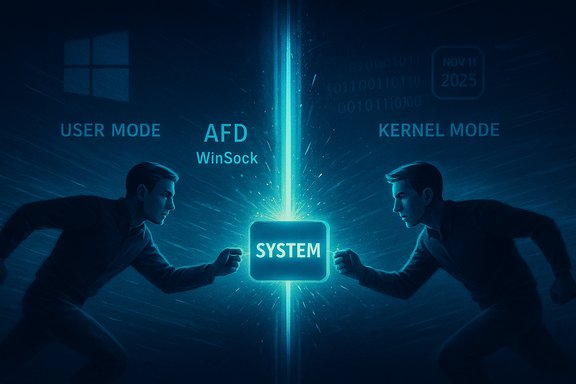
The Windows Ancillary Function Driver for WinSock (commonly called AFD or afd.sys) sits at a privileged boundary between user-mode socket APIs and kernel-mode networking plumbing. Because it runs with high privileges, defects in AFD have historically produced high-value exploitation primitives: a successful local elevation-of-privilege (EoP) in the AFD stack lets a low-privileged user or process obtain SYSTEM-level context and take complete control of the machine. Recent years have shown multiple, distinct CVEs in the AFD/WinSock area — including heap overflows, use-after-free errors, and race conditions — and defenders now treat new WinSock CVEs as urgent patch priorities.
CVE-2025-62217 is described by the vendor and vulnerability trackers as a race condition (time-of-check/time-of-use or similar improper synchronization of shared resources) inside the AFD/WinSock code paths. The publicly visible metadata assigns the issue a CVSS v3.1 base score of 7.0 (High), with an Attack Vector of Local, Privileges Required as Low, and no required user interaction — a combination that makes the vulnerability a valuable post‑compromise primitive for adversaries with local access.
(Verified details summarized from Microsoft’s Update Guide entry for CVE‑2025‑62217 and independent vulnerability trackers; community patching and detection guidance reflects industry best practices during prior AFD/WinSock advisories.
Source: MSRC Security Update Guide - Microsoft Security Response Center
 Background / Overview
The Windows Ancillary Function Driver for WinSock (commonly called AFD or afd.sys) sits at a privileged boundary between user-mode socket APIs and kernel-mode networking plumbing. Because it runs with high privileges, defects in AFD have historically produced high-value exploitation primitives: a successful local elevation-of-privilege (EoP) in the AFD stack lets a low-privileged user or process obtain SYSTEM-level context and take complete control of the machine. Recent years have shown multiple, distinct CVEs in the AFD/WinSock area — including heap overflows, use-after-free errors, and race conditions — and defenders now treat new WinSock CVEs as urgent patch priorities.CVE-2025-62217 is described by the vendor and vulnerability trackers as a race condition (time-of-check/time-of-use or similar improper synchronization of shared resources) inside the AFD/WinSock code paths. The publicly visible metadata assigns the issue a CVSS v3.1 base score of 7.0 (High), with an Attack Vector of Local, Privileges Required as Low, and no required user interaction — a combination that makes the vulnerability a valuable post‑compromise primitive for adversaries with local access.
What the advisory actually says (summary of confirmed facts)
- The vulnerability exists in the Windows Ancillary Function Driver for WinSock (afd.sys) and is categorized as a race condition / improper synchronization of shared resources.
- The impact is local elevation of privilege: an attacker who can run code locally as a non‑privileged user may be able to escalate to a high‑privilege context.
- Microsoft published an update on November 11, 2025 to remediate the flaw; administrators are instructed to apply the vendor-supplied security update for the affected Windows builds.
- At the time of initial public reporting, there was no authoritative, public proof‑of‑concept (PoC) or confirmed broad exploitation reported; however, the vulnerability’s characteristics (local, low starting privileges, high impact) make it valuable to attackers once weaponized.
Technical analysis — how a WinSock race condition can be abused
Why AFD is a high-value target
AFD implements kernel‑level socket management and mediates user requests to network resources. It accepts and marshals data from user-mode processes, often via IOCTLs or socket control paths. That mix — privileged kernel execution paths exposed to user inputs — makes synchronization and type/ownership checks critical. When synchronization is incorrect, two concurrent operations can race in a way that allows an attacker to manipulate kernel state between check and use. The outcome often allows modification of pointers, handles, or object state that the privileged code will trust, resulting in privilege escalation or arbitrary kernel memory modification.Typical exploitation chain for a race condition in afd.sys
- Initial foothold: attacker runs code as a standard user on the target system (malicious file, compromised app, or user-initiated code).
- Race trigger: attacker performs carefully timed or parallel operations (socket calls, DeviceIoControl invocations, or crafted WinSock API usage) to cause the AFD driver to enter an inconsistent state.
- Abuse of inconsistent state: attacker-controlled values are interpreted as privileged handles or pointers due to the synchronization gap.
- Privilege conversion: corrupted kernel state is used to overwrite token pointers or spawn a SYSTEM process, converting the low-privileged process into a SYSTEM-level process.
- Post-exploit actions: persistent backdoors, disabling of protections, credential theft, or lateral movement follow.
Complexity and reliability
Race conditions in kernel code can be harder to weaponize than single-shot memory corruption bugs because they often require precise timing or multiple threads/processes to win the concurrency window. That said, exploit developers automate these steps and compensate with memory/CPU grooming or by leveraging timing tricks on modern hardware. Historically, WinSock/AFD issues have been weaponized quickly once technical details or PoCs appeared publicly. For defenders, the combination of low privileges required to start and high impact when successful is the key threat indicator.Confirmed impact, affected platforms, and patching guidance
Impact
- Primary impact: Local elevation of privilege (EoP) allowing attacker processes to obtain higher privileges, potentially SYSTEM.
- Security consequences: Full system compromise, persistent malware installation, credential theft, and lateral movement risks.
- Exploitability: Attack complexity is recorded as High in the public CVSS vector for CVE‑2025‑62217 (AC:H) which reflects a need for more precise conditions to exploit the race; however, Privileges Required is Low, meaning a standard user account is sufficient to attempt exploitation. This combination increases the practical value to adversaries who already have a foothold.
Affected platforms and patching
Microsoft’s advisory and update guide lists the affected Windows builds and the KBs that remediate the vulnerability; administrators should map those KB numbers to their inventory and deploy the vendor updates immediately. Because the MSRC Update Guide is the canonical source for SKU/KB mapping, patch automation systems (WSUS, SCCM/ConfigMgr, Intune) should pull the official Microsoft packages and apply them following standard test‑then‑deploy practice. Operationally recommended steps:- Apply the Microsoft update(s) for CVE‑2025‑62217 immediately in pilot rings and then broadly, prioritizing domain controllers, admin workstations, and systems with local access exposure.
- For systems that cannot be patched immediately, apply compensating controls such as reducing local accounts with interactive logon rights and enforcing strict least-privilege policies.
- Increase EDR/SIEM sensitivity for post‑exploit indicators (unexpected process creations at SYSTEM level, suspicious token manipulations, or afd.sys-related anomalous DeviceIoControl activity).
Detection and hunting: what to look for
Short-term telemetry priorities
- Unexpected privilege escalations to SYSTEM from user processes.
- Repeated, concurrent WinSock/AFD invocation patterns (multiple threads making crafted socket calls) from a single user process.
- Suspicious DeviceIoControl or IOCTL sequences targeting afd.sys or networking driver interfaces.
- EDR signals indicating abnormal handle duplications, process token manipulations, or kernel memory modification attempts.
Long-term detection improvements
- Add detection rules that correlate high-frequency socket control operations with sudden process elevation.
- Implement code‑style or binary integrity checks for afd.sys where possible and monitor driver load/unload events.
- Maintain a curated set of YARA/EDR signatures for WinSock-related PoC artifacts after authoritative technical analyses are published.
Why this vulnerability matters — risk analysis
Notable strengths in vendor response
- Microsoft documented the vulnerability in the Update Guide and published a patch on November 11, 2025, closing the gap for administrators to remediate across supported SKUs. The presence of a vendor patch is the most effective mitigation and reduces the long‑term attack surface if widely applied.
- Public trackers and vulnerability databases have rapidly indexed the advisory, enabling corporate vulnerability management tooling to flag affected assets and prioritize patches. This improves enterprise readiness and situational awareness across diverse environments.
Residual risks and reasons for caution
- Race conditions are often subtle and sometimes yield multiple exploitation techniques; until Microsoft publishes detailed patch diffs or researchers publish deep technical analysis, defenders cannot be certain about the exact exploitation primitives or whether partial mitigations exist. Treat vendor descriptions as authoritative for remediation, but remain cautious about assuming the root-cause class beyond the high-level advisory.
- Public absence of a PoC or "in the wild" exploitation report is not proof of safety. Sophisticated adversaries frequently retain private exploit toolchains for targeted campaigns. Given the EoP nature and low starting privileges required, attackers could weaponize this flaw as a second-stage action after initial compromise.
- Patch rollouts at scale can be slow in large enterprises. Any delay increases the window of exposure; attackers may intentionally target organizations with known slow patching cadence. Operational inertia — testing, compatibility checks, and staggered deployments — must be balanced against the risk of exploitation.
Practical mitigation checklist (for IT teams, quickly)
- Map affected builds: query inventory for the Windows builds and identify hosts that match Microsoft’s affected SKU list.
- Deploy patch to pilot ring within 24 hours and expand to critical systems within 72 hours.
- Harden local access: remove unnecessary local admin privileges, restrict interactive logon, and enforce least privilege.
- Monitor EDR/endpoint logs for privilege-escalation behavior, afd.sys targeting, or unusual DeviceIoControl activity.
- Validate patch success: verify updated driver versions and KB installation status through your patch management reporting tools.
Broader context: WinSock/AFD as a recurring attack surface
AFD/WinSock has surfaced repeatedly as a high-priority target in 2024–2025. The family of WinSock vulnerabilities in recent months includes heap overflows, use-after-free issues, type confusion, and race conditions; these different classes show that the AFD code paths exercise complex object handling and synchronization logic that can be fragile under crafted inputs. The community’s operational guidance after prior WinSock advisories was clear: treat WinSock EoP CVEs as urgent because they convert commonplace footholds into SYSTEM-level compromise quickly when chained with initial access techniques.What we still don’t know (and what to watch for)
- Microsoft’s public advisory gives the high-level weakness class (race condition) and remediation mapping, but until the patch is reverse-engineered or Microsoft publishes a technical write‑up, the exact exploitation vector (the IOCTLs or API calls used) remains vendor-limited. That means defenders should remain conservative: assume adversaries will attempt to weaponize this pedestal of local privilege escalation.
- Watch for proof-of-concept (PoC) publications on responsible-researcher blogs and for any KEV (CISA Known Exploited Vulnerabilities) listing or government advisories that indicate observed exploitation in the wild. Historically, some AFD issues have appeared in targeted, stealthy campaigns before public PoCs were posted; early telemetry is an important signal.
- Verify whether the CVSS vector or vendor classification is revised after additional analysis; vulnerability metadata sometimes changes as new information arrives, and those changes affect prioritization logic in automated patching tools.
Conclusion
CVE‑2025‑62217 is another reminder that privileged kernel components exposed to user operations are perennial and high-value attack surfaces. The vendor-provided patch released on November 11, 2025 is the definitive mitigation; organizations should treat the vulnerability as high priority, map affected assets, push the Microsoft update through their standard test-and-deploy channels, and tighten local access policies on any hosts that cannot be immediately patched. Even with the publicly stated attack complexity rated as higher than some WinSock bugs, the combination of low starting privileges required and high impact makes CVE‑2025‑62217 a dangerous second-stage primitive for adversaries. Monitor published technical analyses and PoCs as they appear, keep endpoint telemetry tuned for post‑exploit indicators, and verify patch installation across your estate.(Verified details summarized from Microsoft’s Update Guide entry for CVE‑2025‑62217 and independent vulnerability trackers; community patching and detection guidance reflects industry best practices during prior AFD/WinSock advisories.
Source: MSRC Security Update Guide - Microsoft Security Response Center
