

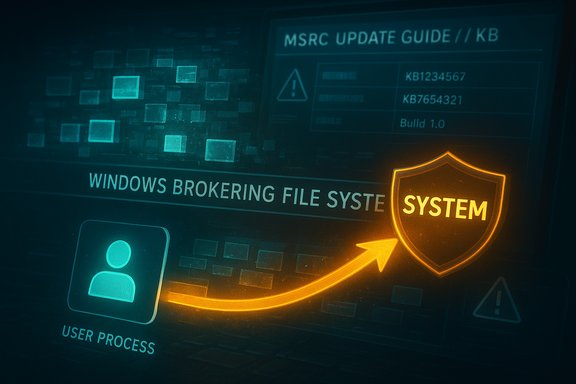
Microsoft’s security naming for CVE‑2025‑62469 appears in some feeds as an alleged Elevation‑of‑Privilege (EoP) issue affecting the Microsoft Brokering File System, but as of this reporting the specific CVE string cannot be reliably located or rendered on public vendor pages and major trackers — treat the identifier as provisionally reported until MSRC or at least two independent authoritative sources confirm the advisory and map it to exact KBs and builds.
The Brokering File System (BFS) — the component Microsoft uses to mediate, cache and broker complex file operations across processes and services — has been the subject of several elevated‑privilege advisories through 2024–2025. In practice, the BFS family of bugs frequently shares the same exploitation archetypes: memory‑safety defects (use‑after‑free, double‑free), null pointer dereferences, improper impersonation or handle validation, and TOCTOU / link‑following issues that enable privileged services to perform attacker‑controlled I/O. These patterns have been repeatedly discussed in vendor advisories and community writeups as the likely root causes for BFS‑family EoP CVEs. A few critical points from the current public record and community analysis that inform the threat model:
Source: MSRC Security Update Guide - Microsoft Security Response Center
 Background / Overview
The Brokering File System (BFS) — the component Microsoft uses to mediate, cache and broker complex file operations across processes and services — has been the subject of several elevated‑privilege advisories through 2024–2025. In practice, the BFS family of bugs frequently shares the same exploitation archetypes: memory‑safety defects (use‑after‑free, double‑free), null pointer dereferences, improper impersonation or handle validation, and TOCTOU / link‑following issues that enable privileged services to perform attacker‑controlled I/O. These patterns have been repeatedly discussed in vendor advisories and community writeups as the likely root causes for BFS‑family EoP CVEs. A few critical points from the current public record and community analysis that inform the threat model:- Impact class: local Elevation of Privilege (EoP) — an attacker with local code execution or a logged‑in low‑privilege user could escalate to SYSTEM if exploitation succeeds.
- Typical root causes: memory corruption (use‑after‑free / double‑free), null pointer dereference, or improper privilege checks on file/handle operations.
- Exploitability: often requires local access. The public surface tends to be low‑barrier once an attacker controls a process on the host, but initial exploitation engineering (heap grooming, timing) may be required.
What we could (and could not) verify about CVE‑2025‑62469
Verifiable facts
- Multiple independent vulnerability trackers and vendor advisories document a family of Microsoft Brokering File System EoP issues throughout 2024–2025, with CVSS scores commonly reported in the High 7.0–7.8 range for these defects. These trackers describe the same high‑level risks: local attackers elevating privileges to SYSTEM if a vulnerable build is left unpatched.
- Community technical analysis and defensive guidance for BFS‑class bugs consistently recommend immediate patching, validating CVE→KB→SKU mappings, and applying compensating controls like disabling unnecessary brokering/offline‑file features and enforcing least privilege.
What we could not corroborate
- The exact MSRC advisory contents and KB mapping for CVE‑2025‑62469 could not be rendered or located in multiple public mirrors at the time this article was prepared. A direct vendor URL was provided but the dynamic page required JavaScript — the advisory may exist behind MSRC’s UI but it was not possible to extract authoritative metadata (affected builds, KB number, CVSS vector) through automated indexing. Until that MSRC page is rendered and the vendor KBs are listed, treat the CVE identifier as unverified by independent trackers.
Technical analysis — how BFS vulnerabilities are abused
Common exploitation primitives
- Use‑After‑Free (UAF) / Double‑Free: BFS code paths that free objects while references remain reachable let attackers trigger controlled memory corruption. UAFs in privileged context can be escalated into arbitrary kernel writes or controlled code execution.
- Null pointer dereference and uninitialized pointer handling: failing to validate pointers before dereferencing in privileged brokering code can let crafted requests induce memory corruption and overwrite kernel structures.
- Improper impersonation / handle reuse: brokering services that accept client handles or impersonation tokens without strict validation can be coerced into acting on attacker‑controlled resources while running as SYSTEM.
- TOCTOU / Link‑following (reparse points): privileged services that resolve file paths and then perform non‑atomic operations can be tricked into acting on attacker‑supplied reparse points, enabling privileged writes or replacements of system artifacts.
Typical exploitation chain (high level)
- Initial foothold: attacker runs code as a normal user (phishing payload, malicious installer, or compromised app).
- Trigger: attacker calls the BFS surface (file operations, IPC, IOCTLs, stream attach/detach) to reach the vulnerable code path.
- Corruption or impersonation: UAF/null deref or handle misuse creates a powerful primitive (write‑what‑where, token swap, privileged file write).
- Privilege conversion: attacker manipulates token structures, spawns SYSTEM processes, or replaces service binaries to obtain persistence and lateral movement capabilities.
- Post‑exploit: implants, credential theft, and disabling of defenses.
Operational impact and risk assessment
Who is at risk?
- Single‑user workstations where local code execution can be gained by other threat vectors (malicious downloads, phishing) — exploitation allows complete host compromise.
- Shared administrative workstations, jump boxes, developer build hosts, CI/CD runners, and virtualization hosts — compromise of such hosts can be used to pivot to domain resources or to obtain cloud tokens.
- Enterprise fleets with unpatched SKUs or mixed update‑management configurations where KB mappings are not strictly validated — patch fragmentation multiplies blast radius.
Likelihood and severity
- Likelihood: medium for targeted attackers with local access; lower for remote, unauthenticated attackers unless chained with other vulnerabilities. Community telemetry often reports no public PoC at initial disclosure, but Rapid weaponization can follow patch diff disclosure.
- Severity: high. Successful EoP to SYSTEM provides full host control, allowing credential harvesting, disabling of defenses, persistent implant installation, and lateral movement. Most BFS family CVEs carry CVSS scores in the high 7.x range in third‑party trackers.
Immediate actions for defenders (0–72 hours)
1. Confirm whether the CVE applies to your estate- Query your asset inventory (WSUS/Intune/SCCM/CMDB) for the specific KB numbers that MSRC lists for the CVE once the vendor advisory renders; do not rely only on the CVE string — map to KB→build. If you cannot render the MSRC page programmatically, use an interactive browser to view the Update Guide.
- Test vendor KBs in a representative lab ring. Roll to pilot ring, then broad deployment, prioritizing admin workstations, jump hosts, build servers, and VDI/terminal hosts. Vendor patches are the canonical remediation for memory‑safety defects.
- Enforce least privilege: remove local admin from day‑to‑day users.
- Disable BFS/brokering features when feasible for hosts that don’t require them (feature toggle or Group Policy).
- Restrict creation of symbolic links, reparse points, or the ability to perform privileged mount operations on multi‑tenant hosts.
- EDR/AV: look for unexpected elevation to SYSTEM, new service creation, scheduled tasks created by low‑privileged users, or abrupt crashes/restarts of brokering services.
- SIEM hunts: correlate service crashes with subsequent configuration changes or process creations that appear with SYSTEM context. Collect memory snapshots and event logs prior to remediation if compromise is suspected.
- Ensure IR knows how to capture volatile evidence (memory, relevant event traces).
- Treat any unexpected SYSTEM process creation or manipulation of protection mechanisms (tampering with AV or Defender settings) near a brokering service crash as high‑priority.
Detection recipes and telemetry examples
- Windows Event Logs
- Service Control Manager events: unexpected stops, crashes, or restarts of BFS-related services, or crashes showing faulting module names tied to brokering components.
- Security event anomalies: sudden elevation events or creation of scheduled tasks by low‑privileged accounts.
- EDR/SIEM queries (examples)
- Search for process creation events where parent process is a user process but child process runs as SYSTEM.
- Correlate process crash events (Application Error / WTF dumps) for brokering binaries with subsequent SYSTEM context changes.
- Forensic capture
- If exploitation is suspected, capture a full memory image and relevant event/log files before applying a patch or rebooting. Time‑stamped evidence is critical for later attribution and root cause analysis.
Common remediation pitfalls and operational traps
- CVE fragmentation: third‑party trackers sometimes assign different CVE numbers to adjacent or related BFS fixes; automated patch systems that rely solely on a CVE identifier can misapply or miss the correct KB for a given build. Always validate the MSRC KB mapping.
- Blind sweeping: deploying a patch to the wrong SKU or an incomplete KB can leave hosts unprotected. Inventory your builds and match exactly to the vendor‑listed KB.
- Overreliance on absence of public PoC: no public exploit at disclosure is not proof that private exploits don’t exist. Treat the window between patch and public write‑ups as high‑risk for reverse‑engineering and weaponization.
Recommended medium‑ and long‑term hardening
- Reduce the attack surface
- Remove unnecessary components or disable brokering/offline file features for hosts where they are not required.
- Harden developer and build platforms: treat build hosts as high‑risk assets and isolate them.
- Principle of least privilege and application control
- Implement application‑whitelisting, restrict local admin use, and use hardened administrative workstations for privileged operations.
- Detection maturity
- Invest in endpoint and kernel‑level telemetry where possible. Correlate service stability metrics with configuration changes and deployment events to spot suspicious post‑crash activity.
- Patch orchestration
- Map CVEs to KBs and OS builds with a canonical source of truth; automate verification of post‑patch file/driver versions to confirm updates were applied correctly.
Strengths, limits, and risks in the public reporting around this CVE family
- Strengths
- Vendor patches for BFS issues generally appear promptly once the issue is verified; Microsoft’s Update Guide and Update Catalog remain the authoritative mechanisms for remediation.
- Community writeups and enterprise trackers provide useful operational context and hunting recipes that defenders can adopt quickly.
- Limits and risks
- Vendor UI rendering (the MSRC Update Guide) can obscure programmatic access to advisory metadata; this sometimes delays mirror indexing and third‑party automation.
- CVE identifier fragmentation across multiple BFS advisories raises the risk of mismatched patches in heterogeneous environments. Environments that depend on CVE‑only automation are particularly vulnerable to errors.
- Public reporting at initial disclosure is often intentionally sparse on exploit mechanics to limit short‑term weaponization — which is responsible but leaves defenders with uncertainty. Until patch diffs or researcher analyses surface, defenders should assume worst‑case impact for unpatched hosts.
Practical checklist (actionable)
- Immediate (within 24 hours)
- Confirm whether MSRC lists CVE‑2025‑62469 for your builds via an interactive browser session to the Microsoft Update Guide. If the MSRC page will not render for automation, use a secure admin workstation to view the advisory and KB mapping.
- Identify affected hosts by matching OS build numbers and driver/binary versions. Do not assume a single CVE applies to every SKU.
- Patch pilot ring hosts and validate functionality.
- Short term (24–72 hours)
- Roll patches to high‑risk servers and admin workstations.
- Apply compensating controls for hosts that cannot be immediately patched (disable BFS features, restrict local admin, increase auditing).
- Tune EDR/SIEM hunts described earlier and collect pre‑remediation forensic snapshots if compromise is suspected.
- Medium term (1–4 weeks)
- Verify patch deployment with file and driver version checks; reconcile any hosts that report unaffected states.
- Harden build/CI infrastructure and administrative bastions.
- Update IR playbooks with BFS‑class indicators and ensure forensic capabilities are ready.
Conclusion
The Microsoft Brokering File System remains a high‑value attack surface for local Elevation‑of‑Privilege vulnerabilities. While multiple BFS CVEs have been publicized with high severity scores and similar exploitation patterns, the specific CVE identifier you referenced — CVE‑2025‑62469 — could not be independently rendered or corroborated across standard public mirrors at the time of this report. That ambiguity demands a conservative defensive posture: validate the vendor advisory and KB→build mapping on Microsoft’s Update Guide interactively, deploy vendor patches urgently once validated, and apply compensating controls and telemetry hunts while you close the window of exposure. Key operational imperatives remain unchanged: patch promptly, verify KB applicability per SKU, harden the environment with least privilege and app control, and tune detection to spot the classic escalation artifacts that accompany BFS exploitation attempts. The community’s recurring lesson is simple and urgent — don’t let CVE number confusion slow your remediation; rely on KB mapping, robust inventory, and defensive telemetry instead.Source: MSRC Security Update Guide - Microsoft Security Response Center
