

Microsoft’s CVE-2025-62559 advisory labels the issue as a Remote Code Execution (RCE) vulnerability in Microsoft Word, yet the published CVSS vector shows Attack Vector = Local (AV:L) — an apparent contradiction that has caused confusion among IT teams and security practitioners. The reality is that the CVE title and the CVSS Attack Vector are answering two different operational questions: the CVE headline describes what an attacker can ultimately achieve and where they may originate from, while the CVSS AV metric describes where and when the vulnerable code is executed at the moment of exploitation. This distinction is deliberate and operationally important for triage, patching, and risk communication.
Microsoft’s Security Update Guide and many vendor advisories routinely use the phrase Remote Code Execution because it succinctly communicates impact: a remote adversary can, under certain conditions, cause arbitrary code to run on a target system. That phrasing is meant to prompt urgent attention from defenders. At the same time, the Common Vulnerability Scoring System (CVSS) Attack Vector metric is intentionally granular and standardized; it records the locality of the trigger — whether the vulnerable code executes in a network-facing process, an adjacent network context, a local process, or requires physical access. For many document-parsing vulnerabilities like this Word issue, the vulnerable component is invoked inside a local application process (e.g., WINWORD.EXE) when the document is opened or previewed, so CVSS assigns AV:L even though the malicious document can be delivered remotely.
Common root causes include:
Source: MSRC Security Update Guide - Microsoft Security Response Center
 Background
Microsoft’s Security Update Guide and many vendor advisories routinely use the phrase Remote Code Execution because it succinctly communicates impact: a remote adversary can, under certain conditions, cause arbitrary code to run on a target system. That phrasing is meant to prompt urgent attention from defenders. At the same time, the Common Vulnerability Scoring System (CVSS) Attack Vector metric is intentionally granular and standardized; it records the locality of the trigger — whether the vulnerable code executes in a network-facing process, an adjacent network context, a local process, or requires physical access. For many document-parsing vulnerabilities like this Word issue, the vulnerable component is invoked inside a local application process (e.g., WINWORD.EXE) when the document is opened or previewed, so CVSS assigns AV:L even though the malicious document can be delivered remotely.Why the distinction matters right now
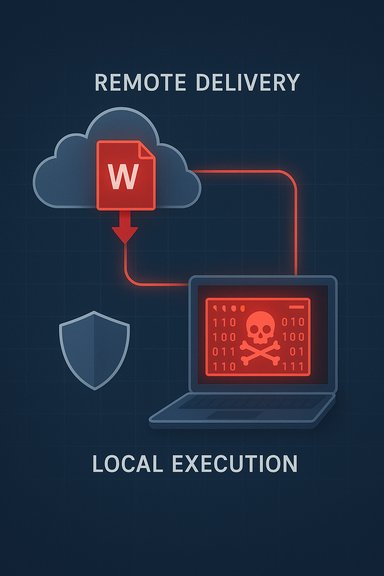
Security teams triage thousands of CVEs each year. A short, high-impact headline like Remote Code Execution signals that the vulnerability class is capable of arbitrary code execution — one of the highest severity outcomes — and therefore should be prioritized. CVSS, on the other hand, is designed for automated risk calculations and comparative scoring; it documents exploit mechanics so that teams can consistently rank and compare vulnerabilities. Misreading AV:L as “low risk” is a hazardous mistake: AV:L for a document RCE often simply means remote delivery + local execution, which still represents a high operational risk.Overview: How “remote delivery, local execution” works
The canonical attack chain
- An attacker crafts a malicious Word document that triggers a memory‑safety or logic bug in a Word parser (for example, use‑after‑free, heap overflow, or type confusion).
- The attacker distributes that file remotely (phishing email attachment, cloud share, or public download).
- A victim opens or previews the document in Microsoft Word (or a preview handler), causing the local Word process to parse the malicious content.
- The parsing operation triggers the bug and the attacker’s payload executes within the context of the local process under the victim user’s privileges.
The CVSS semantics in plain language
- AV:N (Network) — the vulnerable code can be reached directly across network boundaries; no local application invocation is required.
- AV:A (Adjacent Network) — attacker must be on the same network segment or otherwise adjacent.
- AV:L (Local) — the exploited code runs in a local process; an action on the host (e.g., opening a file) triggers it.
- AV
 (Physical) — physical access to the machine is required.
Technical anatomy: why Word document RCEs commonly show AV:L
Why parsers are the weak link
Microsoft Word (like other Office apps) uses complex native parsers to handle legacy binary records, Open XML payloads, embedded OLE objects, images, and numerous rendering subsystems. Those parsers run inside the Word process and are written in native code, where memory management errors can lead to memory corruption primitives that attackers convert into reliable code execution.Common root causes include:
- Use‑after‑free (CWE‑416)
- Heap or buffer overflows
- Type confusion or improper validation
- Out‑of‑bounds reads/writes
When macros aren’t involved
Because the exploit targets the native parser rather than script-based automation, macro-blocking policies do not necessarily prevent these attacks. That’s why security controls that focus solely on disabling macros are insufficient: modern exploitation frequently uses crafted binary inputs within the document to corrupt native code paths and achieve arbitrary execution without macros or ActiveX.Operational implications: triage, mitigation, and prioritization
Why AV:L doesn’t mean “low priority”
- Office is ubiquitous: a crafted document can reach many victims quickly.
- Delivery channels are low friction: email, cloud shares, and public file uploads scale distribution.
- User interaction is easily social‑engineered: convincing a user to open an attachment remains trivial for many targeted attacks.
The critical server-side exception
If any server-side component (mail gateways, document-conversion services, Office Online Server, cloud preview engines) uses the same vulnerable parser to render or preview uploaded files, the exploitation model changes: the vulnerable parser now runs in a network-exposed process. In that configuration the correct CVSS Attack Vector should be AV:N (Network), because an unauthenticated remote attacker could trigger the vulnerability simply by uploading a file. Vendors explicitly call this out when applicable because it materially increases the exposure and urgency of remediation. Administrators must check server-side parsing points in their environment as a priority.Practical mitigation checklist (prioritized)
Apply the following steps in the order given to reduce exposure quickly and sustainably.- Patch immediately: identify the KBs that map to CVE-2025-62559 for each Office installation model (Click‑to‑Run, MSI, LTSC, etc. and deploy via your patch management tooling. Confirm the targeted build numbers are updated.
- Audit server-side renderers: identify any email gateways, file‑storage services, SharePoint, collaboration platforms, or document preview services that parse or render Office files and prioritize patching or isolating them if they use the vulnerable parser.
- Enforce Protected View for Internet-origin files: configure Word to open email attachments and downloaded documents in Protected View until editing is explicitly allowed.
- Disable automatic previews: turn off Outlook/File Explorer preview panes for high-risk user groups and for servers that perform automatic rendering.
- Apply Attack Surface Reduction (ASR) and application control: use ASR rules to block Office apps from launching child processes, and consider AppLocker or Windows Defender Application Control (WDAC) where feasible.
- Enforce least privilege: ensure users operate without local administrative rights to limit post‑exploit impact.
- Route attachments through sandboxing: use mail gateway detonation/sandboxing for suspicious attachments and quarantine suspect files.
- Tune EDR and SIEM: create alerts for Office processes spawning unusual child processes, in-memory code injections, or new persistence mechanisms initiated by Word processes.
- User awareness: brief high‑risk teams (finance, HR, legal) on suspicious attachments and phishing tactics to reduce the chance of a user opening weaponized documents.
Verification and uncertainty: what is and isn’t known
Vendor confirmation vs. technical detail
Microsoft’s advisory is the authoritative record linking the CVE to the appropriate KBs and builds. In many early vendor advisories the low‑level exploitation mechanics (exact parser function, record type, memory layout details) are withheld to reduce the risk of immediate weaponization. Analysts must therefore rely on vendor-supplied KB mappings for remediation and treat the vulnerability as confirmed for patching purposes even if public proofs-of-concept (PoCs) do not yet exist. Flag any low-level exploitability claims that are not corroborated by the vendor or independent, reputable technical analyses.Items to verify in your environment
- Do any servers or cloud services perform server-side parsing or previewing of Word documents? If so, consider them high priority for patching.
- Are automatic preview panes enabled for Outlook or file management interfaces?
- Which Office packaging models are deployed (Click‑to‑Run vs MSI vs LTSC), and which KBs correspond to each? Microsoft typically issues multiple updates per CVE to cover different SKUs.
Common misunderstandings — and how to avoid them
- Misread CVSS AV:L as “network-safe”: AV:L documents the moment of execution; it does not mean the vulnerability cannot be delivered remotely. Treat RCE-class advisories as high-priority regardless of AV alone.
- Relying on headline-only automation: automated triage systems that ingest only CVE titles and ignore CVSS fields or advisory bodies will misclassify risk. Use the full advisory text, CVSS vector, and an inventory of parsing endpoints for accurate prioritization.
- Assuming macros are the core problem: modern RCEs often exploit native parsers and require no macros; macro blocking is not a complete mitigation.
Threat modeling: what successful exploitation enables
When an attacker achieves code execution inside the Word process, the immediate consequences depend on context and privileges:- User‑context compromise: enemy code runs with the logged‑on user’s rights; credential theft and lateral movement are possible.
- Privilege escalation chaining: if further flaws exist, attackers may escalate to system or domain privileges.
- Ransomware and data exfiltration staging: RCE on a workstation can be the initial foothold for broader compromise.
- Large blast radius if server-side: if the vulnerable parser runs in a network-exposed service, unauthenticated uploads could yield mass compromise across customers or tenants.
How security teams should communicate this to leadership
- State the impact succinctly: CVE-2025-62559 is an RCE in Microsoft Word — it can lead to arbitrary code execution on impacted hosts if a crafted document is opened or previewed.
- Explain the CVSS nuance briefly: CVSS lists AV:L because exploitation requires the Word process to parse a local file; this does not reduce the operational severity.
- Give clear remediation steps: patch affected Office builds, verify and patch server-side parsers, disable automatic previews, and apply the prioritized mitigations above.
- Provide a timeframe and verification plan: schedule staging and deployment windows, and report back using concrete indicators (KB build numbers, update compliance percentages).
When the labeling changes: what to watch for
Vendors will call out when the exposure model changes (for example, when a vulnerable parser is also used in a network‑exposed server component). When that happens:- CVSS Attack Vector may be reclassified to AV:N (Network).
- The advisory will typically include stronger language calling for immediate remediation of internet‑facing systems.
- Incident response SOPs should be triggered for any externally accessible services that parse Office files.
Final analysis: strengths, risks, and recommended posture
- Strengths of the vendor approach:
- The CVE title quickly communicates worst‑case impact, which drives rapid organizational attention.
- CVSS provides granular exploit mechanics needed for automated triage and consistent scoring across thousands of CVEs.
- Risks and potential for misunderstanding:
- Over-reliance on headline language or on a single CVSS metric can cause misprioritization.
- Failing to identify server-side parsing endpoints can leave an organization exposed to network-level exploitation even when CVSS lists AV:L.
- Recommended posture:
- Treat RCE-class Office advisories as high priority regardless of AV. Patch promptly and confirm remediation by matching KBs to installed builds.
- Audit and patch server-side renderers first if present, and apply layered mitigations (Protected View, ASR rules, sandboxing).
- Tune detection and incident response plans to preserve evidence and speed containment.
Conclusion
The phrasing “Remote Code Execution” in the CVE title for CVE‑2025‑62559 and the CVSS Attack Vector value AV:L (Local) are not contradictory — they are complementary. One signals attacker origin and what the vulnerability enables; the other precisely documents how and where the vulnerable code is executed at the moment of exploitation. Security teams should treat this advisory as urgent: patch affected Office builds, audit server-side parsing infrastructure, and apply layered compensating controls while updates are rolled out. Misinterpreting AV:L as low risk is the most dangerous outcome; the correct operational stance is to assume high priority until systems are verified remediated.Source: MSRC Security Update Guide - Microsoft Security Response Center
