

A newly disclosed high‑severity vulnerability in the popular JavaScript cryptography library node‑forge (tracked as CVE‑2025‑66031) enables unbounded ASN.1 recursion that can be trivially abused to crash Node.js processes parsing untrusted DER inputs — and the fix landed quickly in node‑forge v1.3.2, but the real work for defenders starts with discovering every downstream consumer and applying updates across build pipelines and deployed binaries.
node‑forge (also referred to simply as Forge) is a widely used pure‑JavaScript implementation of many cryptographic primitives and formats — including ASN.1 encoding/decoding — and appears across web services, tools, and embedded JavaScript runtimes. The vulnerability, formally recorded as CVE‑2025‑66031, is an Uncontrolled Recursion flaw in the ASN.1 DER parser: an attacker can craft a small DER blob whose constructed TLVs are nested to an extreme depth, which causes the parser to recurse until the V8 stack is exhausted and the process throws a RangeError, resulting in a denial‑of‑service (DoS). The upstream maintainers published an advisory and committed a targeted fix that introduces a recursion depth limit and exposes a configurable option to override it. The patch was included in the library release 1.3.2; projects using older versions (≤ 1.3.1) are considered vulnerable until updated.
RangeError: Maximum call stack size exceeded
This uncontrolled recursion is a classic stack exhaustion DoS pattern (CWE‑674) — simple to trigger, reliably crashy, and exploitable anywhere untrusted DER is parsed without defensive controls.
From a defensive standpoint, the incident underlines three perennial lessons:
Acknowledgement of verification: this article’s technical facts were cross‑checked against the node‑forge GitHub security advisory and the upstream commit that added the recursion limit, and corroborated by public CVE/NVD trackers and distribution security pages; any assertions about current in‑the‑wild exploitation are carefully qualified because telemetry and EPSS show low activity at publication time.
Source: MSRC Security Update Guide - Microsoft Security Response Center
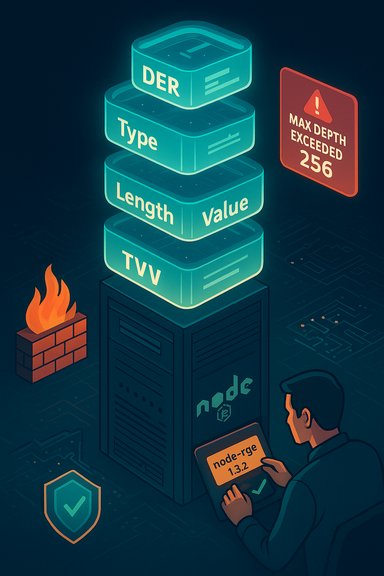 Background / Overview
node‑forge (also referred to simply as Forge) is a widely used pure‑JavaScript implementation of many cryptographic primitives and formats — including ASN.1 encoding/decoding — and appears across web services, tools, and embedded JavaScript runtimes. The vulnerability, formally recorded as CVE‑2025‑66031, is an Uncontrolled Recursion flaw in the ASN.1 DER parser: an attacker can craft a small DER blob whose constructed TLVs are nested to an extreme depth, which causes the parser to recurse until the V8 stack is exhausted and the process throws a RangeError, resulting in a denial‑of‑service (DoS). The upstream maintainers published an advisory and committed a targeted fix that introduces a recursion depth limit and exposes a configurable option to override it. The patch was included in the library release 1.3.2; projects using older versions (≤ 1.3.1) are considered vulnerable until updated. Technical anatomy: how the attack works
What ASN.1 parsing normally does
ASN.1 DER encodes data as TLV (Type-Length-Value) units. Constructed types — for example SEQUENCE and SET — can contain other ASN.1 values inside them, which means parsers must handle nested structures. Implementations typically parse by walking nested values until the outermost construct is complete.Where node‑forge went wrong
The node‑forge implementation used a recursive function that invoked itself once per constructed value, with no upper bound on recursion depth. Because DER allows arbitrarily deep nesting in theory, an attacker can craft a DER blob where each constructed TLV contains another constructed TLV — the payload can be tiny but nest thousands of levels deep. When node‑forge attempts to parse this input, the recursive call stack grows until the JavaScript engine runs out of stack and throws:RangeError: Maximum call stack size exceeded
This uncontrolled recursion is a classic stack exhaustion DoS pattern (CWE‑674) — simple to trigger, reliably crashy, and exploitable anywhere untrusted DER is parsed without defensive controls.
What the upstream change does
The maintainers added a default maximum recursion depth (set to 256) and made it configurable via options passed to asn1.fromDer. The parser now checks the current depth on each recursive entry and throws a controlled error ("ASN.1 parsing error: Max depth exceeded.") when the configured maximum is hit. That change eliminates unbounded recursion and gives application developers an explicit control point. The change is small, surgical, and low risk — exactly the kind of fix you want to see for a parser defect.Scope and impact
- Affected library versions: node‑forge < 1.3.2 (patched in 1.3.2).
- Primary impact: Denial‑of‑Service (availability) via stack exhaustion when parsing attacker‑supplied DER. Exploitation requires delivery of untrusted DER to code paths that call node‑forge's ASN.1 parser.
- Attack vector: Network or local file input, depending on how the application consumes DER. No authentication is required to trigger the recursion once input reaches the parser.
- CVSS and exploitation likelihood: GitHub’s advisory and multiple trackers classify this as High (CVSS ~8.7 in GitHub’s assessment), yet EPSS/telemetry numbers remain low, reflecting that the vulnerability is trivial to exploit but requires a reachable parser entry point for untrusted DER. Organizations should treat that as urgent for availability‑critical services.
Real‑world places to worry first
- Services that parse certificates, CSRs, S/MIME messages, OCSP/CRL entries, or other DER/ASN.1 artifacts using node‑forge.
- Email processors, network appliances, TLS offloaders, or custom PKI tooling that accept external certificates or CRLs.
- Electron or desktop apps that embed node‑forge and parse certificates or keys locally.
- Containers and serverless functions where a single instance crash reduces overall capacity or causes cascading failures.
Verified facts and cross‑checks
Key technical claims in this article were verified against multiple independent sources:- The vulnerability description and affected versions are documented in the project’s security advisory and the GitHub Advisory Database. The advisory explains the asn1.fromDer recursion and identifies the patched release 1.3.2.
- The upstream commit that implements a depth limit and default maxDepth = 256 is publicly viewable in the project’s repository (commit 260425c). The diff shows the added asn1.maxDepth constant, the options.maxDepth defaulting, and the depth check that throws when exceeded.
- National and community vulnerability trackers (NVD, Debian security tracker, OpenCVE/Aqua) mirror the CVE metadata and enumerate the same root cause and patch version. These independent records corroborate the severity and remediation guidance.
Actionable remediation checklist (prioritized)
Apply the following steps in order of priority. The guidance is practical for Windows‑centric operations teams and Node.js developers alike.1. Inventory: find every consumer of node‑forge
- For each application repo, run:
- npm ls node-forge
- yarn why node-forge
- For monorepos and CI artifacts, search for node‑forge in lockfiles:
- PowerShell quick search in a repo root:
- Get-ChildItem -Recurse -Include package-lock.json,yarn.lock | Select-String -Pattern 'node-forge' -List
- For wider enterprise scanning, use SBOM tooling (CycloneDX, SPDX) or SCA products (npm audit, Snyk, OSS Index) to locate transitive usage.
- For container images, inspect layers and package manifests or recreate images into a scanner.
2. Patch upstream library and rebuild
- Update direct dependencies:
- npm install node-forge@1.3.2 --save (or --save‑dev as appropriate)
- yarn add node-forge@1.3.2
- For transitive usages, coordinate with maintainers or rebuild packages that bundle node‑forge. If your package manager resolves a transitive node‑forge, run:
- npm update node-forge
- npm audit fix (review changes before pushing)
- Rebuild artifacts, container images, installers and reissue them. For packaged Electron apps or single‑file binaries that statically bundle node‑forge, you must rebuild the application and re‑distribute patched binaries.
- node -e "console.log(require('node-forge').version)" (if node‑forge is available at runtime)
3. Apply intermediate compensating controls if immediate patching isn’t possible
- Sanitize inputs: block or validate DER inputs at the network edge (WAF) or application gateway; reject overly small blobs with suspicious TLV headers.
- Apply whitelisting: only accept certificates and CRLs from trusted origins or pre‑validated sources.
- Add runtime guards around parsing calls:
- Wrap asn1.fromDer calls in try/catch and fail gracefully; log stack traces to detect repeated exploitation attempts.
- Rate‑limit parsing requests and enforce stricter timeouts on processes that parse external ASN.1 to reduce blast radius.
- Use a hardened TLS/termination proxy (e.g., an updated reverse proxy that doesn’t rely on node‑forge) to terminate TLS and handle certificate parsing.
4. Detection and monitoring
- Hunt for logs showing:
- RangeError: Maximum call stack size exceeded
- Uncaught exception stack traces from parse code paths
- Repeated process restarts or OOMs correlated with certificate parsing endpoints
- Add instrumentation:
- Application‑level telemetry to capture failures in certificate/DER parsing routines
- Process‑supervisor alerts (PM2, systemd, Kubernetes liveness probes) to detect restart frequency spikes
- Network signals:
- Unusual POST/PUTs of small bodies to certificate upload endpoints or endpoints that accept X.509 blobs
- Repeated malformed DER submissions from single IPs, indicating probing
5. Post‑patch validation and supply‑chain control
- After updating, run full regression and integration tests focusing on certificate parsing, TLS handshake flows, and any custom DER handling.
- For third‑party vendor products (appliances, SDKs, firmware) that embed node‑forge statically, open tickets and request patched firmware or software. Track those that lack timely vendor fixes as higher residual risk.
- Add node‑forge to your SBOM and vulnerability tracker so future transitive usage is visible during procurement and CI builds.
Detection examples and investigative notes
- A typical server log entry that likely corresponds to this exploit will look like:
- UnhandledException: RangeError: Maximum call stack size exceeded at _fromDer (asn1.js:...
- Search your telemetry for repeated stack overflow errors originating from modules that import node‑forge or have paths like /node_modules/node-forge/lib/asn1.js.
- If you see repeated short‑lived TLS termination failures coinciding with inbox‑like services or certificate uploads, correlate with client IPs and payload captures (PCAP) to reconstruct the submitted DER.
Why this matters for Windows admins and enterprise defenders
- Node.js services are common on Windows servers and in DevOps toolchains; Electron and cross‑platform desktop apps on Windows may embed node‑forge and crash user sessions if fed malicious files.
- Availability failures on certificate or key management services can have downstream business impact: automated certificate rotation tools, ACME clients, VPN gateways and load balancers may rely on these parsers.
- Supply‑chain impact is central: node‑forge is often a transitive dependency. Patching only top‑level projects may leave appliance binaries and vendor SDKs vulnerable. Enterprise teams must coordinate with vendors and rebuild images where the library is statically linked.
Developer guidance: defensive coding and hardening
- Never deliberately parse untrusted ASN.1 blobs without limits. Always prefer parser APIs that expose or enforce depth/size limits.
- If using node‑forge, pass a conservative options.maxDepth to asn1.fromDer for sensitive code paths and handle thrown errors explicitly.
- Validate DER length fields and reject suspiciously dense nesting patterns before handing payloads to the parser.
- Prefer using well‑maintained, audited crypto libraries for production TLS and certificate handling; where node‑forge is used for convenience in tooling, add extra input sanitization.
Risk assessment and remaining uncertainties
- Risk profile: High availability risk with low exploitation complexity when untrusted DER reaches a vulnerable parser. The practical blast radius depends on where node‑forge is used in your estate.
- Active exploitation: As of publication, public telemetry indicates low EPSS and no confirmed widespread exploitation, but the vulnerability is trivial to weaponize and will likely prompt opportunistic probes — do not delay remediation.
- Patch applicability: The upstream patch is small and non‑breaking, but downstream packaging, vendor firmware and statically linked binaries are the long tail; expect multi‑week or multi‑month remediation windows for embedded appliances and vendor‑supplied installers.
Practical checklist — what to do in the next 48 hours
- Run a rapid inventory:
- npm ls node-forge (per repo and in CI artifacts)
- Scan container images and binaries for node-forge strings
- For projects using node‑forge, update to node‑forge@1.3.2 and rebuild artifacts. Restart services after deployment.
- For packages you cannot immediately update (third‑party binaries), apply network restrictions, rate limits, and add input validation at ingress.
- Add detection rules for RangeError stack overflows tied to asn1 parsing and review recent crash logs.
- Open vendor tickets for appliances that embed node‑forge and schedule firmware updates as they become available.
Closing analysis — strengths, trade‑offs and operational risks
The response from the node‑forge maintainers was rapid and correct: a minimal, well‑scoped change that adds a sensible default depth limit and an explicit option is best practice for parser hardening. The fix is low risk and straightforward to adopt for most projects. The principal operational risk is not the patch itself but the supply‑chain propagation: many enterprises rely on vendor binaries, embedded firmware, or transitive dependencies that will not be automatically updated. That long tail amplifies residual exposure and demands disciplined inventory, vendor engagement, and rebuilds of images and installers.From a defensive standpoint, the incident underlines three perennial lessons:
- Inventory trumps everything: you cannot patch what you cannot find.
- Parser hardening must be assumed in any code that consumes external formats.
- Short‑term mitigations (rate limits, proxies) buy time but are not a substitute for applying the upstream fix and rebuilding dependent artifacts.
Acknowledgement of verification: this article’s technical facts were cross‑checked against the node‑forge GitHub security advisory and the upstream commit that added the recursion limit, and corroborated by public CVE/NVD trackers and distribution security pages; any assertions about current in‑the‑wild exploitation are carefully qualified because telemetry and EPSS show low activity at publication time.
Source: MSRC Security Update Guide - Microsoft Security Response Center
