

A small, surgical kernel fix published in mid‑December closes a subtle yet real stability hole in the Mellanox/NVIDIA mlx5 driver: CVE‑2025‑68209 corrects unsafe default values used when creating Completion Queues (CQs), preventing a rare path where a polling‑only kernel CQ could be spuriously triggered and dereference a user‑only completion callback, causing a kernel null‑pointer fault.
The mlx5 driver (the upstream Linux kernel driver for Mellanox / NVIDIA ConnectX and BlueField adapters) implements the low‑level building blocks for RDMA and advanced NIC offloads. Two concepts are central to understanding this defect:
Operational priorities are clear: inventory RDMA‑equipped hosts, confirm vendor backports, stage and test patched kernels, and address the vendor image long tail. For Windows‑centric environments that host Linux guests, WSL kernels or Azure Marketplace images, perform artifact‑level verification rather than assuming safety from a single vendor listing. The technical fix restores a deterministic invariant in mlx5’s CQ handling; the remaining work for administrators is systems engineering — test, patch, and verify — to prevent a rare kernel nil dereference from becoming an incident.
CVE‑2025‑68209 is therefore an important, actionable maintenance item: fix the kernel packages where they are in use, confirm vendor images are updated, and tighten detection for mlx5‑related kernel oopses so that any remaining vulnerable systems are quickly identified and remediated.
Source: MSRC Security Update Guide - Microsoft Security Response Center
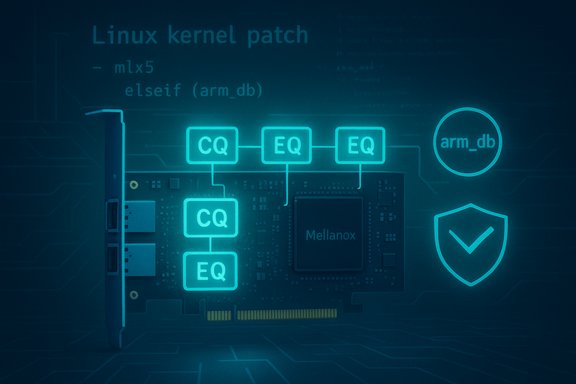 Background
The mlx5 driver (the upstream Linux kernel driver for Mellanox / NVIDIA ConnectX and BlueField adapters) implements the low‑level building blocks for RDMA and advanced NIC offloads. Two concepts are central to understanding this defect:- Completion Queues (CQs) — hardware‑backed rings where the NIC posts events (CQEs) to indicate completed Work Requests (WRs).
- Event Queues (EQs) and doorbells vs. polling — the hardware can notify the kernel via interrupts (EQs) or the software can poll the CQ for completions. Kernel CQs intended for polling must not be spuriously armed to receive EQ interrupts until they are explicitly initialized.
What the patch changes (overview)
The upstream patch makes two defensive, minimal changes to the CQ creation flow:- Install a dummy default completion function for all newly created CQs so that, even if an EQ triggers a CQ that has not been explicitly configured, the kernel will invoke a safe no‑op rather than a user‑mode tasklet helper — eliminating the null‑pointer window.
- Initialize the CQ arm state (the command sequence / arm_db) to an invalid sequence number by default for kernel CQs, ensuring the firmware will not interrupt polling‑only CQs until the driver explicitly arms them with mlx5_cq_arm.
Why this mattered: the technical risk
On paper, this is not a conventional "remote code execution" style CVE. The practical threat model is local or tenant‑adjacent: a user or process able to exercise RDMA verbs, create QPs/CQs or otherwise interact with the device driver can drive the edge conditions necessary to trigger the bug. The immediate observable effects reported are:- A kernel null‑pointer dereference or WARN trace when a polling‑only CQ is unexpectedly triggered by an EQ interrupt.
- Hanging or instability in RDMA‑heavy workloads where completion handling is critical (storage clusters, HPC, distributed fabrics).
- Potentially reproducible kernel faults on hosts with Mellanox/NVIDIA hardware when callers do not fully initialize CQ state before use.
The public record: commits and trackers
The vulnerability was cataloged under CVE‑2025‑68209 and entered mainstream vulnerability databases shortly after the patch was merged into the stable trees. The OSV/NVD entries summarize the change and link to the upstream commits in the kernel stable repository; the mailing‑list and netdev postings contain the actual patch diffs and developer rationale. The kernel patch note explicitly references the root cause and credits the fix as originating from a recent change that added SQ/CQ support for ASO (Address‑Space Object) and subsequently left unsafe initialization behavior in the generalized create path. Key public artifacts include:- The netdev / linux‑kernel patch submission and discussion that explain the two defensive defaults added to create CQ.
- OSV/NVD/aggregators that enumerated CVE metadata and pointed to the upstream commit IDs used for vendor backports.
A closer look: how the race manifests
To make the issue concrete, consider this simplified sequence:- Kernel code calls the common core path to allocate a CQ structure and program the hardware CQ context.
- Because the create routine left the CQ's completion pointer unset, the pointer resolves to a default that is only valid for user CQs.
- The CQ's arm_db (command sequence number used by CQ arming / doorbell semantics) is left with a valid value that the firmware recognizes as "armed."
- Before the driver has switched the CQ into its intended polling mode or installed a kernel completion handler, the firmware issues an EQ interrupt that targets the CQ.
- The EQ handling code invokes the completion callback — which for kernel CQs should not be the user‑tasklet helper — resulting in an invalid dereference and a kernel oops.
Who’s affected and how to prioritize
Affected binaries are kernels that include the mlx5 driver code paths that were changed — in other words, upstream Linux kernels and distribution kernels that have not yet applied the stable backport. Practical exposure depends on hardware and workloads:- High priority: Hosts with Mellanox/NVIDIA ConnectX or BlueField NICs used for RDMA, storage clustering, NFV or virtualization hosts that present RDMA devices to guests. Multi‑tenant hypervisors and cloud hosts are especially sensitive.
- Medium priority: Dedicated RDMA testbeds, HPC nodes, and storage servers that use kernel‑mode RDMA stacks.
- Low priority: Desktop or workstation systems without RDMA hardware or where the mlx5 kernel module is not loaded.
Detection, hunting and practical triage
Operational teams should prioritize kernel telemetry and narrow on mlx5‑specific patterns. Practical detection steps:- Check whether mlx5 kernel modules are present:
- lsmod | grep mlx5
- modinfo mlx5_core
- Inspect kernel logs for the null‑pointer/OOPS signature and related stack traces:
- journalctl -k | egrep -i 'mlx5|mlx5_core|mlx5_ib|BUG:|NULL pointer dereference|oops'
- dmesg | egrep -i 'mlx5|dispatch_event_fd|devx_event_notifier|mlx5_add_cq_to_tasklet'
- If you see hung threads waiting on RDMA completions, capture vmcore / kdump and the full dmesg before rebooting — the traces are ephemeral and may be lost on restart.
- Alert on kernel OOPS logs that mention mlx5 symbols or the specific "task blocked" traces tied to CQ handling.
- Correlate device attach/detach or representor/devlink operations around the crash time — many mlx5 problems surface during reconfiguration or driver reload cycles.
- In environments exposing RDMA to tenants, correlate user/tenant actions that create QPs/CQs with kernel log spikes.
Remediation and mitigations
The only reliable fix is to install a kernel that contains the upstream commit or vendor backport and reboot into it. Recommended steps:- Inventory hosts with mlx5 hardware (lspci, lsmod, ethtool -i).
- Check vendor/distribution advisories and package changelogs for the CVE or the upstream commit IDs; only treat a host remediated when the package explicitly lists the fix.
- Deploy patched kernels in a staged rollout (pilot → staging → production) and run your RDMA functional tests (MR deregistration, QP recovery, CQ arming flows) in the pilot ring.
- Reboot into the patched kernel and monitor kernel logs closely for two weeks after rollout to watch for regressions.
- If the workload does not require RDMA, consider blacklisting mlx5 modules temporarily (echo "blacklist mlx5_core" > /etc/modprobe.d/blacklist-mlx5.conf) — but be aware this removes NIC/RDMA capability.
- Restrict who can perform devlink, ethtool or other device reconfiguration operations to administrators only, reducing accidental triggers.
- Isolate RDMA hosts from multi‑tenant workloads until patched.
Critical analysis: strengths of the fix and remaining risks
Strengths- The patch is deliberately small, defensive and low‑risk: set safe defaults on create rather than attempt heroic rewrites. That makes backporting to stable kernel series straightforward and reduces regression risk.
- The changes directly close the root cause (unsafe defaults) rather than merely mitigating individual call sites with one‑off fixes.
- The approach aligns with standard kernel hardening patterns: ensure objects are fully initialized prior to publication and install conservative defaults that guarantee safe behavior until callers explicitly configure the object.
- Vendor and appliance lag: the long tail of vendor‑supplied or embedded kernels may remain vulnerable until vendors ship updated images. This is the single biggest operational exposure for many organizations.
- The fix guards a particular race and initialization bug but does not change hardware behavior: some firmware implementations still discard CQEs on RESET per IB semantics, and driver‑firmware interactions remain a delicate surface.
- The scenario remains an availability hazard; while there is no authoritative public proof‑of‑concept for privilege escalation or RCE anchored to this bug, lifecycle/race defects can sometimes be combined with other allocator or use‑after‑free issues in complex exploit chains. Absent a published PoC, treat escalation claims as unverified.
Recommended checklist for WindowsForum readers (practical, prioritized)
- Inventory and discovery (immediate)
- Identify hosts running Mellanox/NVIDIA NICs: lspci | grep -i mellanox
- List kernel versions and loaded mlx5 modules: uname -r; lsmod | egrep 'mlx5|mlx5_core|mlx5_ib'
- Confirm vendor patch status (short term)
- Check distro security trackers (Ubuntu, Debian, RHEL, SUSE, Amazon) for the CVE and backport mapping.
- For Azure customers, check Azure Linux advisories and the vendor image’s kernel packages; do not assume an image is patched merely because upstream is.
- Apply and validate (operational)
- Deploy patched kernel packages in a pilot ring.
- Reboot and run RDMA test harnesses exercising CQ creation, CQ arm, MR deregistration and QP RESET flows.
- Confirm that previously reproducible hangs or oops traces no longer appear.
- Containment if you cannot patch immediately
- Restrict who can run devlink/rdma tools; consider isolating or migrating critical workloads to patched hosts.
- As a last resort, unload mlx5 modules — but only after evaluating the functional impact on services.
Example detection commands and sample log signatures
- Check module presence:
- lsmod | grep mlx5
- Quick kernel log searches:
- journalctl -k | egrep -i 'mlx5|mlx5_core|dispatch_event_fd|devx_event_notifier|mlx5_add_cq_to_tasklet'
- dmesg | tail -n 200 | egrep -i 'BUG:|NULL pointer dereference|oops|task .* blocked'
- Verify package changelog / kernel contains the fix:
- zgrep -n "CVE-2025-68209" /usr/share/doc/*/changelog.Debian.gz
- rpm -q --changelog kernel | grep -i mlx5
Final assessment
CVE‑2025‑68209 is a classic example of how small initialization mistakes in a complex kernel driver can create outsized operational hazards. The upstream response is appropriately conservative: add safe defaults to the CQ creation path so that a CQ is always in a safe, non‑interrupting state until the caller explicitly configures it. That makes the fix inherently low‑risk to apply and straightforward for distributors to backport.Operational priorities are clear: inventory RDMA‑equipped hosts, confirm vendor backports, stage and test patched kernels, and address the vendor image long tail. For Windows‑centric environments that host Linux guests, WSL kernels or Azure Marketplace images, perform artifact‑level verification rather than assuming safety from a single vendor listing. The technical fix restores a deterministic invariant in mlx5’s CQ handling; the remaining work for administrators is systems engineering — test, patch, and verify — to prevent a rare kernel nil dereference from becoming an incident.
CVE‑2025‑68209 is therefore an important, actionable maintenance item: fix the kernel packages where they are in use, confirm vendor images are updated, and tighten detection for mlx5‑related kernel oopses so that any remaining vulnerable systems are quickly identified and remediated.
Source: MSRC Security Update Guide - Microsoft Security Response Center
