

A newly assigned CVE, CVE-2025-68257, closes a subtle but dangerous gap in the Linux kernel’s COMEDI driver by ensuring compat ioctl handlers verify whether a device is actually attached before performing operations — a change that eliminates a reproducible NULL-pointer kernel crash reported by automated fuzzing and hardens legacy 32-bit compatibility paths against misuse.
The COMEDI subsystem (Control and Measurement Device Interface) is a long-standing Linux kernel driver set that exposes data acquisition and instrumentation hardware to user space via device nodes and ioctl interfaces. COMEDI’s ioctl surface includes both modern (native) ioctl handlers and compat wrappers that allow 32-bit userland to interface with 64-bit kernels or otherwise provide backward compatibility. These compat handlers are subtle: they mirror the behavior of native ioctls but must preserve the same preconditions, checks, and validation to avoid introducing new failure modes.
Syzbot — an automated kernel fuzzing and crash-reporting system — flagged a kernel oops originating in COMEDI code where a NULL pointer dereference occurred while attempting to call dev->get_valid_routes. The callback in question should have been set by device setup code, but it was absent when a compat ioctl path invoked the operation on an unconfigured device. In short: compat ioctl variants omitted a sanity check that the device was attached/initialized, allowing certain ioctl code paths to run against a partially configured or unconfigured device and trigger a kernel crash. The vulnerability entry and editorial summary were published in the NVD and multiple tracking mirrors on December 16, 2025.
For defenders, the practical takeaway is twofold: prioritize patching systems that expose COMEDI device nodes or run 32-bit compatibility workloads, and treat compat syscall paths as first-class members of the test matrix for kernel fuzzing and regression testing. Operationally, the path to remediation is clear: apply the kernel update from your distribution or vendor and verify with logs and package changelogs. Where patching cannot be immediate, reduce exposure by restricting device access and isolating affected hosts.
Administrators should consult their distribution security trackers and vendor advisories to map package versions to the upstream stable commits referenced in the CVE records, validate fixes in test environments, and roll updates with appropriate reboots. The recorded Syzbot crash traces and the upstream commit references provide the necessary artifacts for technical validation; operators should verify their binaries against patched sources or package changelogs before declaring hosts remediated.
Conclusion: this CVE is a clear example of defensive hygiene — ensure preconditions in all syscall paths — and the remedy is straightforward: patch your kernels, restrict untrusted access to COMEDI devices in the interim, and improve testing for compat ioctl coverage so the next subtle mismatch is caught before it finds a production user.
Source: MSRC Security Update Guide - Microsoft Security Response Center
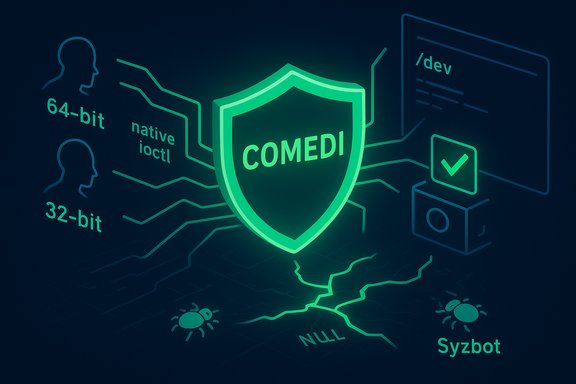 Background / Overview
The COMEDI subsystem (Control and Measurement Device Interface) is a long-standing Linux kernel driver set that exposes data acquisition and instrumentation hardware to user space via device nodes and ioctl interfaces. COMEDI’s ioctl surface includes both modern (native) ioctl handlers and compat wrappers that allow 32-bit userland to interface with 64-bit kernels or otherwise provide backward compatibility. These compat handlers are subtle: they mirror the behavior of native ioctls but must preserve the same preconditions, checks, and validation to avoid introducing new failure modes.Syzbot — an automated kernel fuzzing and crash-reporting system — flagged a kernel oops originating in COMEDI code where a NULL pointer dereference occurred while attempting to call dev->get_valid_routes. The callback in question should have been set by device setup code, but it was absent when a compat ioctl path invoked the operation on an unconfigured device. In short: compat ioctl variants omitted a sanity check that the device was attached/initialized, allowing certain ioctl code paths to run against a partially configured or unconfigured device and trigger a kernel crash. The vulnerability entry and editorial summary were published in the NVD and multiple tracking mirrors on December 16, 2025.
What exactly went wrong — technical root cause
At its core the bug is a logic mismatch between two layers:- The modern (native) COMEDI ioctl handlers use a consolidated entrypoint that performs a device-attached sanity check — typically via helpers such as comedi_unlocked_ioctl — before invoking specific ioctl implementations.
- Several compat (compatibility) ioctl variants were implemented by copying the logic from their native equivalents but were modified in ways that removed or bypassed the attached check. As a result, these compat handlers could call into device-specific routines even when the device was not fully set up, allowing dereferences like dev->get_valid_routes where the callback pointer had not been initialized.
- It surfaces predominantly in compat/32-bit syscall paths (i386 userland interacting with a 64-bit kernel or other compatibility contexts), which receive far less focused testing in many CI pipelines.
- The eventual crash is a NULL-pointer dereference — an obvious failure mode once triggered, but one that requires the right combination of unconfigured device state and compat ioctl invocation to appear.
- Automated fuzzers such as Syzbot are especially effective at finding these exact races or precondition lapses by exercising unusual sequences of ioctl calls that real-world userland rarely performs.
Affected scope and what to inventory
The canonical vulnerability descriptions indicate the issue was found in the in-tree Linux kernel sources and addressed via stable-branch commits. Public vulnerability mirrors list several stable commits associated with the remedy; the CVE record references kernel stable commits that implement the check in drivers/comedi/comedi_fops.c. Administrators and kernel packagers should treat any kernel build containing the vulnerable COMEDI sources prior to the stable commits listed in the tracking entries as potentially exposed. Practical populations at risk:- Systems that expose COMEDI device nodes to untrusted or semi-trusted userland, especially multi-user workstations and development hosts that permit user processes to access device nodes under /dev.
- Embedded and industrial appliances that include COMEDI support for data-acquisition hardware; these devices commonly run vendor-forked kernels and may lag upstream backports.
- 32-bit userland or compatibility layers interacting with 64-bit kernels (the bug primarily manifested in i386 / compat syscall contexts in the reports).
- Identify whether COMEDI support is present and whether related modules are loaded:
- lsmod | grep comedi
- grep -i COMEDI /boot/config-$(uname -r) (or examine /proc/config.gz)
- Determine whether your environment exposes COMEDI device nodes to non-privileged users (ls -l /dev/comedi or other vendor-specific nodes).
- For distributions, consult your vendor’s kernel security advisories and package changelogs to map installed kernel package versions to the upstream stable commits associated with the CVE. Public trackers include references to the stable commits that shipping distributions should have backported.
Exploitability, impact, and realistic threat model
Nature of the impact:- The observed failure mode is a NULL-pointer dereference in kernel space, producing an oops and likely a kernel crash or reboot. This is fundamentally an availability impact — a denial of service — rather than a straightforward privilege escalation or arbitrary code-execution primitive.
- Kernel NULL dereferences can, in rare circumstances combined with other bugs, escalate into more serious integrity violations, but no evidence at disclosure suggested that this particular bug directly enables arbitrary code execution.
- Local: an attacker or misbehaving local process must be able to invoke the relevant COMEDI ioctls (compat ioctl paths) against the device node or influence COMEDI device configuration sequences.
- The bug is particularly reachable when COMEDI devices can be opened and manipulated by unprivileged processes or containers, or when device configuration can be triggered via COMEDI_DEVCONFIG-like interfaces.
- The Syzbot reports suggest the crash reproducibly appears in i386 syscall compatibility contexts; therefore devices or hosts that support 32-bit userland interacting with the kernel are higher-risk in practice.
- At disclosure time there were no credible public exploits demonstrating privilege escalation or remote compromise based on this CVE. The immediate practical impact is DoS. Automated fuzzing produced reliable kernel oops traces, which is why this issue received a CVE and a prompt upstream fix.
- The Exploit Prediction Scoring System (EPSS) and exploit feeds were either low or unassigned at disclosure, reflecting a low short-term likelihood of targeted exploitation beyond local attack scenarios.
- High priority for environments where unprivileged processes or containerized workloads can access COMEDI device nodes (multi-tenant hosts, CI runners, developer workstations).
- Medium priority for typical desktop systems unless COMEDI devices are exposed; the attack vector remains local and not trivially remote.
- Critical to patch for embedded / industrial devices that include COMEDI support and are managed by vendors, because such devices often run long-lived kernels that do not receive frequent updates.
The upstream fix and how it was implemented
Upstream kernel maintainers applied a minimal and defensive patch to bring compat ioctl handlers into parity with native paths. The change ensures that compat handlers check the device’s attached/initialized status before execution, thereby guaranteeing that callbacks like dev->get_valid_routes are set and valid prior to use. This is intentionally a small correction — the goal is to restore precondition checks rather than redesign APIs — which makes the change easy to review and safe to backport into stable kernel branches. References to the stable commits appear in public vulnerability trackers and distribution advisories. Note on verifying the exact commit: several stable commit hashes associated with the remedy are recorded in CVE trackers; operators who build kernels from source or maintain vendor kernels should cross-check those commit IDs against their own trees. If your environment blocks access to git.kernel.org or similar mirrors, consult your distribution’s security tracker or package changelog to confirm the presence of the fix. (In some restricted environments, fetching raw kernel.org pages may fail; use mirrored advisory pages or distribution changelogs as alternate verification.Remediation and mitigation: a prioritized runbook
- Patch first (definitive)
- Apply vendor- or distribution-provided kernel updates that include the upstream stable commits for CVE-2025-68257.
- Reboot hosts into the updated kernel to make the fix active.
- For custom kernels, merge the upstream stable commit(s) into your kernel tree, rebuild, and deploy.
- Rationale: kernel fixes for NULL-pointer dereferences require kernel code changes and a reboot to take effect.
- Short-term compensations if you cannot patch immediately
- Restrict access to COMEDI device nodes using udev rules or file permissions: remove world access and limit nodes to a trusted group.
- For containerized workloads, ensure COMEDI devices are not bind-mounted into untrusted containers or VMs.
- If device functionality is not required, consider unloading the COMEDI kernel modules until a patched kernel can be applied (be mindful of service or hardware dependencies).
- Detection and hunting
- Inspect kernel logs for oops traces and call stacks mentioning drivers/comedi/comedi_fops.c or get_valid_routes.
- Example commands:
- journalctl -k | grep -i comedi
- dmesg | grep -i comedi
- If you see repeated NULL dereference or call traces referencing parse_insn, do_insnlist_ioctl, compat_insnlist, or comedi_compat_ioctl, prioritize patching those hosts immediately.
- Validation after patching
- Confirm the running kernel (uname -r) matches the patched package and review the package changelog for the referenced stable commits.
- Re-run any instrumentation or tests that previously triggered the issue (if you exercised the crash during validation) to confirm stability.
- Vendor coordination for embedded devices
- For appliances and industrial controllers that use vendor-provided kernels, open support tickets requesting patched firmware/kernel images with the CVE fix backported.
- Document devices that cannot be patched and apply mitigations such as network segmentation and strict local device access controls.
Security operations checklist — practical steps for SOCs and admins
- Inventory:
- Identify hosts with COMEDI support: lsmod | grep comedi and check /dev for COMEDI nodes.
- Map which images, VMs, or embedded appliances include COMEDI in their kernel builds.
- Patch rollout:
- Stage kernel updates in test environments and validate with representative workloads.
- Roll out patches using phased deployments; reboot as required.
- Monitoring:
- Add SIEM rules to alert on kernel oops patterns or strings tied to the COMEDI stack.
- Retain kernel logs and crash dumps for forensic analysis in case of suspected exploitation.
- Compensating controls:
- Use udev to restrict node permissions; example udev rule pattern: ACTION=="add", KERNEL=="<comedi-node>", OWNER="root", GROUP="trusted", MODE="0660".
- For virtualized platforms, block passthrough of COMEDI-like devices into untrusted guests.
Critique and analysis: strengths of the fix and remaining risks
Strengths- The patch is surgical and minimal, which aligns with kernel maintainers’ best practices for stable backports and reduces the chance of regressions.
- Restoring parity between native and compat ioctl paths addresses a common source of compatibility-layer regressions and hardens a wide swath of legacy syscall handling.
- The fix was driven by automated fuzzing (Syzbot), showcasing the effectiveness of continuous kernel fuzz-testing at catching subtle precondition lapses that human reviewers can miss.
- The vulnerability highlights a more systemic risk: compatibility wrappers (compat ioctl, 32-bit compatibility paths, etc. are often copy-pasted and can diverge from native logic, creating latent bugs. The long-term mitigation is better automated coverage for compat paths in CI and fuzzing suites.
- Vendor- and OEM-supplied kernels for embedded devices remain the largest operational exposure: these devices commonly lag in receiving upstream stable security backports. Operators must track vendor advisories and plan for extended remediation windows.
- Although the bug is DoS-oriented at disclosure, NULL-pointer dereferences in kernel context can sometimes be chained with other bugs in targeted attacks. Maintainers and defenders should not treat DoS-only CVEs as low priority in high-value or multi-tenant environments.
- In restricted environments where kernel.org commit pages cannot be fetched, operators should rely on distribution advisories and change logs for authoritative confirmation; do not assume a package is fixed without explicit changelog or vendor confirmation.
How operators should communicate and prioritize this CVE internally
- Triage classification:
- Mark as high-priority for any host where unprivileged users or containers can access COMEDI device nodes.
- Mark as medium-priority for desktop fleets where such device access is restricted.
- For embedded/industrial devices with vendor kernels, treat as high-priority for vendor engagement and require formal SLAs for remediation.
- Messaging to stakeholders:
- Communicate that the fix is a kernel update requiring reboot and that the immediate risk is local denial of service rather than remote code execution.
- Provide a clear remediation timeline, prioritizing exposed multi-tenant systems and devices that expose COMEDI nodes to untrusted processes.
- Post-remediation verification:
- Ensure reboot completeness and collect proof of patching (package changelogs, uname -r, kernel build metadata) before closing tickets.
Closing analysis
CVE-2025-68257 is an instructive example of how compatibility layers and minor codepath divergences can create severe reliability bugs in kernel space. The vulnerability did not stem from exotic memory corruption; it arose from a missing sanity check in compat ioctl handlers that allowed device-specific callbacks to be invoked before devices were fully configured. The upstream remedy is deliberately modest — enforcing the same attached-device check across compat and native ioctl paths — and is therefore low-risk to apply and straightforward to backport.For defenders, the practical takeaway is twofold: prioritize patching systems that expose COMEDI device nodes or run 32-bit compatibility workloads, and treat compat syscall paths as first-class members of the test matrix for kernel fuzzing and regression testing. Operationally, the path to remediation is clear: apply the kernel update from your distribution or vendor and verify with logs and package changelogs. Where patching cannot be immediate, reduce exposure by restricting device access and isolating affected hosts.
Administrators should consult their distribution security trackers and vendor advisories to map package versions to the upstream stable commits referenced in the CVE records, validate fixes in test environments, and roll updates with appropriate reboots. The recorded Syzbot crash traces and the upstream commit references provide the necessary artifacts for technical validation; operators should verify their binaries against patched sources or package changelogs before declaring hosts remediated.
Conclusion: this CVE is a clear example of defensive hygiene — ensure preconditions in all syscall paths — and the remedy is straightforward: patch your kernels, restrict untrusted access to COMEDI devices in the interim, and improve testing for compat ioctl coverage so the next subtle mismatch is caught before it finds a production user.
Source: MSRC Security Update Guide - Microsoft Security Response Center
