

The Linux kernel received a targeted fix for CVE-2025-68344 — an integer overflow in the ALSA wavefront driver's sample-size validation — that closes a corner-case bug where a 32‑bit size field was cast to a signed integer and compared in a way that could wrap and produce incorrect bounds; operators should treat this as a kernel-level availability hazard, inventory affected images and kernels, and deploy vendor-supplied kernel packages or upstream-stable backports as the definitive remedy.
ALSA (Advanced Linux Sound Architecture) hosts a wide array of audio drivers and controller glue within the Linux kernel. One of those drivers — identified in the public CVE record as wavefront — had a validation routine that compared a sample header size (declared as an unsigned 32‑bit integer) against an available memory or buffer size after a cast to a signed type. The mismatch produced an integer overflow/wrap in corner cases, creating an out‑of‑range condition the kernel could later use to index or size buffers incorrectly. Public vulnerability trackers recorded the issue and linked upstream stable-tree commits that implement the fix. This style of bug is a recurring pattern in kernel code: arithmetic performed in a narrower signed type can wrap or truncate before the result is promoted, producing a value that looks reasonable numerically but is semantically incorrect for allocation or pointer arithmetic. Upstream maintainers typically prefer surgical fixes — promoting the operand to an unsigned/pointer-width type or using explicit bounds checks — because these changes are low risk and easy to backport into distribution kernels.
CVE-2025-68344 is a classic example of how small type-safety mistakes in kernel drivers produce outsized operational impact. The upstream remedy is intentionally minimal and reliable; the real work for defenders is tactical — inventory, patch, reboot — and strategic — harden processes for long-tail assets and tighten controls on device attachment and passthrough in virtualized environments.
Source: MSRC Security Update Guide - Microsoft Security Response Center
 Background
ALSA (Advanced Linux Sound Architecture) hosts a wide array of audio drivers and controller glue within the Linux kernel. One of those drivers — identified in the public CVE record as wavefront — had a validation routine that compared a sample header size (declared as an unsigned 32‑bit integer) against an available memory or buffer size after a cast to a signed type. The mismatch produced an integer overflow/wrap in corner cases, creating an out‑of‑range condition the kernel could later use to index or size buffers incorrectly. Public vulnerability trackers recorded the issue and linked upstream stable-tree commits that implement the fix. This style of bug is a recurring pattern in kernel code: arithmetic performed in a narrower signed type can wrap or truncate before the result is promoted, producing a value that looks reasonable numerically but is semantically incorrect for allocation or pointer arithmetic. Upstream maintainers typically prefer surgical fixes — promoting the operand to an unsigned/pointer-width type or using explicit bounds checks — because these changes are low risk and easy to backport into distribution kernels.What the CVE actually describes
The core defect (plain language)
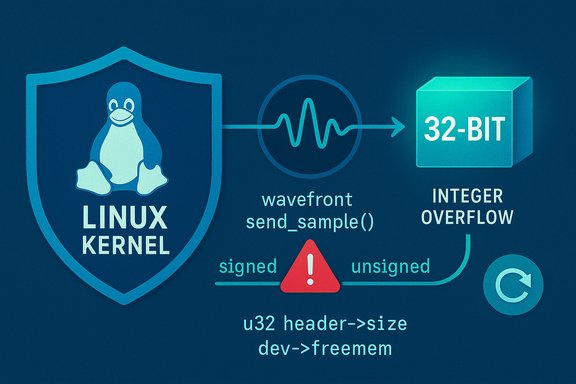
The vulnerable function — referenced in public records as wavefront_send_sample — validated an incoming sample's declared size by reading a header->size field that is defined as an unsigned 32‑bit integer (u32). That value was cast to a signed int when compared to a device-side free-memory counter (dev->freemem), so very large values or crafted inputs could make the signed comparison evaluate incorrectly due to integer wrapping. The fix is straightforward: perform an unsigned comparison (or otherwise promote to a sufficiently wide unsigned type) so the arithmetic cannot overflow and the validation is correct for the full u32 range.Why this matters in kernel space
Kernel code runs with full privileges; a miscomputed size or offset can produce an out‑of‑range access that leads to a kernel oops or panic. In most realistic threat models for this kind of bug the immediate consequence is availability — crashes, system instability, or service interruption — rather than a direct, reliable remote code execution primitive. That said, kernel crashes and memory corruption are powerful primitives in multi-stage exploit chains, so defenders should not dismiss the potential for escalation if other weaknesses exist. Public trackers and early analysis characterize this CVE primarily as an overflow/availability issue.Who is affected, and how severe is the risk?
- Systems running a Linux kernel that includes the ALSA wavefront driver are the primary population in scope. The exact exposure depends on kernel configuration (whether the driver was built in or as a module) and whether the code path is reachable on the running host.
- The attack surface is local or local-adjacent: exploitation requires the ability to exercise the wavefront code path (for example, by opening or streaming to the affected audio device, or by presenting a crafted/virtualized device descriptor in environments that accept device passthrough). This makes typical remote-network-only exploitation less likely, but not impossible in virtualization or cloud scenarios where device emulation/passthrough is allowed.
- Immediate practical impact is denial of service (kernel oops/panic). Distributions and vendors generally rate such bugs moderate-to-high on availability impact — the exact numeric severity (CVSS) may be pending in central repositories. Early automated scoring (EPSS) appears low, consistent with the requirement for local interaction to trigger the flaw.
The upstream fix and provenance
Upstream kernel commits referenced by the public CVE record implement a minimal and targeted change: avoid casting the u32 header->size to a signed int and instead use an unsigned/pointer-width comparison (or otherwise promote the type) so the validation remains correct for the entire unsigned range. The CVE entry and multiple vulnerability aggregators cite stable-tree commits as the canonical fix references. Those commits have been merged into upstream and marked for stable backports, enabling distribution maintainers to cherry-pick them into vendor kernel packages. Because the fix is small and localized, it is well-suited to inclusion in stable branches — this reduces regression risk and shortens the time needed for distributors to publish patched kernel packages. Public trackers list the git commits and reference IDs that distribution security teams can use when mapping the CVE to fixed package versions.Detection and immediate mitigation guidance
Operators should treat this as a kernel-level issue that needs a package-level fix and a reboot. Use the following practical checklist to triage and mitigate exposure quickly.Quick inventory (commands to run)
- Confirm the running kernel version:
- uname -r
- Check whether a wavefront-related module or object exists on the system:
- grep -i wavefront /lib/modules/$(uname -r) -R || lsmod | grep -i wavefront
- If the driver was built into the kernel rather than provided as a module, search the kernel config:
- zcat /proc/config.gz | grep -i WAVEFRONT || grep -i wavefront /boot/config-$(uname -r)
- Inspect kernel logs for symptomatic traces:
- journalctl -k | grep -i wavefront
- dmesg | grep -i -E 'wavefront|snd|ALSA|pcm|oops'
Short‑term mitigations (when patching is delayed)
- Unload or blacklist the driver module (if present). Example:
- sudo modprobe -r wavefront
- To prevent automatic loading after reboot, create a blacklist file under /etc/modprobe.d/ with the single line: blacklist wavefront
- Warning: blacklisting will disable the affected audio functionality for the device(s) involved. This is a trade-off between availability of audio features and system stability.
- Restrict USB/attached-device acceptance and virtualization device passthrough for untrusted guests or co-tenants. In cloud environments, disable or limit device passthrough features until patched images are available.
- Monitor for kernel oopses and repeatedly failing audio sessions; these symptoms can indicate attempted or accidental triggering of the vulnerable path.
Remediation playbook (recommended steps)
- Inventory: Identify all hosts and images that run kernels with ALSA audio enabled and that either compile or load the wavefront driver. Use package management and image manifests to locate kernels used by VMs, containers, WSL/guest kernels, and cloud images.
- Map: Consult your distribution’s security advisory and kernel package changelog for CVE-2025-68344 to find the fixed package versions. Public trackers and distributors will map the upstream commits to specific package releases.
- Patch: Apply official vendor/distribution kernel packages that include the backported fix, or — for custom kernels — merge the upstream stable commit and rebuild the kernel following your standard test and deployment processes.
- Reboot: Because this is a kernel-level patch, reboot the host into the updated kernel to complete remediation.
- Verify: After reboot, confirm the removed module is updated (modinfo wavefront), run dmesg and journalctl to ensure no audio-driver oopses occur, and validate the functionality of any dependent audio workloads.
Technical analysis — why the bug likely leads to DoS, not RCE
- The root pattern is mixed-width arithmetic and signedness mismatch: an unsigned value is cast to signed before comparison, allowing large values to wrap into the signed domain and pass a size check they should fail. When this wrapped or truncated value is subsequently used to compute allocation sizes or buffer offsets, the kernel ends up accessing out-of-range memory and generates an oops.
- For an attacker to escalate to reliable arbitrary code execution from such a correctness bug usually requires additional conditions (predictable allocator behavior, heap metadata corruption primitives, or other memory-corruption vectors in the same process). Public community writeups emphasize availability as the most probable outcome for this class of kernel bug and reserve RCE as theoretically possible but speculative without a demonstrated proof-of-concept.
- In multi-tenant or virtualized environments where a malicious host or co‑tenant can present a crafted device descriptor via passthrough, the attacker model becomes more realistic for causing repeated crashes and denial-of-service; organizations with such setups should prioritize remediation.
Operational risks and the long tail
Two operational realities amplify the practical risk from kernel driver CVEs:- Vendor forks and embedded devices: OEM and embedded kernels are often long‑lived and may not pick up upstream fixes promptly. Devices shipped with older kernel forks can remain exposed for months or years. This is a known pattern for audio-subsystem CVEs and requires product teams to track and push backports to device images.
- Cloud and virtualization complexity: cloud images, marketplace artifacts, and virtual appliances are distinct artifacts; a vendor-level attestation for one family (for example, Azure Linux images) does not automatically cover all images the vendor distributes. Each artifact must be inventoried and validated for the presence of the vulnerable component. Microsoft explicitly noted such product‑by‑product mapping in its early VEX/CSAF attestations.
Recommended monitoring and detection rules
- Alert on kernel oops and panic events in your logging/telemetry systems and correlate them with device attach/detach events and /dev/snd access. Repeated or correlated oops events synchronous with USB or IEEE-1394 device operations are a high-fidelity indicator of attempted triggers.
- For virtualization platforms, monitor and audit guest device passthrough operations and restrict passthrough to trusted images only. For hypervisors that permit host-to-guest device emulation, place strict controls on untrusted guests and co-tenants.
- Inventory images and packages using automation: gather uname -r / package metadata, then match kernel package versions against distribution security trackers and advisory mappings that list fixed kernels. This is the only reliable, scalable way to ensure coverage.
What the public record does — and does not — tell us
- The CVE description and multiple aggregator entries (OSV, CVE‑Details, OpenCVE) clearly summarize the technical root cause (signed cast of u32 and incorrect comparison) and point to upstream stable commits that implement the fix. Those references provide sufficient provenance to trust the technical summary and to map fixes to stable kernels.
- Public trackers and community writeups do not (as of publication) show an authoritative proof‑of‑concept or confirmed active exploitation in the wild for this specific CVE. Absence of observed exploitation should not be treated as absence of risk; local exploitability and the long tail argue for timely patching. Be explicit in threat modeling that the most probable outcome is DoS, although escalation cannot be categorically ruled out without further evidence.
- When a vendor publishes an artifact-level attestation (for example, Microsoft’s initial mapping for Azure Linux images), that is authoritative for the vendor artifact it names, but it is not a global assertion about all artifacts the vendor produces; defenders must verify other images and kernels independently until each is attested.
Final recommendations (short list)
- Prioritize kernel updates: apply vendor patches or upstream stable backports that include the commit(s) referenced in the CVE and reboot affected hosts.
- Inventory and verify: run checks for wavefront-related modules or identifiers and map running kernels to distribution advisories and fixed package versions.
- Use mitigations when you cannot immediately patch: unload or blacklist the driver module (with the expected loss of audio functionality) and restrict device passthrough.
- Monitor aggressively for kernel oops traces tied to audio subsystems and correlate with device attachment events.
- Track embedded and vendor kernels separately: OEM devices and appliances often lack timely backports and require vendor outreach.
CVE-2025-68344 is a classic example of how small type-safety mistakes in kernel drivers produce outsized operational impact. The upstream remedy is intentionally minimal and reliable; the real work for defenders is tactical — inventory, patch, reboot — and strategic — harden processes for long-tail assets and tighten controls on device attachment and passthrough in virtualized environments.
Source: MSRC Security Update Guide - Microsoft Security Response Center
