

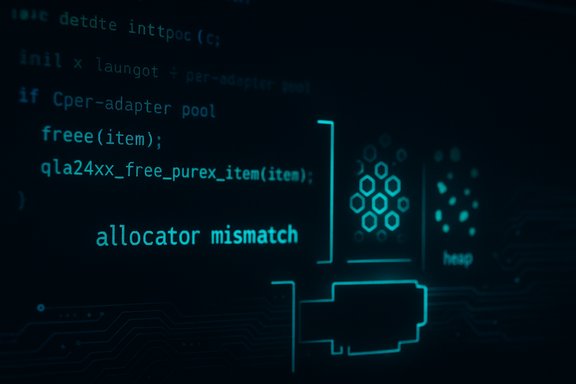
A subtle but consequential memory-handling bug in the Linux kernel’s qla2xxx SCSI driver has been assigned CVE-2025-68741 and patched upstream: an error path in qla2xxx_process_purls_iocb used kfree to release a structure that may have been drawn from a per-adapter pre‑allocated pool, which can lead to memory corruption; the fix replaces kfree with the driver’s proper allocator-aware deallocator, qla24xx_free_purex_item.
The qla2xxx driver family implements support for QLogic/Marvell Fibre Channel host bus adapters in the Linux kernel and has accumulated NVMe‑over‑Fibre-Channel enhancements in recent releases. The vulnerability is rooted in the interaction between two helper routines in that codepath: qla27xx_copy_multiple_pkt, which can produce a "purex item" via qla24xx_alloc_purex_item, and the error-handling branch of qla2xxx_process_purls_iocb, which incorrectly frees that item with kfree. Because qla24xx_alloc_purex_item may hand back either a dynamically allocated object (kzalloc) or a pre‑allocated object from a fixed per‑adapter pool, calling kfree unconditionally on a pooled item is a use-after-free/heap-corruption risk. The upstream correction substitutes qla24xx_free_purex_item in place of kfree, ensuring the deallocation honors the allocation origin.
Source: MSRC Security Update Guide - Microsoft Security Response Center
 Background
The qla2xxx driver family implements support for QLogic/Marvell Fibre Channel host bus adapters in the Linux kernel and has accumulated NVMe‑over‑Fibre-Channel enhancements in recent releases. The vulnerability is rooted in the interaction between two helper routines in that codepath: qla27xx_copy_multiple_pkt, which can produce a "purex item" via qla24xx_alloc_purex_item, and the error-handling branch of qla2xxx_process_purls_iocb, which incorrectly frees that item with kfree. Because qla24xx_alloc_purex_item may hand back either a dynamically allocated object (kzalloc) or a pre‑allocated object from a fixed per‑adapter pool, calling kfree unconditionally on a pooled item is a use-after-free/heap-corruption risk. The upstream correction substitutes qla24xx_free_purex_item in place of kfree, ensuring the deallocation honors the allocation origin. Where this lives in the tree
The change is localized to drivers/scsi/qla2xxx/qla_nvme.c — specifically the error path inside qla2xxx_process_purls_iocb. Upstream stable-branch commits and kernel mailing-list patches show the single-line swap from kfree(item) to qla24xx_free_purex_item(item). The kernel advisory and CVE entries were posted in late December 2025.What the bug actually does (technical explanation)
At its core the flaw is an allocator-mismatch bug.- qla24xx_alloc_purex_item is a small-object allocator for the driver: for small, frequent allocations it can return an object from a per-adapter pool (no kzalloc); for larger or rare allocations it will call kzalloc and return a heap-allocated buffer.
- In one error branch inside qla2xxx_process_purls_iocb — a handler for NVMe link-service/unsolicited requests — the code assumed the item was always heap-allocated and invoked kfree.
- If the item returned was actually from the pool, kfree will attempt to free memory that was not allocated via kzalloc, corrupting allocator metadata or the pool structure itself. That corruption can manifest as kernel crashes (denial-of-service), memory corruption with unpredictable side effects, or—under particularly unlucky conditions—control-flow corruption or escalation possibilities.
Scope and likely impact
- Affected code: the qla2xxx kernel driver (drivers/scsi/qla2xxx), specifically NVMe-related handling in qla_nvme.c. The vulnerability is in the kernel source and therefore affects distributions and kernels that include the unpatched driver. Upstream sources list the CVE and reference the kernel commits.
- Attack surface: the vulnerable code executes in the kernel context and is invoked by processing NVMe‑over‑Fibre-Channel requests. The most immediate impacts are memory corruption and denial-of-service (kernel panic/hang). Whether this can be escalated to arbitrary code execution depends on the runtime layout, kernel hardening (KASLR, SMEP/SMAP, etc., and exploitability of the corruption pattern; no public proof-of-concept was published alongside the CVE at the time of disclosure. Because the flaw is in a path tied to NVMe-over-FC processing, remote exploitation typically requires access to the Fibre Channel fabric or an adjacent environment capable of delivering crafted FC NVMe traffic to the host.
- CVSS / severity: NVD’s record for CVE-2025-68741 was published with the description but had not supplied an NVD-calculated CVSS score at time of initial posting; third‑party trackers (e.g., Tenable) have assigned a medium severity, listing a CVSSv3 base score of 5.5 with an Access Vector consistent with adjacent/network access to the driver interface. Those scores should be treated as provisional until your distribution vendor publishes official guidance.
- Who should care most: enterprises using QLogic/Marvell HBAs, storage servers, hypervisor hosts, and any Linux systems participating in Fibre Channel NVMe fabrics. Systems that do not have the qla2xxx driver loaded or which do not expose NVMe-over-FC services are not directly affected.
Evidence and verification
Two independent types of primary evidence confirm the issue and fix:- The NVD entry for CVE-2025-68741 includes the vulnerability description and references to kernel commits; NVD’s record also shows the CVE as received on 24 December 2025. The NVD entry provides a neutral confirmation of the CVE details published by kernel.org.
- A kernel mailing list / patch submission archive contains the patch and unified diff that implements the fix: the one-line replacement in drivers/scsi/qla2xxx/qla_nvme.c (kfree → qla24xx_free_purex_item). This patch was posted by the driver maintainer set and is the actionable upstream change. Reviewing that diff provides a precise, verifiable change to the source code.
Why this matters for administrators and SREs
- Kernel-level memory corruption is high-risk by nature because it can destabilize systems and affect confidentiality/integrity/availability depending on exploitation.
- The affected driver handles storage networking traffic. On storage hosts and hypervisors, even intermittent kernel instability can cause multi-tenant outage, silent data corruption, or failover storms in clusters.
- Because the bug is a one-line allocator mismatch, it is trivial for maintainers to patch — but the real cost to operators is tracking, building, and rolling updated kernels across storage fleets without introducing regressions in storage path behavior.
Mitigation and remediation steps
- Immediate actions
- Confirm whether the qla2xxx module is present and loaded: run modinfo qla2xxx and lsmod | grep qla2xxx. If the module is not in use on a host, the risk is low.
- For hosts connected to Fibre Channel fabrics: consider isolating or restricting NVMe‑over‑FC traffic from untrusted initiators until patching is complete.
- Where possible, plan maintenance windows for kernel updates on storage hosts and hypervisors that host critical workloads.
- Patch and update
- Apply the upstream patch by updating to a kernel version that includes the qla2xxx fix from the stable tree, or apply your distribution’s security update once it is published. The NVD entry and OSV/packaging trackers list commit references for the fix.
- If you operate vendor-kernel packages (RHEL, SUSE, Ubuntu, Debian, Rocky, etc., monitor the respective security-tracker pages and package feeds for a backport or vendor advisory. Debian’s OSV-tracker and other distribution databases already list the CVE and potential affected kernel versions; follow your distro’s recommended upgrade path rather than a generic upstream kernel unless you manage kernel builds centrally.
- If you cannot update immediately
- As a short-term mitigation, restrict access to the storage network, apply zoning/ACLs in the Fibre Channel fabric, and harden host-level controls (remove untrusted initiators). This reduces the chance that untrusted traffic will trigger the vulnerable code path.
- Consider unloading the qla2xxx module where feasible and supported — but be aware that removing the module will disrupt attached storage if the adapter is in use.
- Long-term
- Incorporate kernel-driver vulnerability checks into baseline audits.
- For storage-critical workloads, maintain a test lab to validate kernel updates against NVMe-over-FC functionality and vendor firmware versions to avoid regressions.
Detection: how to find vulnerable systems
- Kernel version / module checks:
- Run uname -a to list kernel version and check your distro kernel changelogs for the qla2xxx fix.
- Use modinfo qla2xxx to get module versioning and parameters.
- Examine dmesg and /var/log/messages for qla2xxx / nvme‑fc startup logs that indicate the driver is active.
- Package and distribution tracking:
- Consult your distribution’s security tracker and the NVD entry for CVE-2025-68741 to see whether your shipping kernel series is listed as affected or patched. Debian/OSV listings enumerate affected kernel releases; check your distro’s package metadata for security fixes.
- Runtime anomaly detection:
- Monitor for kernel oops/panic patterns, unexplained storage-side hangs, and logs indicating allocator corruption. A sudden increase in kernel oopses affecting qla2xxx or nvme‑fc call traces merits immediate investigation.
Practical patching guidance (step-by-step)
- Inventory
- Identify hosts with qla2xxx loaded:
- Command: lsmod | grep qla2xxx; modinfo qla2xxx.
- Tag systems that are NVMe-over-FC endpoints or initiators.
- Test
- In a staging environment with representative FC fabrics, deploy a kernel that contains the upstream fix and validate storage I/O and NVMe‑FC behavior (connectivity, failover, multipathing).
- Deploy
- Follow your standard kernel rollout: schedule maintenance windows, update packages via your package manager (apt, yum/dnf, zypper), or deploy a vendor kernel that includes the fix.
- Reboot hosts to load the updated kernel and re-confirm qla2xxx behavior.
- Verify
- Post-update, confirm that the module uses the updated code path (dmesg messages and lack of new oopses).
- Re-run any storage test suites that check for stability under load.
Developer and vendor notes (for kernel engineers and integrators)
- The fix is minimal and correct: use the matching allocator deallocator pair (qla24xx_alloc_purex_item ↔ qla24xx_free_purex_item). This pattern prevents double-free/use-after-free when pooled objects are returned to the pool rather than freed with kfree.
- If backporting to older, vendor-maintained kernels, ensure that qla24xx_free_purex_item and its data structures (pool metadata) are present in your tree; if not, backport both the allocator and the free routine as a unit.
- Review other qla2xxx codepaths for similar allocator-mismatch patterns; a single oversight often indicates other places where pooled vs. heap allocations are mixed.
Risk analysis and recommendations
- Strengths of the upstream response:
- The maintainers produced a focused, single-line change that directly addresses the error; the patch is non-invasive and easy to audit.
- The issue was tracked through the CVE/NVD pipeline and made visible to vendors and integrators quickly.
- Remaining risks and caveats:
- Exploitability uncertainty: while memory corruption exists, a working exploit requires delivery of crafted NVMe-over-FC traffic and favorable heap/layout conditions. There was no public proof-of-concept at disclosure, but the presence of a kernel memory-corruption bug in a storage driver is a meaningful risk in sensitive deployments.
- Distribution lag: many environments rely on vendor-supplied kernels; patch windows can be long in enterprise settings. Operators should prioritize storage and hypervisor hosts for rapid deployment of kernel updates.
- Detection and forensics: memory corruption can produce noisy or ambiguous indicators, and attacks that do not leave clear logs may be difficult to confirm after the fact. Maintain good logging and kernel crash collection (kdump) to aid analysis.
- Practical recommendation:
- Treat CVE-2025-68741 as a patch-now-if-you-are-on-storage/hypervisor hosts item. For non-storage edge or desktop hosts without qla2xxx loaded, track but deprioritize.
FAQ: quick answers
- Is my machine vulnerable if it has the qla2xxx module available but not loaded?
- Risk is considerably lower if the module isn’t loaded and the adapter isn’t in use; however, confirm that the module won’t be auto-loaded by udev or hotplug in your environment. Use modprobe.blacklist for temporary mitigation if operationally acceptable.
- Will a reboot be required?
- Yes: kernel-level driver fixes require reboot to load the updated kernel (or an out-of-tree module replacement and careful testing). Plan reboots during maintenance windows.
- Are there any published exploits?
- At disclosure there were no public PoCs tied to CVE-2025-68741. That does not mean exploitation is impossible; kernel memory-corruption bugs have been weaponized historically. Maintain vigilance and apply patches.
Conclusion
CVE-2025-68741 is a textbook example of an allocator-mismatch bug in a kernel driver: a small, single-line error that nevertheless opens the door to kernel memory corruption when triggered. The fix is straightforward and present in upstream; what matters now is operational follow-through. Storage administrators and SREs running QLogic/Marvell adapters, NVMe‑over‑FC endpoints, or any systems with the qla2xxx driver should prioritize confirming exposure, testing the updated kernel in staging, and rolling the vendor-supplied fix into production. Given the code’s role in storage networking, even intermittent instability can cause significant downstream impacts; swift, measured patching and fabric access control are the prudent defenses.Source: MSRC Security Update Guide - Microsoft Security Response Center
