

Libsodium's ed25519 point-validation routine contains a subtle but important bug that can let malformed points slip past validation in niche workflows, a flaw tracked as CVE-2025-69277 and fixed in the commit
Libsodium has long been the portable, easy-to-use cryptography toolkit for applications that need safe, high-level primitives. It exposes both high-level functions and several low-level utilities that some developers use for custom protocols. One such low-level routine is
Source: MSRC Security Update Guide - Microsoft Security Response Center
ad3004e.
 Background
Libsodium has long been the portable, easy-to-use cryptography toolkit for applications that need safe, high-level primitives. It exposes both high-level functions and several low-level utilities that some developers use for custom protocols. One such low-level routine is crypto_core_ed25519_is_valid_point, intended to validate whether a 32-byte Edwards25519 point lies in the library’s expected main subgroup. That function is the focal point of CVE-2025-69277. Edwards25519 (often abbreviated Ed25519 when used for signatures) is an elliptic-curve construction where the curve group decomposes into multiple subgroups of different orders. Cryptographic correctness generally assumes operations take place in the large, prime-order subgroup (commonly called the main subgroup, of order L). If an implementation accepts points that are not in that main subgroup, it can break assumptions that underpin signature verification, custom protocols, and certain arithmetic properties. The libsodium validation routine was intended to reject non-main-subgroup points but, under some inputs, it accepted some mixed-order points. What the vulnerability is (concise technical summary)
- Vulnerability identifier: CVE-2025-69277.
- Affected code:
crypto_core_ed25519_is_valid_pointin libsodium versions prior to commitad3004ec8731730e93fcfbbc824e67eadc1c1bae(short:ad3004e). - Root cause: after multiplying a candidate point by the subgroup order
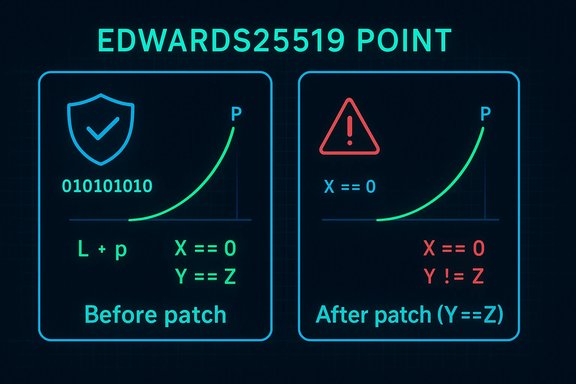
Lthe code only checked one of the internal coordinates (specificallyX == 0) to decide whether the result was the identity; it neglected to verify thatY == Zas well. That incomplete check allowed some points that are not in the main subgroup to be accepted as valid.
L check was insufficient, and the fix adds the missing Y == Z test so identity is confirmed by both X == 0 and Y == Z. The fix is minimal but necessary. Why this matters: cryptographic implications
Most applications that use libsodium’s high-level APIs are not affected by this bug. High-level signing and keypair functions ensure public keys are generated in the correct subgroup, and many high-level procedures do not even callcrypto_core_ed25519_is_valid_point. However, the vulnerability is neither academic nor trivial for the use cases it does affect. The primary risk surface includes:- Custom cryptographic constructions that explicitly validate or consume externally supplied Edwards25519 points using
crypto_core_ed25519_is_valid_point. In these atypical flows, an attacker able to supply crafted points could get a point accepted that should have been rejected. - Libraries or applications that treat low-level libsodium primitives as authoritative validators for externally sourced points. If such code relies solely on the affected routine, it could misclassify mixed-order points as valid.
How the bug works (a deeper technical walkthrough)
Edwards-format points in libsodium are represented internally with projective coordinates (typicallyX, Y, Z). To determine whether a point P belongs to the main subgroup of order L, a standard test multiplies P by L. If P is in the main subgroup, L [I] P equals the identity point. In the library's internal coordinate system, the identity point is characterized by X = 0 and Y = Z (where Z is a projective scale factor and may not be 1). The vulnerable code performed ge25519_mul_l(&pl, p) to compute pl = L [/I] p and then tested only fe25519_iszero(pl.X) (i.e., whether X == 0) to decide if pl was the identity. Critically, that single check is insufficient because some non-main-subgroup points, after multiplication by L, can yield a result with X == 0 but Y != Z. These are not the identity and therefore indicate the original point is not in the main subgroup. The missing verification of Y == Z allowed such inputs to falsely be treated as valid. The upstream fix is straightforward and small in size: after computing pl, compute t = pl.Y - pl.Z and require both pl.X == 0 and t == 0 before accepting the point. That addition closes the gap that allowed mixed-order points to pass. Who is affected and how to check
Affected parties are a narrow but notable subset of libsodium users:- Developers or services that call
crypto_core_ed25519_is_valid_pointon untrusted or externally-supplied Edwards25519 point encodings. - Implementers of custom cryptographic protocols or bespoke key-exchange/signature schemes using low-level libsodium primitives.
- Integrations that bundle an older libsodium build (pre-
ad3004e) in binary packages, containers, or OS distributions without other compensating checks.
crypto[I]sign[/I]* APIs and standard keypair generation routines are not exposed because those functions guarantee subgroup properties for generated public keys. The upstream maintainer explicitly noted that high-level signing APIs and standard scalar multiplication operations are not impacted in the default, canonical use cases. How to check your environment:- Audit your codebase for direct calls to
crypto_core_ed25519_is_valid_pointor similar low-level point-validation routines. - Identify third-party libraries and language bindings that may expose low-level validation functions (for example, language wrappers or FFI bindings).
- Check the libsodium version in your runtime or vendor packages. Versions prior to the upstream commit
ad3004eare affected. Distribution patches and package versions vary; consult your platform’s package status.
Fixes, vendor response, and timing
The upstream maintainer discovered and fixed the bug, committing an explicit change (ad3004e) that adds the missing Y == Z check and updates unit tests to cover a now-rejected malformed point. The maintainer published a detailed note explaining the bug, why it mattered, and recommended mitigations, including using Ristretto where appropriate. Packaged updates followed quickly: vendor and distribution trackers show fixes in unstable and current branches, and official libsodium tarballs published after the fix include the correction. The recommendation from maintainers is to upgrade to builds that include commit ad3004e or later. For Windows developers specifically, the maintainer indicated that new official binaries (Visual Studio builds, MinGW, NuGet packages) were produced to include the fix, so Windows-distributed binaries that come from the official libsodium artifacts should be updated. If an application bundles a static or vendored copy of libsodium, it must be rebuilt with the patched source. Mitigation options (short-term and long-term)
Immediate actions to reduce risk:- Apply the upstream patch by updating to the libsodium release that contains commit
ad3004eor any later version. This is the single most effective and simplest mitigation. - If you cannot patch immediately, audit code paths that call
crypto_core_ed25519_is_valid_pointand add an extra application-level check forY == Zafter multiplying byL, or use the conservative application-level test recommended by the maintainer (a multiply-by-L - 1check plus an identity comparison). These application-level mitigations are viable stopgaps but inferior to upgrading. - Prefer
Ristretto255or other cofactor-handling encodings for new protocols. Ristretto hides cofactor complexities and guarantees group elements decode to the canonical prime-order group; this removes the need for awkward low-level subgroup checks. If protocol design allows, migrate point encodings to Ristretto.
- Expand test coverage for low-level primitives in your CI pipelines, especially for language bindings and wrappers that expose the raw validation routines.
- If your deployment accepts untrusted curve points, add explicit tests that assert canonical encodings and main-subgroup membership, and log anomalous decode attempts for forensic analysis.
- Inventory third-party dependencies and trackers for embedded libsodium versions (container images, SDKs, mobile libraries), since many supply chains bundle C libraries statically. Distribution advisories will help find packages that were rebuilt to include the fix.
Risk analysis: exploitability and realistic threat model
The vulnerability was rated Medium (CVSS 4.5) because it requires specific, often local conditions and only applies in atypical code paths. The attack vector reported by several trackers is local with high attack complexity, which means the conditions to trigger a meaningful impact are non-trivial and typically require the attacker to interact with a vulnerable validation routine with crafted point encodings. A few practical observations on risk:- Remote, unauthenticated exploitation of mainstream libsodium usage (signing, common key exchange) is unlikely because the vulnerable function is a low-level validator and not called by the high-level APIs in those standard flows.
- Attack potential increases for systems that intentionally accept untrusted Edwards25519 points (for example, custom multiparty protocols, exotic signature schemes, or some experimental crypto libraries). In such systems, a crafted mixed-order point could subvert validation and produce subtle integrity errors.
- At the time of writing there are no authoritative public reports of active exploitation in the wild for CVE-2025-69277; public advisories and trackers list the issue and fixes but do not cite incident reports. That absence of evidence is not proof of non-exploitation, but it is consistent with the vulnerability’s narrow applicability and medium severity. Organizations that fit the affected profile should act quickly, but mass panic is unwarranted.
Practical audit checklist (for security teams and integrators)
- Inventory: locate all apps, services, SDKs, and containers that bundle or depend on libsodium. Check binary packages and vendor directories for the libsodium version and commit SHA.
- Identify usage patterns: search the codebase for direct calls to
crypto_core_ed25519_is_valid_pointor similar ed25519 point-validation functions. Mark those call sites as high-priority for review. - Update: apply patched libsodium binaries or rebuild from source that includes commit
ad3004e. For vendor-supplied binaries, obtain updated packages from your vendor or distro. - Test: add unit tests that feed mixed-order and small-order points to your validation code and assert the expected rejection behavior. The upstream test additions provide examples of such inputs.
- Monitor: log decode/validation failures for ed25519 points and configure alerts for unusual patterns (e.g., repeated malformed point submissions). This will help detect attempted misuse.
For developers and Windows packagers
Windows application authors should verify whether their apps bundle libsodium statically or link to vendor-provided builds. The upstream maintainer published patched official binaries and NuGet packages; Windows developers whose build pipeline consumes those artifacts should upgrade and rebuild. If an application uses a language wrapper (for example,libsodium-net, libsodium-windows, or other bindings), ensure the wrapper itself was rebuilt against the corrected native library or that the language package explicitly bumps the libsodium version. Binary distributors and packagers should confirm their released artifacts contain the patched sources. Distribution trackers list the vulnerable package versions and where fixes have been applied; use those trackers to verify your platform’s status. Strengths of the response and what went right
- The upstream fix was minimal and surgical: the vulnerability was addressed quickly with a small, well-understood code change that restores explicit identity testing. A small, targeted patch reduces the chance of introducing regressions.
- The maintainer communicated the issue transparently, explaining root cause, scope, and recommended mitigations including Ristretto as a safer alternative for new protocols. Clear communication helps users triage and respond appropriately.
- Distribution and package trackers reacted rapidly, and multiple distros have recorded the issue and begun packaging updates; this reduces the operational burden for many administrators who can rely on standard package updates.
Residual risks and caveats
- The flaw’s narrow applicability means it can be overlooked: many teams assume libsodium’s low-level primitives are safe for any use, which is not always true. Developers who misuse low-level functions without cryptographic review risk subtle protocol flaws. This incident underlines the risk of exposing low-level primitives to application code.
- Supply-chain complexity: bundled and statically linked copies of libsodium in third-party SDKs or older container images might remain unpatched unless vendors proactively issue updates. Conducting a thorough supply-chain inventory is essential.
- No evidence of exploitation is not proof of absence—organizations that accept external ed25519 points should still assume the worst until patched. Log and monitor relevant endpoints.
Conclusion and action summary
CVE-2025-69277 is a real but narrowly scoped vulnerability in libsodium’s low-level ed25519 point-validation routine that allowed certain non-main-subgroup points to be accepted because an internal identity check omitted a required coordinate comparison. The upstream fix (commitad3004e) corrects the logic by verifying both X == 0 and Y == Z after multiplying a candidate by the subgroup order L. Upgrading to a patched libsodium build is the recommended and simplest mitigation. Immediate priorities for affected teams are: inventory where libsodium is used, audit for direct calls to crypto_core_ed25519_is_valid_point, update to patched binaries or rebuild from the corrected sources, and add application-level checks or test coverage where necessary. Where possible, prefer Ristretto-encoded points to avoid cofactor pitfalls altogether. This vulnerability reinforces a recurring lesson in applied cryptography: using high-level, well-vetted abstractions and avoiding ad-hoc low-level manipulations generally reduces risk. When low-level primitives are necessary, conservative validation, good test coverage, and rapid patching are critical to maintaining security hygiene. Source: MSRC Security Update Guide - Microsoft Security Response Center
