

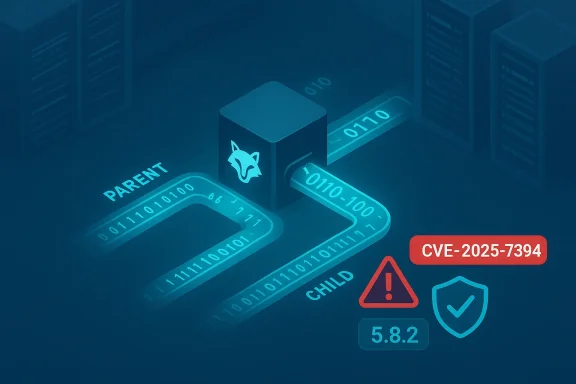
A subtle bug in wolfSSL’s OpenSSL compatibility layer has quietly exposed a classic fork‑safety failure: under certain conditions, calls to RAND_bytes() in a child process could produce predictable values because the pseudo‑random generator state was inherited unchanged across fork(). The issue — tracked as CVE‑2025‑7394 — was reported by Per Allansson of Appgate and fixed by wolfSSL in a patch that both corrects RAND_poll() behavior and adds automatic Hash‑DRBG reseeding when a process fork is detected; operators and developers relying on RAND_bytes() in forked programs should update to wolfSSL 5.8.2 or later immediately.
In UNIX‑style systems the fork() system call creates a new process that is an almost-identical copy of the parent. That includes memory state: any in‑process PRNG state present before fork() will be duplicated in the child. If both parent and child then draw random bytes from the same PRNG state without reseeding, their outputs can be identical or otherwise correlated — an obvious cryptographic hazard. OpenSSL and other libraries have long warned that applications must reseed PRNGs after fork() (for example, by calling RAND_poll() or similar), but real‑world code and compatibility layers sometimes get the details wrong. The wolfSSL advisory explains that its OpenSSL compatibility implementation did not behave as expected around RAND_poll(), which left applications that call RAND_bytes() after fork() exposed to predictable outputs.
This CVE is narrowly scoped: it affects applications that both (a) use wolfSSL’s OpenSSL compatibility layer and (b) explicitly call RAND_bytes() in child processes after forking. wolfSSL’s internal TLS operations were not affected, because they use separate RNG paths; nevertheless, the condition is relevant for applications that generate keys, nonces, session tokens, or any randomness in forked children using RAND_bytes().
1.) Patch first: upgrade wolfSSL to version 5.8.2 or later as soon as your testing windows allow. The vendor patch both fixes RAND_poll() behavior and adds automatic reseeding on fork detection. This is the primary remediation.
2.) Audit code for dangerous patterns: search code and dependencies for explicit calls to RAND_bytes(), RAND_priv_bytes(), RAND_pseudo_bytes, or RAND_poll(), and check whether these calls can execute in a forked child without reseeding. A simple grep across your source tree is a practical starting point:
4.) Inventory dependencies & static binaries: many embedded and server images statically link wolfSSL. Scan binaries, containers and images for wolfSSL artifacts and version strings; check package management records for wolfssl package versions. If binaries were built with an affected wolfSSL release, rebuild them against the patched library where possible. Use SCA tools and SBOMs to accelerate discovery.
5.) Short‑term behavioral mitigations: if immediate patching is impossible, prevent child processes from calling RAND_bytes() or restructure initialization so the parent performs necessary seeding after fork and the child then uses a fresh DRBG. Where practical, avoid spawning untrusted child processes that perform crypto operations until you deploy the fix.
6.) Logging and monitoring: add observability around cryptographic failures and abnormal authentication patterns. Predictable RNG exploits often manifest as repeated token collisions, session hijacking events, or uncharacteristic authentication anomalies. While detection is hard, logs that capture token generation and authentication metrics can help spot anomalies quickly.
Source: MSRC Security Update Guide - Microsoft Security Response Center
 Background / Overview
In UNIX‑style systems the fork() system call creates a new process that is an almost-identical copy of the parent. That includes memory state: any in‑process PRNG state present before fork() will be duplicated in the child. If both parent and child then draw random bytes from the same PRNG state without reseeding, their outputs can be identical or otherwise correlated — an obvious cryptographic hazard. OpenSSL and other libraries have long warned that applications must reseed PRNGs after fork() (for example, by calling RAND_poll() or similar), but real‑world code and compatibility layers sometimes get the details wrong. The wolfSSL advisory explains that its OpenSSL compatibility implementation did not behave as expected around RAND_poll(), which left applications that call RAND_bytes() after fork() exposed to predictable outputs.This CVE is narrowly scoped: it affects applications that both (a) use wolfSSL’s OpenSSL compatibility layer and (b) explicitly call RAND_bytes() in child processes after forking. wolfSSL’s internal TLS operations were not affected, because they use separate RNG paths; nevertheless, the condition is relevant for applications that generate keys, nonces, session tokens, or any randomness in forked children using RAND_bytes().
What went wrong: technical anatomy
The incompatibility around RAND_poll()
At the heart of CVE‑2025‑7394 is a mismatch between expectations and behavior in the OpenSSL compatibility layer’s RAND_poll()/RAND_bytes() handling. OpenSSL documentation and community guidance have long stated that RAND_bytes() is not implicitly fork‑safe: an application that forks should reseed the PRNG in the child (for example by calling RAND_poll(), RAND_seed(), or reading from the OS entropy device) before generating new random material. wolfSSL’s compatibility layer intended to emulate OpenSSL semantics but its RAND_poll() implementation did not guarantee the same outcome in all fork scenarios, which could allow the Hash‑DRBG to continue from pre‑fork state and produce predictable values in both parent and child.Hash‑DRBG and duplicated state
Modern CSPRNG designs in TLS stacks often use a Deterministic Random Bit Generator (DRBG) such as Hash‑DRBG. A DRBG maintains internal state that, when duplicated, will produce the same output sequence unless the state is advanced or reseeded with fresh entropy. After fork(), both processes hold identical Hash‑DRBG state; absent explicit reseeding or automatic detection, RAND_bytes() calls in a child can yield values predictable to an attacker who can observe or manipulate the parent process’s state or reproduction conditions. wolfSSL’s fix introduces detection of a PID change and forces reseeding of the Hash‑DRBG when a process fork is detected, aligning behavior more closely with expectations and the way newer OpenSSL builds handle fork‑safety.Why internal TLS operations were not impacted
wolfSSL’s advisory states that the vulnerability does not affect wolfSSL’s internal TLS operations. This distinction matters: many TLS stacks use a private or separate DRBG instance for protocol internals (session nonces, TLS master secrets, etc.), or incorporate OS entropy sources on each handshake. The problem here arises specifically when application code uses the OpenSSL compatibility RAND_bytes() API in a forked child without reseeding. The advisory reiterates that library internals remain protected, but again that does not excuse application-level misuse.Timeline, credit and remediations
- Discovery and report: credited to Per Allansson of Appgate. wolfSSL acknowledged the report and published a vulnerability disclosure and fixes.
- Public CVE assignment: CVE‑2025‑7394 was assigned and published in mid‑July 2025; public trackers and vulnerability databases recorded details and affected ranges.
- Patch: wolfSSL released changes in wolfSSL 5.8.2 to correct RAND_poll() behavior and add automatic Hash‑DRBG reseeding after detecting a fork. Users are advised to upgrade to 5.8.2 or later.
Who is exposed — attack surface and practical risk
Vulnerable application patterns
This vulnerability is only exploitable in narrow application patterns, but those patterns are common enough to matter:- Long‑running servers that fork worker processes and then rely on RAND_bytes() in the child to create session IDs, tokens, or ephemeral keys.
- Daemons or cron‑spawned children that call RAND_bytes() without explicit reseeding after fork().
- Embedded or IoT code that uses the wolfSSL OpenSSL compatibility RAND APIs and forks to handle work in separate processes.
Attack scenarios
- Predictable session IDs: An attacker who can coerce a server to fork or can observe a parent process could predict session tokens generated in the child, enabling session hijacking.
- Nonce/IV reuse: If RAND_bytes() supplies nonces or IVs for symmetric encryption, duplication between processes can break nonce uniqueness assumptions and allow cryptanalysis.
- Key/seed predictability: Any use of RAND_bytes() to seed higher‑level key material or generate key pairs risks total compromise if the outputs are predictable.
Likelihood and severity
Different trackers assign different severity scores: the NVD and many aggregators list a CVSS v3.1 base score of 9.8 (Critical), while some vendor or community analyses have reported lower base scores (for example, CVSS v4.0 assessments at a HIGH severity level). The variation stems from differing assumptions about the ease of exploitation and the scope of impact (network‑exposed vs. local, whether TLS internals are affected, and how likely applications are to call RAND_bytes() post‑fork). As a practical matter, defenders should treat this as a high‑priority issue for any codebase that matches the vulnerable pattern because the consequences of predictable cryptographic randomness can be catastrophic.Immediate mitigations and recommended actions (what to do now)
If you run software that includes wolfSSL or uses the OpenSSL compatibility RAND APIs, take these steps immediately.1.) Patch first: upgrade wolfSSL to version 5.8.2 or later as soon as your testing windows allow. The vendor patch both fixes RAND_poll() behavior and adds automatic reseeding on fork detection. This is the primary remediation.
2.) Audit code for dangerous patterns: search code and dependencies for explicit calls to RAND_bytes(), RAND_priv_bytes(), RAND_pseudo_bytes, or RAND_poll(), and check whether these calls can execute in a forked child without reseeding. A simple grep across your source tree is a practical starting point:
- grep -R "RAND_bytes" ./
- grep -R "RAND_priv_bytes" ./
4.) Inventory dependencies & static binaries: many embedded and server images statically link wolfSSL. Scan binaries, containers and images for wolfSSL artifacts and version strings; check package management records for wolfssl package versions. If binaries were built with an affected wolfSSL release, rebuild them against the patched library where possible. Use SCA tools and SBOMs to accelerate discovery.
5.) Short‑term behavioral mitigations: if immediate patching is impossible, prevent child processes from calling RAND_bytes() or restructure initialization so the parent performs necessary seeding after fork and the child then uses a fresh DRBG. Where practical, avoid spawning untrusted child processes that perform crypto operations until you deploy the fix.
6.) Logging and monitoring: add observability around cryptographic failures and abnormal authentication patterns. Predictable RNG exploits often manifest as repeated token collisions, session hijacking events, or uncharacteristic authentication anomalies. While detection is hard, logs that capture token generation and authentication metrics can help spot anomalies quickly.
For developers: best practices and safe coding patterns
- Treat fork() as a security boundary for PRNGs. Always reseed in the child process before generating any cryptographic material.
- Prefer using OS‑provided randomness (getrandom()/getentropy) for seeding and for one‑off random reads when available and appropriate for the platform.
- Avoid relying on compatibility layers without checking their semantics: an OpenSSL compatibility API in a third‑party library may behave differently from upstream OpenSSL in subtle ways. Test for fork safety in CI.
- Parent forks.
- Child immediately calls an explicit reseed routine that invokes the platform entropy source or RAND_poll().
- Child proceeds to call RAND_bytes() only after confirming the reseed succeeded.
Detection, triage and forensic guidance
Detecting whether a system has been exploited through predictable RNG is inherently difficult because the evidence is subtle: repeated token reuse, unusual authentication bypasses, or successful forgery/impersonation attempts are likely the first visible signs. If you suspect exposure:- Identify all processes that fork and use RAND_bytes() and cross‑check their wolfSSL versions for the vulnerable range.
- Rebuild or patch affected binaries immediately and, where possible, rotate any cryptographic material (session keys, long‑lived tokens, API keys) that may have been influenced by affected RNG outputs.
- Collect and preserve logs showing token generation, process forks, and suspicious authentication events for post‑incident analysis.
- If you run embedded devices or long‑lived firmware with statically linked wolfSSL, prioritize those deployments for update or rebuild.
Critical analysis: strengths of the fix, residual risks, and vendor coordination
Strengths
- wolfSSL fixed the root cause and improved default behaviour by adding Hash‑DRBG reseeding on fork detection, reducing reliance on application authors to remember to call RAND_poll(). This moves security toward safer defaults and reduces the chance of developer error.
- The fix was credited quickly and published with clear guidance; public trackers (NVD, OSV, Snyk and national CERTs) cataloged the CVE and the patched versions, enabling automated tooling to detect vulnerable instances.
Residual risks and limitations
- Scanner/score divergence: different repositories and scanners assigned differing severity metrics (some using CVSS v3.1 = 9.8, others mapping to v4.0 = 7.0). This difference reflects varying assumptions about exploitability and impact; defenders should not let scoring variance lull them into inaction. Treat exposure as high risk when the vulnerable pattern exists.
- Static linking and supply‑chain persistence: patched library packages won’t fix statically linked binaries and firmware images. Those artifacts must be rebuilt or replaced. Large fleets, embedded devices, or OEM products can have a significant remediation surface that requires coordination with vendors and supply‑chain owners.
- Detection difficulty: predictable RNG exploitation often leaves little direct forensic evidence; attackers may exploit duplicated outputs opportunistically. Organizations should assume possible silent compromise of any material generated under the affected conditions unless proven otherwise.
- Behavioral assumptions: wolfSSL’s statement that TLS internals are unaffected relies on the library’s internal partitioning of PRNG use. While that is an important and reassuring point, defenders should still audit usages of RAND_bytes() across applications. A library’s assertion reduces but does not eliminate the need for artifact-level verification.
Long‑term recommendations and hardening
- Make PRNG fork‑safety tests part of your CI regression suite. Include unit and integration tests that simulate fork and reseed behavior.
- Treat cryptographic APIs as privileged: enforce code reviews and static checks around random number generation calls and around forking patterns.
- Adopt reproducible builds and SBOMs so you can reliably locate and rebuild artifacts that embed vulnerable code. This reduces the operational load for future supply‑chain CVEs.
- Favor principle of least privilege and process models that avoid unnecessary forking when cryptography is required in child processes; use worker pools that preseed or perform random operations in parent context where safe.
- Push vendors and ecosystem partners to issue patched rebuilds for embedded systems and appliances; track vendor advisories until all fielded products are attested patched.
Conclusion
CVE‑2025‑7394 is a reminder that even well‑understood problems — PRNG state duplication after fork — still surface in modern stacks when compatibility layers or subtle implementation differences exist. wolfSSL’s fix (automatic DRBG reseeding after fork detection plus RAND_poll() corrections) restores safer defaults and narrows the window for developer error, but the responsibility to patch, audit, and rebuild remains with operators and developers. If your code uses RAND_bytes() and your processes fork — particularly in servers, daemons, or embedded images — update to wolfSSL 5.8.2 or later, reseed in child processes where appropriate, inventory statically linked binaries, and treat any usage of RAND_bytes() post‑fork as a high‑priority triage item. The cost of predictable randomness in cryptographic systems is high; the remedy is straightforward and urgent.Source: MSRC Security Update Guide - Microsoft Security Response Center
