

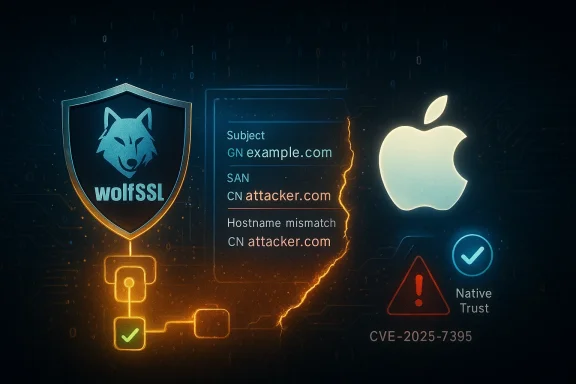
The industry disclosure for CVE-2025-7395 describes a dangerous certificate-validation bypass in wolfSSL that can allow a malicious or misconfigured server to present a certificate issued by a trusted Certificate Authority and have that certificate accepted for any hostname when wolfSSL is built with system CA usage and Apple native validation enabled. This is a high‑severity cryptographic verification failure: wolfSSL’s Apple-native verification routine could override wolfSSL’s internal checks (including hostname/SNI checks, OCSP/CRL validation, and other chain errors), producing a situation where a successful native trust‑store result masks earlier failures and the client accepts a peer it should not trust. The defect was reported responsibly, fixed in wolfSSL 5.8.2 (PR #8833), and has been mapped as CVE‑2025‑7395 in public vulnerability databases.
TLS relies on two related but distinct verification steps: (1) the certificate chain must chain to a trusted root CA, and (2) the certificate’s identity must match the hostname (SNI) the client expects. A correct implementation enforces both checks and treats either failure as a validation error. CVE‑2025‑7395 breaks that model in a specific build/configuration of wolfSSL on Apple platforms: when wolfSSL is configured to use the system CA store (WOLFSSL_SYS_CA_CERTS) and to defer certain verification behaviors to Apple’s native certificate validation APIs (WOLFSSL_APPLE_NATIVE_CERT_VALIDATION), the native result can override earlier wolfSSL-detected errors, including hostname mismatches. This means an attacker who controls a TLS server and can obtain any certificate signed by a CA trusted by the endpoint’s system store (a realistic condition for many CAs) can impersonate arbitrary hostnames to vulnerable clients. Multiple independent vulnerability trackers and vendor notices confirm the technical summary and the fix shipped in wolfSSL 5.8.2.
But operational realities cr‑party vendors may not rebuild immediately (especially closed-source products), and they may not always publish SBOMs. Customers must request attestations or rebuilt binaries.
Source: MSRC Security Update Guide - Microsoft Security Response Center
 Background / Overview
TLS relies on two related but distinct verification steps: (1) the certificate chain must chain to a trusted root CA, and (2) the certificate’s identity must match the hostname (SNI) the client expects. A correct implementation enforces both checks and treats either failure as a validation error. CVE‑2025‑7395 breaks that model in a specific build/configuration of wolfSSL on Apple platforms: when wolfSSL is configured to use the system CA store (WOLFSSL_SYS_CA_CERTS) and to defer certain verification behaviors to Apple’s native certificate validation APIs (WOLFSSL_APPLE_NATIVE_CERT_VALIDATION), the native result can override earlier wolfSSL-detected errors, including hostname mismatches. This means an attacker who controls a TLS server and can obtain any certificate signed by a CA trusted by the endpoint’s system store (a realistic condition for many CAs) can impersonate arbitrary hostnames to vulnerable clients. Multiple independent vulnerability trackers and vendor notices confirm the technical summary and the fix shipped in wolfSSL 5.8.2.What exactly is broken? Technical anatomy
How the verification path is supposed to work
A typical client certificate verification path includes:- Chain building and signature checks, validating the presented chain up to a trusted root.
- Validation of revocation status (OCSP/CRL) where configured.
- Hostname/SNI matching against the certificate’s Subject CN / SAN entries.
- Any application-level policy checks (e.g., pinning, key usage).
Where wolfSSL went wrong in affected builds
When wolfSSL is built on Apple platforms with the options WOLFSSL_SYS_CA_CERTS and WOLFSSL_APPLE_NATIVE_CERT_VALIDATION enabled, it delegates parts of certificate verification to Apple’s Security/Trust APIs so that the system trust store and native behavior are used. The bug is a precedence/regression issue: wolfSSL’s own verification logic performed checks and recorded errors (for example, a hostname mismatch), but the Apple native verification routine returned a success result for chain‑trust (because the certificate did chain to a trusted CA in the system), and that success cleared or overrode earlier wolfSSL errors. Practically, that meant the stack treated the overall verification as successful even though core checks (hostname match, revocation, or other chain errors) had previously failed. The end result: hostname verification could be effectively bypassed. wolfSSL’s vendor disclosure and the public fix note this precise behavior and credit the researcher.Affected products, builds and versions
- wolfSSL builds on Apple platforms that were compiled with both:
- WOLFSSL_SYS_CA_CERTS (load system CAs), and
- WOLFSSL_APPLE_NATIVE_CERT_VALIDATION (use Apple native verification)
- Public advisories and trackers list affected versions spanning older 5.x releases up to the pre‑fix 5.8.0 line; wolfSSL 5.8.2 contains the fix. If you build wolfSSL for Apple targets and used the default configuration introduced in prior releases, you are likely impacted. The vendor confirmed the fix landed in the 5.8.2 release and documented it in their release notes and vulnerability disclosure.
Exploitability and practical impact
- Attack vector: Network. An attacker controls a TLS server the client connects to (or performs a man-in-the-middle). No local privileges are required.
- Complexity: Low. Because the vulnerability requires only presenting a certificate that chains to a trusted CA, exploitation is trivial once the attacker controls a server or a network path — or can coerce a genuine CA to issue a certificate (for example, via misissuance or a subordinate CA). Many public CAs will issue certificates for a domain the attacker controls; some enterprise CAs trusted by endpoints make the attack even easier inside specific environments.
- Impact: High for confidentiality and integrity of TLS sessions. A successful bypass enables a classic man‑in‑the‑middle scenario: a client will accept a certificate that should have failed hostname verification, allowing the attacker to intercept and tamper with supposedly authenticated TLS connections. The published CVSSv4.0 and vendor scores reflect the criticality (vendor/researcher-assigned scores mapped to a high 9.x value in public trackers).
Timeline and disclosure
- Vulnerability reported / CVE assigned: July 2025 (CVE‑2025‑7395).
- Vendor fix: wolfSSL published the fix and released wolfSSL 5.8.2 with the Apple-native-cert-fix referenced as PR #8833; the vendor disclosure and release notes explicitly call out CVE‑2025‑7395 and credit the reporter.
- Public trackers and aggregators (CIRCL, Snyk, Wiz, PTsecurity, cvedetails and others) indexed the CVE and mirrored vendor details shortly after disclosure, providing corroborating technical summaries and mitigation guidance.
Detection: how to find vulnerable binaries and builds in your environment
Because the vulnerability depends on build-time flags and the use of Apple native verification, detection requires both binary inspection and build/packaging inventory.- Identify wolfSSL binaries and libraries:
- Search installed file systems and application bundles for wolfssl/wolfcrypt libraries or linked symbols (libwolfssl, wolfssl symbols).
- For macOS/iOS apps: inspect embedded frameworks and dylib references inside application bundles.
- Determine wolfSSL version:
- Where possible, query the binary for version strings or check package metadata that was used to install it.
- Check build options or release notes:
- If the binary was built by your team, check the build configuration logs or the CMake/autotools command line for WOLFSSL_SYS_CA_CERTS or WOLFSSL_APPLE_NATIVE_CERT_VALIDATION definitions.
- For third‑party or vendor-supplied binaries:
- Contact the vendor or check their release notes/SBOMs. Many suppliers have published advisories or rebuilt packages; ask for confirmation that their deliverables were rebuilt with wolfSSL 5.8.2+ or that the native‑validation option is disabled.
- Container images: scan image layers for wolfSSL packages or linked binaries and rebuild images that contain vulnerable wolfSSL with the fixed release.
Mitigation and remediation guidance (actionable steps)
- Upgrade wolfSSL to 5.8.2 or later
- The definitive remediation is to update to the wolfSSL release that contains the PR fixing the Apple native validation precedence. wolfSSL’s release notes and vulnerability disclosure name 5.8.2 as the fixed version. Rebuild and redeploy any binaries that statically link wolfSSL or vendor the wolfssl source.
- If you cannot immediately upgrade: change build configuration
- Rebuild using a configuration that disables WOLFSSL_APPLE_NATIVE_CERT_VALIDATION and/or avoids WOLFSSL_SYS_CA_CERTS, forcing certificate verification to be performed entirely by wolfSSL’s own (fixed) path or a verified verification routine. This is a valid temporary mitigation while you plan upgrades.
- For packaged or third‑party software (no rebuild possible right away)
- Contact the vendor and request a security statement: did they rebuild with 5.8.2+ or otherwise mitigate the issue? If vendor responses are slow or inconclusive, consider isolating or restricting the affected application’s network access (e.g., allowlist endpoints, use strong application-level authentication) until the vendor provides a patched binary.
- Harden client behavior where possible
- Enforce application-level hostname checking in addition to wolfSSL’s checks (if your application performs its own certificate verification).
- Use certificate pinning or mutual TLS in high‑value paths where you can control both client and server.
- Monitor endpoints for unexpected certificate chains or connections to unrecognized servers.
- Validate post‑patch
- After upgrading, run integration tests that perform TLS connections to known bad/mismatched certificates to verify hostname checks are effective.
- Use test servers that present certificates with valid chain but wrong SAN to ensure the client rejects them.
- Inventory and rebuild containers and static binaries
- Remember that patching the host package is insufficient for containers and statically linked binaries. Rebuild container images and application artifacts that include wolfSSL to ensure they include the fixed library.
Monitoring and detection rules / indicators of compromise
- Log and alert on TLS sessions where the certificate SAN does not match the requested hostname but the session succeeds; this is an anomalous condition that indicates a potential verification logic error or misconfigured client.
- Watch for connections to untrusted or unusual endpoints that nonetheless succeed with TLS verification — particularly for clients expected to connect to a small set of hostnames.
- Use network-based TLS inspection (where lawful and permitted) to capture TLS ServerHello and certificates from suspicious connections and correlate against client logs.
- For telemetry/endpoint agents: add fuzzing or negative‑test cases that connect to a server presenting a valid-chain but non‑matching certificate; failing these tests after patching indicates an incomplete remediation.
Supply‑chain and vendor response: what to expect and what to demand
wolfSSL issued a release and a public disclosure that names CVE‑2025‑7395 and the fix; many downstream trackers and packagers mirrored that information quickly. This is the right sequence: vendor patch → public advisory → distro/package updates → third‑party vendor rebuilds.But operational realities cr‑party vendors may not rebuild immediately (especially closed-source products), and they may not always publish SBOMs. Customers must request attestations or rebuilt binaries.
- Container images and appliance images that vendor wolfSSL must be rebuilt and republished; host package updates alone do not remedy embedded copies.
Risk analysis: where the real danger concentrates
- Mobile and desktop clients on Apple platforms are at particular risk because the bug specifically involves Apple native verification paths. Applications that rely on wolfSSL to load and use system CAs will be vulnerable unless rebuilt with the fix.
- Embedded devices and appliances that ship wolfSSL compiled for Apple-targeted flows (for example, cross‑compiled development for embedded Apple-like targets or custom toolchains) require special attention because firmware updates may be infrequent.
- Services and agents that connect to many third‑party hosts (update clients, crawlers, software update agents, telemetry collectors) are attractive targets: attackers can host a malicious server and present a valid CA-backed certificate to induce connections and intercept sensitive data.
Critical takeaways and operational checklist (prioritized)
- Immediate: Inventory — identify all wolfSSL instances and Apple-targeted builds in your environment (apps, agents, containers, appliances).
- Immediate: Patch — upgrade to wolfSSL 5.8.2 or later in all build pipelines and vendor-managed products under your control.
- 24–72 hours: Contact vendors — for third‑party software that bundles wolfSSL, demand a security statement and patched artifacts or workarounds.
- 72 hours: Rebuild images and static binaries — ensure containers, appliances, and statically linked applications are rebuilt with the fixed wolfSSL release.
- Post‑patch: Validate — run negative verification tests to ensure hostname mismatches are rejected; add monitoring rules for anomalous successful TLS sessions.
- Medium term: Adopt SBOMs and supply‑chain attestations — require vendors to provide SBOMs or attestations showing wolfSSL versions and build flags used, reducing fut
What this incident teaches us about TLS implementations and vendor attestation
CVE‑2025‑7395 is a reminder of two persistent truths in modern security:- Small precedence logic bugs in certificate verification — the glue code that connects platform native APIs and library internal checks — can produce catastrophic outcomes. The complexity of bridging platform-native and library-native verification is a repeated source of subtle errors.
- Inventory and supply‑chain transparency matter. Vendors that publish machine-readable attestations (CSAF/VEX) and SBOMs make it far easier for customers to triage exposure. But those attestations are only as good as the scope they cover; absence of an attestation is not evidence of absence. Microsoft’s staged attestation approach reduces uncertainty for named products but leaves the onus on customers to inventory other artifacts until attestations are complete. Multiple community analyses explain this nuance and advise operators to verify artifacts themselves in the interim.
Conclusion
CVE‑2025‑7395 is a high‑risk certificate‑validation bypass that affects wolfSSL when the library is configured to rely on Apple’s native trust APIs while also using system CA loading. The fix exists (wolfSSL 5.8.2, PR #8833); the practical work is triage and remediation across builds, containers, embedded appliances, and third‑party software. Operators should act now: inventory artifacts, upgrade and rebuild where necessary, request vendor attestations, and add monitoring that catches anomalous TLS success conditions. This vulnerability underscores that correct TLS security is not optional and that platform/library integration must be designed and audited with extreme care.Source: MSRC Security Update Guide - Microsoft Security Response Center
