

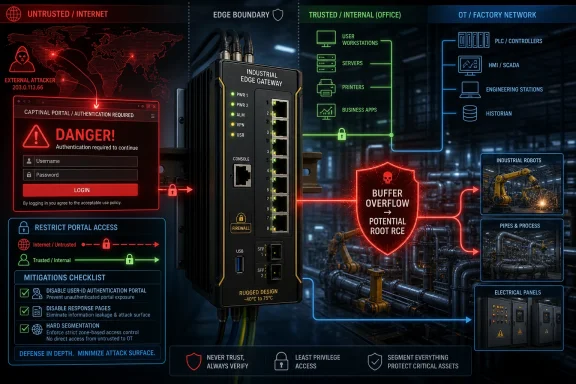
On May 19, 2026, CISA republished Siemens ProductCERT’s advisory for Siemens RUGGEDCOM APE1808 devices, warning that all versions are affected by CVE-2026-0300, a critical Palo Alto Networks PAN-OS buffer overflow that can allow unauthenticated root-level code execution. The advisory is formally about an industrial Siemens product, but the real story is broader: a firewall vulnerability has crossed into the ruggedized edge of operational technology. That is the kind of boundary failure security teams dread, because it turns a perimeter device into a possible beachhead inside environments built to run factories, utilities, and transport systems. Siemens says fixes are being prepared; until then, the only defensible posture is exposure reduction, portal restriction, and hard segmentation.
The Siemens RUGGEDCOM APE1808 is not a typical enterprise firewall sitting in a climate-controlled data closet. It is part of the industrial networking world, where devices are expected to survive difficult environments, long refresh cycles, and operational constraints that make emergency patching less routine than it looks on a security dashboard. When a vulnerability lands here, the question is not simply whether a CVE is severe. The question is whether the affected function sits close enough to real-world process networks to matter.
CVE-2026-0300 matters because it is the wrong kind of bug in the wrong kind of component. The affected software is Palo Alto Networks PAN-OS, specifically the User-ID Authentication Portal, also known as Captive Portal. The flaw is described as a buffer overflow, mapped to CWE-787, an out-of-bounds write weakness. In practical terms, specially crafted network packets can trigger memory corruption in a service that may be reachable over the network.
That is already bad in a conventional IT setting. On a firewall, it is worse. Firewalls are high-trust devices by design: they inspect, route, enforce, log, tunnel, and often sit at the hinge between zones with very different security assumptions. If an attacker can execute code on such a box with root privileges, the device is no longer a gatekeeper. It becomes infrastructure under hostile control.
The Siemens angle gives the advisory its industrial weight. CISA lists the affected equipment as Siemens RUGGEDCOM APE1808 devices, with all versions affected. The sectors and geography are equally blunt: critical manufacturing, worldwide deployment, Siemens headquartered in Germany. This is not a niche desktop application bug that can be waited out until Patch Tuesday. It is a critical vulnerability in a platform used where downtime, safety, and change control all compete with cyber urgency.
But every authentication surface is still a surface. A portal that accepts network traffic must parse requests. A parser that mishandles input can become a memory corruption primitive. And a memory corruption flaw in a privileged network-facing service is the old, grim story of remote code execution wearing a modern product name.
The details in the advisory are stark. The attacker does not need credentials. The attack vector is network reachable. The attack complexity is low. No user interaction is required. The CVSS v3.1 base score is 10, the maximum rating, with high impact to confidentiality, integrity, and availability. That combination is not advisory inflation; it is the shape of a vulnerability that can plausibly lead to complete device compromise.
Palo Alto Networks’ own upstream advisory treated the issue as urgent, and outside reporting has described exploitation as observed in the wild against exposed portals. That matters because defenders tend to triage differently once a bug moves from theoretical exploitability to real activity. A vulnerability with no patch is uncomfortable. A vulnerability with observed exploitation and a workaround-only window is a live incident management problem.
Siemens’ guidance reflects that reality. The company is preparing fix versions and tells customers to contact support for patch and update information. But the immediate mitigations are configuration changes: disable Response Pages in Interface Management Profiles attached to exposed Layer 3 interfaces, disable the User-ID Authentication Portal if it is not required, and restrict portal access to trusted internal IP addresses only. Those are not cosmetic changes. They are attempts to remove the vulnerable code path from untrusted reach.
Siemens’ recommendations are pointed because they focus on reducing the set of systems that can touch the vulnerable portal. Disabling Response Pages on interfaces where untrusted or internet traffic can ingress reduces exposure in zones where the service does not belong. Keeping those pages enabled only where legitimate internal user browsers ingress is a classic least-exposure move: do not advertise a feature outside the trust boundary that needs it.
Disabling the Authentication Portal entirely is cleaner when operationally possible. Many environments enable features because they are useful during a rollout and then leave them in place long after the initial need has passed. A critical vulnerability is a forcing function: if no one can articulate why a network-facing service is required, it should not be listening.
Restricting access to trusted internal IP addresses is the fallback for organizations that need the feature. It is not as clean as turning the portal off, because “trusted internal” is often a messy category in real networks. Still, an access control list that blocks the internet and untrusted zones is vastly better than leaving a root-RCE trigger reachable from places where no legitimate authentication flow should originate.
The notable phrase in Siemens’ advisory is that customers should consult and implement the upstream Palo Alto Networks workarounds. That is a reminder of how dependency chains work in modern industrial products. Siemens is the vendor in the CISA advisory, but the vulnerable software component is upstream. Operators are left to navigate both worlds: the industrial vendor’s product lifecycle and the security vendor’s mitigation guidance.
That is why advisories involving APE1808 devices often read like a catalog of inherited exposure. The platform can host or integrate third-party network security functions, and vulnerabilities in those functions can become Siemens advisories when the affected software is deployed as part of the device ecosystem. This is not unique to Siemens. It is the same supply-chain security story seen across appliances, hyperconverged boxes, embedded Linux systems, VPN gateways, and virtual network functions.
The difference is consequence. In enterprise IT, a compromised firewall is a major breach. In operational technology, it can also threaten visibility, segmentation, remote maintenance boundaries, and the carefully negotiated separation between business networks and control networks. Even if an attacker never touches a PLC, owning the device that mediates traffic into an industrial zone can be enough to steal credentials, pivot, disrupt access, or blind defenders.
This is where the old distinction between IT and OT starts to look quaint. The firewall code is IT. The enclosure and deployment context are OT. The risk is both. A security team that treats the advisory purely as a Palo Alto issue may miss affected Siemens inventory. An operations team that treats it purely as a Siemens support ticket may move too slowly on exposure reduction.
The better reading is that RUGGEDCOM operators need to ask a specific question: where do APE1808 devices run PAN-OS services that expose the User-ID Authentication Portal or related Response Pages to any untrusted ingress path? That is the map that matters before any patch lands.
That does not make the bug less serious. It means defenders should prioritize based on exposure, not product name alone. A public-facing or partner-facing interface with Response Pages enabled deserves immediate action. So does any interface reachable from a flat corporate network, a contractor VPN pool, a remote access subnet, or an untrusted industrial DMZ.
The “internal only” argument should also be handled carefully. Internal networks are not magic. Phished credentials, compromised laptops, unmanaged engineering workstations, vendor remote access jump boxes, and misconfigured VPNs all turn internal reachability into a plausible attack path. Industrial defenders know this already because many serious intrusions begin in ordinary business IT and then move laterally toward more sensitive zones.
The vulnerability’s lack of authentication requirement makes this worse. Credentials are not the choke point. If the attacker can send the right packets to the vulnerable service, the bug does not ask whether the user has permission. That is why network-layer control becomes the urgent compensating measure.
This is also why defenders should not wait for a perfect asset inventory before acting. If there is uncertainty about whether APE1808 devices expose the portal, teams should assume the answer may be yes until configuration proves otherwise. The cost of checking interface management profiles and portal settings is low compared with the cost of discovering exposure after exploitation.
Segmentation is easy to admire and hard to maintain. Plants grow. Vendors add remote support paths. Temporary engineering connections become permanent. Firewalls accumulate exceptions. Authentication portals that made sense during one phase of a deployment remain reachable after the environment changes around them. Over time, the real network and the diagram drift apart.
CVE-2026-0300 punishes that drift. A portal intended for controlled identity mapping becomes a remotely reachable attack surface if placed on the wrong interface or exposed to the wrong zone. A device designed to protect industrial traffic becomes a high-value target precisely because it sits where traffic converges.
For WindowsForum readers, there is a familiar lesson here. Windows administrators have spent decades learning that exposed management interfaces, legacy services, and overly broad access rules eventually become breach paths. Industrial networking is going through the same discipline under harsher conditions. The difference is that taking a server offline to patch IIS is rarely the same as scheduling a change in an operational network that supports production.
The answer is not to pretend industrial systems can patch like cloud workloads. It is to design networks so that emergency mitigation does not require heroic effort. If disabling a vulnerable portal breaks legitimate access in ways nobody anticipated, that is not just a vulnerability response problem. It is an architecture problem revealed by the vulnerability.
The answer, inconveniently, is everyone. Vendors own clear guidance and timely fixes. CISA owns visibility and public coordination. But asset owners own the deployed configuration. If an APE1808 sits with vulnerable services exposed to an untrusted network, the practical risk lives in that environment, not in an advisory PDF.
That is particularly true for organizations that use centralized vulnerability scanners and ticketing workflows built for conventional IT assets. A scanner may detect a PAN-OS version or an exposed portal, but it may not understand the Siemens packaging or the operational constraints around the device. Conversely, an OT asset inventory may know there is a RUGGEDCOM appliance but may not map the embedded or hosted security software to the relevant Palo Alto advisory.
The remediation path therefore needs human correlation. Security teams should tie together Siemens asset records, PAN-OS configuration states, interface exposure, remote access paths, and maintenance plans. This is tedious work, but it is exactly the work that separates real risk reduction from CVE bookkeeping.
There is also a communication burden. Plant managers do not need a lecture on CWE-787. They need to know whether a firewall-like device near their environment could be remotely compromised, whether the vulnerable portal is exposed, what will change if mitigations are applied, and when a vendor-supported fix can be installed. The best incident response here will translate severity into operational language without sanding off the urgency.
“All versions” advisories are especially challenging in industrial fleets because deployment records are often uneven. A company may have a few well-documented devices at flagship sites and a long tail of older deployments at smaller facilities, remote stations, acquired plants, or vendor-managed environments. The most exposed device is not always the one with the most mature local IT support.
This is where governance becomes security engineering. Organizations need a reliable way to answer four questions quickly: where are the devices, who administers them, what network zones can reach them, and what vendor support path applies? If those questions cannot be answered during a critical advisory, the gap is not merely administrative. It extends attacker dwell time.
The Siemens ProductCERT and CISA advisory flow helps by making the issue visible to organizations that track industrial advisories rather than only Palo Alto bulletins. But visibility is not remediation. A maximum-severity CVE entering the ICS advisory stream should trigger a prebuilt playbook, not a fresh meeting to decide who owns the asset class.
The right playbook is not complicated in concept. Identify affected devices. Check whether Authentication Portal is enabled. Check Response Pages and Interface Management Profiles. Determine whether any untrusted or internet-facing ingress can reach the service. Apply mitigations immediately where exposure exists. Open vendor support channels for patch information. Document any cases where mitigation cannot be applied and compensate with upstream filtering.
A firewall compromise is not merely another host compromise. Firewalls see flows that endpoints do not. They can reveal network topology, trust relationships, authentication patterns, and administrative habits. In environments where the firewall terminates VPNs or enforces segmentation, it may also sit adjacent to credentials and routes that make lateral movement easier.
For industrial sites, the stealth implications are as important as the initial access. A compromised enforcement point can selectively permit, block, mirror, or alter traffic in ways that complicate detection. Even without dramatic sabotage, an attacker with that position may gather intelligence on operational schedules, remote access windows, engineering workstations, and vendor maintenance routines.
That is why post-mitigation review matters. If a device was exposed before mitigations were applied, defenders should not treat configuration hardening as proof that nothing happened. Logs, configuration history, administrative accounts, unexpected processes, and traffic patterns deserve scrutiny. The advisory itself may not provide indicators of compromise, but the risk profile justifies a compromise assessment for exposed systems.
This is also a moment to revisit trust in firewall logs. If the device itself may have been compromised, its logs are useful but not sufficient. Correlating upstream router data, SIEM telemetry, NetFlow, VPN logs, endpoint detections, and external exposure scans can help reconstruct whether suspicious traffic reached the vulnerable service.
Windows administrators often inherit the consequences. Once an attacker controls an edge device, the next targets may be Active Directory, file servers, jump hosts, certificate services, software deployment tools, and privileged access workstations. The exploit may begin in PAN-OS, but the blast radius can land squarely in the Windows estate.
The industrial setting sharpens the lesson because it mixes older assumptions with modern exposure. Many OT environments still depend on Windows engineering stations, domain-joined management hosts, remote desktop workflows, and vendor tools running on standard PCs. If the network control point protecting those assets is compromised, the Windows layer becomes part of the attacker’s path.
This is why defenders should connect the Siemens advisory to identity hygiene. If a firewall or authentication portal has been exposed, review which accounts interact with it, which administrative systems can reach it, and whether those accounts have broader domain privileges. Root compromise of a network appliance and overprivileged Windows administration are a dangerous pairing.
It is also a good time to verify that Windows logging and endpoint detection cover the systems used to administer APE1808 devices and PAN-OS configurations. Attackers do not need to exploit every system directly if they can steal the credentials or session material used by administrators. The appliance may be the first victim, but the management workstation may be the next source of leverage.
Industrial cybersecurity is less about a single clever control than about layered inconvenience. An attacker should not be able to reach a captive portal from the internet. If they reach a remote access layer, they should not automatically reach industrial firewalls. If they compromise an IT workstation, they should not have a straight route to OT management interfaces. If they compromise one appliance, monitoring should notice the abnormal traffic and administration patterns around it.
CVE-2026-0300 is a reminder that high-end security products are still software. They parse inputs, expose services, and ship vulnerabilities. Buying a firewall does not remove the need to firewall the firewall. That sounds circular until a bug like this arrives, and then it becomes basic architecture.
The recommended mitigations also point to a mature principle: features should be enabled only where the threat model supports them. Response Pages and Authentication Portal functions may be legitimate in trusted user-facing zones. They are much harder to justify on interfaces exposed to untrusted traffic. The boundary between “useful feature” and “critical attack surface” is often just one interface profile.
Operators should be careful not to overcorrect in a way that breaks visibility or access without a rollback plan. CISA rightly reminds organizations to perform impact analysis and risk assessment before deploying defensive measures. But impact analysis should not become paralysis. For exposed portals, the risk calculation is unusually clear.
CSAF can help route the right advisory to the right asset class. It can tell asset owners that a Palo Alto Networks PAN-OS flaw is relevant to Siemens RUGGEDCOM APE1808 devices. That connection is precisely the sort of thing organizations miss when their tooling treats vendor ecosystems as isolated islands.
But automation stops short of judgment. It will not know whether a given portal is exposed through a forgotten NAT rule. It will not know whether a contractor VPN pool is effectively untrusted. It will not know whether disabling a portal will disrupt a shift change, a maintenance workflow, or a safety-approved access path. Human operators still have to turn advisory data into safe action.
The better future is not fewer advisories. It is richer asset context. Industrial operators need inventories that understand not just model numbers and firmware versions, but embedded components, enabled services, interface profiles, trust zones, and compensating controls. Without that context, every critical advisory becomes a manual archaeology project.
For now, the practical lesson is simple: if your vulnerability management program cannot quickly identify Siemens RUGGEDCOM APE1808 devices and map them to PAN-OS configuration exposure, this incident should be used to fix that gap before the next one arrives.
Security teams should resist the urge to treat “not internet-facing” as the finish line. The advisory’s mitigation language includes any zone where untrusted or internet traffic can ingress. That includes partner networks, wireless segments, remote access pools, shared corporate networks, poorly segmented lab environments, and any network where a compromised endpoint could plausibly originate traffic.
Once mitigations are applied, teams should preserve the before-and-after state. Which interfaces had Response Pages enabled? Was Authentication Portal enabled? Which ACLs or security policies restricted access? Were there logs showing unsolicited requests to the portal? This documentation is not busywork; it determines whether the organization needs only hardening or a deeper compromise investigation.
The patch phase should be planned but not deferred into abstraction. Siemens says customers should contact support for patch and update information. That means affected organizations should open vendor cases now, not after internal debate concludes. In industrial settings, lead time matters, and support queues become crowded during critical advisories.
Finally, organizations should capture lessons for the next edge-device vulnerability. If the response required heroic manual effort, the process is too fragile. If the organization could not identify owners, the inventory is too thin. If emergency configuration changes were risky because dependencies were unknown, the network architecture is carrying hidden debt.
 A Firewall Bug Becomes an Industrial Problem
The Siemens RUGGEDCOM APE1808 is not a typical enterprise firewall sitting in a climate-controlled data closet. It is part of the industrial networking world, where devices are expected to survive difficult environments, long refresh cycles, and operational constraints that make emergency patching less routine than it looks on a security dashboard. When a vulnerability lands here, the question is not simply whether a CVE is severe. The question is whether the affected function sits close enough to real-world process networks to matter.CVE-2026-0300 matters because it is the wrong kind of bug in the wrong kind of component. The affected software is Palo Alto Networks PAN-OS, specifically the User-ID Authentication Portal, also known as Captive Portal. The flaw is described as a buffer overflow, mapped to CWE-787, an out-of-bounds write weakness. In practical terms, specially crafted network packets can trigger memory corruption in a service that may be reachable over the network.
That is already bad in a conventional IT setting. On a firewall, it is worse. Firewalls are high-trust devices by design: they inspect, route, enforce, log, tunnel, and often sit at the hinge between zones with very different security assumptions. If an attacker can execute code on such a box with root privileges, the device is no longer a gatekeeper. It becomes infrastructure under hostile control.
The Siemens angle gives the advisory its industrial weight. CISA lists the affected equipment as Siemens RUGGEDCOM APE1808 devices, with all versions affected. The sectors and geography are equally blunt: critical manufacturing, worldwide deployment, Siemens headquartered in Germany. This is not a niche desktop application bug that can be waited out until Patch Tuesday. It is a critical vulnerability in a platform used where downtime, safety, and change control all compete with cyber urgency.
The Captive Portal Was Supposed to Identify Users, Not Invite Attackers
The vulnerable PAN-OS component has an ordinary-sounding purpose. User-ID features help map network activity to users rather than just IP addresses, and the Authentication Portal can challenge users so the firewall can associate traffic with an identity. In enterprise networks, that identity layer is useful. In industrial networks, it can be part of a more controlled access architecture, especially where administrators want policy tied to people and roles rather than flat address ranges.But every authentication surface is still a surface. A portal that accepts network traffic must parse requests. A parser that mishandles input can become a memory corruption primitive. And a memory corruption flaw in a privileged network-facing service is the old, grim story of remote code execution wearing a modern product name.
The details in the advisory are stark. The attacker does not need credentials. The attack vector is network reachable. The attack complexity is low. No user interaction is required. The CVSS v3.1 base score is 10, the maximum rating, with high impact to confidentiality, integrity, and availability. That combination is not advisory inflation; it is the shape of a vulnerability that can plausibly lead to complete device compromise.
Palo Alto Networks’ own upstream advisory treated the issue as urgent, and outside reporting has described exploitation as observed in the wild against exposed portals. That matters because defenders tend to triage differently once a bug moves from theoretical exploitability to real activity. A vulnerability with no patch is uncomfortable. A vulnerability with observed exploitation and a workaround-only window is a live incident management problem.
Siemens’ guidance reflects that reality. The company is preparing fix versions and tells customers to contact support for patch and update information. But the immediate mitigations are configuration changes: disable Response Pages in Interface Management Profiles attached to exposed Layer 3 interfaces, disable the User-ID Authentication Portal if it is not required, and restrict portal access to trusted internal IP addresses only. Those are not cosmetic changes. They are attempts to remove the vulnerable code path from untrusted reach.
The Patch Is Not the First Control, and Siemens Knows It
The natural reflex in vulnerability management is to ask, “Where is the patch?” That is fair, but in industrial environments it is also incomplete. Patches must be tested, scheduled, validated, and sometimes coordinated with vendors, integrators, plant operations, safety teams, and maintenance windows. The harder truth is that configuration is often the first emergency fix, especially when a vulnerable service is exposed more broadly than it needs to be.Siemens’ recommendations are pointed because they focus on reducing the set of systems that can touch the vulnerable portal. Disabling Response Pages on interfaces where untrusted or internet traffic can ingress reduces exposure in zones where the service does not belong. Keeping those pages enabled only where legitimate internal user browsers ingress is a classic least-exposure move: do not advertise a feature outside the trust boundary that needs it.
Disabling the Authentication Portal entirely is cleaner when operationally possible. Many environments enable features because they are useful during a rollout and then leave them in place long after the initial need has passed. A critical vulnerability is a forcing function: if no one can articulate why a network-facing service is required, it should not be listening.
Restricting access to trusted internal IP addresses is the fallback for organizations that need the feature. It is not as clean as turning the portal off, because “trusted internal” is often a messy category in real networks. Still, an access control list that blocks the internet and untrusted zones is vastly better than leaving a root-RCE trigger reachable from places where no legitimate authentication flow should originate.
The notable phrase in Siemens’ advisory is that customers should consult and implement the upstream Palo Alto Networks workarounds. That is a reminder of how dependency chains work in modern industrial products. Siemens is the vendor in the CISA advisory, but the vulnerable software component is upstream. Operators are left to navigate both worlds: the industrial vendor’s product lifecycle and the security vendor’s mitigation guidance.
RUGGEDCOM’s Strength Is Also Its Operational Burden
The RUGGEDCOM brand exists because industrial networks are not office networks with dust on them. Devices in this category are built for harsh environments, remote locations, electromagnetic noise, wide temperature ranges, and long service lives. Those characteristics are strengths. They also create a security problem: the more durable the platform, the longer its software dependencies remain part of the risk landscape.That is why advisories involving APE1808 devices often read like a catalog of inherited exposure. The platform can host or integrate third-party network security functions, and vulnerabilities in those functions can become Siemens advisories when the affected software is deployed as part of the device ecosystem. This is not unique to Siemens. It is the same supply-chain security story seen across appliances, hyperconverged boxes, embedded Linux systems, VPN gateways, and virtual network functions.
The difference is consequence. In enterprise IT, a compromised firewall is a major breach. In operational technology, it can also threaten visibility, segmentation, remote maintenance boundaries, and the carefully negotiated separation between business networks and control networks. Even if an attacker never touches a PLC, owning the device that mediates traffic into an industrial zone can be enough to steal credentials, pivot, disrupt access, or blind defenders.
This is where the old distinction between IT and OT starts to look quaint. The firewall code is IT. The enclosure and deployment context are OT. The risk is both. A security team that treats the advisory purely as a Palo Alto issue may miss affected Siemens inventory. An operations team that treats it purely as a Siemens support ticket may move too slowly on exposure reduction.
The better reading is that RUGGEDCOM operators need to ask a specific question: where do APE1808 devices run PAN-OS services that expose the User-ID Authentication Portal or related Response Pages to any untrusted ingress path? That is the map that matters before any patch lands.
CVSS 10 Is a Siren, but Reachability Is the Fire
A maximum CVSS score grabs attention, but it does not tell the whole operational story. The practical risk depends heavily on reachability. A vulnerable portal exposed to the public internet is a very different proposition from the same feature bound only to a tightly controlled internal management segment. Siemens and Palo Alto both push customers toward the same conclusion: limit who can reach the vulnerable service.That does not make the bug less serious. It means defenders should prioritize based on exposure, not product name alone. A public-facing or partner-facing interface with Response Pages enabled deserves immediate action. So does any interface reachable from a flat corporate network, a contractor VPN pool, a remote access subnet, or an untrusted industrial DMZ.
The “internal only” argument should also be handled carefully. Internal networks are not magic. Phished credentials, compromised laptops, unmanaged engineering workstations, vendor remote access jump boxes, and misconfigured VPNs all turn internal reachability into a plausible attack path. Industrial defenders know this already because many serious intrusions begin in ordinary business IT and then move laterally toward more sensitive zones.
The vulnerability’s lack of authentication requirement makes this worse. Credentials are not the choke point. If the attacker can send the right packets to the vulnerable service, the bug does not ask whether the user has permission. That is why network-layer control becomes the urgent compensating measure.
This is also why defenders should not wait for a perfect asset inventory before acting. If there is uncertainty about whether APE1808 devices expose the portal, teams should assume the answer may be yes until configuration proves otherwise. The cost of checking interface management profiles and portal settings is low compared with the cost of discovering exposure after exploitation.
Industrial Segmentation Gets Another Stress Test
CISA’s general recommendations in advisories like this can sound repetitive: minimize exposure, keep control systems off the public internet, isolate control networks from business networks, and use secure remote access methods such as updated VPNs. The repetition is not laziness. It reflects the fact that the same architectural mistakes keep turning product bugs into operational crises.Segmentation is easy to admire and hard to maintain. Plants grow. Vendors add remote support paths. Temporary engineering connections become permanent. Firewalls accumulate exceptions. Authentication portals that made sense during one phase of a deployment remain reachable after the environment changes around them. Over time, the real network and the diagram drift apart.
CVE-2026-0300 punishes that drift. A portal intended for controlled identity mapping becomes a remotely reachable attack surface if placed on the wrong interface or exposed to the wrong zone. A device designed to protect industrial traffic becomes a high-value target precisely because it sits where traffic converges.
For WindowsForum readers, there is a familiar lesson here. Windows administrators have spent decades learning that exposed management interfaces, legacy services, and overly broad access rules eventually become breach paths. Industrial networking is going through the same discipline under harsher conditions. The difference is that taking a server offline to patch IIS is rarely the same as scheduling a change in an operational network that supports production.
The answer is not to pretend industrial systems can patch like cloud workloads. It is to design networks so that emergency mitigation does not require heroic effort. If disabling a vulnerable portal breaks legitimate access in ways nobody anticipated, that is not just a vulnerability response problem. It is an architecture problem revealed by the vulnerability.
The Upstream Vendor Sets the Clock, but Operators Own the Exposure
Siemens says it is preparing fix versions. Palo Alto Networks is the upstream source for the vulnerable PAN-OS component. CISA republishes the advisory to broaden visibility. That chain is useful, but it can also create ambiguity in the first critical days of response. Who owns the patch? Who owns the workaround? Who owns the risk acceptance if a plant cannot change settings today?The answer, inconveniently, is everyone. Vendors own clear guidance and timely fixes. CISA owns visibility and public coordination. But asset owners own the deployed configuration. If an APE1808 sits with vulnerable services exposed to an untrusted network, the practical risk lives in that environment, not in an advisory PDF.
That is particularly true for organizations that use centralized vulnerability scanners and ticketing workflows built for conventional IT assets. A scanner may detect a PAN-OS version or an exposed portal, but it may not understand the Siemens packaging or the operational constraints around the device. Conversely, an OT asset inventory may know there is a RUGGEDCOM appliance but may not map the embedded or hosted security software to the relevant Palo Alto advisory.
The remediation path therefore needs human correlation. Security teams should tie together Siemens asset records, PAN-OS configuration states, interface exposure, remote access paths, and maintenance plans. This is tedious work, but it is exactly the work that separates real risk reduction from CVE bookkeeping.
There is also a communication burden. Plant managers do not need a lecture on CWE-787. They need to know whether a firewall-like device near their environment could be remotely compromised, whether the vulnerable portal is exposed, what will change if mitigations are applied, and when a vendor-supported fix can be installed. The best incident response here will translate severity into operational language without sanding off the urgency.
“All Versions” Is a Governance Problem, Not Just a Technical One
The advisory’s affected-products line is uncomfortably simple: all versions. That phrasing eliminates a common escape hatch. There is no quick narrowing by minor release. There is no comforting “only versions before X” statement in the CISA text. If the device is in scope, defenders must evaluate exposure and mitigation regardless of version.“All versions” advisories are especially challenging in industrial fleets because deployment records are often uneven. A company may have a few well-documented devices at flagship sites and a long tail of older deployments at smaller facilities, remote stations, acquired plants, or vendor-managed environments. The most exposed device is not always the one with the most mature local IT support.
This is where governance becomes security engineering. Organizations need a reliable way to answer four questions quickly: where are the devices, who administers them, what network zones can reach them, and what vendor support path applies? If those questions cannot be answered during a critical advisory, the gap is not merely administrative. It extends attacker dwell time.
The Siemens ProductCERT and CISA advisory flow helps by making the issue visible to organizations that track industrial advisories rather than only Palo Alto bulletins. But visibility is not remediation. A maximum-severity CVE entering the ICS advisory stream should trigger a prebuilt playbook, not a fresh meeting to decide who owns the asset class.
The right playbook is not complicated in concept. Identify affected devices. Check whether Authentication Portal is enabled. Check Response Pages and Interface Management Profiles. Determine whether any untrusted or internet-facing ingress can reach the service. Apply mitigations immediately where exposure exists. Open vendor support channels for patch information. Document any cases where mitigation cannot be applied and compensate with upstream filtering.
The Root Privilege Detail Is the One Nobody Should Glide Past
Many advisories describe remote code execution, but the root-privilege detail changes the mental model. Root on a firewall-class appliance can mean control over packet handling, configuration, logs, processes, and potentially stored secrets. It can also mean that a compromised device may remain useful to an attacker even after nearby endpoints are cleaned.A firewall compromise is not merely another host compromise. Firewalls see flows that endpoints do not. They can reveal network topology, trust relationships, authentication patterns, and administrative habits. In environments where the firewall terminates VPNs or enforces segmentation, it may also sit adjacent to credentials and routes that make lateral movement easier.
For industrial sites, the stealth implications are as important as the initial access. A compromised enforcement point can selectively permit, block, mirror, or alter traffic in ways that complicate detection. Even without dramatic sabotage, an attacker with that position may gather intelligence on operational schedules, remote access windows, engineering workstations, and vendor maintenance routines.
That is why post-mitigation review matters. If a device was exposed before mitigations were applied, defenders should not treat configuration hardening as proof that nothing happened. Logs, configuration history, administrative accounts, unexpected processes, and traffic patterns deserve scrutiny. The advisory itself may not provide indicators of compromise, but the risk profile justifies a compromise assessment for exposed systems.
This is also a moment to revisit trust in firewall logs. If the device itself may have been compromised, its logs are useful but not sufficient. Correlating upstream router data, SIEM telemetry, NetFlow, VPN logs, endpoint detections, and external exposure scans can help reconstruct whether suspicious traffic reached the vulnerable service.
Windows Shops Should Read This as an Edge-Device Warning
A Windows-focused audience might be tempted to file this under industrial networking and move on. That would be a mistake. The same pattern keeps recurring across the modern enterprise: perimeter and edge devices become the preferred targets because they are exposed, privileged, and unevenly monitored. VPN appliances, firewalls, secure web gateways, load balancers, and remote management portals are now first-class attack surfaces.Windows administrators often inherit the consequences. Once an attacker controls an edge device, the next targets may be Active Directory, file servers, jump hosts, certificate services, software deployment tools, and privileged access workstations. The exploit may begin in PAN-OS, but the blast radius can land squarely in the Windows estate.
The industrial setting sharpens the lesson because it mixes older assumptions with modern exposure. Many OT environments still depend on Windows engineering stations, domain-joined management hosts, remote desktop workflows, and vendor tools running on standard PCs. If the network control point protecting those assets is compromised, the Windows layer becomes part of the attacker’s path.
This is why defenders should connect the Siemens advisory to identity hygiene. If a firewall or authentication portal has been exposed, review which accounts interact with it, which administrative systems can reach it, and whether those accounts have broader domain privileges. Root compromise of a network appliance and overprivileged Windows administration are a dangerous pairing.
It is also a good time to verify that Windows logging and endpoint detection cover the systems used to administer APE1808 devices and PAN-OS configurations. Attackers do not need to exploit every system directly if they can steal the credentials or session material used by administrators. The appliance may be the first victim, but the management workstation may be the next source of leverage.
Siemens’ Advice Is Conservative Because the Environment Demands It
Siemens’ general recommendation is familiar: protect network access with appropriate mechanisms, operate devices in a protected IT environment, follow Siemens’ industrial security operational guidelines, and consult product manuals. Critics sometimes dismiss this language as boilerplate. In this case, the boilerplate is exactly where the hard truth lives.Industrial cybersecurity is less about a single clever control than about layered inconvenience. An attacker should not be able to reach a captive portal from the internet. If they reach a remote access layer, they should not automatically reach industrial firewalls. If they compromise an IT workstation, they should not have a straight route to OT management interfaces. If they compromise one appliance, monitoring should notice the abnormal traffic and administration patterns around it.
CVE-2026-0300 is a reminder that high-end security products are still software. They parse inputs, expose services, and ship vulnerabilities. Buying a firewall does not remove the need to firewall the firewall. That sounds circular until a bug like this arrives, and then it becomes basic architecture.
The recommended mitigations also point to a mature principle: features should be enabled only where the threat model supports them. Response Pages and Authentication Portal functions may be legitimate in trusted user-facing zones. They are much harder to justify on interfaces exposed to untrusted traffic. The boundary between “useful feature” and “critical attack surface” is often just one interface profile.
Operators should be careful not to overcorrect in a way that breaks visibility or access without a rollback plan. CISA rightly reminds organizations to perform impact analysis and risk assessment before deploying defensive measures. But impact analysis should not become paralysis. For exposed portals, the risk calculation is unusually clear.
The ICS Advisory Pipeline Is Doing Its Job, but It Cannot Close the Gap
CISA’s republication is not the origin of the vulnerability. It is an amplification mechanism. The advisory explicitly says it is a verbatim republication of Siemens ProductCERT SSA-967325 from a direct conversion of the vendor’s CSAF advisory. That matters because automated advisory formats are becoming more important as defenders try to process vulnerabilities at machine speed.CSAF can help route the right advisory to the right asset class. It can tell asset owners that a Palo Alto Networks PAN-OS flaw is relevant to Siemens RUGGEDCOM APE1808 devices. That connection is precisely the sort of thing organizations miss when their tooling treats vendor ecosystems as isolated islands.
But automation stops short of judgment. It will not know whether a given portal is exposed through a forgotten NAT rule. It will not know whether a contractor VPN pool is effectively untrusted. It will not know whether disabling a portal will disrupt a shift change, a maintenance workflow, or a safety-approved access path. Human operators still have to turn advisory data into safe action.
The better future is not fewer advisories. It is richer asset context. Industrial operators need inventories that understand not just model numbers and firmware versions, but embedded components, enabled services, interface profiles, trust zones, and compensating controls. Without that context, every critical advisory becomes a manual archaeology project.
For now, the practical lesson is simple: if your vulnerability management program cannot quickly identify Siemens RUGGEDCOM APE1808 devices and map them to PAN-OS configuration exposure, this incident should be used to fix that gap before the next one arrives.
The APE1808 Response Should Be Measured in Interfaces, Not Meetings
The most useful response to this advisory is concrete and configuration-driven. A long risk committee discussion will not reduce exposure if the vulnerable service is still reachable from untrusted networks. The first phase should be discovery and containment, followed by patch coordination when vendor fixes become available.Security teams should resist the urge to treat “not internet-facing” as the finish line. The advisory’s mitigation language includes any zone where untrusted or internet traffic can ingress. That includes partner networks, wireless segments, remote access pools, shared corporate networks, poorly segmented lab environments, and any network where a compromised endpoint could plausibly originate traffic.
Once mitigations are applied, teams should preserve the before-and-after state. Which interfaces had Response Pages enabled? Was Authentication Portal enabled? Which ACLs or security policies restricted access? Were there logs showing unsolicited requests to the portal? This documentation is not busywork; it determines whether the organization needs only hardening or a deeper compromise investigation.
The patch phase should be planned but not deferred into abstraction. Siemens says customers should contact support for patch and update information. That means affected organizations should open vendor cases now, not after internal debate concludes. In industrial settings, lead time matters, and support queues become crowded during critical advisories.
Finally, organizations should capture lessons for the next edge-device vulnerability. If the response required heroic manual effort, the process is too fragile. If the organization could not identify owners, the inventory is too thin. If emergency configuration changes were risky because dependencies were unknown, the network architecture is carrying hidden debt.
The Concrete Moves Siemens Customers Should Make This Week
The advisory’s severity can make the situation feel abstractly catastrophic, but the near-term response is practical. The goal is to make the vulnerable service unreachable from places that should never have been able to reach it, then prepare for vendor-supported fixes. That sequence is not glamorous, but it is how many critical edge-device vulnerabilities are actually survived.- Inventory Siemens RUGGEDCOM APE1808 devices and treat all versions as affected until vendor guidance proves otherwise for a specific deployment.
- Determine whether PAN-OS User-ID Authentication Portal is enabled and disable it wherever the feature is not operationally required.
- Review every Interface Management Profile and disable Response Pages on Layer 3 interfaces in zones where untrusted or internet-originated traffic can enter.
- Restrict any remaining Authentication Portal access to trusted internal IP addresses, and verify that “trusted” does not include broad VPN pools, partner networks, or flat corporate segments.
- Contact Siemens customer support for patch and update information while maintaining mitigations until fixed versions are installed and validated.
- Investigate exposed devices for signs of suspicious traffic or configuration changes, because observed exploitation against exposed portals means hardening alone may not answer whether compromise already occurred.
References
- Primary source: CISA
Published: 2026-05-19T12:00:00+00:00

Siemens RUGGEDCOM APE1808 Devices | CISA
www.cisa.gov
- Related coverage: cert.europa.eu
