

Microsoft’s Security Response Center (MSRC) has recorded CVE-2026-20804: an incorrect privilege assignment in Windows Hello that, according to the vendor summary, “allows an unauthorized attacker to perform tampering locally.” This advisory was published by Microsoft and appears in the vendor’s update guide; as of January 13, 2026, administrators should treat the CVE as an active, local tampering / privilege-path vulnerability and act accordingly.
Windows Hello is Microsoft’s integrated biometric and PIN authentication platform for Windows desktop and server products. It stores biometric templates locally, uses TPM-backed keys for secure sign-in, and implements Enhanced Sign-in Security (ESS) features such as Virtualization-Based Security (VBS) and Trusted Platform Module (TPM) protection to isolate authentication material from the normal OS. These architectural choices are intended to keep biometric data local and reduce the risk of credential theft or remote replay. Windows Hello and its business-focused sibling, Windows Hello for Business, have been the subject of multiple vulnerability disclosures in recent years — ranging from spoofing and information disclosure to other bypasses of biometric protections. Those prior incidents demonstrate that biometric authentication reduces attack surface for passwords but introduces new, subtle failure modes at the sensor, device driver, and broker layers. Context from earlier Windows Hello advisories shows this is an ongoing hardening effort rather than a one-off fix.
That said, there is important uncertainty: Microsoft’s advisory is brief and, at publication time, independent technical analyses or public PoCs were not yet available. This lack of external corroboration means defenders must operate under a conservative threat model—assume the vulnerability can be leveraged from a normal user context to manipulate authentication artifacts until proven otherwise.
Immediate, pragmatic steps are clear:
By treating this advisory with high priority, staging updates thoughtfully, and strengthening telemetry and least‑privilege controls, Windows administrators can reduce the practical risk posed by CVE-2026-20804 while awaiting any deeper technical analysis or detection signatures from the research community.
Source: MSRC Security Update Guide - Microsoft Security Response Center
 Background
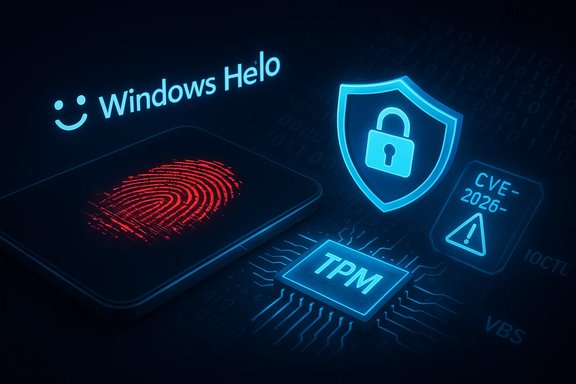
Windows Hello is Microsoft’s integrated biometric and PIN authentication platform for Windows desktop and server products. It stores biometric templates locally, uses TPM-backed keys for secure sign-in, and implements Enhanced Sign-in Security (ESS) features such as Virtualization-Based Security (VBS) and Trusted Platform Module (TPM) protection to isolate authentication material from the normal OS. These architectural choices are intended to keep biometric data local and reduce the risk of credential theft or remote replay. Windows Hello and its business-focused sibling, Windows Hello for Business, have been the subject of multiple vulnerability disclosures in recent years — ranging from spoofing and information disclosure to other bypasses of biometric protections. Those prior incidents demonstrate that biometric authentication reduces attack surface for passwords but introduces new, subtle failure modes at the sensor, device driver, and broker layers. Context from earlier Windows Hello advisories shows this is an ongoing hardening effort rather than a one-off fix. What Microsoft says about CVE-2026-20804
Microsoft’s short advisory for CVE-2026-20804 classifies the issue as an incorrect privilege assignment that permits an unauthorized local actor to carry out tampering. The vendor’s phrasing implies the vulnerability lives in a component that grants or inherits privileges improperly — in other words, code that should not execute with elevated authority can be induced to do so, enabling a local attacker to tamper with protected resources or authentication flows. The advisory entry is present in the Microsoft Update Guide. Important operational points Microsoft’s advisory makes (directly or by implication):- The attack vector is local — exploitation requires the attacker to be running code or otherwise interacting locally with the vulnerable host.
- The root cause class is incorrect privilege assignment — this typically means the software grants greater rights than intended to a subject, or fails to correctly validate the privilege context before performing sensitive actions.
Why this matters: technical risk and attack model
Biometric authentication is only as strong as the entire chain that supports it — sensor, driver, middleware, authentication broker, and the OS-level protections that isolate keys and templates. An incorrect privilege assignment inside any of those components can translate into one or more of the following real-world impacts:- Local tampering of authentication tokens or key material. If an attacker can cause privileged code to accept or act upon attacker-controlled inputs, they may be able to manipulate or inject authentication artifacts that allow unauthorized sign-ins.
- Bypass or spoofing of biometric protections. A privileged misuse path may permit substitution of biometric data or the bypassing of checks that detect replay or artificial input. Prior Windows Hello issues have shown facial or sensor spoofing can be realistic when hardware or software checks are insufficient.
- Post‑compromise escalation and persistence. Because authentication artifacts often gate access to other secrets (keys, certificates, credential vaults), tampering at the Windows Hello layer can help an attacker escalate privileges, move laterally, or maintain persistent access.
Technical analysis: plausible mechanics and limitations
Microsoft’s one-line description does not include exploit details, function names, or proof-of-concept (PoC) code. However, an incorrect privilege assignment in an authentication subsystem typically emerges from one or more of the following coding failures:- Missing or incorrect validation of the caller’s identity before granting access to privileged functionality (CWE-266).
- Untrusted search paths or load-time privilege inheritance that allow attacker-controlled modules to be loaded into a higher-privilege context.
- Race conditions or TOCTOU (time-of-check to time-of-use) windows where a resource’s identity or access rights are validated under one context and acted upon under another, allowing an attacker to switch the underlying resource between those steps.
- Improperly scoped service or driver ACLs that permit less-privileged users to issue privileged commands via device interfaces or IPC endpoints.
Verification and corroboration: what we could (and could not) find
- The definitive record for CVE-2026-20804 at time of publication is Microsoft’s entry in the Update Guide. Administrators should consult that entry for the vendor’s KB → build mappings and published update packages.
- Independent, detailed technical writeups, proof-of-concept exploit code, or full NVD enrichment for CVE-2026-20804 were not available at the time this article was written. That absence is meaningful: it means defenders can only rely on Microsoft’s advisory and standard patching guidance until third‑party researchers publish reproductions or deeper analyses. When vendor advisories are terse, defensive teams should assume worst-case consequences for protected assets.
- For context and precedent, several Windows Hello vulnerabilities disclosed in 2024–2025 show how biometric authentication bugs can manifest (for example, prior Windows Hello spoofing and information disclosure CVEs). Those earlier cases illustrate both the exploitation patterns and the urgent need to apply vendor updates when they are available.
Operational impact: who should worry first
Prioritization should follow the principle of exposure and criticality:- High priority: Privileged admin workstations, domain controllers, and jump boxes where Windows Hello is used to unlock admin sessions. A compromise of Windows Hello on these hosts can yield significant escalation and persistence advantages for attackers.
- Medium priority: Multi-user shared hosts such as VDI infrastructures, Remote Desktop Session Hosts, or developer machines that accept third‑party drivers or devices. Attackers with local access in those environments may use a local tampering primitive to attack other users or the host.
- Lower (but non‑negligible) priority: Standalone consumer devices and single‑user laptops. While the blast radius is smaller, local persistence and credential theft on these endpoints still fuel targeted attacks (e.g., access to corporate resources via cached credentials or stored tokens).
Immediate actions (0–72 hours)
- Check Microsoft’s Update Guide entry for CVE-2026-20804 and identify the KB number(s) and affected builds in your environment. Apply the vendor fixes in a staged manner (pilot → expanded rollout).
- If an immediate patch is not available for a given SKU, implement compensating controls:
- Enforce strict least privilege: remove unnecessary local admin rights and restrict interactive or local logons for high‑value accounts.
- Temporarily disable Windows Hello on the highest‑value admin hosts where feasible, or enforce alternate sign-in methods until you can patch and validate.
- Harden device and driver policies:
- Enforce driver signing and block known‑vulnerable or unsigned drivers.
- Use Windows Defender Application Control (WDAC) or AppLocker to restrict which binaries and DLLs may be loaded by privileged processes.
- Instrument and hunt: Increase telemetry for elevation and authentication flows.
- Log and alert on unusual elevation events, sudden changes in authentication artifacts, or unexpected token creation under admin contexts.
- Monitor EDR for processes opening Windows Hello service handles, device IOCTLs to sensor drivers, or child processes spawned by sign-in brokers.
Detection, hunting, and incident response guidance
Detection of exploitation for local tampering is often behavioural rather than signature-based. Focus on these telemetry signals:- Unexpected process elevations to SYSTEM or administrative tokens originating from non‑admin parent processes.
- Abnormal device interface or IOCTL activity targeting biometric sensor drivers or broker services.
- File system writes or module loads into locations used by privileged sign-in helpers or search paths.
- Authentication anomalies: unexpected successful sign‑ins or credential‑use patterns inconsistent with normal user behavior.
- Preserve volatile forensic artifacts (memory images, WER minidumps) before rebooting.
- Collect Windows Security event logs (token creation, logon events) and EDR telemetry correlated with device driver loads.
- Treat successful tampering of authentication material as a high‑severity incident: rotate keys where possible, reset affected credentials, and rebuild compromised hosts after forensic triage.
Longer-term remediation and hardening
Beyond the immediate patch-and-hunt cycle, organizations should treat authentication-path integrity as an ongoing control objective:- Enforce Privileged Access Workstations (PAWs) for all sensitive admin operations to isolate high‑risk sign‑in surfaces.
- Deploy Just‑In‑Time (JIT) admin models and privileged access management (PAM) to reduce standing administrative privileges.
- Centralize telemetry for sign-in brokers and instrument Windows Hello processes explicitly so anomalies produce actionable alerts.
- Use hardware-enforced features (TPM, VBS, ESS) and validate peripheral devices against trusted hardware lists wherever possible.
Strengths and weaknesses of Microsoft’s public advisory
Strengths:- Microsoft has assigned a CVE and published an update guide entry, which is the canonical start point for remediation planning. Administrators now have an explicit vendor record to map KBs and build numbers against.
- The MSRC advisory for CVE-2026-20804 is terse and lacks technical detail; this is a common vendor practice to reduce exploit publication pressure, but it leaves defenders working with limited context. Until independent researchers publish analysis or Microsoft supplies additional technical notes, defenders must assume conservative (high-risk) threat models.
- Third‑party corroboration and tooling updates take time to appear. Without independent PoCs or vendor-provided technical diffs, detection and signature-based protections cannot be precisely tuned. Organizations should therefore emphasize behavioral detection and rapid patch deployment.
Practical checklist for Windows administrators
- Query inventory tools (WSUS, SCCM, Intune, other patch management) for the KB(s) mapped to CVE-2026-20804 in Microsoft’s Update Guide and create a prioritized deployment ring.
- Pilot updates on representative admin workstations and VDI hosts; test Windows Hello sign-in flows and external peripheral compatibility.
- Harden driver and application policies: enable driver signing enforcement, apply WDAC, and restrict writable locations used in elevated process search orders.
- Increase monitoring of authentication flows, elevation events, and driver IOCTL activity. Keep a validated incident response plan ready for rapid host rebuilds and key rotations.
- If Windows Hello is used for critical admin authentication, consider temporary removal of biometric sign‑in on the most sensitive endpoints until updates and testing are complete.
Final assessment: severity, uncertainty, and recommended posture
CVE-2026-20804 is a vendor‑recorded incorrect privilege assignment related to Windows Hello that permits local tampering. The issue should be prioritized by defenders who operate Windows Hello in administrative or multi‑user environments because authentication-path compromise is a high‑value objective for attackers.That said, there is important uncertainty: Microsoft’s advisory is brief and, at publication time, independent technical analyses or public PoCs were not yet available. This lack of external corroboration means defenders must operate under a conservative threat model—assume the vulnerability can be leveraged from a normal user context to manipulate authentication artifacts until proven otherwise.
Immediate, pragmatic steps are clear:
- Consult Microsoft’s Update Guide entry and apply the listed KBs as the authoritative remediation mapping.
- Prioritize critical hosts for patching, ship updates through a staged pilot, and harden driver and authentication policies.
- Expand behavioral telemetry for sign‑in and elevation events, and be prepared to perform forensic triage if anomalous authentication behavior is observed.
By treating this advisory with high priority, staging updates thoughtfully, and strengthening telemetry and least‑privilege controls, Windows administrators can reduce the practical risk posed by CVE-2026-20804 while awaiting any deeper technical analysis or detection signatures from the research community.
Source: MSRC Security Update Guide - Microsoft Security Response Center
