

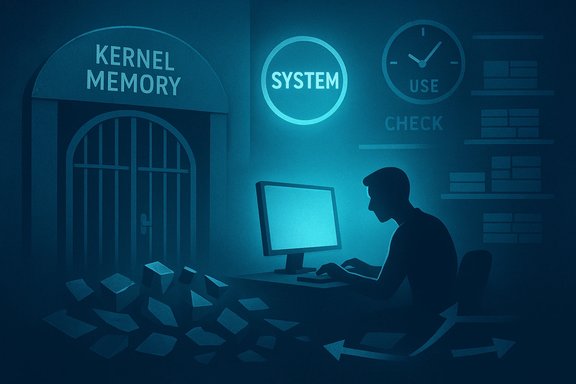
Microsoft’s advisory identifies CVE-2026-20809 as a time-of-check/time-of-use (TOCTOU) race condition in Windows kernel memory that can be abused by an authorized local user to gain SYSTEM privileges — in short, a local elevation-of-privilege (EoP) vulnerability rooted in kernel memory management that must be treated as a high-priority patching and detection item for both endpoints and servers.
Race conditions that occur in kernel-mode code — commonly described as TOCTOU (time-of-check/time-of-use) defects — are a long-standing class of Windows vulnerabilities. They occur when privileged code performs a security-relevant check and later uses the resource without holding a locking or pinning primitive that preserves the resource’s invariants; an attacker can alter the resource in the narrow window and cause the kernel to act on attacker-controlled data. In kernel context this often leads to memory corruption primitives (double-free, use-after-free, out-of-bounds) that an attacker converts into a token-stealing or write-what-where capability, effectively elevating privileges to SYSTEM. CVE-2026-20809, as recorded in Microsoft’s Update Guide (user-provided source), is described as one such TOCTOU race in kernel memory that allows local privilege elevation. Because the attack requires local code execution or an authenticated account on the host, this vulnerability is not directly a remote RCE — but it is exactly the kind of post‑compromise primitive adversaries chain with an initial foothold (phishing, web exploit, malicious installer, sandbox escape) to achieve full host compromise. Security reporting on analogous Windows kernel TOCTOU issues repeatedly stresses that a local EoP primitive of this kind is a force multiplier in real-world campaigns.
Key immediate actions (short checklist)
Source: MSRC Security Update Guide - Microsoft Security Response Center
 Background / Overview
Race conditions that occur in kernel-mode code — commonly described as TOCTOU (time-of-check/time-of-use) defects — are a long-standing class of Windows vulnerabilities. They occur when privileged code performs a security-relevant check and later uses the resource without holding a locking or pinning primitive that preserves the resource’s invariants; an attacker can alter the resource in the narrow window and cause the kernel to act on attacker-controlled data. In kernel context this often leads to memory corruption primitives (double-free, use-after-free, out-of-bounds) that an attacker converts into a token-stealing or write-what-where capability, effectively elevating privileges to SYSTEM. CVE-2026-20809, as recorded in Microsoft’s Update Guide (user-provided source), is described as one such TOCTOU race in kernel memory that allows local privilege elevation. Because the attack requires local code execution or an authenticated account on the host, this vulnerability is not directly a remote RCE — but it is exactly the kind of post‑compromise primitive adversaries chain with an initial foothold (phishing, web exploit, malicious installer, sandbox escape) to achieve full host compromise. Security reporting on analogous Windows kernel TOCTOU issues repeatedly stresses that a local EoP primitive of this kind is a force multiplier in real-world campaigns.What the record says (concise, verifiable facts)
- Nature of the bug: TOCTOU race condition in Windows kernel memory handling, allowing an attacker to change kernel- or user-mode state between check and use, producing memory corruption or misdirected pointer dereferences.
- Attack vector: Local, authorized user (an attacker must run code on the host under a non‑privileged account or induce an authorized user to run carefully crafted inputs).
- Impact: Elevation of privilege to SYSTEM (kernel-level memory corruption enables token manipulation or arbitrary kernel writes that translate to SYSTEM context).
- Exploitability: historically, TOCTOU bugs are rated with high exploitation complexity (timing-dependent, multi-threaded), but community experience shows skilled exploit authors and automation can make these reliable — so operational exposure is real even when the technical bar is higher.
- Patching: Microsoft has an Update Guide entry for the vulnerability; enterprises must map the CVE to the correct KB(s) for each OS build and deploy via WSUS, SCCM/ConfigMgr, Intune, or the Microsoft Update Catalog. Where Microsoft marks a kernel EoP as “Exploitation Detected” or ships fixes in a security rollup, agencies and SOCs commonly treat remediation windows as hours rather than days.
Technical anatomy — how TOCTOU kernel memory races are abused
The typical attack primitive
- A privileged kernel routine performs a validation step (time-of-check), for example verifying a pointer, handle, or buffer length.
- The kernel then uses that pointer or buffer later (time-of-use) but fails to lock the backing pages, pin the object, or take a synchronization primitive.
- An attacker races to change the backing memory, file handle, reparse target, or other state between check and use. The subsequent privileged dereference operates on attacker-controlled memory.
- The outcome is a memory corruption primitive — double-free, write-what-where, or untrusted pointer dereference — that an attacker escalates into a token swap or arbitrary kernel write, enabling SYSTEM-level execution.
Why kernel-mode makes this deadly
Kernel-mode runs at ring‑0 and governs the system’s security model. Any reliable write‑what‑where or token-manipulation primitive in the kernel can disable endpoint protections, extract LSA/DPAPI secrets, install kernel persistence, or spawn SYSTEM processes that the attacker controls. That’s why these flaws are prioritized in the field even when the initial exploit is “local only.” Security vendors and incident responders specifically flag admin workstations, domain controllers, RDP/VDI hosts, and hosts that process untrusted uploads as high‑value targets for such primitives.Who and what is affected
- Supported Windows client and server builds present in the field at the time of the fix are the likely coverage set. Administrators must map the CVE to their exact SKU/build before patching. Do not assume a single cumulative applies to all builds.
- Systems with any exposure to untrusted local execution are at the greatest risk:
- Shared workstations and VDI/RDS hosts that accept user-supplied executables.
- Developer build servers, imaging stations, or test hosts that mount untrusted VHD/VHDX images.
- Administrative jump boxes and domain controllers if an attacker can achieve any local execution on a neighbouring host.
- Systems accepting user uploads and performing server‑side parsing or previewing tasks.
Practical mitigation and remediation plan (0–72 hours)
- Patch first
- Identify the KB(s) that map to CVE-2026-20809 for each Windows build in your environment using Microsoft’s Update Guide and your patch management inventory.
- Deploy to a small, representative pilot ring (domain controllers, admin workstations, RDP hosts), verify functionality, then roll out to high‑value and broad groups.
- Reboot hosts where required and verify build/KF/KB presence after restart.
- If you cannot patch immediately, apply compensating controls
- Enforce application allow‑listing (WDAC / AppLocker) for high-risk endpoints.
- Remove unnecessary local admin rights and apply least privilege.
- Restrict interactive logon to high-value hosts and segregate jump boxes onto isolated networks.
- Restrict mounting or attaching of untrusted VHD/VHDX images and disallow arbitrary code execution in user directories.
- Strengthen detection and hunting
- Push EDR/IDS rules that flag: sudden process elevation to SYSTEM, token duplication APIs (DuplicateTokenEx/OpenProcessToken), suspicious DeviceIoControl/IOCTL sequences from user processes, and kernel crashes referencing relevant drivers.
- Hunt for anomalous parent/child process trees where non‑privileged processes spawn cmd.exe, PowerShell or SYSTEM shells.
- Preserve forensics if exploitation is suspected
- Isolate the host, collect memory images and minidumps, preserve Windows Event logs and recent device attach logs, and avoid additional reboots until captures are complete.
Detection, indicators and SIEM/EDR tuning
Priority signals to instrument:- Token and process anomalies:
- Unexpected DuplicateTokenEx/CreateProcessAsUser sequences from non-admin contexts.
- Processes suddenly running as SYSTEM where parent is an interactive user process.
- Kernel instability and driver faults:
- Sudden BSODs or crashes correlated with user activity on the host (note driver filename mentions if present).
- Repeated crashes in kernel components after identical user-space trigger patterns.
- Suspicious DeviceIoControl/IOCTL usage:
- Non-standard processes making DeviceIoControl calls to networking, storage VSP, or virtualization drivers shortly before elevation events.
- Behavioural hunts:
- Look for repeated thread-forks and allocator grooming behaviour on user processes (a common pattern used to win race windows).
- Correlate process creation events with file or path changes that indicate reparse point or placeholder manipulation.
Risk assessment — strengths to weigh and hazards to watch
Notable strengths in the vendor response
- Microsoft’s Update Guide entry and delivered patches (when available) are the definitive mitigations; an official vendor fix closes the faithful exploitation path if applied correctly. Security operations should treat vendor patching as the primary defense.
- Industry trackers and multiple vendors historically converge quickly on kernel EoP disclosures, enabling detection rules to be created and distributed via EDR/IDS vendors. That ecosystem response reduces dwell time for attackers who rely on unpatched systems.
Potential hazards and operational gaps
- Local vector + low privileges required: any environment that permits untrusted local execution makes the issue high-priority despite the “timing complexity” label; attackers commonly achieve footholds through phishing or weak remote exposures and then use a local EoP to escalate.
- Limited vendor detail: Microsoft routinely omits exploit mechanics in public advisories to slow immediate weaponization; that leaves defenders to rely on behavioural detection and rapid patching rather than signature-based fixes. This protective redaction is sensible, but it increases short-term operational uncertainty.
- Post‑patch PoC risk: historically, once patches are public, exploit developers reverse‑engineer fixes to produce PoCs and weaponized exploits — meaning unpatched systems become rapidly more attractive targets after disclosure. Prioritize rapid deployment accordingly.
Deployment playbook for large estates (recommended sequencing)
- Inventory & mapping
- Use your inventory tools to map CVE → KB → OS build. Do not rely on generic CVE strings; KB IDs are the deployment unit.
- Pilot testing (24–72 hours)
- Validate critical services, third‑party drivers, and backup/restore operations in a small pilot ring representing admin hosts, RDS/VDI hosts and domain controllers. Kernel patches can interact poorly with unsigned or poorly written kernel drivers; test those early.
- Prioritized rollout
- High‑priority: domain controllers, jump boxes, VPN and RDP hosts, admin workstations, and servers that process untrusted content.
- Broad rollout: rest of the estate after pilot confirms stability. Use automated patching with controlled reboots.
- Post‑deployment validation
- Query installed KBs (Get‑HotFix or inventory tool) and confirm the OS build string matches Microsoft guidance. Monitor for unusual instability that may indicate incompatible third‑party drivers.
Hardening beyond the immediate patch
- Enforce least privilege and JIT admin access to reduce standing attack surface.
- Use application allow‑listing (WDAC / AppLocker) on critical hosts to prevent arbitrary user binaries from running.
- Maintain HVCI / Memory Integrity where hardware supports it to reduce kernel exploitation reliability.
- Maintain and enforce driver signing policies and vulnerable-driver blocklists.
- Isolate file‑parsing pipelines (thumbnail/preview services) into ephemeral containers or segregated systems with strict upload controls.
Verification and source confidence
This analysis is grounded on Microsoft’s Update Guide entry for CVE-2026-20809 (user-provided link) and corroborated with multiple independent industry sources that document the class of kernel TOCTOU EoP issues and the operational behaviours observed in similar disclosures. Independent reporting on kernel TOCTOU bugs and their operational handling — including vendor patch delivery, exploitation patterns, and enterprise mitigations — aligns with the guidance above. However, the MSRC Update Guide is JavaScript-powered and could not be rendered directly in this environment; therefore readers should confirm the precise KB mappings, CVSS vector and any Microsoft-supplied mitigation text directly via the Update Guide or Microsoft Update Catalog before implementing a broad change. If any specialized claims appear in secondary writeups (for example, exact function names, a published PoC, or confirmed actor attribution), they should be treated as unverified until validated by either Microsoft’s diffs/KB notes or multiple reputable vendor analyses; treat publicly posted PoC code cautiously and never run it on production systems.Conclusion — operational imperative
CVE-2026-20809 is the archetype of a high-impact, local kernel EoP: the flaw itself is triggered locally but, when chained with an initial foothold, becomes the final act that converts limited access into full system compromise. The single most effective step to eliminate the operational risk is to map the CVE to the correct Microsoft KB for each build and apply the patch immediately to high-value hosts (domain controllers, admin workstations, RDP/VDI hosts, and servers that process untrusted content). Until patches are in place, apply compensating controls (application allow‑listing, least privilege, limiting local execution) and tune EDR/SIEM to look for the detection signals listed above. Rapid patching plus behavioural hunting is the practical, defensible response to a kernel TOCTOU EoP of this class.Key immediate actions (short checklist)
- Confirm the MSRC Update Guide mapping of CVE‑2026‑20809 → KB for each OS build and schedule patches now.
- Pilot the update on a small ring (admin hosts, jump boxes, RDP hosts) and verify third‑party driver compatibility.
- If patching is delayed, enforce WDAC/AppLocker, reduce interactive logons, and isolate high-risk services.
- Push EDR detections focused on token duplication, DeviceIoControl anomalies, and unexpected SYSTEM process creation.
Source: MSRC Security Update Guide - Microsoft Security Response Center
