

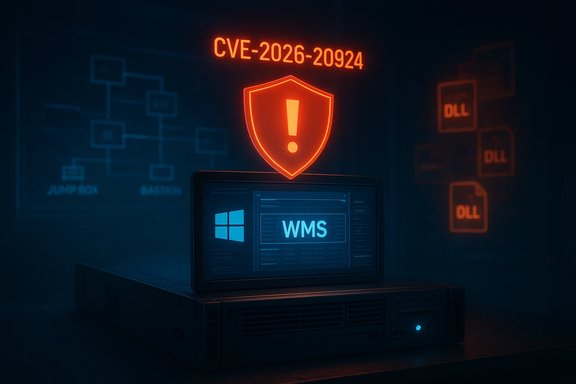
A newly recorded elevation‑of‑privilege flaw in Windows Management Services (WMS) — tracked as CVE‑2026‑20924 — has been registered in Microsoft’s Security Update Guide and classified as an elevation of privilege risk on administrative hosts, forcing operators to treat management‑plane hosts as high‑priority for triage, patching, and hunting.
Windows Management Services is a management‑plane surface used to host administrative tooling, extensions, and update/attestation flows on Windows servers and management workstations. Management hosts frequently act as jump boxes and bastions, holding elevated tokens, credentials, or privileged tooling that can be leveraged to control broad portions of an enterprise estate. That operational context makes any local elevation‑of‑privilege (EoP) defect in WMS disproportionately dangerous relative to a similarly scoped flaw in a user application.
Microsoft’s public registration for CVE‑2026‑20924 in the Security Update Guide confirms the vulnerability exists but, consistent with Microsoft’s typical disclosure cadence for privileged inbox components, the vendor’s advisory text is intentionally concise and may omit low‑level exploit primitives until fixes are broadly staged. Administrators must therefore treat the vendor’s listing as authoritative for CVE existence and remediation mapping while using conservative, evidence‑based inferences about exploitation.
For CVE‑2026‑20924, the presence of an MSRC entry is significant: it establishes high confidence that the vulnerability exists and that remediation mapping will be available via the Security Update Guide. However, because the initial MSRC text may be compact, defenders must not rely on the CVE string alone for patch automation — the correct KB→SKU mapping must be verified in the Update Guide or Microsoft Update Catalog before deploying updates.
At the same time, the terse advisory model shifts burden onto defenders to infer plausible attack patterns from historical analogs and to rapidly instrument detection and containment controls. This creates operational friction for teams that lack mature patching or EDR capabilities, particularly in environments with many bespoke management hosts. The absence of a public PoC also means some blue teams may deprioritize a CVE until more details appear — a risky posture for management‑plane vulnerabilities where the blast radius is large.
Applying the prioritized checklist and strengthening hygiene around management hosts will materially reduce your exposure while patches are staged and deployed. Vigilant telemetry, careful patch verification, and a conservative threat model are the practical defenses that turn this advisory from a high‑risk alarm into a manageable operational task.
Source: MSRC Security Update Guide - Microsoft Security Response Center
 Background / Overview
Windows Management Services is a management‑plane surface used to host administrative tooling, extensions, and update/attestation flows on Windows servers and management workstations. Management hosts frequently act as jump boxes and bastions, holding elevated tokens, credentials, or privileged tooling that can be leveraged to control broad portions of an enterprise estate. That operational context makes any local elevation‑of‑privilege (EoP) defect in WMS disproportionately dangerous relative to a similarly scoped flaw in a user application.Microsoft’s public registration for CVE‑2026‑20924 in the Security Update Guide confirms the vulnerability exists but, consistent with Microsoft’s typical disclosure cadence for privileged inbox components, the vendor’s advisory text is intentionally concise and may omit low‑level exploit primitives until fixes are broadly staged. Administrators must therefore treat the vendor’s listing as authoritative for CVE existence and remediation mapping while using conservative, evidence‑based inferences about exploitation.
What Microsoft’s “exploitability / confidence” metric means here
Microsoft uses an internal metric to communicate how confident it is that a vulnerability both exists and is operable (i.e., there is enough technical detail to support reliable exploitation). When Microsoft marks an advisory with a higher exploitability confidence, the urgency for patching rises because the vendor considers the underlying bug real and the technical details sufficiently precise for attackers to act upon. Conversely, terse vendor entries — like those sometimes used for inbox management services — indicate high‑confidence existence but intentionally limited disclosure of exploit mechanics during coordinated patching.For CVE‑2026‑20924, the presence of an MSRC entry is significant: it establishes high confidence that the vulnerability exists and that remediation mapping will be available via the Security Update Guide. However, because the initial MSRC text may be compact, defenders must not rely on the CVE string alone for patch automation — the correct KB→SKU mapping must be verified in the Update Guide or Microsoft Update Catalog before deploying updates.
Technical anatomy: plausible defect classes and exploitation primitives
Microsoft’s short advisory label — “Elevation of Privilege” in Windows Management Services — is a classification that maps to a small set of recurring technical fault classes that historically affect WMS and similar inbox services. Independent community analysis of adjacent WMS CVEs and vendor‑agnostic writeups show three recurring root patterns that plausibly explain CVE‑2026‑20924:- Race condition / TOCTOU (Time‑of‑Check‑to‑Time‑of‑Use) — privileged code performs checks then acts on resources that an attacker can replace or swap within the small window between check and use. This often leads to DLL hijacks, signed‑artifact substitution, or launching an updater that loads attacker‑controlled modules.
- Use‑After‑Free (UAF) / memory lifecycle bugs — a freed object remains referenced, and controlled allocation timing converts the weakness into write‑what‑where or code‑control primitives under the privileged process. Past WMS advisories have used this pattern to escalate from a standard user to SYSTEM.
- Insufficient verification of trusted artifacts — privileged components assume signatures, attestation blobs, or files in shared locations are trustworthy without atomic validation, allowing signed‑artifact substitution or trusted loader abuse. This class has been observed in WMS‑adjacent advisories and independent write‑ups.
Why WMS EoP flaws matter operationally
Management hosts provide outsized value to attackers for several reasons:- They often store elevated credentials, service principal tokens, or have persistent privileged access to many endpoints.
- Compromise of a single bastion or WMS host can enable rapid lateral movement and supply‑chain‑style abuse because update/extension flows are commonly trusted by other systems.
- Privileged escalations on management endpoints commonly convert into domain or tenant compromises in enterprise settings.
Attack scenarios — realistic chains to prioritize in threat modeling
Using conservative, evidence‑backed reasoning based on historical WMS CVEs, defenders should prioritize the following post‑compromise and pre‑exploit scenarios:- A local, unprivileged user or process abuses WMS update/extension workflows — substituting a signed script or a DLL in a writable directory — which the privileged WMS component later executes or loads (signed‑artifact substitution / DLL hijack).
- A Time‑of‑Check‑to‑Time‑of‑Use (TOCTOU) race where WMS validates an artifact in one process but loads it later from a location that an attacker can swap in the interim, producing SYSTEM code execution.
- A UAF or memory‑safety bug enabling a low‑privileged process to corrupt objects in the privileged context, producing token theft or arbitrary code execution as SYSTEM. Historical WMS advisories follow this pattern.
Detection and hunting guidance
While awaiting vendor patch details or PoC, defenders should tune telemetry to detect behavior consistent with WMS EoP exploitation attempts. The following signals are practical and derived from observed patterns in similar advisories:- Watch for unexpected crashes, restarts, or faulting modules in WMS components and associated service hosts. Sudden restarts followed by child processes running in SYSTEM context are high‑value indicators.
- Detect local processes spawning privileged processes (e.g., standard user processes causing service creation, SYSTEM process spawns, or scheduled tasks appearing after WMS instability).
- Monitor file system activity around WMS extension/update directories: rapid deletes/creates, file renames or artifacts being replaced shortly after validation events — particularly where the directory is writable to non‑administrative accounts.
- EDR/SIEM hunts: search for PowerShell executions with Base64 payloads originating from management hosts, suspicious command sequences (domain recon commands issued by system contexts), or outbound connections initiated by unexpected processes shortly after WMS activity. These patterns were seen in adjacent vulnerability exploitation cases and are high‑priority hunting targets.
- Correlate package/extension updates. If WMS publishes or applies an update, validate the cryptographic provenance of the artifact and reconcile with change control records. Unapproved package changes on management hosts are an immediate red flag.
Immediate mitigation and incident response (0–72 hours)
Apply the following prioritized actions immediately; they are designed to contain, reduce risk, and prepare for a fast remediation cycle.- Verify CVE→KB→SKU mapping in Microsoft’s Security Update Guide and the Microsoft Update Catalog before distributing patches. Do not rely solely on the CVE string for automation.
- Stage vendor fixes in a controlled pilot ring that includes jump boxes, bastion hosts, and high‑value management endpoints. Validate management workflows and backups before wide rollout.
- If immediate patching is not possible: apply compensating controls
- Restrict write permissions to any directories used by WMS for updates, extensions, or temporary staging to administrative accounts only.
- Where feasible, isolate management hosts on segmented networks and limit inbound connections to trusted admin subnets.
- Temporarily disable nonessential WMS plugins or extension loading if the feature can be turned off without breaking critical operations.
- Increase monitoring and alerting:
- Tune EDR to flag SYSTEM process creation by non‑privileged parents.
- Alert on unusual file modifications in extension/update directories.
- Correlate WMS-related service crashes with subsequent privileged actions.
- Prepare an IR plan that preserves volatile evidence: collect memory dumps, Event Log exports, and WMS configuration state before reboot or patching when possible. This is critical for forensic verification if exploitation is suspected.
Patch management best practices for CVE‑2026‑20924
- Confirm the specific KB(s) for each affected build in the Microsoft Update Guide and enumerate those across your estate. The MSRC is the canonical mapping and should be authoritative.
- Pilot patches on a small representative ring (admin workstations, bastions, build agents) and validate critical management processes.
- Roll out in waves with rollback plans and post‑patch verification checks (service functionality, extension updates, attestation flows).
- After deployment, increase post‑deployment monitoring for the next 72–120 hours to detect any anomalous activity that could represent attempted exploitation before patching.
Risk assessment — who is at highest risk?
- Organizations that run internal management hosts or jump boxes with WMS installed and that allow non‑privileged users to interact with update/extension directories are at greatest risk.
- Enterprises that centralize update flows or store credentials/tokens on management hosts face an outsized blast radius if WMS is compromised.
- Administrators of hybrid clouds, virtualization hosts, or environments where WMS endpoints have access to provisioning or attestation APIs should prioritize remediation because a single elevated host can yield tenant or workload compromises.
Verification, caveats, and the limits of current public data
- Confirmed: Microsoft has registered CVE‑2026‑20924 in its Security Update Guide which establishes high confidence in the vulnerability’s existence. Administrators must use the Update Guide for the authoritative KB→SKU mapping.
- Corroboration: Independent community trackers and rapid‑response write‑ups for adjacent WMS CVEs document consistent exploitation models (race conditions, UAFs, signed‑artifact substitution) that are useful analogs for threat modeling CVE‑2026‑20924. Use these as conservative technical guidance until Microsoft or third‑party researchers publish detailed technical notes.
- Unverified claims: At the time of writing there is no public, authoritative proof‑of‑concept or exploit blueprint for CVE‑2026‑20924 in mainstream mirrors. Any assertion about precise exploit primitives, IOCTLs, or function names would be speculative until vendor patch diffs or independent technical analyses are published. Treat such detailed claims as provisional and flag them in operational documentation.
Practical prioritized checklist (ready for operational use)
- Immediate (within hours)
- Confirm presence of WMS on hosts; inventory all management hosts and jump boxes.
- Verify the CVE→KB mapping in Microsoft’s Security Update Guide for each build.
- Short term (24–72 hours)
- Pilot and deploy vendor patches once verified for your SKU.
- Restrict filesystem permissions for WMS extension/update directories to administrators.
- Block unnecessary inbound access to management hosts and isolate bastions onto a dedicated management VLAN.
- Medium term (1–3 weeks)
- Audit and rotate any tokens or credentials that were stored on affected management hosts if there is any sign of suspicious access.
- Harden update/extension pipelines to use atomic validation and minimize reliance on writable shared directories.
- Ongoing
- Maintain a grooming process to keep vendor advisories and KB mappings reconciled with your CMDB.
- Retain post‑patch monitoring for anomalous behavior for at least 30 days after remediation.
Final analysis — strengths and risks of the current disclosure model
Microsoft’s conservative disclosure practice — registering CVEs in the Security Update Guide while withholding exploit‑level details until fixes are widely available — is a pragmatic balance: it provides authoritative tracking and remediation mapping while reducing immediate attack surface leakage. That model has clear strengths for enterprise defenders: it forces administrators to rely on vendor KBs and provides a controlled window to patch before detailed exploit information becomes public.At the same time, the terse advisory model shifts burden onto defenders to infer plausible attack patterns from historical analogs and to rapidly instrument detection and containment controls. This creates operational friction for teams that lack mature patching or EDR capabilities, particularly in environments with many bespoke management hosts. The absence of a public PoC also means some blue teams may deprioritize a CVE until more details appear — a risky posture for management‑plane vulnerabilities where the blast radius is large.
Conclusion
CVE‑2026‑20924 is a high‑value, high‑urgency advisory because it targets Windows Management Services — a management‑plane surface inherently rich in privileged artifacts and control. Microsoft’s registration of the CVE in the Security Update Guide confirms the vulnerability’s existence, but the vendor’s concise public text requires defenders to act conservatively: verify KB mappings, prioritize patch pilots on management hosts, apply compensating controls to extension/update directories, and tune detection for the behavioral patterns described here. Use the vendor’s Update Guide as the authoritative source for remediation mapping, and treat any detailed exploit claims as provisional until corroborated by vendor patch diffs or independent technical research.Applying the prioritized checklist and strengthening hygiene around management hosts will materially reduce your exposure while patches are staged and deployed. Vigilant telemetry, careful patch verification, and a conservative threat model are the practical defenses that turn this advisory from a high‑risk alarm into a manageable operational task.
Source: MSRC Security Update Guide - Microsoft Security Response Center
