

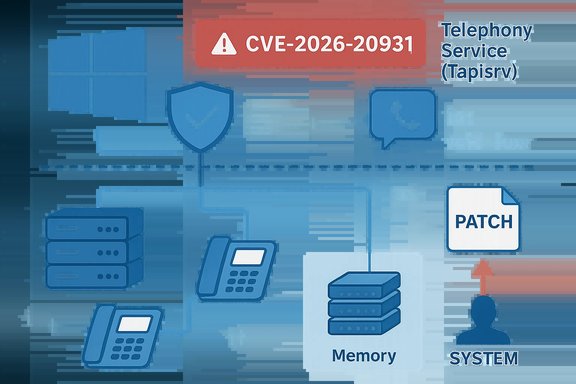
Microsoft has assigned CVE‑2026‑20931 to a privilege‑escalation flaw in the Windows Telephony Service, a component long tied to the Telephony Application Programming Interface (TAPI) and enterprise VoIP/telephony integrations; Microsoft’s advisory lists the issue as an Elevation of Privilege vulnerability and administrators should treat affected hosts as high priority for assessment and patching.
The Windows Telephony Service (Tapisrv / TAPI) provides an OS‑level framework that allows applications to manage telephony devices and sessions — everything from legacy modems and fax handling to enterprise Voice‑over‑IP and call‑center systems. Because the service commonly runs with elevated privileges inside Windows, any flaw in its input handling or memory management can lead to serious local or remote escalation outcomes. Many recent Patch‑Tuesday waves have repeatedly surfaced memory‑safety and input‑validation defects in telephony and other inbox services, underscoring the recurring attack surface these legacy components provide.
Microsoft lists CVE‑2026‑20931 in its Security Update Guide as affecting the Windows Telephony Service; the vendor classifies the impact as Elevation of Privilege and publishes a short advisory entry mapping the CVE to the relevant update packages for supported SKUs. Because Microsoft’s vendor advisory model for inbox services typically omits low‑level exploit primitives until customers are broadly patched, public technical details are often intentionally limited in the initial advisory. Administrators must therefore rely on vendor KB mappings and reputable third‑party trackers when mapping patches to specific builds.
Because the advisory intentionally limits technical detail, outside researchers and vendors will typically produce patch‑diff analyses and PoCs later; treat early public speculation about exact memory corruption types as unverified until corroborated by at least two independent analyses.
Note on sources and verification: This article synthesizes vendor advisory patterns, community analysis, and vulnerability tracker listings. Microsoft’s Security Update Guide entry confirms CVE‑2026‑20931 and its mapping to January 2026 fixes; community technical commentary and historic Telephony Service advisories provide context for risk and mitigation strategy. Where specific exploit mechanics or PoCs were not available in the vendor advisory, those details have been explicitly marked as unverified and treated as provisional.
Source: MSRC Security Update Guide - Microsoft Security Response Center
 Background / Overview
The Windows Telephony Service (Tapisrv / TAPI) provides an OS‑level framework that allows applications to manage telephony devices and sessions — everything from legacy modems and fax handling to enterprise Voice‑over‑IP and call‑center systems. Because the service commonly runs with elevated privileges inside Windows, any flaw in its input handling or memory management can lead to serious local or remote escalation outcomes. Many recent Patch‑Tuesday waves have repeatedly surfaced memory‑safety and input‑validation defects in telephony and other inbox services, underscoring the recurring attack surface these legacy components provide.Microsoft lists CVE‑2026‑20931 in its Security Update Guide as affecting the Windows Telephony Service; the vendor classifies the impact as Elevation of Privilege and publishes a short advisory entry mapping the CVE to the relevant update packages for supported SKUs. Because Microsoft’s vendor advisory model for inbox services typically omits low‑level exploit primitives until customers are broadly patched, public technical details are often intentionally limited in the initial advisory. Administrators must therefore rely on vendor KB mappings and reputable third‑party trackers when mapping patches to specific builds.
What we know right now (concise technical summary)
- Affected component: Windows Telephony Service (TAPI / Tapisrv).
- CVE ID: CVE‑2026‑20931 — vendor classification: Elevation of Privilege.
- Vendor action: Microsoft has published an advisory entry in the Security Update Guide and has mapped fixes into the January 2026 patch wave; administrators should consult the MSRC mapping to find the exact KB for each Windows build.
- Public technical details: Microsoft’s advisory for inbox components typically confirms impact and affected SKUs but omits exploit mechanics; at time of writing no vendor‑published exploit primitives or proof‑of‑concept code are present in the official advisory. Treat claims about exact exploit sequences (heap overflow vs. use‑after‑free vs. race) as provisional until independent researchers publish patch diffs or PoCs.
Why this matters: risk and attack surface
The Telephony Service touches multiple dimensions that raise risk:- High privilege context. Telephony components historically run with elevated process privileges, so a successful exploit frequently yields SYSTEM or equivalent-level control.
- Network exposure (in many deployments). Enterprise telephony/VoIP endpoints or gateways are often reachable from internal or DMZ networks; some large installations even expose SIP or related services externally. Network‑accessible flaws scale quickly.
- Legacy code and complex parsing logic. Telephony stacks implement decades of protocols and vendor‑specific extensions, increasing the probability of memory management or boundary‑checking errors.
- Automation risk. When proof‑of‑concept code appears, attackers commonly weaponize remote vulnerabilities into wormable or mass‑scanable toolsets—especially if the exploit is low complexity. Historical Telephony issues have sometimes attracted automated exploitation.
Vendor confidence and disclosure posture
Microsoft uses an advisory model for inbox components that balances disclosure with risk: vendor advisories confirm the existence and impact class (here, Elevation of Privilege) and map fixes to KBs and builds, but they often avoid publishing exploit‑level details until patches are widely available. That approach reduces the immediate window for mass exploitation but places the burden on defenders to act quickly without relying on public exploit details. The Security Update Guide entry confirms the CVE and the mitigation channel (patched updates) but does not provide exploitation mechanics — consistent with Microsoft’s recent practice on similar issues.Because the advisory intentionally limits technical detail, outside researchers and vendors will typically produce patch‑diff analyses and PoCs later; treat early public speculation about exact memory corruption types as unverified until corroborated by at least two independent analyses.
Practical mitigation checklist — immediate steps
- Patch first (canonical fix)
- Identify the correct KB mapping for each Windows build using Microsoft’s Security Update Guide and your patch‑management tools. Deploy the update to test channels, then to production via WSUS, SCCM/ConfigMgr, or your chosen update pipeline. Reboot hosts as required.
- Disable the Telephony Service when not required (temporary mitigation)
- On endpoints or servers that do not rely on TAPI, set the Telephony Service to Disabled and stop running instances (services.msc → Telephony → Stop / Startup type = Disabled). This eliminates the attack surface at the cost of breaking telephony‑dependent apps; verify before rolling out widely. Many advisories and community write‑ups recommend this step as a short‑term measure.
- Network hardening and segmentation
- Block unnecessary inbound access to telephony endpoints. Segment VoIP infrastructure away from general purpose hosts and sensitive domain controllers. Use ACLs and firewall rules to limit the set of IPs that can reach telephony services.
- Increase monitoring and detection posture
- Tune EDR / EPP rules to look for suspicious behavior around TAPI processes and unusual network connections from telephony hosts. Check for new service creation, abnormal process injection attempts, or unexpected persistence mechanisms. Use packet capture/NetFlow/IDS signatures for anomalous SIP or call control traffic where applicable.
- Inventory and prioritize
- Map which systems run Telephony Service or host telephony applications. Prioritize servers exposed to internal networks or serving call‑center functions, and patch those first. Perform asset discovery to enumerate any nonstandard devices using TAPI or vendor telephony drivers.
- Test and rollback readiness
- Because telephony integrations can be fragile, test patches in representative staging environments that include PBX/VoIP stacks. Have rollback plans if a patch causes interoperability problems.
Detection guidance — what to look for
- Unexpected restarts or crashes of Tapisrv / telephony processes after patch rollouts (post‑patch instability can show up if third‑party drivers were relying on undefined behaviors).
- Outbound connections from telephony hosts to unusual external IPs or C2 infrastructure.
- Signs of privilege escalation on hosts that previously showed only lower‑privilege activity: new SYSTEM‑level scheduled tasks, new service registrations, or changes to local group membership.
- Forensics indicators: unusual memory writes into telephony process space, anomalous loaded DLLs in Tapisrv’s process context, or suspicious event log entries (Event Viewer → System / Application). Use EDR to capture full process trees for suspicious Tapisrv activity.
Assessment of public claims and analyst chatter (critical view)
- Multiple community write‑ups and forum posts have rapidly discussed Telephony Service CVEs across the 2024–2026 timeframe, often advising disabling the service and patching immediately. These community messages are useful operationally but sometimes conflate separate CVEs or reuse boilerplate mitigation advice; treat each CVE as unique and map to specific KBs.
- Microsoft’s advisory style for inbox components intentionally withholds low‑level exploit details; therefore absence of a public PoC does not mean the vulnerability isn’t serious — it often means the vendor is protecting customers during the patch rollout window. Defenders should act on vendor advisories rather than waiting for exploit write‑ups.
- Some third‑party trackers and vulnerability aggregators list multiple Telephony‑related CVEs from 2024–2026 and provide scoring/metadata (CVSS/EPS), but the accuracy of CVSS and affected‑build lists can vary across aggregators. Cross‑check aggregator listings against the Microsoft Security Update Guide and official KBs before making deployment decisions.
For enterprise teams: triage and patch‑deployment playbook
- Use Microsoft’s Security Update Guide to map CVE‑2026‑20931 to the KB for each Windows SKU in your environment; document the KB and testing plan.
- Identify all hosts with Telephony Service installed or running; prioritize internet‑facing and DMZ systems first.
- Create short‑cycle testing in staging that includes representative telephony middleware (PBX integrations, VoIP gateways) to validate compatibility with the patch.
- Schedule phased deployment: patch high‑risk hosts within 24–72 hours; extend to remaining hosts in the following maintenance windows. Use WSUS/ConfigMgr/Intune to coordinate.
- After patching, validate by: (a) verifying service has updated binaries, (b) checking event logs for errors, and (c) running functional tests for telephony workflows.
- If patching is impossible short‑term, apply compensating controls: isolate telephony hosts, restrict access via firewalls, and increase monitoring and incident‑response readiness.
Known strengths of Microsoft’s current approach — and attendant gaps
Strengths:- Microsoft’s mapping from CVE → KB → affected builds is authoritative and enables targeted remediation when used correctly. The Security Update Guide is the canonical source for deployers.
- Vendor restraint in withholding exploit details reduces short‑term mass‑exploitation risk during the patch window, giving defenders time to deploy fixes.
- The lack of low‑level details can frustrate third‑party telemetry authors and slow the creation of reliable detection signatures until independent analyses appear.
- Organizations that delay or centralize patching without emergency channels may remain exposed during the disclosure window; Telephony Service issues are particularly dangerous in enterprises that rely on legacy integrations.
What we still do not know — and how to treat those unknowns
- Exact exploit primitives (heap overflow vs. use‑after‑free vs. race) for CVE‑2026‑20931 are not published by Microsoft’s advisory at release; treat any community‑posted technical classification as provisional until verified by at least two independent researchers.
- There is no widely published proof‑of‑concept or verified in‑the‑wild exploitation report at time of initial advisory; absence of evidence ≠ evidence of absence — practice defensive urgency. Several community posts indicate no confirmed exploitation, but those are status snapshots and can change quickly.
- If/when public PoCs or patch‑diff analyses appear, defenders should immediately evaluate exploitability against their specific OS build/driver combinations and adjust mitigation priorities accordingly.
Conclusion — concrete takeaway for Windows administrators
CVE‑2026‑20931 is an Elevation of Privilege vulnerability in the Windows Telephony Service included in Microsoft’s January 2026 patch wave. Treat the advisory as a high‑priority operational task: map the CVE to your KBs, patch telephony hosts promptly, and apply compensating controls (service disablement, segmentation, monitoring) where immediate patching is not feasible. Because Microsoft’s advisory model often limits exploit detail in the initial disclosure, act on the vendor’s fixes and trusted patch‑management procedures rather than waiting for community technical write‑ups. For admins: prioritize hosts that (a) host telephony workloads, (b) are reachable from untrusted networks, or (c) have high privileges and legacy telephony drivers. Revisit detection rules and EDR playbooks after patching, and be prepared to investigate any anomalous telephony process behavior in the hours and days after the update.Note on sources and verification: This article synthesizes vendor advisory patterns, community analysis, and vulnerability tracker listings. Microsoft’s Security Update Guide entry confirms CVE‑2026‑20931 and its mapping to January 2026 fixes; community technical commentary and historic Telephony Service advisories provide context for risk and mitigation strategy. Where specific exploit mechanics or PoCs were not available in the vendor advisory, those details have been explicitly marked as unverified and treated as provisional.
Source: MSRC Security Update Guide - Microsoft Security Response Center
