

Microsoft has assigned CVE-2026-20945 to a SharePoint Server spoofing vulnerability, and the public wording signals a familiar Microsoft pattern: the issue is considered real enough to publish in the Security Update Guide, but the company is keeping the technical root-cause detail intentionally sparse. In practical terms, that means defenders should treat the entry as a confirmed vulnerability with meaningful remediation urgency, even if the advisory page does not reveal the exploit mechanics in full. Microsoft’s broader Security Update Guide and MSRC disclosure model are built to publish the vulnerability class, impact, and update path while withholding attacker-friendly implementation specifics. rong occupied a peculiar place in the Windows ecosystem. It is simultaneously collaboration software, a document platform, a workflow engine, and in many enterprises a business-critical intranet layer that sits close to identity, authentication, and internal data. That makes SharePoint vulnerabilities unusually sensitive: a flaw there is rarely “just a website bug.” It can become a trust failure inside the core of an organization’s internal communications and document processes. Microsoft has repeatedly treated SharePoint issues as high-value security events for that reason.
The spoofing label matters here. In Mity taxonomy, spoofing typically means an attacker can impersonate trusted content, origin, identity, or UI cues in a way that deceives users or systems. In SharePoint, that can translate into malicious content that looks like legitimate internal material, an attacker-controlled page rendering as if it were trustworthy, or content that appears to come from a legitimate source when it does not. That kind of weakness is especially dangerous in an enterprise environment where users are conditioned to trust internal portals more than external sites.
Microsoft’s public CVE pages often provide only the high-levelt is not an accident. The company increasingly publishes richer machine-readable metadata through the Security Update Guide, CSAF, and associated feeds, but it still avoids exposing exploit primitives that would help offensive research. Microsoft has explicitly described the Security Update Guide as the authoritative public source for vulnerabilities and updates, while also emphasizing the value of advisory pages for remediation information that does not always fit the standard CVE format. sr tension in modern security publishing. On one hand, administrators need enough detail to decide urgency, map exposure, and validate compensating controls. On the other hand, over-disclosure can shorten the time from public notice to weaponization. Microsoft appears to have settled on a middle path: confirm the issue, classify it, publish the update guidance, and leave the internals partially obscured. That is exactly the sort of public signal that should raise confidence in a vulnerability’s existence rather than lower it.
For SharePoint s has already shown in recent cycles that on-premises instances remain a frequent target class. In 2025, the ctive attacks against on-premises SharePoint Server customers and shipped security updates for multiple supported versions. That recent history is important because it demonstrates that SharePoint remains an attractive target for attackers and a high-priority patch surface for defenders. CVE-2026-20945 arrives against that backdrop, not in a vacuum.
That is why the impact should be read broadly. The attacker does not necessarily need to “own” the server to cause damage. If the bug lets them convince users that malicious material is legitimate, the attack can support credential theft, phishing, lateral movement, or social-engineering follow-on steps. That is the real danger of spoofing: it scales through trust.
What Microsoftvaccessible advisory context, is the full root cause. We do not yet have a public statement that the flaw stems from XSS, HTML sanitization, URL validation, authentication conm specific implementation defect. That omission should not be mistaken for uncertainty. It is better understood as deliberate publication restraint, especially for a problem type that could be weaponized quickly once the weakness is understood.
The user-provided definition of the celevant here because it matches Microsoft’s own disclosure philosophy. Confidence increases when the vendor has directly acknowledged the vulnerability and classified it in the canonical update system. The public details may still be incomnce of the flaw is now much more credible than if the only evidence came from a third-party claim. In other words, the confidence level is high even if the attacker knowledge level remains partial.
That combination is coodern vulnerability reporting. It is also why defenders should avoid a false sense of comfort from the lack of technical detail. A concise advisory does not mean a weak issue; it often means the opposite.
In enterprise environments, trust is trust the site because it is internal, trust the browser because it is on a corporate machine, and trust the workflow because it appears to be a routine business process. A spoofing vulnerability breaks that chain. Once the visual and contextual cues are compromised, attackers can position malicious content as routine intwhich is often more persuasive than a phishing email from the outside. That is why spoofing is not a low-grade nuisance; it is a trust-hijacking mechanism.
Microsoft has historically treated Sh related client-side issues as important because their impact extends beyond the server. A 2010 MSRC discussion of SharePoint XSS described how attacks could execute in the context of a user’s SharePoint session, reinforcing the idea that the platform’s value is tied to user trust and session context. That legacy still matters: when the platform itself is the decttacker inherits the credibility of the enterprise intranet.
The recent wave of SharePoint security attention in 2025 oint: Microsoft’s on-premises SharePoint estate remains a live target. When Microsoft published emergency guidance for SharePoint vulnerabilities in July 2025, it explicitly said the attacks were targeting on-premises customers and that SharePoint Online was not impacted. That distinction matters because many enterprises still operate on-prem SharePoint for data residency, legacy integration, or governance reasons. CVE-2026-20945 therefore lands in a world where patching pressure is already familiar.
This also changes how administrators should think about blast radius. A Shareability might not directly expose the server OS, but it can influence trust relationships across the environment. If internal employees rely on SharePoint as a source of truth, then a spoofing weakness becomes a policy, identity, and productivity threat all at once. It is one of the few classes of issue where the security impact and the business impact are almost inseparable.
The risk is especially acute in:
Microsoft’s own documentation on the Security Update Guide shows that it has on structured publication, with update entries, advisories, and machine-readable data all feeding into the same public-facing ecosystem. The company’s November 2024 CSAF announcement and related materials make clear that Microsoft wants customers to be able to consume vulnerabilities programmatically as well as manually. That trend implies the advisory is intended for operational response, not just transparency theater.
At the same time, Microsten do not expose the minimum detail an attacker wout an exploit chain. This is not a weakness of the disclosure process; it is a feature. The company has repeatedly shown that it will document the issue class while keeping exploit mechanics constrained. The absence of more detail here should be read as a signal that the company is balancing customer awareness against abuse prevention.
It also suggests a practical posture:
For security teams, the key question is whether the vulnerability can be exploited remotely, requor depends on specific user interaction. Microsoft has not yet publicly disclosed those details in the accessible advisory context, so assumptions should be avoided. What can be said with confidence is that spoofing issues in collaboration platforms often become high-value enablers for phishing and credential harvesting even when they do not directly execute code.
For IT administrators, the issue is especially relevant if SharePoint is used as an internal port users are expected to trust at face value. That includes policy announcs, executive memos, approval workflows, and any portal that sits behind a “trusted internal” mental model. If an attacker can fake that trust relationship, the downstream consequences may include business process manipulation and targeted fraud.
Enterprise risk includes:
At the same time, Microsoft’s handling of SharePoint vulnerabilities in 2025 demonstrated that the company will movmbecomes a live target. The July 2025 SharePoint guidance was unusually urgent because Microsoft said attackers were actively targeting customers. That recent experience should make organizations more alert, not less. Even if CVE-2026-20945 is not yet publicly associated with active exploitation, the product family has already shown itself to be a high-interest target.
This matters because many security teams still prioritize only the highest CVSS score or the most dramatic label. But Microsoft’s SharePoint history argues froach. A spoofing vulnerability in a central collaboration system may not sound like a headline-grabbing shell-access bug, yet it can still disrupt trust pathways at the heart of an enterprise. That is the kind of issue that can produce real damage before anyone notices a “critical” alert banner. Severity is not always about the loudest exploit class.
The reason is simple: collaboration platforms are where users expect to see legitimate internal information. If the attacker can blend malicious content intoey inherit the organization’s own credibility. That can be enough to trigger downloads, approvals, follow-on phishing, or even policy exceptions. In that sense, spoofing can function as the first stage of a broader intrusion chain.
There is also a governance dimension. If internal business units rely on SharePoint content as the official record, then spoofed information can produce operg before an incident response team gets involved. For some organizations, the damage might be reputational; for others, it could become financial or legal if a spoofed workflow leads to an unauthorized action. *That is why “just spoofing” is an inaccurate way to think about icess implications
A spoofed SharePoint surface can affect:
The vulnerability also creates an opportunity for organizations to clean up SharePoint trust assumptions, review content publishing controls, and tighten wothenticity. In many cases, patching one CVE becomes the excuse to improve a broader security posture.
Another concern is the prevalence of on-premises SharePoint deployments in organizations that have not fully migrated to cloud services. Those environments often contain older ons, and exceptions that can amplify the risk.
CVE-2026-20945 is therefore beminder that the most dangerous enterprise vulnerabilities are not always the ones that crash servers or detonate shells. Sometimes they are the ones that quietly undermine what people believe to be true, and in a collaboration system, that can be just as damaging.
Source: MSRC Security Update Guide - Microsoft Security Response Center
The spoofing label matters here. In Mity taxonomy, spoofing typically means an attacker can impersonate trusted content, origin, identity, or UI cues in a way that deceives users or systems. In SharePoint, that can translate into malicious content that looks like legitimate internal material, an attacker-controlled page rendering as if it were trustworthy, or content that appears to come from a legitimate source when it does not. That kind of weakness is especially dangerous in an enterprise environment where users are conditioned to trust internal portals more than external sites.
Microsoft’s public CVE pages often provide only the high-levelt is not an accident. The company increasingly publishes richer machine-readable metadata through the Security Update Guide, CSAF, and associated feeds, but it still avoids exposing exploit primitives that would help offensive research. Microsoft has explicitly described the Security Update Guide as the authoritative public source for vulnerabilities and updates, while also emphasizing the value of advisory pages for remediation information that does not always fit the standard CVE format. sr tension in modern security publishing. On one hand, administrators need enough detail to decide urgency, map exposure, and validate compensating controls. On the other hand, over-disclosure can shorten the time from public notice to weaponization. Microsoft appears to have settled on a middle path: confirm the issue, classify it, publish the update guidance, and leave the internals partially obscured. That is exactly the sort of public signal that should raise confidence in a vulnerability’s existence rather than lower it.
For SharePoint s has already shown in recent cycles that on-premises instances remain a frequent target class. In 2025, the ctive attacks against on-premises SharePoint Server customers and shipped security updates for multiple supported versions. That recent history is important because it demonstrates that SharePoint remains an attractive target for attackers and a high-priority patch surface for defenders. CVE-2026-20945 arrives against that backdrop, not in a vacuum.
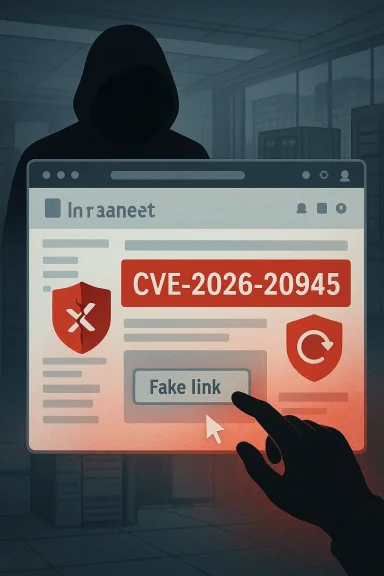 Why spoofing in SharePoint is difg in a consumer app might be annoying. A spoofing bug in SharePoint can be operationally disruptive because internal portals often anchor approvals, forms, policy notices, and file sharing. If an attacker can convincingly mimic trusted SharePoint content, the payload is not just visual deception; it is organizational trust abuse.
That is why the impact should be read broadly. The attacker does not necessarily need to “own” the server to cause damage. If the bug lets them convince users that malicious material is legitimate, the attack can support credential theft, phishing, lateral movement, or social-engineering follow-on steps. That is the real danger of spoofing: it scales through trust.What Microsoft Has Actually Confirmed
Microsoft has publicly labeled CVE-2026-20945 as a Microsoft SharePoint Server Spoofing Vulnerability. That is the most important fact available at the moment, because it confirms the issue is not merely a speculative third-party theory or an unverified rumor. In Microsoft’s ecosystem, the act of assigning a CVE and publishing it through the Security Update Guide is itself a strong signal that the company has enough evidence to treat the issue as real and actionable.What Microsoftvaccessible advisory context, is the full root cause. We do not yet have a public statement that the flaw stems from XSS, HTML sanitization, URL validation, authentication conm specific implementation defect. That omission should not be mistaken for uncertainty. It is better understood as deliberate publication restraint, especially for a problem type that could be weaponized quickly once the weakness is understood.
The user-provided definition of the celevant here because it matches Microsoft’s own disclosure philosophy. Confidence increases when the vendor has directly acknowledged the vulnerability and classified it in the canonical update system. The public details may still be incomnce of the flaw is now much more credible than if the only evidence came from a third-party claim. In other words, the confidence level is high even if the attacker knowledge level remains partial.
What the public record implies
Ties three things at once. First, Microsoft considers the issue worthy of patch guidance. Second, the company believes the SharePoint product family is affected in a way that matters to security. Third, the advisory is intentionally not a full exploit guide.That combination is coodern vulnerability reporting. It is also why defenders should avoid a false sense of comfort from the lack of technical detail. A concise advisory does not mean a weak issue; it often means the opposite.
- The vulnerability is vendor-acknowledged.
- The flaw is classified as spoofing, not merely a cosmetic issue.
- The public details are intentionally limited.
- The entry should be treated as actionable, not theoretical.
Why Spoofing Is Operationally Serious
Spoofing sits in the security gray zone between technical compromise and human deception. It is not always as dramatic as remote code execution, but in many enterprises it is more effective because it exploits how people make decisions under time pressure. If a SharePoint page or asset looks legitimate enough, users may click, approve, share, or disclose information without hesitation.In enterprise environments, trust is trust the site because it is internal, trust the browser because it is on a corporate machine, and trust the workflow because it appears to be a routine business process. A spoofing vulnerability breaks that chain. Once the visual and contextual cues are compromised, attackers can position malicious content as routine intwhich is often more persuasive than a phishing email from the outside. That is why spoofing is not a low-grade nuisance; it is a trust-hijacking mechanism.
Microsoft has historically treated Sh related client-side issues as important because their impact extends beyond the server. A 2010 MSRC discussion of SharePoint XSS described how attacks could execute in the context of a user’s SharePoint session, reinforcing the idea that the platform’s value is tied to user trust and session context. That legacy still matters: when the platform itself is the decttacker inherits the credibility of the enterprise intranet.
Spoofing versus direct compromise usually tries to seize systems. A spoofing issue tries to shape perception. In many real-world incidents, perception is enough to start the compromise chain.
That can lead to:- Credential capture through fake login prompts or pages.
- Session abuse when users are tricked into reusing trusted contexts.
- Document manipulation that changes business decisions.
- Social-engineering follow-up against admiateral movement seeded by internal trust.
SharePoint’s Threat Model Has Changed
SharePoint used to be thought of mainly as a document portal. Today, many organizations use it as a business process platform with deeply integrated identity, search, file sharing, and workflow behavior. That broader role means the consequences of a spoofing flaw are more complex than they were a decade ago. The attack surface now includes browser rendering, authentication expectations, document previews, embedded links, and user-driven collaboration patterns.The recent wave of SharePoint security attention in 2025 oint: Microsoft’s on-premises SharePoint estate remains a live target. When Microsoft published emergency guidance for SharePoint vulnerabilities in July 2025, it explicitly said the attacks were targeting on-premises customers and that SharePoint Online was not impacted. That distinction matters because many enterprises still operate on-prem SharePoint for data residency, legacy integration, or governance reasons. CVE-2026-20945 therefore lands in a world where patching pressure is already familiar.
This also changes how administrators should think about blast radius. A Shareability might not directly expose the server OS, but it can influence trust relationships across the environment. If internal employees rely on SharePoint as a source of truth, then a spoofing weakness becomes a policy, identity, and productivity threat all at once. It is one of the few classes of issue where the security impact and the business impact are almost inseparable.
The enterprise reality
Enterprises rarely use SharePoint in isolation. They connect it to Active Directory, Entra ID, Microsoft 365 workflows, third-party plugins, and document automation systems. That creates an environment where a content trust flaw can spread pressure into adjacent systems.The risk is especially acute in:
- Executive communications portals.
- Internal HR or finance workflows.
- Document approval systems.
- Knowledge bases with high user trust.
- Intranet pages that link to sensitive services.
Confidence, Reporting, and the Meaning of a Published CVE
The confidence metric in the user’s prompt is essentially asking a deeper question: how sure are we that the vulnerability exists, and how much can an attacker realistically infer from the public record? In this case, confidence is relatively high because Microsoft itself has already given the issue a formal CVE identity and a vulnerability class. The public page is not a placeholder; it is a vendor-confirmed security record.Microsoft’s own documentation on the Security Update Guide shows that it has on structured publication, with update entries, advisories, and machine-readable data all feeding into the same public-facing ecosystem. The company’s November 2024 CSAF announcement and related materials make clear that Microsoft wants customers to be able to consume vulnerabilities programmatically as well as manually. That trend implies the advisory is intended for operational response, not just transparency theater.
At the same time, Microsten do not expose the minimum detail an attacker wout an exploit chain. This is not a weakness of the disclosure process; it is a feature. The company has repeatedly shown that it will document the issue class while keeping exploit mechanics constrained. The absence of more detail here should be read as a signal that the company is balancing customer awareness against abuse prevention.
What defenders should infer
Defenders should infer that Microsoft has enough internal validenough reason to publish exploit-enabling specifics. That combination generally suggests a real flaw with undisclosed mechanics.It also suggests a practical posture:
- Treat the CVE as genuine and confirmed.
- Assume the exploitation conditions may be narrower than the label implies.
- Watch for later research, proof-of-concept disclosures, or exploitation reports.
- Prioritize patching before the details become public.
Likely Impact on Organizations
The immediate organizational impact of CVE-2026-20945 depends on how heavily a company uses SharePoint and how much trust it places in internal content presentation. In a lightly used environment, the bug may be a contained patch item. In a deeply integrated enterprise, it can influence workflows, identity assurance, and user behavior in ways that go far beyond the browser window.For security teams, the key question is whether the vulnerability can be exploited remotely, requor depends on specific user interaction. Microsoft has not yet publicly disclosed those details in the accessible advisory context, so assumptions should be avoided. What can be said with confidence is that spoofing issues in collaboration platforms often become high-value enablers for phishing and credential harvesting even when they do not directly execute code.
For IT administrators, the issue is especially relevant if SharePoint is used as an internal port users are expected to trust at face value. That includes policy announcs, executive memos, approval workflows, and any portal that sits behind a “trusted internal” mental model. If an attacker can fake that trust relationship, the downstream consequences may include business process manipulation and targeted fraud.
Consumer versus enterprise exposure
Consumers are less likely to encounter SharePoint Server is an on-premises enterprise product. But for the organizations that do run it, the vulnerability’s consequences can be severe because the pl surfaces material that employees assume is authoritative.Enterprise risk includes:
- Internal phishing that bypasses user skepticism.
- Fraudulent document sharing or approvals.
- Misleading policy or incident notices.
- Stolen credentials via trusted-lookalike pages.
- Reputational damage if internal users are tricked at scale.
How This Fits Micity Posture
Microsoft has spent the last several years trying to make the Security Update Guide more structured, more transparent, and more machine-readable. The introduction of advisory tabs, CVRF/CSAF support, and other publication improvements shows that the company expects customers and partners to use these records operationally. CVE-2026-20945 fits neatly into that model: it is a confirmed, classified issue designed to be consumed by patch management and vulnerability management systems.At the same time, Microsoft’s handling of SharePoint vulnerabilities in 2025 demonstrated that the company will movmbecomes a live target. The July 2025 SharePoint guidance was unusually urgent because Microsoft said attackers were actively targeting customers. That recent experience should make organizations more alert, not less. Even if CVE-2026-20945 is not yet publicly associated with active exploitation, the product family has already shown itself to be a high-interest target.
This matters because many security teams still prioritize only the highest CVSS score or the most dramatic label. But Microsoft’s SharePoint history argues froach. A spoofing vulnerability in a central collaboration system may not sound like a headline-grabbing shell-access bug, yet it can still disrupt trust pathways at the heart of an enterprise. That is the kind of issue that can produce real damage before anyone notices a “critical” alert banner. Severity is not always about the loudest exploit class.
The disclosure trend
Microsoft’s publishing pattern suggests three ongoing priorities:- Faster publication of confirmed vulnerability records.
- Broader structured metadata for defenders.
- Controlled withholding of exploit-sensitive internals.
Comparative Risk: Why SharePoint Spoofing Matters More Than It Sounds
It is tempting to read “spoofing” and assume lower urgency than remote code execution or privilege escalation. That would be a mistake in the SharePoint context. Spoofing in an enterprise collaboration platform can influence trusted user flows, and trusted user flows are often more valuable to attackers than raw system access.The reason is simple: collaboration platforms are where users expect to see legitimate internal information. If the attacker can blend malicious content intoey inherit the organization’s own credibility. That can be enough to trigger downloads, approvals, follow-on phishing, or even policy exceptions. In that sense, spoofing can function as the first stage of a broader intrusion chain.
There is also a governance dimension. If internal business units rely on SharePoint content as the official record, then spoofed information can produce operg before an incident response team gets involved. For some organizations, the damage might be reputational; for others, it could become financial or legal if a spoofed workflow leads to an unauthorized action. *That is why “just spoofing” is an inaccurate way to think about icess implications
A spoofed SharePoint surface can affect:
- Approval chains.
- Internal announcements.
- HR and finance self-service.
- Help desk guidance.
- Incident communication.
Strengths and Opportunities
The good news is that Microsoft’s disclosure model gives defendpoint even when the technical details are incomplete. A published CVE in the Security Update Guide means security teams can track, patch, and audit exposure without waiting for a third-party reverse engineering report. That alone is a meaningful operational advantage.The vulnerability also creates an opportunity for organizations to clean up SharePoint trust assumptions, review content publishing controls, and tighten wothenticity. In many cases, patching one CVE becomes the excuse to improve a broader security posture.
- Confirmed vendor acknowledgment.
- Clear product scope.
- Actionable patch-management signal.
- Opportunity to audit trust boundaries.
- Chance to harden internal publishing workflows.
- Good fit for SIEM and vulnerability-management prioritization.
- Useful catalyst for user awareness training.
Risks and Concerns
The main concern is that spoofing bugs are often underrated until they are chained into a bigger intrusion. If attackers can exploit a trusted internal platform to present convincing fake content, the resulting fraud or credential theft may be harder to detect than a classic malware outbreak. Microsoft’s limited pub defenders may not yet know the exact exploit conditions.Another concern is the prevalence of on-premises SharePoint deployments in organizations that have not fully migrated to cloud services. Those environments often contain older ons, and exceptions that can amplify the risk.
- Attackers may use the flaw for phishing and trust abuse.
- The lack of public technical detail delays precise threat modeling.
- On-premises deployments may have uneven patch hygiene.
- Custom SharePoint integrations can widen the blast radius.
- Internal users are more likely to trust spoofed content.
- Security teams may initially underrate a non-RCE CVE.
- Legacy deployments may complicate remediation speed.
What to Watch Next
The next development to watch is whether Microsoft expands the advisory with more detail, additional mitigations, or a clarification about attack conditions. It is also worth watching for security researcher analysis, proof-of-concept writeups, or evidence of active exploitation. In Microsoft’s ecognals often determine whether a CVE stays an internal priority or becomes a public incident-response issue. uld also watch for any correlation with other SharePoint security updates. Microsoft’s recent history shows that SharePoint vulnerabilities can arrive in cluumasks a broader set of related issues. The best posture is to treat the current advisory as part of a living set of SharePoint trust and patch concerns, not as an isolated event.- Microsoft may later publish more remediation detail.
- Threat researchers may uncover the specific attack path.
- Active exploitation could reshape urgency quickly.
- SharePoint cumulative updates should be reviewedtrust-based workflows should be audited.
- Security monitoring should flag unusual portal spoofing behavior.
CVE-2026-20945 is therefore beminder that the most dangerous enterprise vulnerabilities are not always the ones that crash servers or detonate shells. Sometimes they are the ones that quietly undermine what people believe to be true, and in a collaboration system, that can be just as damaging.
Source: MSRC Security Update Guide - Microsoft Security Response Center
Last edited:
