

Microsoft’s Security Update Guide and supporting SharePoint cumulative updates confirm that CVE-2026-20947 is a real, vendor-tracked Microsoft SharePoint Server remote code execution (RCE) vulnerability addressed in January 2026 — but the public technical details remain intentionally sparse, so defenders must act on the vendor’s KB mappings and apply layered operational mitigations immediately.
Microsoft SharePoint Server has been a recurring focal point for high-impact vulnerabilities and large-scale incident activity over the past few years, particularly where unauthenticated or low-privilege HTTP(S) requests can be abused to achieve code execution in the IIS worker process (w3wp.exe). Past incident clusters — notably the “ToolShell” campaigns — combined deserialization or ViewState abuse with layout-endpoint write primitives to drop ASPX web shells, harvest ASP.NET machineKey material, and forge signed tokens for persistent access. Those operational patterns remain the most useful threat model for new SharePoint advisories. Microsoft included CVE-2026-20947 in the SharePoint cumulative updates released on January 13, 2026 (packaged under KB5002822 and corresponding SharePoint 2016/2019 language-pack updates), listing it alongside multiple other SharePoint service CVEs. The KB entry is the authoritative place to verify which update package and build string applies to each on‑premises SKU. Administrators should always confirm CVE→KB mappings in Microsoft’s update pages before declaring hosts remediated.
Caveat: specific exploit mechanics, attack counts, and any claim that the CVE’s publicly available details trace to a single exploit chain should be treated cautiously until corroborated by Microsoft security telemetry or multiple independent technical analyses; where such claims are cited by third‑party feeds, they should be cross‑checked against the vendor KB and national advisories before operationalizing detection rules. Conclusion: act immediately on Microsoft’s January 13, 2026 SharePoint updates, rotate your machineKey values, enable AMSI and EDR protections, hunt for indicators of compromise, and assume high operational risk for any internet‑exposed on‑prem SharePoint farms until you can prove them patched and free of web shells.
Source: MSRC Security Update Guide - Microsoft Security Response Center
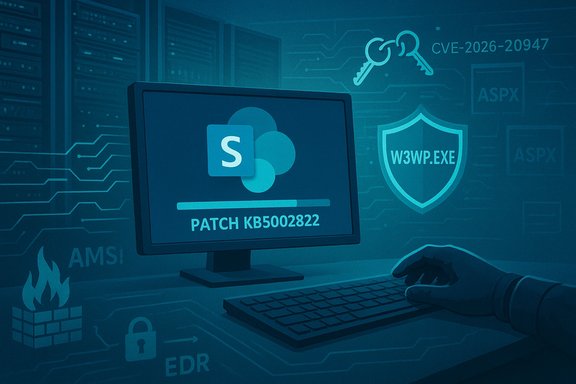 Background
Microsoft SharePoint Server has been a recurring focal point for high-impact vulnerabilities and large-scale incident activity over the past few years, particularly where unauthenticated or low-privilege HTTP(S) requests can be abused to achieve code execution in the IIS worker process (w3wp.exe). Past incident clusters — notably the “ToolShell” campaigns — combined deserialization or ViewState abuse with layout-endpoint write primitives to drop ASPX web shells, harvest ASP.NET machineKey material, and forge signed tokens for persistent access. Those operational patterns remain the most useful threat model for new SharePoint advisories. Microsoft included CVE-2026-20947 in the SharePoint cumulative updates released on January 13, 2026 (packaged under KB5002822 and corresponding SharePoint 2016/2019 language-pack updates), listing it alongside multiple other SharePoint service CVEs. The KB entry is the authoritative place to verify which update package and build string applies to each on‑premises SKU. Administrators should always confirm CVE→KB mappings in Microsoft’s update pages before declaring hosts remediated. What we know (and what we don’t)
Confirmed facts
- Vendor acknowledgement and patching: Microsoft’s security update documentation for January 13, 2026 explicitly lists CVE‑2026‑20947 as one of the SharePoint vulnerabilities fixed by that release, which raises the confidence that the vulnerability exists and that Microsoft has produced remediation.
- Affected products: The January 13, 2026 update package covers SharePoint Server Subscription Edition builds (and corresponding 2019/2016 packages where applicable); the KB notes the exact builds and the update file names to download. Administrators must apply the SKUspecific KBs for their farms.
Unconfirmed / intentionally withheld details
- Exploit recipe and low-level mechanics: Microsoft’s publicly displayed vulnerability pages are intentionally terse and often omit exploit code paths and precise technical primitives to avoid helping malefactors. There is no official, public step‑by‑step exploit recipe published by Microsoft for CVE‑2026‑20947 at the time of the update notice; defenders must therefore rely on canonical KB mappings, vendor mitigations, and operational hunting rather than unverified third‑party claims.
- Exact exploit primitive (if any): While historic SharePoint RCEs typically used unsafe deserialization, ViewState manipulation, or layout-endpoint write primitives to achieve web‑shell drops and token theft, Microsoft has not published the precise root cause for CVE‑2026‑20947 in public-facing explanatory text. Treat any single-claim about the exact vulnerable method as provisional until corroborated by Microsoft technical notes or multiple independent, high-quality writeups.
Why the confidence metric matters for CVE‑2026‑20947
Security teams categorize confidence in a vulnerability on a three-tier continuum:- Published identifier with low public detail — the CVE exists in vendor trackers, but technical specifics are scant.
- Corroborated by independent research — third‑party researchers publish analyses that illuminate the exploit surface or primitives.
- Vendor‑acknowledged with updates/patches — the highest confidence: the vendor publishes an advisory and matching remediation packages.
Likely attack patterns and operational impact (practical threat model)
Even without vendor-disclosed exploit code, defenders should map CVE‑2026‑20947 against SharePoint’s known historical exploit patterns and the high‑impact outcomes those patterns created in 2024–2025. Those outcomes are repeatable and relevant:- Unsafe deserialization / ViewState abuse: Allowing attacker‑controlled data to be deserialized into objects that execute code during reconstruction. This class has repeatedly led to ASPX web shell placements.
- Layout‑endpoint file‑write primitives: POSTs to _layouts/ pages or ToolPane endpoints that have been abused to write ASPX files into the farm TEMPLATE\LAYOUTS folder. Web shells placed here are served by IIS and provide immediate persistence and filesystem access.
- MachineKey theft and token forgery: Web shells have been used to read web.config or memory and steal the ASP.NET machineKey (ValidationKey and DecryptionKey). Possession of machineKey enables forging signed ViewState or other signed tokens to maintain stealth and persistence across some remediation steps.
- Follow‑on activity: Once RCE is gained in SharePoint’s process context, attackers can enumerate network shares, harvest service principal secrets, stage ransomware, and use lateral movement primitives with real operational impact. Historical incident responses show web shells often precede long‑term campaigns.
How administrators should prioritize their response (practical, step‑by‑step)
The following is a practical remediation and mitigation playbook, ordered by priority and the measure of immediate risk reduction.- Inventory and exposure mapping
- Enumerate every on‑prem SharePoint host (Subscription Edition, SharePoint Server 2019, SharePoint Server 2016), including language packs and workflow manager nodes.
- Identify which hosts are internet‑facing or reachable through reverse proxies. Publicly reachable farms get top priority.
- Patch with the exact Microsoft KBs mapped to your SKU
- Apply the January 13, 2026 cumulative update packages that include KB5002822 (Subscription Edition) and the corresponding KBs for SharePoint 2019/2016 language packs. Do not assume a generic platform patch covers your specific product+language combination; validate installed build numbers after patching.
- Rotate ASP.NET machineKey farm‑wide
- After applying security updates, rotate the machineKey values (ValidationKey and DecryptionKey) across the farm and restart IIS on each node to invalidate any previously stolen keys and to prevent re-use of forged __VIEWSTATE payloads. Use SharePoint Central Administration jobs or documented PowerShell commands to do this safely at scale. This is repeatedly recommended after SharePoint web‑shell incidents.
- Enable and verify AMSI and enterprise antimalware/EDR coverage
- Configure Antimalware Scan Interface (AMSI) integration for SharePoint and ensure Microsoft Defender for Endpoint (or comparable EDR) is deployed and monitoring w3wp.exe. AMSI and EDR make in‑process malicious activity and web‑shell execution far easier to detect.
- Restrict or isolate publicly reachable SharePoint farms
- If a SharePoint farm must be internet‑accessible, place it behind an authenticated gateway, hardened web application firewall (WAF), or reverse proxy with strict allow lists. If AMSI cannot be enabled, consider removing public exposure until mitigation is complete.
- Hunt for indicators of prior compromise (parallel to patching)
- Search IIS logs and ULS logs for anomalous POST/GETs to ToolPane.aspx, new or modified ASPX files under TEMPLATE\LAYOUTS (look for names like spinstall0.aspx and other odd filenames), and w3wp.exe spawning cmd.exe or PowerShell. Use EDR alerts to find processes initiated by w3wp.exe and anomalies in token issuance or automation approvals.
- Post‑patch validation
- Confirm KB installation and post‑patch build numbers on every node.
- Re-run hunts for web shells and suspicious changes (new files, modified timestamps, unknown IIS virtual directories).
- Re-check machineKey rotation success and validate that signed payloads no longer verify with old keys.
- Incident response readiness
- If a compromise is suspected, engage IR and forensic teams quickly; assume web shells and token theft may already grant deep access. Consider disconnecting affected hosts from the internet and preserving logs and disk images for investigation. CISA and other national responders have documented this as the standard posture for active SharePoint campaigns.
Detection indicators and hunting queries (practical checklist)
- Search IIS/ULS logs for:
- Unexpected POST requests to _layouts/ or ToolPane.aspx endpoints returning 200/201 with unusual request bodies.
- Requests that cause file writes or unusual responses to unauthenticated callers.
- File system checks:
- New or modified .aspx files under C:\Program Files\Common Files\Microsoft Shared\Web Server Extensions\<version>\TEMPLATE\LAYOUTS
- EDR/AMSI signs:
- w3wp.exe spawning PowerShell, cmd.exe, or executing other shell commands shortly after HTTP activity.
- Unusual outbound connections from SharePoint servers to unknown external endpoints.
- Token and config checks:
- Unexpected changes to machineKey entries or evidence of web.config reads at odd times.
- Automation/tenant events:
- Sudden consent grants, runbook approvals, or connector additions that were not authorized by administrators.
Confidence assessment for CVE‑2026‑20947 — practical interpretation
Because Microsoft assigned and remediated CVE‑2026‑20947 within an official SharePoint cumulative update (January 13, 2026), the existence of the vulnerability is high‑confidence. When a vendor issues a matched KB and build fixes, that is the strongest practical signal for operations teams to treat the CVE as actionable. That said:- The absence of a public, vendor‑authored technical writeup or reproduced PoC means technical details remain at a lower confidence level. Defenders should assume familiar SharePoint exploit chains as the threat model but avoid over‑relying on single-source speculative details.
- Independent corroboration by multiple respected trackers or national agencies (for example, CISA) increases confidence — when those agencies publish hunting guidance or confirm active exploitation, operational urgency rises accordingly. For prior SharePoint incidents, CISA updates and national advisories materially shaped remediation priorities.
Notable strengths of Microsoft’s handling — and the risks that remain
Strengths
- Rapid inclusion in cumulative updates: Packaging CVE‑2026‑20947 into a January 13, 2026 SharePoint cumulative update provides a single remediation vector for administrators to consume via Microsoft Update or the Microsoft Download Center. This centralized approach simplifies deployment for large estates that already have change control around SharePoint updates.
- Consistent guidance for post‑exploit steps: Microsoft’s KB ecosystem and community advisories consistently highlight operational mitigations such as machineKey rotation and AMSI integration — pragmatic, high‑leverage actions for operators.
Risks and limitations
- Vendor opaqueness on exploit mechanics: The deliberate terseness of vendor advisories increases the chance that defenders will adopt incorrect tactical assumptions (for example, misclassifying which SKUs or language packs require updates) unless they validate KB→SKU mappings. Errors here have operational consequences.
- Legacy and unsupported deployments: Many organizations run older SharePoint builds that are difficult to patch or unsupported; those farms remain at elevated risk and may require isolation or migration.
- Telemetry and instrumentation gaps: Not all SharePoint farms have enterprise EDR, AMSI, or centralized logging. Those blind spots materially increase the chance of undetected persistence after initial compromise.
When public PoCs appear: what changes operationally
If a public proof‑of‑concept (PoC) or exploit module appears for CVE‑2026‑20947, the operational calculus changes: exploit attempts often spike rapidly once working code is widely available. In that event, priority for internet‑facing farms, jump boxes, and admin workstations increases; defenders should accelerate patch schedules, harden perimeter controls, and elevate monitoring thresholds for the detection queries listed above. Historically, the appearance of PoC material correlated with rapid exploitation campaigns against unpatched farms.Practical checklist (one‑page executive / SOC playbook)
- Apply the January 13, 2026 SharePoint cumulative update KBs for your SKU immediately (KB5002822 for Subscription Edition; apply the matching KBs for 2019 & 2016 language packs).
- Rotate ASP.NET machineKey values across the farm and restart IIS nodes.
- Enable AMSI body scanning for HTTP requests and verify enterprise antimalware/EDR coverage on SharePoint servers.
- Hunt for web shells, new .aspx files in TEMPLATE\LAYOUTS, and w3wp.exe process anomalies; preserve logs if compromise is suspected.
- Isolate or place public SharePoint farms behind authenticated gateways/WAFs; if AMSI cannot be enabled, consider removing public exposure until mitigated.
Final analysis and editorial judgment
CVE‑2026‑20947 is best understood as a vendor‑confirmed SharePoint Server RCE that Microsoft addressed in January 2026 cumulative updates. The vendor’s remediation packages and KB entries give defenders the highest practical confidence in the flaw’s existence and how to remediate it, which is the most important operational signal for IT teams. However, the lack of public, low‑level exploit details requires defenders to default to the conservative threat model: assume deserialization/ViewState/layout endpoint patterns until proven otherwise, apply the exact KBs for your SKUs, rotate machineKeys, and run immediate hunts for web shells and suspicious w3wp.exe activity. When vendors publish an identifier and matching KBs, the practical action is clear: patch, validate, harden, and hunt. The community’s job — incident responders, SOCs, and platform owners alike — is to convert that vendor action into operational resilience: remove internet exposure where possible, ensure robust telemetry, and treat SharePoint RCE advisories as high‑urgency items in a modern patch‑and‑hunt program.Caveat: specific exploit mechanics, attack counts, and any claim that the CVE’s publicly available details trace to a single exploit chain should be treated cautiously until corroborated by Microsoft security telemetry or multiple independent technical analyses; where such claims are cited by third‑party feeds, they should be cross‑checked against the vendor KB and national advisories before operationalizing detection rules. Conclusion: act immediately on Microsoft’s January 13, 2026 SharePoint updates, rotate your machineKey values, enable AMSI and EDR protections, hunt for indicators of compromise, and assume high operational risk for any internet‑exposed on‑prem SharePoint farms until you can prove them patched and free of web shells.
Source: MSRC Security Update Guide - Microsoft Security Response Center
