

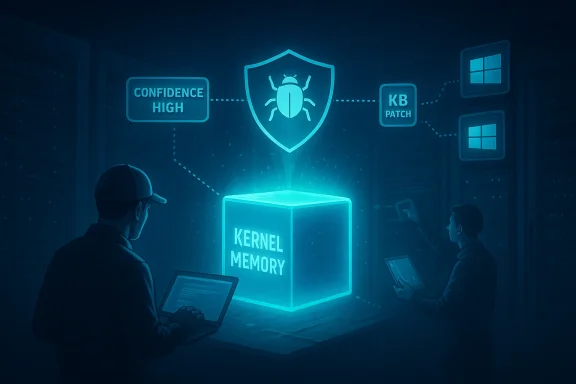
Microsoft’s public record for CVE-2026-21239 identifies a kernel-level elevation of privilege in Windows and pairs that entry with Microsoft’s new “confidence” indicator — a vendor signal that shapes how defenders should triage, patch, and hunt for this class of risk. The entry is short on exploit-level specifics, but the operational facts are clear: this is a locally triggered Windows kernel vulnerability that can be converted into SYSTEM privileges if successfully exploited, and the presence of a vendor-mapped update makes rapid, evidence-driven remediation the primary defensive action.
Microsoft has increasingly paired CVE records with a plain-English confidence metric that signals two things: (1) how certain the vendor is that the vulnerability is real, and (2) how much technical detail the vendor will disclose publicly. When Microsoft records a kernel CVE and attaches a high-confidence rating (or maps it to cumulative/security updates), the advisory is the authoritative trigger for operations teams: identify affected hosts, validate the exact KB→SKU mapping, test, and deploy. Conversely, a lower confidence rating or deliberately terse advisory suggests the vendor is withholding exploit mechanics while preparing patches — but the vulnerability should still be treated as operationally real until proven otherwise.
CVE-2026-21239 has been categorized as a Windows Kernel Elevation-of-Privilege (EoP) issue. Kernel EoP bugs are a recurring high-impact class because the kernel (and a small set of inbox kernel-mode drivers) execute at ring‑0; an attacker who can convert a local defect into kernel memory corruption or logic bypass often obtains SYSTEM-level control. The canonical attack model is local: an attacker needs a foothold (a low-privileged process, a user account, or a compromised sandbox) and then triggers the vulnerable kernel surface to escalate privileges.
Conclusion
CVE-2026-21239 is a reminder of the asymmetric threat posed by kernel-level vulnerabilities: the technical mechanics can be complex, but the operational response is straightforward and time-sensitive. When Microsoft records a kernel CVE and maps it to updates (especially with an affirmative confidence signal), the sensible, defensible course of action is immediate: inventory, verify KB mappings, patch high‑value hosts first, and tune defenses to catch exploitation attempts. Beyond triage, treat these advisories as prompts to harden developer and administrative hosts, strengthen application allow‑listing, and invest in telemetry that turns post‑exploit behaviors into early, actionable alerts. The goal is simple: reduce the chance that a local foothold turns into a systemic compromise.
Source: MSRC Security Update Guide - Microsoft Security Response Center
 Background / Overview
Microsoft has increasingly paired CVE records with a plain-English confidence metric that signals two things: (1) how certain the vendor is that the vulnerability is real, and (2) how much technical detail the vendor will disclose publicly. When Microsoft records a kernel CVE and attaches a high-confidence rating (or maps it to cumulative/security updates), the advisory is the authoritative trigger for operations teams: identify affected hosts, validate the exact KB→SKU mapping, test, and deploy. Conversely, a lower confidence rating or deliberately terse advisory suggests the vendor is withholding exploit mechanics while preparing patches — but the vulnerability should still be treated as operationally real until proven otherwise.CVE-2026-21239 has been categorized as a Windows Kernel Elevation-of-Privilege (EoP) issue. Kernel EoP bugs are a recurring high-impact class because the kernel (and a small set of inbox kernel-mode drivers) execute at ring‑0; an attacker who can convert a local defect into kernel memory corruption or logic bypass often obtains SYSTEM-level control. The canonical attack model is local: an attacker needs a foothold (a low-privileged process, a user account, or a compromised sandbox) and then triggers the vulnerable kernel surface to escalate privileges.
Technical context: why kernel EoP bugs matter
What makes kernel bugs powerful?
The Windows kernel — and kernel-mode components like Win32k, graphics drivers, SMB server, and a handful of other privileged services — exposes surfaces that bridge user-mode input into privileged memory and execution contexts. When those bridges mishandle types, lifetimes, or access checks, user-supplied data can produce:- Information leaks (address disclosures) that defeat ASLR and other mitigations.
- Arbitrary read/write primitives that enable write-what-where corruption.
- Control-flow hijack through function pointer or vtable overwrites.
- Token manipulation or process spawn techniques that yield SYSTEM.
Common root causes historically observed
A short list of recurring root causes explains why the vendor often refuses to publish exploit details immediately:- Type confusion — kernel code assumes an object is one type but it’s another, producing out-of-bounds access or pointer misinterpretation.
- Use‑after‑free (UAF) — objects freed prematurely and later accessed, enabling attacker-controlled allocations to be reused.
- Race conditions (TOCTOU) — privileged code performs a check and then acts on a changed resource.
- Heap/buffer overflows — overwrite adjacent kernel data to redirect execution or corrupt critical structures.
- Insufficient access checks across privilege boundaries — trusting handles or tokens originating in less-privileged contexts.
Reading Microsoft’s confidence metric and the practical meaning for triage
Microsoft’s confidence annotation is an operational signal, not an academic notation. Use it this way:- High confidence + KB mapping present: Treat the CVE as verified and actionable. Immediate priority: identify affected systems and plan rapid deployment of the corresponding KB for each SKU/build. Assume the vendor understands the root cause and the published KBs contain the correct fixes.
- Medium/Low confidence (entry present, limited technical detail): The vendor acknowledges an issue but either is still investigating or is intentionally withholding exploit mechanics. The record is still actionable — use compensating controls where patching is delayed — but expect follow‑up updates (patches, technical writeups) from Microsoft or third‑party researchers.
- No vendor entry (third-party report only): Exercise caution. Corroborate with multiple independent sources before mass-remediation actions that might impact operations.
What defenders should assume about CVE-2026-21239
Because the advisory is for a Windows kernel elevation-of-privilege, defenders should assume the following until proven otherwise:- The attack vector is local — an attacker must run code or trick a local process into invoking the vulnerable kernel surface.
- A successful exploit can result in SYSTEM-level privileges.
- Modern kernel mitigations (Kernel ASLR, Control Flow Guard variants, SMEP/SMAP, KCFG, pointer-protection schemes) increase exploitation difficulty but do not eliminate the risk for skilled actors.
- Absence of a public PoC does not equal safety. Patches are often reverse-engineered quickly; patch diffs and symbol exposure can produce weaponized exploit code within days.
Immediate operational checklist (first 24–72 hours)
- Inventory and identify affected hosts.
- Query your estate for Windows builds that match the affected SKUs listed in Microsoft’s update mapping for CVE-2026-21239.
- Prioritize multi-user and admin endpoints, domain-joined build agents, and any host that runs developer tooling or sandboxes.
- Confirm the KB→SKU mapping in your environment.
- Use your patch-management tooling (WSUS/SCCM/Intune/other) or the vendor update catalog to confirm the exact KB(s) and whether a reboot is required.
- Do not rely on third‑party mirrors for KB IDs.
- Stage the update in a monitored pilot ring.
- Select representative hosts (endpoint, server, VDI) and validate application compatibility, developer workflows, and any critical functionality.
- Validate that the update actually changes the patched file versions and that the host’s functionality remains acceptable.
- Deploy to high-priority systems within 24–72 hours.
- Patch admin workstations, jump boxes, bastions, and any host used to manage other infrastructure first.
- Schedule reboots where required and confirm remediation by validating the updated file versions post-reboot.
- Apply compensating controls where patching must be delayed.
- Disable features that are not required (for example, WSL, in some advisories, or specific services) if the feature interfaces with the vulnerable surface.
- Enforce least privilege: remove unnecessary local admin rights and avoid shared local accounts.
- Hunt and tune detection.
- Deploy EDR/SIEM detection rules for suspicious privilege escalation behavior (see detection playbook below).
- Increase telemetry retention for at least two weeks post-deployment to support hunts and forensics.
Detection and hunting playbook
When kernel EoP advisories appear, defenders should tune telemetry to the canonical exploitation patterns rather than waiting for a PoC:- Monitor for unexpected SYSTEM processes spawned by non-SYSTEM parents.
- Legitimate process trees rarely show user-launched processes directly creating SYSTEM contexts.
- Watch for token duplication APIs and suspicious calls.
- API patterns that duplicate or substitute tokens (e.g., NtDuplicateObject variations, token-duplication sequences) are common post-exploit steps.
- Alert on abnormal DeviceIoControl usage.
- Many kernel exploits require interacting with a device driver via IOCTLs. Sudden DeviceIoControl calls coming from low-privilege processes merit scrutiny.
- Detect kernel crashes, BSODs, or repeated service restarts.
- Failed exploitation attempts often cause instability. Correlate crashes with user process activity preceding the crash.
- Search EDR telemetry for heap grooming behaviour and high-rate thread creation.
- Exploit primitives sometimes create many threads or repeated memory allocations; signature-less behavioral anomalies are the key.
- Hunt for persistence patterns created after escalation attempts.
- New local admin accounts, unexpected scheduled tasks, unsigned drivers installed, or new services created shortly after the timeline of suspicious activity are red flags.
- Preserve forensic artifacts: if compromise is suspected, isolate the host, perform memory capture, and collect kernel-mode artifacts before rebooting.
Hardening and short-to-medium term mitigations
- Application control: Deploy WDAC or AppLocker to limit execution of unsigned or unknown binaries, especially on administrative hosts and bastion machines.
- Least privilege: Enforce strict least-privilege policies; remove local admin rights where not necessary.
- Reduce feature footprint: Turn off Windows features not required on production machines (for example, WSL, optional inbox services) using DISM or group policy.
- Network segmentation: Limit lateral movement by restricting which hosts can connect to administrative systems; firewalling and microsegmentation reduce blast radius.
- Patch management discipline: Ensure fast, reliable KB distribution and verifiable installation across the estate; use automation but validate with a pilot ring.
- EDR/host-based mitigations: Ensure EDR is configured to detect process injection, kernel memory corruption heuristics, and token-manipulation behaviours.
Technical analysis: plausible exploit path (no PoC disclosure)
Without revealing a PoC or step-by-step exploit, it is useful to map the canonical stages an attacker would use so defenders can tune for them:- Footprint & foothold: Attacker obtains local code execution (malicious installer, user-run binary, sandbox escape).
- Trigger the kernel surface: Crafted input is sent to the vulnerable kernel interface (Win32k call, device IOCTL, SMB request, or similar).
- Convert to memory primitive: The bug yields information disclosure, arbitrary read/write, or a write-what-where primitive.
- Leverage the primitive: Attacker overwrites a process token, spawns a SYSTEM process, or manipulates crucial kernel structures to obtain SYSTEM privileges.
- Post‑exploitation: Defender-evasive steps: disable security tools, install backdoors, create admin accounts for persistence.
Testing guidance for patch rollouts
- Build a minimal test matrix.
- Cover representative SKUs and build numbers for your estate.
- Include developer machines, servers, VDI images, and domain-joined endpoints.
- Validate both function and performance.
- Execute common user workflows and any high-risk developer toolchains (IDEs, build agents, virtualization hosts).
- Watch for regressions in rendering, printing, or virtualization scenarios if the vulnerability touches graphics or Win32k surfaces.
- Simulate edge cases.
- Run automation that exercises device drivers and kernel-mode components (printing, graphics, third-party drivers) to surface regressions.
- Rollback plan.
- Maintain clear rollback procedures and snapshots for critical servers and test hosts in case the update causes unacceptable regressions.
- Post-deployment verification.
- Confirm KBs are installed and file versions reflect the update.
- Validate that telemetry shows no residual exploitation attempts in the days following patching.
Threat modeling and risk prioritization
Not all hosts are equal. Prioritize based on business risk and attacker opportunity:- Highest priority:
- Domain controllers, admin workstations, jump boxes, bastion hosts.
- Build agents and CI runners with access to code signing keys, credential stores, or deployment pipelines.
- Publicly reachable management hosts and VDI images used by developers.
- Medium priority:
- Standard user endpoints with small privilege pools but frequent external file ingestion (email, downloads).
- Lower priority:
- Isolated lab machines or devices with no network access and no admin-level tasks.
Why vendors withhold low-level details — and why that matters to defenders
Vendors often publish minimal technical detail for high-impact kernel bugs while patches are being staged. That decision balances two competing risks:- Publish details → accelerates defensive research but also enables attackers to weaponize patches and PoCs more quickly.
- Withhold details → reduces short-term weaponization risk but places more burden on defenders to act on the vendor’s update mapping alone.
Communication and governance: what security leaders should tell executives
- Statement of risk: CVE-2026-21239 is a vendor-confirmed kernel elevation-of-privilege. If exploited, it can yield SYSTEM-level control.
- Operational posture: The update is available (vendor-mapped KB). We are treating the CVE as an urgent patching and detection priority.
- Planned actions: Inventory > Pilot > Deploy to high-priority hosts within 24–72 hours > Extend to remainder of estate > Post-deployment hunts.
- Compensations: Where immediate patching is infeasible, system hardening and stricter application control are being applied.
- Metrics: Track % of high-priority hosts patched, number of suspicious privilege escalation alerts, and time-to-detect for EDR telemetry.
Longer-term controls and architectural shifts
- Reduce reliance on long-lived local admin accounts.
- Move to just-in-time (JIT) elevation, ephemeral admin sessions, and managed privileged access solutions.
- Harden developer build environments.
- Isolate CI runners in segmented networks; use ephemeral images; limit access to signing materials and secrets.
- Adopt stronger application control and allow-listing across high-value hosts.
- Prevent arbitrary user-run code from executing on bastions and jump boxes.
- Invest in kernel-level telemetry.
- Higher fidelity EDR and kernel telemetry shorten mean-time-to-detect for memory corruption and process token manipulation.
Practical takeaways (executive checklist)
- Treat CVE-2026-21239 as a high-priority local elevation-of-privilege risk until your environment proves otherwise.
- Confirm the KB→SKU mapping for your installed Windows builds and apply the vendor update after pilot testing.
- Prioritize admin workstations, bastions, build agents, and developer laptops in the first 24–72 hours.
- Tune EDR/SIEM to detect canonical exploit stages: unexpected SYSTEM spawns, token duplication, DeviceIoControl anomalies, and kernel instability.
- Use compensating controls (application control, disabling unnecessary features, least privilege) where patching cannot be immediate.
- Keep an eye on vendor follow-ups and third-party technical writeups, but do not wait for a public PoC to act.
Conclusion
CVE-2026-21239 is a reminder of the asymmetric threat posed by kernel-level vulnerabilities: the technical mechanics can be complex, but the operational response is straightforward and time-sensitive. When Microsoft records a kernel CVE and maps it to updates (especially with an affirmative confidence signal), the sensible, defensible course of action is immediate: inventory, verify KB mappings, patch high‑value hosts first, and tune defenses to catch exploitation attempts. Beyond triage, treat these advisories as prompts to harden developer and administrative hosts, strengthen application allow‑listing, and invest in telemetry that turns post‑exploit behaviors into early, actionable alerts. The goal is simple: reduce the chance that a local foothold turns into a systemic compromise.
Source: MSRC Security Update Guide - Microsoft Security Response Center
