

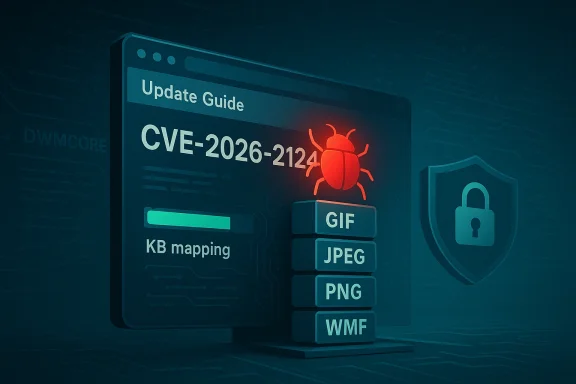
Microsoft’s Security Response Guide lists an entry for CVE‑2026‑21246 as a Windows Graphics Component elevation‑of‑privilege issue, but public records and independent trackers show conflicting identifiers and sparse technical detail — meaning defenders must treat the advisory as confirmed by vendor listing while also acknowledging that the CVE’s public footprint and exploit specifics are currently ambiguous and require careful verification before acting on assumptions. (msrc.microsoft.com)
The Windows Graphics Component (the family of user‑mode libraries historically identified as GDI+, win32k/DWM surfaces, and related codecs) is a recurrent target for high‑impact vulnerabilities. These libraries parse images, metafiles and complex rendering resources used by Office, File Explorer thumbnails, mail preview panes, server‑side converters and many third‑party applications. Memory‑safety defects in those parsers — heap overflows, use‑after‑free (UAF), type confusion and integer overflows — repeatedly translate into local elevation of privilege (EoP) and, when combined with other primitives, remote code execution (RCE). Microsoft and the security community have treated Windows graphics bugs as a persistent, high‑value attack surface for years.
Microsoft’s Security Update Guide (MSRC) exposes a short, authoritative record for each CVE it tracks; the site also publishes a compact “confidence” metric that indicates how certain Microsoft is of a vulnerability’s existence and how much technical detail it is prepared to share publicly. That metric is specifically intended to help defenders prioritise triage: a confirmed entry with vendor‑assigned KBs and available updates is operationally different from a low‑confidence or preliminary listing that Microsoft is still validating. Several recent Windows graphics advisories explicitly call out this confidence signal and urge patching when vendor confirmation and fixes exist.
Source: MSRC Security Update Guide - Microsoft Security Response Center
 Background
The Windows Graphics Component (the family of user‑mode libraries historically identified as GDI+, win32k/DWM surfaces, and related codecs) is a recurrent target for high‑impact vulnerabilities. These libraries parse images, metafiles and complex rendering resources used by Office, File Explorer thumbnails, mail preview panes, server‑side converters and many third‑party applications. Memory‑safety defects in those parsers — heap overflows, use‑after‑free (UAF), type confusion and integer overflows — repeatedly translate into local elevation of privilege (EoP) and, when combined with other primitives, remote code execution (RCE). Microsoft and the security community have treated Windows graphics bugs as a persistent, high‑value attack surface for years.Microsoft’s Security Update Guide (MSRC) exposes a short, authoritative record for each CVE it tracks; the site also publishes a compact “confidence” metric that indicates how certain Microsoft is of a vulnerability’s existence and how much technical detail it is prepared to share publicly. That metric is specifically intended to help defenders prioritise triage: a confirmed entry with vendor‑assigned KBs and available updates is operationally different from a low‑confidence or preliminary listing that Microsoft is still validating. Several recent Windows graphics advisories explicitly call out this confidence signal and urge patching when vendor confirmation and fixes exist.
What the MSRC entry and public trackers say (verification and ambiguity)
- The MSRC page the user referenced exists for CVE‑2026‑21246, but the MSRC web UI requires JavaScript; automated fetches of the page return a placeholder and do not reveal the rendered KB mapping or text without interactive browsing. That means defenders should consult MSRC interactively to confirm affected SKUs and the exact KB packages for their OS builds before declaring systems remediated. (msrc.microsoft.com)
- Independent public trackers and security feeds return a confusing mosaic of nearby CVE identifiers in this family (for example, numerous 2025 and 2026 Windows Graphics Component EoP CVEs), and many vendor advisories in recent months have used identical language while varying in CVE numbers. NVD and major vulnerability aggregators show high confidence for related graphics CVEs (heap overflows, UAFs and type‑confusion issues) but do not consistently show a well‑populated record for the specific string CVE‑2026‑21246 in machine‑friendly feeds. In short: the vendor listing exists, but public mirrors and indexing services show inconsistent coverage. Treat any cross‑CVE mapping claims with caution and always map CVE → KB → build via MSRC interactively.
- Historical context strengthens the operational takeaway: when Microsoft records a graphics EoP and ships fixes, enterprises should prioritise remediation. Prior graphics bugs (for example, the GDI+/win32k family) have been patched in emergency and Patch‑Tuesday updates and have been weaponised or turned into reliable exploit chains soon after public disclosure in multiple incidents. The presence of a vendor fix is therefore the most actionable signal for administrators.
Technical anatomy: why graphics components are sensitive
Graphics subsystems are both ubiquitous and complex. They handle user‑supplied image data (GIF, JPEG, PNG, WMF/EMF/metafiles), font parsing, and inter‑process graphics objects. Typical vulnerability classes include:- Heap‑based buffer overflows (CWE‑122) where parsing code writes past allocated buffers.
- Use‑after‑free (UAF, CWE‑416) where freed objects are later dereferenced.
- Type confusion leading to privileged pointer dereferences and control‑flow hijacking.
- Integer overflows and unsafe size calculations leading to out‑of‑bounds reads/writes.
- Deliver attacker‑controlled rendering data (embedded in a document, uploaded file, or local IPC).
- Trigger the parsing path that contains the memory corruption.
- Use heap grooming and timing to place controlled data at targeted offsets.
- Convert memory corruption to control‑flow hijack, token theft, or SYSTEM‑process spawn.
Practical impact scenarios
Not all vulnerable hosts carry the same business risk. The highest‑value and highest‑urgency targets are:- Public‑facing document processors (webmail, CMS, OCR/thumbnail services) that automatically parse uploaded files. These can be exploited without user interaction and therefore are high blast‑radius systems.
- Virtualisation and VDI hosts where shared graphics stacks or compositor services run with elevated privileges; some bug classes have historically been used in VM‑escape chains.
- Multi‑user Windows desktop farms (RDS, Citrix/VDI) where a single compromised session can be escalated to system‑level access.
- Admin workstations and servers where an exploited EoP converts a low‑privilege foothold into domain‑wide compromise.
Confidence, disclosure and what that metric means operationally
Microsoft’s MSRC uses a small “confidence” signal to inform defenders about how much technical information it is comfortable publishing. The practical implications are:- Vendor‑confirmed (high‑confidence) CVEs that include KB mappings and cumulative updates are operationally actionable: patch now, map KB → build.
- Lower‑confidence or embargoed entries may indicate Microsoft is still validating exploit conditions, reproducibility or precise affected code paths; in those cases, defenders should still prepare and prioritize but may be able to stage mitigations while awaiting fixes.
- The absence of a public proof‑of‑concept (PoC) does not mean low risk. History shows that once vendor patches and symbols are released, exploit code and automated weaponisation can follow quickly. Treat vendor confirmation as the primary triage signal.
What to do right now — prioritized remediation checklist
If you manage Windows systems, use this prioritized checklist immediately. The order reflects likely blast radius and speed of mitigation.- Confirm the MSRC advisory and KB mapping for CVE‑2026‑21246 interactively (do not rely on a single third‑party mirror). If the MSRC page does not render in your tooling, open it in a browser and capture the KB list for your OS builds. (msrc.microsoft.com)
- Patch public‑facing document and image processing servers first (webmail, CMS, OCR, thumbnail generators). These systems can be exploited without user interaction and present the largest risk.
- Patch virtualization hosts, VDI/RDS farms and admin workstations next. Validate GPU/driver compatibility in a small canary ring before broad rollout.
- For systems that cannot be patched immediately, implement compensating controls:
- Disable automatic previews and thumbnailing in mail gateways and File Explorer.
- Restrict upload handling to sandboxed converters or isolated VMs.
- Block or heavily filter upload endpoints at the network edge where feasible.
- Enforce application allow‑listing for document converters and processing daemons.
- Tune detection and EDR hunts:
- Monitor for repeated crashes of dwm.exe, dwmcore, dxgkrnl, or other graphics processes.
- Hunt for abnormal SYSTEM process spawns from user‑level processes and for suspicious child processes of Office/explorer. Preserve memory dumps for triage.
Detection and post‑patch validation
Patch deployment is necessary but not sufficient. Validate fixes and watch for indicators of exploitation:- Use the Microsoft Update Catalog and MSRC to confirm the exact KBs are installed on each build and architecture; do not assume a cumulative update applied to one build applies to all. Automate verification where possible.
- Preserve crash dumps and EDR telemetry during the rollout window. If exploitation was attempted prior to patching, you may find anomalous heap layouts, repeated process crashes or pre‑patch exploitation artifacts.
- For critical services, perform offline validation by processing a set of benign, representative files against the updated binaries in a test ring to confirm no regressions before broad deployment.
Exploitation complexity and likelihood — a measured view
- Complexity: Many Windows graphics flaws require heap grooming, timing and an ability to shape allocation patterns. That places them in a “medium to high” exploitation complexity bracket initially. However, skilled exploit authors and automation lower that bar rapidly once details and fixes are public.
- Privilege requirements: Most Graphics Component EoP entries are local — they require code execution in a low‑privilege user context or a way to coerce a privileged process to parse attacker content. The real danger arises when those local primitives are chained with remote initial access vectors (phishing documents, unvetted uploads).
- Timeline: Historically, PoCs and exploit toolkits appear shortly after patches and symbol diffs are released. The absence of a public PoC at the moment should not be interpreted as safety. Prioritise patching for high‑exposure systems.
Common operational pitfalls to avoid
- Patching the wrong SKU or KB: Microsoft’s updates for graphics and other system components are frequently packaged per‑SKU. Do not declare hosts “patched against CVE X” without confirming the exact KB lists for each OS build. Build images that show the OS build and installed KB metadata to prevent erroneous remediations.
- Ignoring server‑side parsers: Many teams focus on endpoints but neglect backend conversion services. Those services can be exploited without any interactive user and must be treated as high priority.
- Over‑reliance on a single vendor mirror: Third‑party trackers sometimes show mismatched CVE numbers (a notable example is the proliferation of 2025 vs 2026 CVE identifiers for similar graphics issues). Always cross‑check MSRC and NVD, and use two independent vendor trackers when building compliance reports. Flag any unverifiable CVE details until they are vendor‑confirmed.
Why this matters beyond immediate patching
Graphics parser vulnerabilities illustrate three persistent operational truths for defenders:- Ubiquity amplifies risk: the same parser code is invoked in many different contexts (interactive desktops, mail servers, web services), increasing the attack surface and the places where exploitation is feasible.
- Chainability: a local EoP in a graphics component is a powerful enabler when an attacker already has limited code execution on a host. It converts trivial footholds into full compromise and supports lateral movement and persistence.
- Post‑patch weaponisation: vendor patches and any publicly disclosed technical detail can accelerate exploit development; thus, the remediation clock starts immediately when Microsoft publishes fixes or KB mappings.
Critical strengths and potential risks in Microsoft’s handling (analysis)
Strengths- Vendor patching discipline: Microsoft’s pattern of bundling fixes into cumulative updates and providing KB mapping in the MSRC Update Guide makes vendor remediation actionable once you can map CVE → KB → build. That is the single clearest operational lever defenders have. (msrc.microsoft.com)
- Confidence metric: the MSRC’s confidence indicator is a practical triage tool that helps reduce ambiguity for operations teams when deciding immediate rollout tempi. Use it.
- Public indexing lag: MSRC pages often require interactive rendering; third‑party mirrors and automated indexes can lag or mislabel CVE numbers (2025 vs 2026 variants), producing confusion for patch teams and auditors. This is a structural gap that increases the risk of incorrect KB application. Flag and rectify any mismatch before marking compliance. (msrc.microsoft.com)
- Limited public technical detail: Microsoft intentionally omits exploit‑level mechanics in many advisories to limit weaponisation. That’s responsible but it leaves defenders relying on patch availability and mitigations without deep root‑cause detail; where possible, pair vendor advisories with vendor‑approved test packages and internal validation.
Recommended long‑term hardening beyond the immediate patch window
- Harden ingestion pipelines: architect document and image processing as isolated, disposable tasks that run in tightly constrained sandboxes or ephemeral VMs so a vulnerability in a parser cannot be used to pivot into the broader estate.
- Enforce least privilege and application control: reduce the number of processes with broad privileges capable of parsing untrusted content. Use WDAC or AppLocker where possible, and push for defense‑in‑depth (VBS/Memory Integrity, CFG where supported).
- Automate CVE→KB→Image mapping: build automation that ties MSRC entries to installed KBs and OS images so patch runs are verifiable and auditable. This removes a frequent human error vector.
- Operationalize crash and exploit telemetry: make DWM/dxgkrnl/dwmcore crash telemetry a normal part of your SOC hunts and preserve dumps for forensic analysis during a patch window.
Conclusion
CVE‑2026‑21246 appears on Microsoft’s Update Guide, but public tracker coverage for that exact identifier is inconsistent; similar high‑severity Windows Graphics Component elevation‑of‑privilege issues have appeared repeatedly in recent Patch‑Tuesday cycles and have a well‑documented operational impact pattern. Treat the MSRC entry as the authoritative starting point: confirm the KB→SKU mappings interactively, patch high‑exposure servers and shared graphics hosts first, apply compensating controls where immediate patching is impossible, and tune detection and validation workflows to catch attempted exploitation or post‑patch regressions. Do not assume the absence of a public PoC implies low risk — the history of graphics‑component bugs shows rapid weaponisation once fixes and details are public. Patch promptly, validate definitively, and harden the services that process untrusted image and document input. (msrc.microsoft.com)Source: MSRC Security Update Guide - Microsoft Security Response Center
