

Microsoft’s own vulnerability listing shows an entry for CVE-2026-21247 tied to Windows Hyper‑V, but the public advisory contains little low‑level detail and renders via a dynamic web application that prevents straightforward scraping; the result is a vendor‑acknowledged vulnerability with limited public technical disclosure, leaving defenders to prioritize patch mapping, staged rollouts, and layered mitigations while the research and telemetry communities work to verify exploitability and impact. (msrc.microsoft.com)
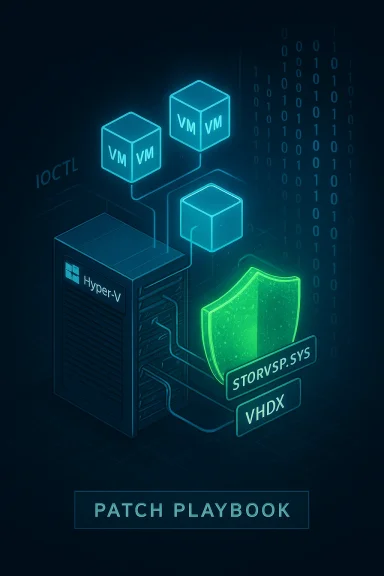
Hyper‑V is Microsoft’s Type‑1 hypervisor embedded into Windows Server and modern client Windows editions. It mediates guest‑to‑host interactions through several subsystems — VMBus and Virtualization Service Providers (VSPs) handle storage, networking, and integration services, while drivers such as storvsp.sys participate in disk and storage operations. Over the past several years, the recurring pattern for Hyper‑V vulnerabilities has been local (authenticated) guest‑to‑host attack vectors that abuse malformed VMBus/device messages, IOCTLs, or virtual disk (VHD/VHDX) parsing to achieve memory corruption, information disclosure, or privilege escalation; CVE‑2026‑21247 sits in that operational landscape.
This article summarizes the available vendor information, correlates operational guidance from security practitioners, explains plausible technical exploitation models, and provides an actionable, prioritized remediation and detection playbook for administrators responsible for Hyper‑V hosts and management infrastructure. Where public facts are absent or unverified, I flag them explicitly and describe what defenders should assume for safe operations.
Practical priorities are simple and concrete:
End of report.
Source: MSRC Security Update Guide - Microsoft Security Response Center
 Background
Hyper‑V is Microsoft’s Type‑1 hypervisor embedded into Windows Server and modern client Windows editions. It mediates guest‑to‑host interactions through several subsystems — VMBus and Virtualization Service Providers (VSPs) handle storage, networking, and integration services, while drivers such as storvsp.sys participate in disk and storage operations. Over the past several years, the recurring pattern for Hyper‑V vulnerabilities has been local (authenticated) guest‑to‑host attack vectors that abuse malformed VMBus/device messages, IOCTLs, or virtual disk (VHD/VHDX) parsing to achieve memory corruption, information disclosure, or privilege escalation; CVE‑2026‑21247 sits in that operational landscape. This article summarizes the available vendor information, correlates operational guidance from security practitioners, explains plausible technical exploitation models, and provides an actionable, prioritized remediation and detection playbook for administrators responsible for Hyper‑V hosts and management infrastructure. Where public facts are absent or unverified, I flag them explicitly and describe what defenders should assume for safe operations.
What Microsoft (and the public record) actually says
- Microsoft lists CVE‑2026‑21247 in its Security Update Guide entry for vulnerabilities, but the page’s content is rendered dynamically and requires an interactive browser to extract the KB→build mapping and official classification details. That makes automated confirmation from the MSRC page difficult without direct browsing. (msrc.microsoft.com)
- The vendor entry, as typical for kernel‑level virtualization issues, omits low‑level exploit mechanics and does not publish proof‑of‑concept code in the public advisory. This is consistent with Microsoft’s standard practice of providing an authoritative remediation mapping while limiting technical detail that would accelerate exploitation. Where Microsoft limits detail, security vendors and incident responders have historically stepped in with operational analysis.
Why Hyper‑V vulnerabilities matter (quick technical refresher)
Hyper‑V mediates many privileged operations on behalf of guests. A host‑side bug in any of these areas breaks important end‑to‑end assumptions:- VMBus and VSP channels are trusted paths for guest‑to‑host requests (storage, network, integration). If inputs on these paths aren’t validated, a guest can cause the host to read or write memory it shouldn’t.
- Virtual disk parsing (VHD/VHDX) and storvsp.sys code paths frequently handle untrusted metadata (descriptors, block lists). Past vulnerabilities have been triggered by malformed descriptors that cause out‑of‑bounds reads/writes or return kernel memory to a less‑privileged context. Those behaviors enable information disclosure and — if chained with other primitives — code execution.
- The practical attack model is commonly local but remote from the host’s perspective: an attacker needs a foothold inside a guest VM or low‑privilege host process that can send crafted messages to the hypervisor. In multi‑tenant cloud or hosting environments, obtaining that foothold is often realistic.
Plausible technical anatomy for CVE‑2026‑21247
Because Microsoft’s public advisory omits low‑level exploit details, defenders must reason using credible, historically recurring failure modes in Hyper‑V:- Input validation failures in VSP or storage drivers: malformed IOCTLs or VMBus packets can trigger heap or stack corruption, use‑after‑free, or integer overflow conditions that lead to RCE on the host.
- Incorrect length/offset handling in VHD/VHDX descriptor parsing: attacker‑controlled descriptors may cause out‑of‑bounds reads that disclose kernel addresses (KASLR bypass) or tokens — information that significantly lowers the cost of developing a working exploit.
- Privileged operation paths lacking authorization checks: device or driver IOCTLs intended for management contexts are sometimes accidentally exposed to less‑privileged callers, enabling reads of sensitive structures or privileged actions.
- Attacker runs code inside a guest VM (or gains low‑privilege access on a host).
- Attacker sends crafted VMBus/IOCTL/VHD inputs that trigger a memory corruption or information leak.
- The leak reveals kernel addresses or credentials, which the attacker uses to build a reliable kernel exploit (write primitive, token theft), converting the initial read into full SYSTEM code execution on the host.
- With host compromise, the attacker can tamper with other VMs, extract host secrets, or persist implants.
What we can verify right now — facts at the security‑operations level
- Vendor acknowledgement: Microsoft has an Update Guide entry for CVE‑2026‑21247. That is the authoritative sign that the company recognizes a defect that requires remediation. However, the public advisory provides limited technical data (the common pattern for kernel/hypervisor issues). (msrc.microsoft.com)
- Public exploit status: there is no widely circulated, vetted proof‑of‑concept published in the public research community at the time of writing. Treat claims of active, large‑scale in‑the‑wild exploitation as unverified until confirmed by multiple telemetry sources or vendor statements. Post‑patch reverse engineering is a common source of PoCs — be vigilant in the days after patch publication.
- The operational threat model resembles previous Hyper‑V RCE or VBS/enclave information disclosure CVEs: local (guest) attackers, multi‑tenant hosts, management jump boxes, and systems that accept untrusted VHDs are high‑value targets and should be prioritized.
Immediate operational checklist (0–72 hours) — prioritized, practical
Follow this runbook in order. Don’t skip the vendor KB mapping step: the MSRC Update Guide is the canonical source for which patch package applies to each Windows SKU and build.- Inventory and tag high‑value systems (1–4 hours)
- Find every system with the Hyper‑V role enabled and tag nodes that host multiple tenants, cluster nodes (Storage Spaces Direct, Azure Stack HCI), VDI hosts, and management/jump boxes. Use SCCM/Intune/WSUS or PowerShell queries (Get‑CimInstance -ClassName Win32ComputerSystem | ? { $.HypervisorPresent }) to build the list.
- Open the Microsoft Update Guide entry and extract KB→build mapping (1–2 hours)
- Microsoft’s page is authoritative. Open it in an interactive browser and copy the exact KB numbers for each affected SKU and build. Do not depend on third‑party CVE→KB feeds for final deployment decisions. (msrc.microsoft.com)
- Pilot the vendor update (4–24 hours)
- Select representative systems covering management hosts, cluster nodes, and VDI hosts.
- Validate VM live migration, backups, replica flows, attestation, and other virtualization functions.
- Collect logs and baseline telemetry so you can spot regressions. Kernel/driver patches often interact with third‑party drivers.
- Staged rollout: management → hypervisors → servers → endpoints (24–72 hours)
- Schedule reboots in maintenance windows and confirm KB installation on each host post‑reboot.
- Prioritize nodes based on business risk: multi‑tenant hosts and jump boxes first.
- Compensating controls if you cannot patch immediately
- Restrict who can mount or attach VHD/VHDX images (ACLs on mount operations).
- Isolate Hyper‑V management, live migration, and storage networks from tenant networks (dedicated VLANs/fabrics).
- Reduce local admin counts and use Just‑In‑Time (JIT) admin flows and MFA for management operations.
- Enable HVCI/Memory Integrity where hardware supports it and enforce driver signing.
- Detection and hunting (ongoing)
- Watch for sudden vmms.exe crashes, BSODs referencing storvsp.sys or storage VSP frames, unusual DeviceIoControl/IOCTL activity, unexpected VHD mounts by non‑admins, and unexplained snapshot creation. Collect minidumps and memory images before rebooting suspected hosts.
- Forensic readiness and incident response
- If compromise is suspected: isolate the host (but avoid rebooting if memory capture is needed), preserve WER minidumps, kernel dumps, event logs, and collect driver and device attach histories. Engage vendor support and incident responders for kernel‑level analysis.
Detection telemetry — what to tune in your EDR / SIEM
- EDR rules for abnormal DeviceIoControl sequences targeting Hyper‑V device objects.
- Alerts for rapid process elevation to SYSTEM originating from non‑standard ancestry (token theft patterns).
- Host crashes or repeated service restarts for vmms.exe correlated with VHD attach events.
- Unexpected VM snapshot creation or automated snapshot patterns outside maintenance windows.
Critical analysis — strengths, gaps, and risk tradeoffs
Strengths in the vendor approach- Microsoft’s Update Guide pattern (canonical CVE→KB mapping) gives administrators a single source of truth for remediation packages across SKUs and builds. That helps ensure the right patch is applied to the right systems. (msrc.microsoft.com)
- Limited public disclosure is a deliberate risk‑management choice: for kernel/hypervisor bugs, omitting low‑level exploit mechanics reduces the probability of broad, rapid exploitation before patches are deployed.
- The Update Guide’s dynamic, JavaScript‑rendered pages complicate automated ingestion and can cause administrators to rely on third‑party feeds that sometimes mismap KBs to builds. That mismatch can lead to incomplete remediation or incorrect rollouts — a real operational hazard. Administrators must manually extract KB IDs from the MSRC page and confirm them in the Microsoft Update Catalog.
- The post‑patch window is a known danger: once a vendor patch is public, attackers and researchers reverse‑engineer the change to develop PoCs. If organizations wait to patch, they may be exposed to weaponized PoCs within days. Prioritize fast, staged rollouts and monitoring in the immediate post‑patch period.
- Lack of public exploit information injects uncertainty. Defenders should assume a conservative posture: treat the CVE as real and operationally significant until proven otherwise, because information‑disclosure or small‑leak primitives historically accelerate full exploit development.
- For multi‑tenant Hyper‑V hosts, the barrier for a local attacker is low by design: a malicious tenant only needs to run code inside a guest VM to reach the hypervisor channels. That makes cloud and hosting providers particularly sensitive to this class of CVE; they should move faster than single‑tenant on‑prem deployments.
Long‑term hardening recommendations
- Inventory and lifecycle management: Tag every Hyper‑V host and management jump box in your CMDB and treat those assets as high‑value. Regularly validate that Hyper‑V roles and drivers are updated via controlled release pipelines.
- Principle of least privilege for virtualization ops: limit which accounts can import VM images, attach disks, or manage enclaves/attestation flows. Use JIT and role‑based access with multifactor authentication.
- Network microsegmentation: put management, migration, and storage traffic on separate, dedicated fabrics inaccessible to tenant networks.
- Baseline and test virtualization workflows: include live migration, backup/restore, and enclave attestation in patch pilots to catch regressions early.
- Endpoint and kernel telemetry: invest in EDR solutions that provide kernel‑level visibility and DeviceIoControl/IOCTL monitoring so you can detect the behavioral signs of exploitation even when low‑level indicators are unavailable.
What defenders should monitor in the next 7–30 days
- Official KB→build mappings posted in Microsoft’s Update Guide and Microsoft Update Catalog (extract KB numbers manually and sync with WSUS/SCCM/Intune). (msrc.microsoft.com)
- Security vendor advisories and IPS signatures (they typically publish compensating controls and detection signatures within 24–72 hours of a vendor advisory).
- Public PoC availability: once a patch is out, assume reverse engineering will follow — treat the post‑patch period as high short‑term risk and accelerate deployments.
- Telemetry for unusual vmms.exe restarts, DeviceIoControl sprawl, and anomalous VHD mounts. If you see such events, collect volatile memory, kernel dumps, and event logs for forensic analysis.
Final assessment and guidance
CVE‑2026‑21247 is vendor‑acknowledged in Microsoft’s Update Guide and should be treated as an actionable operational risk for any organization that runs Hyper‑V hosts, accepts untrusted VHD/VHDX images, or operates multi‑tenant virtualization. The vendor advisory provides the canonical remediation mapping, but intentionally omits exploit mechanics — a reasonable protective posture that nevertheless requires defenders to move quickly.Practical priorities are simple and concrete:
- Inventory Hyper‑V hosts and management jump boxes now.
- Extract and validate the KB→build mapping from Microsoft’s Update Guide and the Microsoft Update Catalog. (msrc.microsoft.com)
- Pilot the vendor updates in a representative ring, then roll out in staged waves, starting with multi‑tenant and management nodes.
- Apply compensating controls (restrict VHD mounts, isolate management/migration networks, enforce least privilege) if you cannot patch immediately.
- Tune detection rules for DeviceIoControl anomalies, vmms.exe instability, and unexpected VHD operations; capture forensic artifacts before rebooting suspected hosts.
End of report.
Source: MSRC Security Update Guide - Microsoft Security Response Center
