

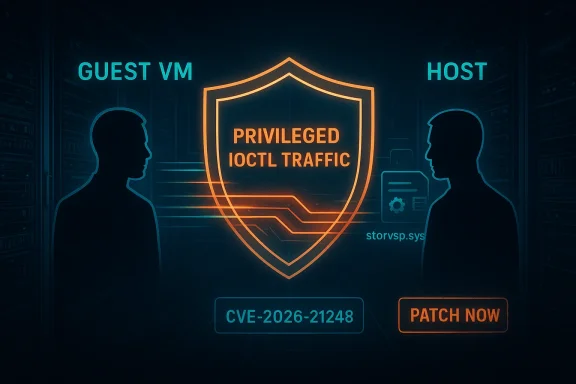
Microsoft's security guidance for CVE-2026-21248 warns Windows administrators that a serious Remote Code Execution (RCE) vulnerability exists in Hyper‑V components used to bridge guest and host operations, and that immediate, prioritized remediation is required even though vendor advisories purposefully omit low‑level exploit mechanics. ulnerability tracked as CVE‑2026‑21248 affects the Hyper‑V virtualization stack and, according to vendor guidance, can be triggered by inputs coming from guest virtual machines or by operations that allow an attacker to interact with virtualization device interfaces. Microsoft’s update guidance is the canonical source for which builds and KBs require remediation; the public advisory intentionally withholds precise IOCTL names, internal code paths, and exploit proof‑of‑concept to limit attacker use while patches are deployed.
Hyper‑V vulnerabilitonsequential because they cross the usual isolation boundary between guest VMs and the host. A successful exploit can elevate an attacker from code running inside a guest VM to host‑level code execution—turning a single compromised VM into a platform for lateral movement across other tenants or workloads on the same host. That risk profile is the reason vendors and incident responders mark kernel‑level virtualization bugs as high‑urgency even when public details are limited.
What we know (authoritative points and remediation mapping:** Microsoft’s Security Update Guide entry for CVE‑2026‑21248 provides the official KB → build mapping administrators must use to determine which update packages to apply to each Windows build. Administrators should treat the MSRC advisory as the source of truth for remediation.
- Disclosure posture: Microsoft’s advisory follows the standl‑level issues by omitting exploit mechanics and low‑level identifiers from the public text; this does not mean the vulnerability is theoretical—treatment should assume real risk until systems are patched.
- Attack surface and likely components: Published operational briefings and defensthe virtualization Virtualization Service Provider (VSP) and storage VSP components—storvsp.sys and related drivers—as likely areas of interest, because these components accept input from guests and expose privileged IOCTLs to the host. While vendor text does not always list the exact driver names, defensive recommendations and incident response playbooks reference these drivers when hunting and mitigating.
- Exploitability model: Most Hyper‑V kernel issues follow a local or guest‑initiated model: an attacker ability to run code inside a guest VM or have local access to a host process that interacts with Hyper‑V services. From that foothold they craft requests—malformed IOCTLs, VHD/VHDX descriptors, or other integration calls—that exercise the vulnerable path. Practical exploitation frequently requires follow‑on primitives (memory corruption or race conditions) to convert an information leak into reliable RCE, but once that chain exists the consequences are severe.
Why this matters: real operational impact
Hypervisors are the fault domain for entire datacenters and VDI farms. A single- Break tenant isolation and provide attackers access to multiple guest images.
- Allow installation of persistent tools with host privileges, undermining host integrity and live migration trust.
- Compromise orchestration, backup, or image build servers that interact with VHD/VHDX content and therefore increase blast radius.
Technical anatomy — what defenders should assume
Because the vendor advisory purposefully avoids disclosing exploit mechanics, defenders must rhnical models derived from historical Hyper‑V bugs and the guidance published by incident responders:- Input vectors: malformed VHD/VHDX descriptors, crafted DeviceIoControl (IOCTL) requests from guests, or mis‑parsed INF/driver configuration information for passed‑through devices. These are common attack surfaces for guest→host interactions.
- Privilege boundary crossed: the vulnerable code runs in kernel or privileged driver context on the host. An attacker who controls a guest can use the guest‑facing interfacehavior that the host did not intend to expose to untrusted guests.
- Typical exploitation steps (high level):
- Achieve code execution or controlled input in a guest VM (often via commodity exploit or social engineering).
- Send crafted inputs to the virtuahannel (e.g., storage VSP, device passthrough).
- Trigger memory safety bug or logic flaw that yields code execution or information disclosure on the host.
- Use host execution to escalate laterally, hide persistence, or exfiltrate data.
Immediate actions (0–72 hours)
Treat CVE‑2026‑21248 as a high‑priority operational item. Follow this succinct playbook, adapted from Microsoft’s advisory best practices and incident response recommendations:every Windows host with the Hyper‑V role enabled (including Server, Desktop hosts used as lab or build agents, and any management jump boxes). Map each host to the Microsoft KB identifiers listed in the advisory. The MSRC page contains the KB mapping you must use for each build—do not rely solely on third‑party feeds.
- Pilot and test: stage the Microsoft update(s) in a small pilot ring that includes representative cluster nodes, VDI hosts, and management servers. Validate live migration, replication, backups, and any vendor storage integrations.
- Pr- First wave: management jump boxes, orchestration and build servers, domain controllers with the Hyper‑V role, and production Hyper‑V hosts in multi‑tenant or high‑exposure contexts.
- Second wave: non‑critical Hyper‑V hosts and developer/test hosts after pilot validation.
- Compensating controls if you cannot patch immediately:
- Restrict who can attach or mount VHD/VHDX images.
- Prevent untrusted users from importing INF files or performing device passthrough.
- Limit interactive logons to host systems; remove unnecesivileges.
- Segment management and tenant networks; isolate hosts that accept untrusted images.
- Update detection rules: apply vendor signatures and telemetry rules (EDR/IPS/IDS) supplied by security vendors that correlate with the advisory; tune to reduce false positives and focus on the high‑value hosts.
- Validate post‑patch: confirm build versions, reboot hosts as requical services (live migration, cluster health, HCI operations). Do not remove hardening controls until the environment is verified stable.
Hunting and detection priorities
Given the lack of public exploit uld focus on behavioral indicators and artefacts correlated with Hyper‑V integrity failure modes:- Sudden host crashes or BSODs referencing storage virtualization drivers (for example, storvsp.sys) or other VSP components. Captry images for forensic analysis.
- Unexpected elevations to SYSTEM or suspicious process ancestry where low‑privilege guest actions precede host service elevation. Monitor Event IDs related to process creation, service control, and device attach events.
- Unusual DeviceIoControl / IOCTL activity toward virtualization device objects; logging and monitoring of device control requesed traffic.
- Attempts to attach or mount untrusted VHD/VHDX images soon before crashes or anomalous host behavior. Preserve copies of suspect images for offline analysis.
Risk assessment: who must care first
Prioritization depends on exposure and asset value. Consider these categoriesti‑tenant Hyper‑V hosts and cloud/hosting providers where compromise of a single host impacts many customers.- Management jump boxes, orchestration servers, and any build agent with Hyper‑V enabled.
- Production HCI clusters, VDI hosts, and storage environments that accept untrusted images or VHD uploads.
- Systems used for automated image processing, pre‑production testing, or any automation that mounts third‑party VHDs.
What defenders should not assume
- Do not assume the vulnerability is safe because the MSRC advisory lacks technical detail. The omission is intentional to reduce exploitability before patches are widely deployed; it is not an assurance that exploitation is unlikely.
- Do not rely exclusively on third‑party CVE summaries or aggregated feeds for KB mapping. Microsoft’s Security Update Guide is the autthe exact KBs and build mappings you must apply. Automated scrapers sometimes fail to capture dynamic advisory fields; manually extract KB IDs where necessary.
- Do not underestimate the operational disruption of emergency patching. Plan staged deployments and communicate rebootause many Hyper‑V fixes require host reboots to take effect.
Longer‑term mitigations and hardening
Beyond immediate patching, adopt these posture improvements to reduce the risk of future guest→host escapes:- Least privilege for virtualization management: limit who can create or attach virtual disks, impoate virtual hardware.
- Strict image provenance: only allow VHD/VHDX images from trusted registries or signed images, and scan images for malicious components before importing into production hosts.
- Nsolate management networks from tenant or internet‑facing networks; limit which accounts and systems can communicate with Hyper‑V hosts.
- Enforce driver signing and block known‑vulnerable drivers; enable virtualization‑based security (VBS) and Memory Integrity / HVCI where supported to create additional barriers to kernel exploitation.
- Integrate Hyper‑V telemetry into your SIEM and EDR platforms: centralize logs from host virtualization drivers and correlate with guest‑side detections to spot cross‑layer attacks early.
Critical analysis: strengths and residual risks
Microsoft’s disclosure and remediation approach here follows an established, cautious pattern: publish a canonical advisory that maps CVE to KBs for rapid operational action, while withholding exploit details to limit immediate abuse. This method has clear strengths: it prioritizes customer patching and reduces the likelihood of public proof‑of‑concept code enabling mass exploitation immediately after disclosure.However, the model also carr Operational lag: Large organizations and cloud providers require testing windows; the time between advisory publication and full deployment creates a predictable window attackers can target.
- Dependence on accurate KB mapping: Automated tooling can misinterpret Microsoft’s dynamic advisory pages; missed KBs or misapplied updates lead to false confidence. Microsoft’s guidance explicitly warns administrators to extract exact KB IDs for each build rather than relying on grd‑party feeds.
- Unknown exploitation tradeoffs: Without public details, defenders must hunt on behavioural patterns rather than IOCs, which complicates detection. Attackers with enough sophistication may develop private exploits against unpatched hosts during the disclosure‑to‑patch window.
Practical checklist for WindowsF
- Inventory all Hyper‑V hosts and map to MSRC KB IDs.
- Stage updates in a pilot ring; validate live migration, replication, and backups.
- Prioritize management jump boxes, multi‑tenant hosts, HCI/VDI clusters for first‑wave patching.
- If you cannot patch immediatelyg, block INF imports, and segment management networks.
- Tune EDR/IPS rules and hunt for behavioral signals (BSODs referencing VSP drivers, abnormal DeviceIoControl activity).
Conclusion
CVE‑2026‑21248 is a high‑consequence Hyper‑V vulnerability that demands urgent, careful action. Microsoft’s advisory is the operational source to d to apply, and defenders should proceed on the assumption that exploitation risk is reahost is patched and validated. Rapid inventory, prioritized patching of management and multi‑tenant hls to limit VHD/driver attachments, and focused behavioural hunting are the practical steps that reduce immediate operational stability. The absence of public exploit details is a protective choice—not a reason for complacency—and the reiation now rests with administrators and cloud providers to move quickly and deliberately.Source: MSRC Security Update Guide - Microsoft Security Response Center
