

Microsoft's advisory entry for CVE-2026-21525 confirms a denial‑of‑service weakness in the Windows Remote Access Connection Manager (RasMan) that can be triggered by a local, authorized actor manipulating file system links — a technical detail that shifts this bug from a generic service crash to a concrete and actionable attack vector for administrators to prioritize immediately. m](Security Update Guide - Microsoft Security Response Center))
Remote Access Connection Manager (commonly referred to as RasMan) is the Windows service that coordinates dial‑up and VPN connections and supports legacy remote‑access APIs. It runs with elevated privileges and interfaces with both networking stacks and on‑disk resources; because of that privileged position, even non‑exploitative bugs (availability defects) can produce outsized operational impact for organizations that rely on RasMan for VPN termination, device management, or legacy connectivity. Historical Microsoft advisories and community analyses have repeatedly flagged RasMan and the broader Routing and Remote Access (RRAS) family as a recurring attack surface, which makes any new RasMan CVE significant for operators.
CVE-2026-21525 is recorded in Microsoft’s Security Update Guide as affecting the Remote Access Connection Manager component. While Microsoft’s web UI for the advisory renders dynamically and therefore requires a browser to view full KB mappings, the vendor’s acknowledgement is the authoritative confirmation that a fix is available or in process; that vendor acknowledgement raises the degree of operational urgency even when public technical detail is intentionally limited. (msrc.microsoft.com)
Important clarifications and limits to the technical picture:
Short term, the most effective actions are to:
Source: MSRC Security Update Guide - Microsoft Security Response Center
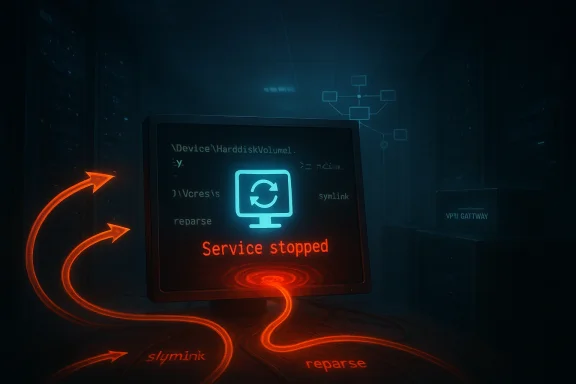 Background / Overview
Remote Access Connection Manager (commonly referred to as RasMan) is the Windows service that coordinates dial‑up and VPN connections and supports legacy remote‑access APIs. It runs with elevated privileges and interfaces with both networking stacks and on‑disk resources; because of that privileged position, even non‑exploitative bugs (availability defects) can produce outsized operational impact for organizations that rely on RasMan for VPN termination, device management, or legacy connectivity. Historical Microsoft advisories and community analyses have repeatedly flagged RasMan and the broader Routing and Remote Access (RRAS) family as a recurring attack surface, which makes any new RasMan CVE significant for operators. CVE-2026-21525 is recorded in Microsoft’s Security Update Guide as affecting the Remote Access Connection Manager component. While Microsoft’s web UI for the advisory renders dynamically and therefore requires a browser to view full KB mappings, the vendor’s acknowledgement is the authoritative confirmation that a fix is available or in process; that vendor acknowledgement raises the degree of operational urgency even when public technical detail is intentionally limited. (msrc.microsoft.com)
What the advisory says — concise technical summary
- Affected component: Remote Access Connection Manager (RasMan).
- Impact: Denial of Service (availability) — the service may crash, hang, or enter an error state that disrupts routing, VPN termination, or other remote‑access services.
- Attack vector: Local (requires file system operations by an authorized local account) — the advisory describes the actor as “authorized,” indicating that complete anonymous remote exploitation is not the intended threat model.
- Root cause (vendor guidance and technical corroboration): Improper link resolution (symlink / reparse point handling) before file access — Rar reparse point in a way that an attacker who can create or control such links can cause the service to fail. This class of defect is cataloged as CWE‑59 (improper link resolution).
Why this matters operationally
RasMan typically runs in a privileged context on endpoints and servers that manage VPNs, dial‑up, or legacy remote‑access flows. The practical consequences of a local RasMan denial of service include:- Immediate loss of VPN termination on the affected host, cutting off remote users or branch connections.
- Failure of routing or NAT functions if the host is acting as a gateway, producing broader network outages.
- Disruption to authentication flows and management tooling that rely on VPN connectivity (including single sign‑on or conditional access mechanisms).
- Increased incident‑response workload, emergency change windows, and potential SLA breaches for critical services.
Technical deep dive: how the flaw works (what we know)
The advisory and corroborating technical summaries indicate the root cause is insecure link resolution — RasMan follows a symbolic link or reparse point and ends up accessing an unexpected target or encountering an error path that causes a crash or service failure. The essential mechanics are:- RasMan attempts to read or open a file path as part of its normal operations.
- The path resolution routine follows a link (symbolic link, junction, or reparse point) that is attacker‑controlled or attacker‑manipulated.
- The final resolved target is unexpected (for example, a protected resource, a file that triggers an error path, or a location that RasMan cannot safely handle), and the code does not validate or handle that result robustly.
- The unexpected result causes an assertion, exception, or unhandled error that crashes or corrupts RasMan’s runtime state, resulting in denial of service.
Important clarifications and limits to the technical picture:
- This is a local availability vulnerability — the advisory specifically notes a local, authorized actor as the attacker model. That reduces the threat of remote, anonymous exploitation but does not eliminate risk for environments where many users o write or link‑creation capabilities.
- The advisory and public trackers do not (at time of publication) include a public proof‑of‑concept or detailed exploit mechanics. The absence of PoC does not guarantee the issue cannot be weaponized; it merely li exploitability.
Attack scenarios — how an adversary could weaponize this
Although this vulnerability is local, realistic attack chains turn a local DoS into meaningful operational leverage:- Scenario 1 — Insider sabotage: A disgruntled or compromised authorized local account creates or swaps a symlink in a path RasMan will resolve, causing a service crash and immediate loss of VPN access for remote workers.
- Scenario 2 — Post‑compromise hardening/backslide: An attacker who already has a low‑privilege shell on an endpoint (e.g., via phishing) can exploit this DoS as a denial or distraction technique while performing lateral movement or data exfiltration elsewhere.
- Scenario 3 — Supply‑chain or imaging misconfiguration: In environments where multiple VMs or image builds rely on the same file system paths or mounted volumes, a crafted link introduced at imaging time can trigger widespread failures after deployment.
- Scenario 4 — Operational disruption during maintenance: An attacker times the DoS to coincide with an administrative window, forcing emergency patching, reboots, and possibly raising the chance of misconfiguration during recovery.
Evidence, corroboration, and the “degree of confidence”
Microsoft’s Security Update Guide entry for CVE‑2026‑21525 is the authoritative acknowledgement that the vulnerability exists; vendor acknowledgement is the highest confidence signal in vulnerability triage. Independent community trackers and security feeds have mirrored the same technical characterization (local link‑following leading to DoS), giving additional corroboration. At the time of writing, public trackers and vendor feeds show:- Consensus on the attack vector (local) and impact (DoS / availability).
- A vendor‑provided CVSS vector in the medium range for availability‑only impacts in similar RasMan advisories; community summaries often highlight that the absence of remote exploitability reduces immediate external attack surface but not operational risk.
- At publication there were no widely published PoC exploits or confirmed in‑the‑wild attacks specifically for CVE‑2026‑21525; multiple community summaries call this out and recommend priorittheless.
Mitigation and remediation guidance — prioritized checklist
- Patch first: Map CVE‑2026‑21525 to the specific KB/security update for each Windows build in your estate and deploy the vendor update as soon as operationally possible. Microsoft’s Security Update Guide is the authoritative mapping — use enterprise update tooling (WSUS, SCCM/ConfigMgr, Microsoft Update for Business, or the Microsoft Update Catalog) to automate and verify distribution. (msrc.microsoft.com)
- If patching is delayed — apply fast containment:
- Disable the RasMan service on hosts that do not require routing or VPN termination. Note: this removes remote‑access functionality and is disruptive for servers acting as VPN gateways. Historically Microsoft has documented disabling RasMan as a valid workaround when appropriate.
- Harden file system permissions and prevent untrusted users or processes from creating symbolic links or reparse points in directories RasMan is likely to resolve. On Windows, symlink creation is typically privileged, but there are contexts (developer machines, containers, build agents) where link creation can be available.
- Review service accounts, build agents, and deployment pipelines that create or supply files to the system paths RasMan interacts with; restrict or audit those flows.
- Inventory and prioritize:
- Identify all systems that have the Remote Access Connection Manager (RasMan) service present and especially those where the RasMan serviceAS role is enabled. RasMan is not present on every server by default, but it is common in VPN/gateway builds and some imaging scenarios. Inventory accuracy is essential.
- Monitoring and detection:
- Detect sudden RasMan crashes, restarts, or service errors in your endpoint and server telemetry. Log and alert on unexpected RasMan service termination events.
- Monitor for changes to symbolic links and reparse points in relevant file system locations. File integrity monitoring (FIM) and EDR solutions can surface suspicious link creation.
- Network telemetry: if your environment relies on RRAS for perimeter VPN, watch for the sudden absence of expected VPN control plane traffic or mass reconnection attempts from remote users.
- Post‑patch validation:
- Verify update installation on the full set of affected builds and validate RasMan service behavior after patching (restart service, test VPN termination, and check for service errors).
- Ensure patch rollout did not break legitimate workflows that depended on previous RasMan behavior (some legacy apps may rely on certain RasMan semantics).
- Long term hardening:
- Where possible, migrate away from legacy RRAS/RasMan VPN termination to more modern, better‑segmented remote‑access solutions (cloud VPN gateways, dedicated hardware appliances, or managed VPN services).
- Reduce the number of hosts that run RasMan unnecessarily — principle of least functionality.
Detection guidance and investigative playbook
Short detection checklist for operators who suspect RasMan abuse or unplanned DoS:- Check Windows Event Logs (System and Application) for RasMan service stop/start events and error codes.
- EDR / Endpoint telemetry: search for local file system operations that create or modify symbolic links, junctions, or reparse points in directories that RasMan references.
- Network telemetry: identify abrupt drops in VPN session counts, or mass reconnection attempts from remote users which often follow a gateway outage.
- Configuration and image scans: detect if any build pipelines or automated installers create symlinks in persistent system locations as part of provisioning — these are common accidental vectors.
- Perform targeted integrity checks on the set of directories RasMan might evaluate at runtime (for example, configuration locations or temporary paths used by the service),states for future comparison.
Risk analysis — strengths, trade‑offs, and residual risks
Strengths of the vendor disclosure and the remediation posture:- Microsoft has formally acknowledged the CVE and mapped it in the Security Update Guide, which provides the canonical update mapping enterprises need to remediate at scale. Vendor acknowledgement raises confidence in the vulnerability’s existence and facilitates coordinated patching. (msrc.microsoft.com)
- The local, authorized attack model reduces the immediate remote threat surface: environments that strictly limit local file system write and link creation for non‑privileged accounts will be less exposed.
- Operationally, RasMan often runs on hosts that are highly critical (VPN concentrators, edge gateways). Even a local DoS can produce outsized impact that merits near‑term patching and careful testing to avoid availability regressions.
- Many enterprise environments have complex service account, build server, and automation footprints that may inadvertently grant the ability to create links or write to the paths RasMan resolves; those intermediate prit radius even when the primary exploit model is local.
- Lack of a public PoC does not equal safety. Historically, once a vendor acknowledgement exists, public technical analysis or exploit code can follow in days or weeks; defenders should not delay patching pending public exploit activity.
- Assuming the Microsoft update fully addresses the improper link resolution, remaining risk is primarily operational (failures during patch deployment) or related to legacy images that are not updated promptly. Inventory and enforcement of patch compliance closes most of the residual window.
Practical recommendations for Windows administrators (quick checklist)
- Immediately map CVE‑2026‑21525 to KBs for your OS builds via Microsoft’s Security Update Guide and schedule patch deployment. Verify updates via enterprise patch tooling. (msrc.microsoft.com)
- If immediate patching is impossible, consider temporarily disabling the RasMan service on non‑gateway hosts, and restrict symlink creation and file writes in directories RasMan touches.
- Audit accounts and services with local file system write permissions; remove unnecessary privileges and apply just‑in‑time / just‑enough administration where appropriate.
- Deploy or tune file integrity monitoring to detect suspicious reparse point or symlink creation.
- Monitor for RasMan crashes and unexpected VPN or routing interruptions; treat unexpected availability loss as a high priority for investigation.
- Plan for staged patching and validation on VPN/gateway hosts to minimize user disruption during remediation windows.
Final assessment — what defenders should take away
CVE‑2026‑21525 is a vendor‑acknowledged vulnerability in the Remote Access Co manifests as a local denial of service via improper link resolution. While not a remote code‑execution or elevation‑of‑privilege bug, it is operationally significant because RasMan often runs in critical VPN and routing roles. Vendor acknowledgement and corroborating community reporting give high confidence that the vulnerability exists and should be addressed as part of routine security patching and operational hardening.Short term, the most effective actions are to:
- Patch urgently using vendor updates mapped to your builds;
- Harden and audit local file system privileges and symlink creation capabilities; and
- Monitor for RasMan crashes and unexpected availability events.
Treat the advisory as an operational priority even though the CVE’s attack model is local — real‑world enterprise complexity (automated build agents, service accounts, imaging) often turns local weaknesses into actionable risks at scale. The vendor acknowledgement gives defenders the tools they need to map, test, and deploy mitigations; the remaining work is execution and gating updates to avoid
Acknowledgement: This analysis synthesizes Microsoft’s advisory entry and independent technical summaries to produce a practical, defense‑focused view of CVE‑2026‑21525 and its operational implications. Readers should consult the Microsoft Security Update Guide for the definitive CVE → KB mapping for their specific Windows builds, and verify patch status via enterprise update tooling. (msrc.microsoft.com)Source: MSRC Security Update Guide - Microsoft Security Response Center
