

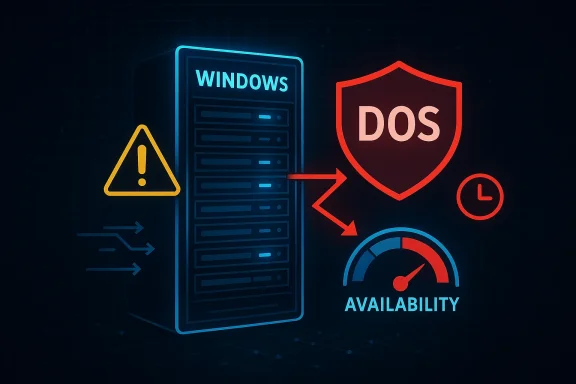
Microsoft’s CVE-2026-21717 entry is, on its face, another reminder that not every dangerous vulnerability is a data-theft story. Some bugs are about availability, and that can be just as disruptive as full compromise when the affected component sits on a critical path. The description attached to this issue points to an attacker being able to fully deny access to resources in the impacted component, either while the attack is ongoing or in a way that persists after the attack ends. In practical terms, that places the flaw in the class of bugs that can turn a healthy service into a brick at exactly the moment it is needed most.
Microsoft’s security team has spent the last several years making its vulnerability disclosures more granular, more standardized, and easier to operationalize for administrators. The move to CVSS-based descriptions in the Security Update Guide was a meaningful shift because it replaced broad prose with structured details about attack vector, complexity, privilege requirements, and impact. That change matters because defenders no longer have to guess whether a vulnerability is likely to be used for code execution, information disclosure, privilege escalation, or a service outage.
The wording around CVE-2026-21717 fits squarely into that modern model. It describes a condition where an attacker can cause total loss of availability in the impacted component, or a severe partial loss whose consequences are still direct and serious. That distinction is important because not all denial-of-service bugs are equal: some simply make a service temporarily sluggish, while others can stop new connections, exhaust key resources, or make the system require a restart.
Microsoft has long treated denial-of-service issues as more than just nuisance defects when they affect public-facing services or core infrastructure. In earlier MSRC guidance, the company explicitly distinguished between temporary and permanent denial of service, noting that the difference can decide whether a flaw is administratively urgent or operationally dangerous. The same logic applies here: if a vulnerability lets an attacker reliably deny access to a service, the blast radius can be enormous even if no code is executed and no secrets are stolen.
That framing is especially relevant in 2026, when Windows environments often support a mix of cloud-connected services, on-premises workloads, remote access layers, and enterprise apps that are all chained together. A component that only looks “partially affected” on paper can still create an outage if it sits in front of authentication, file access, identity, or network coordination. Availability is often the first thing organizations notice and the last thing they fully recover.
There is also a second pathway in the description: even if the attacker cannot cause total shutdown on demand, they may still be able to deny some availability in a way that produces a direct, serious consequence. Microsoft’s example is telling. If an attacker cannot disrupt existing connections but can prevent new ones, or can repeatedly trigger a small leak that eventually becomes a full outage, the issue still qualifies as serious because the cumulative effect is system-level disruption.
This also hints that the vulnerability may not be a single-packet kill switch. The wording allows for attacks that are sustained, persistent, or cumulative. That means defenders should think in terms of resource exhaustion, state corruption, connection starvation, or repeatable fault conditions rather than only hard crashes.
Availability bugs are especially underestimated because they can look “less bad” in a scoring sheet. That perception is misleading. If a flaw disables remote access for an enterprise, breaks a queue that supports transaction processing, or prevents users from reaching an internal app, the business impact can be immediate. In some environments, an outage lasting minutes is already a reportable event.
Microsoft’s own historical guidance reinforces this point. The company has previously noted that administrators should care whether a denial of service is temporary or permanent, because permanent failures often require a restart and can leave a service unusable until maintenance steps are taken. That logic matters here because CVE-2026-21717 appears to fit the more damaging side of the spectrum.
A few common consequences include:
This matters for defenders because an incident may not look like a classic security event at first. It may appear as an intermittent slowdown, a spike in resource usage, or a pattern of aborted requests. By the time operators recognize the pattern, the service may already be effectively unavailable.
Organizations should also remember that denial-of-service vulnerabilities can hurt internal services as badly as internet-facing ones. A compromised internal management plane, backup controller, or identity-adjacent service can stall recovery workflows even if production systems remain nominally healthy. In some cases, the “DoS” is not the incident itself; it is the thing that prevents the organization from responding to the incident.
The hardest part for consumers is that availability attacks can look like normal instability. A service might partially work, then fail, then recover, then fail again. That intermittent behavior makes it feel like an ordinary outage, but the underlying cause may be malicious and repeatable.
A few likely consumer-facing consequences include:
Microsoft’s broader disclosure strategy has also become more detailed over time. By using CVSS-style descriptors and richer vulnerability pages, the company is encouraging customers to look at attack vector, scope, and impact, not just the headline CVE category. That means availability-oriented issues should be evaluated in context: where they sit, who can reach them, and how much damage repeated triggering could cause.
A realistic response plan often includes:
The broader opportunity is to use this kind of CVE as a forcing function for architecture review. If a single component can be denied service by a repeatable attack, that is often a sign that redundancy, throttling, or isolation could be better. The fix for the bug should also inspire a fix for the design.
There is also the risk that the attacker’s method is cheap enough to automate at scale. If the bug can be triggered repeatedly without much cost, a single exposure can become a broad campaign. In that scenario, the vulnerability becomes a reliability problem for every affected organization, not just a local hardening issue.
The next thing to watch is whether Microsoft publishes additional guidance, including mitigations, affected product details, or exploitability notes. That information often determines whether administrators can safely defer patching for a short period or should treat the update as urgent. Until more detail appears, the safest assumption is that any repeatable denial-of-service condition on a key component deserves prompt attention.
Source: MSRC Security Update Guide - Microsoft Security Response Center
 Background
Microsoft’s security team has spent the last several years making its vulnerability disclosures more granular, more standardized, and easier to operationalize for administrators. The move to CVSS-based descriptions in the Security Update Guide was a meaningful shift because it replaced broad prose with structured details about attack vector, complexity, privilege requirements, and impact. That change matters because defenders no longer have to guess whether a vulnerability is likely to be used for code execution, information disclosure, privilege escalation, or a service outage.The wording around CVE-2026-21717 fits squarely into that modern model. It describes a condition where an attacker can cause total loss of availability in the impacted component, or a severe partial loss whose consequences are still direct and serious. That distinction is important because not all denial-of-service bugs are equal: some simply make a service temporarily sluggish, while others can stop new connections, exhaust key resources, or make the system require a restart.
Microsoft has long treated denial-of-service issues as more than just nuisance defects when they affect public-facing services or core infrastructure. In earlier MSRC guidance, the company explicitly distinguished between temporary and permanent denial of service, noting that the difference can decide whether a flaw is administratively urgent or operationally dangerous. The same logic applies here: if a vulnerability lets an attacker reliably deny access to a service, the blast radius can be enormous even if no code is executed and no secrets are stolen.
That framing is especially relevant in 2026, when Windows environments often support a mix of cloud-connected services, on-premises workloads, remote access layers, and enterprise apps that are all chained together. A component that only looks “partially affected” on paper can still create an outage if it sits in front of authentication, file access, identity, or network coordination. Availability is often the first thing organizations notice and the last thing they fully recover.
What the CVE Description Tells Us
The language Microsoft attached to CVE-2026-21717 is unusually direct about impact. It says there is total loss of availability, meaning an attacker can fully deny access to resources in the vulnerable component. That is the sort of phrasing administrators should read as a sign of operational risk rather than a purely theoretical security defect.There is also a second pathway in the description: even if the attacker cannot cause total shutdown on demand, they may still be able to deny some availability in a way that produces a direct, serious consequence. Microsoft’s example is telling. If an attacker cannot disrupt existing connections but can prevent new ones, or can repeatedly trigger a small leak that eventually becomes a full outage, the issue still qualifies as serious because the cumulative effect is system-level disruption.
Why wording matters
The difference between “can crash a process” and “can deny availability” sounds subtle, but it is operationally huge. A bug that kills one worker process may be automatically recovered by a watchdog, while a bug that locks up a listener, starves a queue, or exhausts memory across repeated attempts can turn into a broad outage. That is why the MSRC description is worth reading literally rather than casually.This also hints that the vulnerability may not be a single-packet kill switch. The wording allows for attacks that are sustained, persistent, or cumulative. That means defenders should think in terms of resource exhaustion, state corruption, connection starvation, or repeatable fault conditions rather than only hard crashes.
- Total denial of service is the most severe interpretation.
- Persistent impairment can be as operationally painful as a crash.
- Repeated exploitation can turn a small leak into a major incident.
- Connection exhaustion is especially dangerous on edge-facing services.
- Watchdog recovery may not help if the attacker can retrigger the flaw.
Why Availability Bugs Are Underestimated
Security conversations often focus on the dramatic categories: remote code execution, privilege escalation, or credential theft. Yet in production environments, denial-of-service vulnerabilities can be the ones that force the most urgent action. If an attacker can knock over a customer-facing or internally critical service, the result can be lost revenue, lost productivity, and incident-response churn even when no data leaves the environment.Availability bugs are especially underestimated because they can look “less bad” in a scoring sheet. That perception is misleading. If a flaw disables remote access for an enterprise, breaks a queue that supports transaction processing, or prevents users from reaching an internal app, the business impact can be immediate. In some environments, an outage lasting minutes is already a reportable event.
Microsoft’s own historical guidance reinforces this point. The company has previously noted that administrators should care whether a denial of service is temporary or permanent, because permanent failures often require a restart and can leave a service unusable until maintenance steps are taken. That logic matters here because CVE-2026-21717 appears to fit the more damaging side of the spectrum.
Operational realities
In large environments, availability bugs rarely stay confined to the attacked service. They can trigger automation, failover events, scaling behavior, alert storms, and emergency mitigation steps that create secondary noise. A single attacker can therefore cause more than just a downed process; they can trigger a chain reaction across monitoring, support, and change management.A few common consequences include:
- User-visible outages during business hours.
- Failed authentication or logon attempts if the target is front-line identity infrastructure.
- Service restart loops if recovery mechanisms keep reloading the vulnerable component.
- Queue backlogs when the service stops accepting new work.
- Emergency failover that may be expensive or imperfect.
How Attackers Turn Small Weaknesses into Big Outages
The most interesting part of Microsoft’s wording is its acknowledgment that an attacker may not need to destroy availability in one dramatic step. Instead, the attacker might repeatedly exploit a condition that leaks only a small amount of memory, or otherwise degrades the service incrementally, until the system becomes completely unavailable. That pattern is familiar across modern exploitation: a vulnerability that looks modest in isolation can become severe when it is automated and repeated.Repetition is the force multiplier
Repeated exploitation is one of the oldest ways to convert a “limited” bug into a major incident. If every trigger consumes a little more memory, holds a little more state, or leaves a little less capacity for new work, the attacker can gradually push the service over the edge. That is often more dangerous than a single crash because it can be harder to attribute and easier to reattempt.This matters for defenders because an incident may not look like a classic security event at first. It may appear as an intermittent slowdown, a spike in resource usage, or a pattern of aborted requests. By the time operators recognize the pattern, the service may already be effectively unavailable.
Common abuse patterns
Attackers commonly exploit availability bugs through a few broad patterns:- Resource exhaustion by consuming memory, handles, threads, or sockets.
- State accumulation that slowly degrades process health.
- Connection starvation that blocks new sessions while old ones continue.
- Crash-and-restart loops that keep the service from stabilizing.
- Amplified failure conditions where a small input has a disproportionately large effect.
Enterprise Impact: Why Administrators Should Care
For enterprises, a vulnerability like CVE-2026-21717 is not just a security issue; it is a continuity issue. If the affected component sits in front of end users, business applications, or remote workers, the outage cost can exceed the technical cost of remediation. That is why availability findings often rise quickly in operational priority once a real exploit path is understood.The cost of downtime
Availability failures ripple outward. Help desks get flooded, automation starts failing, and incident teams burn time verifying whether the issue is malicious or accidental. If the component is shared across departments or tenants, a single impacted host can become a broad service event. The larger the dependency tree, the worse the cascade.Organizations should also remember that denial-of-service vulnerabilities can hurt internal services as badly as internet-facing ones. A compromised internal management plane, backup controller, or identity-adjacent service can stall recovery workflows even if production systems remain nominally healthy. In some cases, the “DoS” is not the incident itself; it is the thing that prevents the organization from responding to the incident.
What IT teams should think about
Administrators evaluating a vulnerability of this type should ask:- Is the affected component internet-facing or reachable from low-trust networks?
- Can the attack be repeated cheaply enough to sustain pressure?
- Does the service have watchdogs or auto-recovery that actually help?
- Is there horizontal redundancy or a single choke point?
- Would an outage affect authentication, storage, messaging, or remote access?
Consumer Impact: What It Means Outside the Data Center
Consumers often assume that availability vulnerabilities only matter to large IT departments. In reality, end users feel them immediately when a service stops responding, starts dropping new connections, or becomes unreliable under attack. A home user may not see a CVE identifier on the screen, but they will absolutely notice when a platform becomes inaccessible.The user-facing experience
For consumers, the impact is usually simple and frustrating: apps stop connecting, login flows hang, or a device feature becomes unreachable. Even when the attack is not directed at them personally, they can still be collateral damage if the vulnerable service is shared. That is especially true for cloud-backed services, connected appliances, and consumer-facing Windows features that depend on centralized infrastructure.The hardest part for consumers is that availability attacks can look like normal instability. A service might partially work, then fail, then recover, then fail again. That intermittent behavior makes it feel like an ordinary outage, but the underlying cause may be malicious and repeatable.
Why this matters
Consumers are often the last to know that they are experiencing a security issue rather than a routine problem. If the service provider has not yet disclosed the root cause, users may keep retrying, which can increase load and worsen the failure. That is why timely patching and transparent communication matter even when the vulnerability does not expose data.A few likely consumer-facing consequences include:
- Login failures or endless authentication loops.
- App timeouts when services stop accepting new sessions.
- Unreliable syncing for cloud-connected features.
- Interrupted updates if the service sits in an update chain.
- Device management issues when control planes are unreachable.
What Microsoft’s Historical Guidance Suggests
Microsoft has repeatedly signaled that the company views denial-of-service through a practical lens. Earlier MSRC explanations emphasized whether a vulnerability could cause a system crash, a service termination, or a state in which the service remains unresponsive until restarted. That framing is directly relevant to how defenders should interpret CVE-2026-21717.The MSRC playbook
Historically, Microsoft has treated some DoS conditions as serious because they can affect the reliability of exposed services even without data exposure or code execution. The company has also acknowledged that some vulnerabilities that seem difficult to weaponize for full compromise can still be very effective at making a service unavailable. That is a reminder that exploitability and impact are not the same thing.Microsoft’s broader disclosure strategy has also become more detailed over time. By using CVSS-style descriptors and richer vulnerability pages, the company is encouraging customers to look at attack vector, scope, and impact, not just the headline CVE category. That means availability-oriented issues should be evaluated in context: where they sit, who can reach them, and how much damage repeated triggering could cause.
Why this matters for response
This style of disclosure suggests defenders should resist the urge to dismiss the CVE as “only DoS.” In reality, an availability bug on a key component can be a priority one issue. If the service is customer-facing, security-facing, or recovery-critical, the operational risk can dwarf the technical simplicity of the exploit.- Crash loops can matter more than one-time crashes.
- Persistently broken services are often worse than temporary outages.
- Shared components magnify the blast radius.
- Low-complexity attacks increase the odds of mass abuse.
- Small repeated faults can become major incidents.
Defensive Priorities for Security and Operations Teams
If CVE-2026-21717 affects a service in your environment, the first priority is not just patching; it is understanding exposure. A denial-of-service flaw can be low risk in a closed, isolated lab and high risk in a publicly reachable production service. The same CVE can therefore require very different responses depending on architecture.Immediate triage questions
Security and operations teams should start with the basics:- Is the affected component exposed to untrusted traffic?
- Is the component mission-critical or merely auxiliary?
- Can the service be segmented or rate-limited while waiting for a fix?
- Are there logs, alerts, or telemetry that show unusual repeatable failures?
- Is there an existing workaround that reduces exposure?
Practical mitigations
Depending on the affected product, mitigations might include network filtering, access restrictions, service isolation, load balancer protections, or temporary feature disablement. If the vulnerability is triggered by repeated requests, rate controls and upstream filtering can sometimes reduce the attack window. If the component is stateful, restarts may relieve symptoms but will not solve the underlying exposure.A realistic response plan often includes:
- Confirm the affected product and version.
- Identify whether the vulnerable component is reachable from risky networks.
- Apply the vendor fix as soon as possible.
- Add compensating controls such as segmentation or throttling.
- Monitor for repeat-trigger patterns and resource exhaustion indicators.
Strengths and Opportunities
The clearest strength of Microsoft’s disclosure here is that it gives defenders a precise sense of operational impact. A well-described availability issue can be triaged faster than vague vulnerability language, and that helps administrators prioritize the right systems first. It also creates an opportunity to improve resilience in the same places where the flaw is found.The broader opportunity is to use this kind of CVE as a forcing function for architecture review. If a single component can be denied service by a repeatable attack, that is often a sign that redundancy, throttling, or isolation could be better. The fix for the bug should also inspire a fix for the design.
- Clear impact language makes triage faster.
- Availability-focused risk often maps directly to business impact.
- Repeatable attack patterns can be monitored and detected.
- Compensating controls may reduce exposure before patching.
- Redundancy improvements can lower the cost of future failures.
- Rate limiting and filtering can buy valuable time.
- Service segmentation can keep one component from taking down others.
Risks and Concerns
The main concern with a CVE framed this way is that teams may underreact because it does not mention code execution or data theft. That would be a mistake. Availability failures can be among the most disruptive incidents an organization faces, especially when they affect core infrastructure or shared services.There is also the risk that the attacker’s method is cheap enough to automate at scale. If the bug can be triggered repeatedly without much cost, a single exposure can become a broad campaign. In that scenario, the vulnerability becomes a reliability problem for every affected organization, not just a local hardening issue.
- Underestimation by defenders who equate DoS with low severity.
- Automation risk if the exploit can be repeated cheaply.
- Cascade failures when dependent systems are impacted.
- Partial outages that are harder to detect than total outages.
- Restart loops that prevent recovery.
- Capacity exhaustion that spreads beyond the original target.
- Delayed remediation if teams prioritize visible compromise over service loss.
Looking Ahead
The most important question now is not just what CVE-2026-21717 is, but how widely the affected component is deployed and how easily it can be reached. If Microsoft has assigned the CVE to a broadly used service or platform layer, remediation pressure will increase quickly. If the exposure is narrow, the urgency may be concentrated in specific enterprise environments, but the availability risk can still be high.The next thing to watch is whether Microsoft publishes additional guidance, including mitigations, affected product details, or exploitability notes. That information often determines whether administrators can safely defer patching for a short period or should treat the update as urgent. Until more detail appears, the safest assumption is that any repeatable denial-of-service condition on a key component deserves prompt attention.
- Affected products and versions once Microsoft publishes the full guide entry.
- Any workaround or mitigation that reduces exposure before patching.
- Signs of exploitability in the wild, especially repeated request patterns.
- Whether the issue is persistent or restart-dependent in real deployments.
- Any downstream services that inherit the availability risk indirectly.
Source: MSRC Security Update Guide - Microsoft Security Response Center
