

 Overview
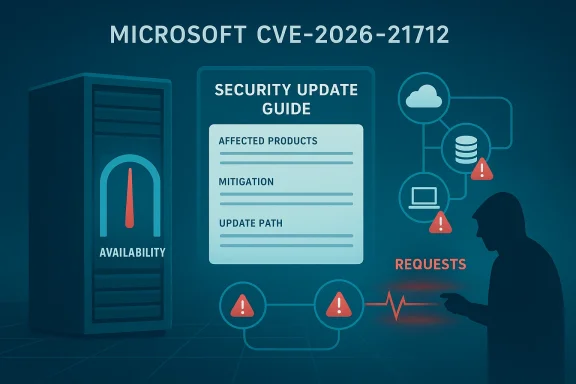
Microsoft has assigned CVE-2026-21712 a denial-of-service classification that is focused on availability loss, not code execution or data theft. The wording matters: Microsoft describes a condition where an attacker can either fully deny access to the impacted component or cause repeated partial disruptions that, over time, produce a serious availability impact. In practical terms, that places this issue in the class of vulnerabilities that administrators cannot afford to dismiss as “just a nuisance,” because sustained service interruption can be as operationally damaging as a breach.What we know from Microsoft’s current update guidance ecosystem is also instructive. Microsoft has increasingly used the Security Update Guide to provide CVE-level detail, CVSS-style language, and deployment context for administrators who need to decide quickly what to patch first. The company has explicitly said the guide is intended to be a more actionable, modern replacement for older bulletin-style disclosures, with clearer vulnerability descriptions and more useful deployment data. That means the presence of a CVE in the guide is itself a signal that Microsoft expects customers to use it as a primary operational planning tool.
At the same time, the public record currently available in Microsoft’s documentation search results does not yet surface a full, product-specific writeup for CVE-2026-21712 itself. That makes it premature to assign affected products, exploitability, or patch urgency beyond the category-level impact language. For the moment, the safest interpretation is that this is an availability-centered issue that should be tracked through the Security Update Guide, where Microsoft usually expands the entry as telemetry, fixes, and deployment guidance become available.
Background
Denial-of-service vulnerabilities sit in a different risk bucket from remote code execution because they attack the reliability of a system rather than its confidentiality or integrity. Yet in enterprise environments, prolonged unavailability can still trigger downstream consequences: failed transactions, broken customer workflows, missed service-level objectives, and cascading operational incidents. Microsoft’s own guidance on past availability bugs has repeatedly emphasized that attackers do not need to steal data to create meaningful business harm.Microsoft has spent the last several years making its vulnerability disclosures easier to consume, especially through the Security Update Guide and related MSRC blog posts. In 2020, Microsoft explained that the guide would expose more structured vulnerability descriptions and allow customers to sort, filter, and prioritize issues more intelligently. In 2024, Microsoft added a dedicated Security Advisory tab for disclosures that do not fit the CVE mold, reinforcing that the company wants one public home for security-event intelligence.
That evolution matters because a CVE like CVE-2026-21712 is not just a security label; it is an operational artifact. Administrators use the guide to decide whether a flaw is a same-day patch, a routine maintenance item, or something that warrants compensating controls while a fix is staged. Microsoft has also pushed machine-readable formats such as CSAF to help security teams automate response, suggesting that the company expects defenders to consume vulnerability data at scale, not manually one page at a time.
Availability issues have a long history of being underestimated. The 2023 HTTP/2 rapid reset episode is a useful comparison: Microsoft described how a protocol flaw could generate severe request pressure, exhaust resources, and disrupt services without necessarily compromising data. That kind of incident is a reminder that “only” a denial-of-service issue can still be a serious production event, especially when it targets exposed infrastructure or high-value services.
What is missing today is the fine print for this specific CVE. Until Microsoft publishes the affected-product matrix, the exploit conditions, and the update path, the responsible stance is to treat the issue as a potentially significant availability risk but avoid speculation about where it lands in the Windows stack. That caution is especially important because Microsoft’s own scoring language distinguishes between sustained denial, persistent denial, and repeated partial denial that becomes operationally severe.
What the CVE Language Really Means
The wording Microsoft uses for CVE-2026-21712 maps to a meaningful severity pattern: the vulnerability does not merely slow a service; it can make resources unreachable or keep them that way. That distinction is central because it separates a transient performance problem from a condition that can disrupt production traffic, user sessions, or administrative access in a sustained way. When availability is the target, the damage often appears first in uptime metrics and only later in incident reports.Availability as a Primary Security Objective
In many environments, availability is the most visible pillar of security because users notice it immediately. If authentication fails, APIs stop responding, or a critical component becomes unreachable, the business impact can be immediate even if no data is stolen or altered. Microsoft’s description of this CVE suggests exactly that kind of risk profile.A denial-of-service bug is especially concerning when it strikes a shared component. A single failure point can affect multiple applications, tenant workloads, or internal systems, multiplying the blast radius. That is why defenders should think not only about the vulnerable component itself, but also about what other workloads depend on it.
- Availability failures can be just as costly as compromise.
- Shared services amplify the blast radius.
- Persistent disruption often outlasts the attack window.
- Partial denial can still be operationally critical.
- High-traffic systems are especially sensitive to resource exhaustion.
Why the CVSS Framing Matters
Microsoft’s modern vulnerability writeups often align textual descriptions with CVSS elements such as attack vector, privileges required, and user interaction. That matters because a denial-of-service issue can look low-complexity on paper while still being hard to mitigate in real-world deployments. The score helps frame risk, but the service topology determines actual pain.For administrators, the practical question is not just whether the issue is exploitable, but what it takes to trigger the failure and how durable the failure is after the attack stops. If a component remains degraded or needs a restart to recover, the operational burden rises sharply. That is why Microsoft’s wording around sustained and persistent denial is more than legal prose; it is a hint about remediation complexity.
- CVSS context helps compare severity across issues.
- Recovery behavior can matter as much as initial exploitability.
- Operational downtime may persist after the attack ends.
- Automation can help, but only if the guidance is timely.
- Topology awareness is essential for real-world prioritization.
Microsoft’s Disclosure Model
Microsoft’s current disclosure style is built around the idea that the CVE page should be the place where defenders get both the narrative and the machine-readable facts. The company has said the Security Update Guide now includes better filtering, multiple data views, and deeper deployment information, so teams can translate security events into patch plans. That framing is relevant here because CVE-2026-21712 will likely be most useful to customers once it is fully populated in that system.Security Update Guide as the Operational Source of Truth
The MSRC blog has repeatedly positioned the Security Update Guide as a “one-stop” source for Microsoft vulnerability information. Over time, Microsoft has added support for CVEs assigned by industry partners, more transparent cloud-service disclosures, and now machine-readable CSAF output. The direction of travel is clear: fewer fragmented advisories, more centralized security intelligence.For defenders, that matters because it shortens the path from disclosure to action. Instead of waiting for a separate bulletin narrative, teams can check the guide for affected products, fixed builds, and update packages. In theory, that should reduce confusion during urgent patch cycles.
Microsoft’s transparency push also tells us something about expectation management. The company is increasingly willing to publish security information even when the customer action is indirect, such as a cloud-side fix or a mitigation baked into a service update. In that sense, a CVE entry is not just a warning; it is a coordination mechanism across products, services, and support channels.
The Limits of Early Visibility
The downside of the model is that not every CVE page is equally informative at first publication. Some entries begin with only a classification and later acquire affected products, exploit notes, or update links as the release process advances. That appears to be the case here, where the public search surface shows the CVE title and impact language but not yet a full remediation narrative.That delay does not mean the issue is unimportant; it means the public-facing record is still maturing. Administrators should avoid overinterpreting the absence of detail as a sign of low severity. Sometimes the most dangerous problems are the ones whose specifics arrive late, after defenders have already started planning around them.
- Centralized guidance reduces confusion.
- Machine-readable data improves automation.
- Early CVE pages may be incomplete.
- Delayed detail does not imply low risk.
- Operational teams still need to monitor for updates.
Availability Risks in Practice
A denial-of-service CVE can be deceptively simple to describe and surprisingly expensive to manage. If an attacker can repeatedly trigger resource exhaustion, keep a service from accepting new work, or force a reset cycle, the business cost can quickly exceed the visible technical damage. Microsoft’s own past guidance on DDoS and availability incidents shows that the real-world burden often falls on incident response, scaling, and service hardening.Sustained versus Persistent Failure
The wording Microsoft uses for CVE-2026-21712 is notable because it includes both sustained and persistent unavailability. Sustained means the attack must continue to keep the service down, while persistent means the condition lingers even after the attacker stops. Persistent failures are particularly troublesome because they force defenders into recovery operations rather than simple traffic filtering.That distinction matters in enterprise operations. A sustained failure can sometimes be absorbed with rate limiting, traffic shaping, or upstream filtering. A persistent failure may require patching, restart, failover, or reconfiguration before normal service can resume. That is a very different incident class from mere packet loss or transient latency spikes.
Partial Denial Can Still Be Severe
Microsoft’s description also includes a more nuanced possibility: the attacker may not be able to interrupt existing connections, but may block new ones or trigger repeated small leaks that eventually starve the service. That is a classic example of why security teams should not equate “limited” impact with “low” business risk. A narrow technical failure can still destroy customer trust if it breaks logins, checkouts, or internal workflows.This is especially true for shared infrastructure. A partial denial on a domain controller, update service, reverse proxy, or authentication tier can cascade far beyond the vulnerable process itself. When one component becomes unreliable, dependent services often begin to fail in ways that are harder to diagnose than the original issue.
- Persistent outages complicate recovery.
- Selective blocking can still halt business operations.
- Shared infrastructure magnifies impact.
- Incident response may be longer than the attack.
- Customer-facing systems feel the damage first.
Enterprise Priorities
Enterprises should treat a CVE like this as a service-management problem as much as a security problem. The first question is not simply “Is there a patch?” but “Which business functions depend on the affected component, and what happens if it stops responding?” Microsoft’s current guidance ecosystem is designed for exactly this kind of prioritization, giving admins a way to map vulnerabilities to deployment decisions.Patch Planning and Change Control
Because Microsoft has not yet surfaced a complete public remediation table for CVE-2026-21712 in the search results available here, defenders should keep one eye on the Security Update Guide and another on internal dependency maps. The right patch sequence may depend on whether the affected component is internet-facing, business-critical, or embedded inside a larger platform. That kind of context often determines whether emergency change control is warranted.Change windows matter because availability fixes sometimes require service restarts or coordinated failovers. Enterprises should be prepared to validate the patch in a test ring, confirm rollback options, and verify that monitoring catches both symptom recovery and post-patch regressions. A denial-of-service fix that destabilizes the service is not a win.
- Inventory dependencies before rollout.
- Test in rings if the component is business-critical.
- Check restart requirements carefully.
- Plan rollback before making changes.
- Monitor service health after deployment.
Compensating Controls
When the patch details are not yet complete, compensating controls become essential. Network segmentation, rate limiting, authentication hardening, and upstream filtering can reduce exposure while teams wait for full remediation details. Microsoft’s earlier guidance on service availability threats has repeatedly pointed toward layered defenses rather than relying on a single fix.In mature environments, the best response is often to combine detection and resilience. That means watching for anomalous connection patterns, unusual resource exhaustion, and repeated crashes or resets, while also ensuring failover paths are actually tested. Redundancy that has never been exercised is often only theoretical resilience.
- Segment exposed services from internal ones.
- Rate-limit abusive request patterns where possible.
- Harden adjacent components and edges.
- Instrument for crash or exhaustion patterns.
- Test failover before it is needed in anger.
Consumer Impact
For consumer users, the direct implications are simpler but still important: if Microsoft ships a patch, installing it promptly is the easiest way to reduce exposure. In Microsoft’s update model, most consumers are protected automatically, but the company’s guidance has long stressed that users should still verify updates are installed. That advice applies here as well, especially for devices that depend on always-on services.Why Home Users Should Still Care
Even if the attack surface turns out to be server-side or enterprise-focused, consumers can still feel the effects indirectly. Outages in identity services, synchronization components, or cloud-connected features can break the everyday tools people rely on without their noticing the underlying security problem. Availability bugs are often invisible until the moment they matter most.The practical consumer takeaway is straightforward: keep Windows Update enabled, let security fixes install automatically, and restart promptly if asked. That is not glamorous advice, but it remains one of the highest-value habits in the Windows ecosystem. Low-friction patching is still the best defense for most home users.
- Automatic updates remain the easiest protection.
- Reboots matter when fixes require them.
- Cloud dependencies can affect home workflows.
- Prompt installation reduces risk quickly.
- Routine maintenance prevents patch drift.
When the User Never Sees the CVE
One subtle problem with availability CVEs is that consumers may never see the name of the flaw at all. The issue may simply appear as a service outage, a stalled app, or a failed sign-in loop. That can make it harder to connect the experience to security hygiene, even when the root cause is a patchable vulnerability.That is why Microsoft’s publication model matters beyond enterprise IT. Public CVE entries create a traceable record of what happened, what was fixed, and how customers should protect themselves. The more complete the disclosure, the easier it is for people to understand that patching is part of service reliability, not just malware defense.
- Outages can look non-security-related at first.
- Patch transparency helps users understand impact.
- Update hygiene benefits both reliability and security.
- Cloud-linked features may fail silently.
- Security and uptime are increasingly intertwined.
Competitive and Market Implications
Microsoft’s handling of availability vulnerabilities also has broader competitive significance. In a market where enterprises compare operating systems, cloud services, and endpoint platforms, security disclosures are part of the trust story. Transparent, timely guidance can reinforce confidence, while unclear remediation paths can create anxiety even when the underlying bug is narrow.Trust as a Product Feature
Vulnerability communication is now a product differentiator. Microsoft has repeatedly expanded the Security Update Guide, added advisory content, and improved machine-readable data because customers expect security operations to be first-class. The more organized the disclosure process, the easier it is for enterprises to absorb risk without turning every CVE into a crisis.That is especially important when competitors can market simplicity or lower administrative burden. If Microsoft’s update guidance is perceived as clear and actionable, it strengthens the case for large organizations that need predictable patch operations. If it is perceived as fragmented, administrators may hesitate or overcompensate with stricter controls. Either way, disclosure quality has strategic value.
The Cloud and Hybrid Angle
Availability CVEs are not confined to on-premises Windows deployments anymore. Microsoft’s recent transparency work on cloud-service CVEs shows that the company increasingly treats service resilience as part of the disclosure story, even when customers do not patch the service themselves. That matters in hybrid environments where a vulnerability in one layer can affect a managed service, a local workload, or both.For rivals, the lesson is clear: customers now expect operational clarity, not just technical remediation. The best security programs pair patch notes with dependency maps, mitigation guidance, and rapid updates when new information arrives. Microsoft has been moving in that direction, and CVE-2026-21712 will be judged in that same context.
- Clear advisories improve trust.
- Hybrid systems demand broader thinking.
- Service resilience is now a market expectation.
- Patch operations affect platform reputation.
- Operational clarity is part of competitive positioning.
How Administrators Should Read the Signal
The key mistake would be to treat CVE-2026-21712 as a low-priority curiosity because it is “only” denial of service. Microsoft’s own wording makes clear that availability loss can be total, persistent, or severe enough to matter even when it is not total. In enterprise environments, that often means the right response is disciplined triage, not dismissal.A Practical Response Framework
Administrators can use a simple sequence to get ahead of a CVE like this. First, identify whether the affected component is present in production or exposed to untrusted traffic. Second, determine whether Microsoft has published a fix, workaround, or mitigation in the Security Update Guide. Third, assess whether the service can tolerate a controlled restart or needs a staged rollout.- Confirm whether the vulnerable component is deployed.
- Check Microsoft’s update guidance for product scope.
- Determine whether the issue is internet-facing or internal-only.
- Evaluate compensating controls if patching is delayed.
- Schedule remediation in the next safe maintenance window.
- Re-test service health after the update is applied.
What to Watch in the MSRC Entry
When Microsoft fills out the CVE page, the most important fields will be the affected products, exploitability details, and update links. Administrators should also look for any language about restart requirements, workarounds, or whether the condition is remote, local, or service-specific. Those details will decide whether the issue is a nuisance patch or a same-day operational event.- Affected products define the blast radius.
- Exploit path determines urgency.
- Workarounds can buy time.
- Restart requirements affect downtime planning.
- Update links turn intelligence into action.
Strengths and Opportunities
Microsoft’s disclosure model has real strengths here, and they matter because availability bugs are easiest to handle when the guidance is crisp and centralized. The company’s ongoing investment in the Security Update Guide, advisory tabs, and machine-readable output gives defenders a better chance of turning raw CVE data into operational action.- Centralized guidance makes it easier to triage quickly.
- CVSS-style descriptions help teams compare risk.
- Machine-readable formats support automation.
- Transparency around availability issues improves planning.
- Advisory integration reduces fragmentation.
- Patch and mitigation data can shorten response time.
Risks and Concerns
The biggest concern with a CVE like this is not just the bug itself, but the possibility that administrators will underestimate it because it lacks the drama of code execution. Availability loss can trigger business outages, support escalations, and downstream failures across dependent systems. If the impacted component is shared, the operational cost can be substantial.- Underestimation risk is high for DoS flaws.
- Shared dependencies can magnify impact.
- Persistent failures may outlast the attack.
- Incomplete early guidance can slow response.
- Patch timing may conflict with uptime goals.
- Compensating controls may not fully cover the gap.
Looking Ahead
The next meaningful milestone is not simply the appearance of a CVE number, but the arrival of a complete MSRC entry with product scope and remediation guidance. Once that lands, the conversation shifts from abstract availability risk to concrete patch planning, change windows, and compensating controls. That is when enterprise defenders can decide whether to accelerate deployment or maintain temporary mitigations.Microsoft’s broader security direction suggests that future disclosures will continue to combine human-readable context with automation-friendly data. That is a good development for customers, because it reduces the gap between “we know about the flaw” and “we have actually remediated it.” For availability flaws especially, that gap is where the pain lives.
- Watch for the full MSRC entry to clarify scope.
- Track whether a patch or mitigation appears first.
- Monitor for revised impact language if Microsoft updates the page.
- Check whether a restart is required for recovery.
- Assess whether the issue affects edge, server, or cloud components.
Source: MSRC Security Update Guide - Microsoft Security Response Center
Last edited:
