

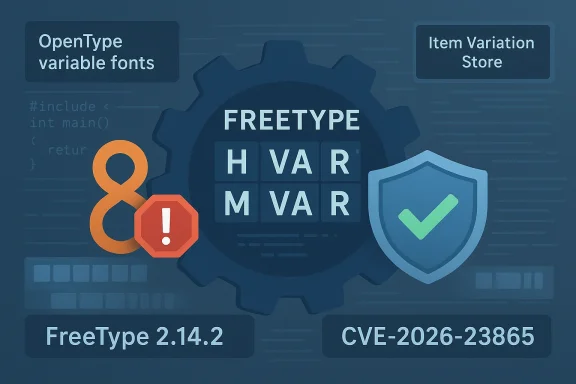
An integer overflow discovered in FreeType’s variable-font parsing code has been assigned CVE-2026-23865 and fixed in upstream FreeType 2.14.2; administrators, packagers, and application maintainers should treat this as a prompt to verify and, where necessary, deploy updated packages immediately to avoid out‑of‑bounds reads when parsing HVAR, VVAR, or MVAR tables in OpenType variable fonts.
FreeType is the de facto open-source font rasterization engine used across desktop Linux distributions, many embedded platforms and device stacks, and inside numerous graphics and browser engines. It provides the low-level machinery for reading OpenType/TrueType font files and turning glyph outlines and metrics into pixels. Because font parsing runs inside text rendering and document/file-handling code paths, bugs in font libraries can be triggered by relatively small, user-supplied inputs such as a malicious font embedded inside a document, a web page, or an application package.
On March 1, 2026, the FreeType project released version 2.14.2, a maintenance release that upstream says “addresses a bunch of potential security problems” and specifically includes a fix for an integer‑overflow issue in the TrueType variable-font handling code. The problem was fixed upstream with a targeted code change in the function named tt_var_load_item_variation_store, and a CVE entry (CVE‑2026‑23865) was published shortly after the fix. The upstream commit implementing the check against array-size overflow and the release announcement make the timeline and technical fix clear: the project added explicit overflow detection before allocating and reading arrays used to hold item-variation delta sets for HVAR/VVAR/MVAR tables.
This is a classic defensive check against unsigned multiplication wrap-around and is the typical remediation for arithmetic overflow-to-read issues.
The main operational challenge is not the absence of a fix but the ecosystem inertia: FreeType is embedded in many libraries, distributions, and products. Ensuring the fix reaches every production runtime — whether a system-wide library, a bundled copy inside an application, or an embedded device image — is the job of downstream maintainers and administrators.
Patch quickly, verify deployment, and monitor for font-processing anomalies. Even though the issue is an out‑of‑bounds read rather than an immediate remote code execution primitive, the ubiquity of font parsing and the historical track record of font library vulnerabilities make immediate remediation the prudent course of action.
Source: MSRC Security Update Guide - Microsoft Security Response Center
 Background
FreeType is the de facto open-source font rasterization engine used across desktop Linux distributions, many embedded platforms and device stacks, and inside numerous graphics and browser engines. It provides the low-level machinery for reading OpenType/TrueType font files and turning glyph outlines and metrics into pixels. Because font parsing runs inside text rendering and document/file-handling code paths, bugs in font libraries can be triggered by relatively small, user-supplied inputs such as a malicious font embedded inside a document, a web page, or an application package.On March 1, 2026, the FreeType project released version 2.14.2, a maintenance release that upstream says “addresses a bunch of potential security problems” and specifically includes a fix for an integer‑overflow issue in the TrueType variable-font handling code. The problem was fixed upstream with a targeted code change in the function named tt_var_load_item_variation_store, and a CVE entry (CVE‑2026‑23865) was published shortly after the fix. The upstream commit implementing the check against array-size overflow and the release announcement make the timeline and technical fix clear: the project added explicit overflow detection before allocating and reading arrays used to hold item-variation delta sets for HVAR/VVAR/MVAR tables.
Overview of the vulnerability and technical details
What is affected
- The vulnerability is an integer overflow in FreeType’s TrueType GX/variation handling codepath, specifically in the function tt_var_load_item_variation_store.
- The problem arises when parsing the Item Variation Store format used by OpenType variation tables — primarily HVAR, VVAR, and MVAR — which store per-item metric deltas for variable fonts.
- Upstream reported the issue as affecting FreeType versions in the 2.13.x and some 2.14.x lines prior to 2.14.2; the fix was included in FreeType 2.14.2.
How the bug works, in plain terms
- The Item Variation Store format holds arrays whose sizes are computed from values in the font file. If an attacker crafts a font with deliberately oversized or malformed counts or offsets, the code can compute a required array size by multiplying two unsigned integers.
- Without proper overflow checks, that multiplication can wrap (an integer overflow), producing a much smaller value than intended. The code then allocates a buffer sized by the wrapped result and proceeds to read data equal to the true (unwrapped) size from the font into that buffer.
- The mismatch between the allocated buffer size and the amount read leads to an out‑of‑bounds read of memory adjacent to the buffer. That can crash the process, and under certain conditions it can also lead to disclosure of memory contents — both outcomes are security-relevant.
Concrete code fix
Upstream inserted an explicit check before allocation: it computes the product and then verifies that dividing the computed product by one multiplicand yields back the other multiplicand. If the check fails, the function aborts and declares the array size invalid, preventing the allocation + read that previously allowed the overflow-derived condition to manifest.This is a classic defensive check against unsigned multiplication wrap-around and is the typical remediation for arithmetic overflow-to-read issues.
Why this matters: impact and risk model
Widespread deployment footprint
FreeType is embedded or used by many platform components and libraries — in Linux distributions’ font stacks, within graphics layers used by web browsers and graphical toolkits, in embedded platforms and some mobile stacks, and in toolchains used to render documents and images. Because text rendering is ubiquitous, a library bug in font parsing has the potential to affect many different applications — from web browsers and PDF viewers to desktop environments and document editors.Realistic attack vectors
- An attacker can package a malicious font into any content that an application will parse with FreeType. Typical vectors include:
- A web page that loads a user-supplied or remote variable font (web fonts).
- A document or archive that contains embedded variable fonts.
- A font file installed into a system or user font directory which gets processed by font indexing and preview utilities.
- The vulnerability itself is an out‑of‑bounds read, not an out‑of‑bounds write. That generally reduces the likelihood of getting arbitrary code execution directly from this specific flaw, but it still allows process crashes (DoS) and, depending on the host application’s memory layout and use of the revealed data, possible information disclosure.
- Historically, FreeType issues in the variable-font and CFF/TrueType parsers have occasionally been chained into much more serious outcomes by attackers who combine multiple flaws or who exploit downstream application behaviors; therefore a conservative risk posture is warranted.
Severity and exploitability assessment
- The vulnerability has been cataloged as a medium severity issue in multiple public trackers, with a CVSSv3 score in that neighborhood. The specific scoring reflects local attack vector characteristics and the requirement for user interaction in many realistic scenarios.
- Exploitation that results in a remotely triggered information disclosure or crash is straightforward if an application parses attacker-controlled fonts in a context that users will interact with (e.g., opening a document, visiting a page).
- Proof-of-concept exploits or wide-scale exploitation have not been publicly reported at the time of disclosure; nevertheless, the combination of broad attack surface and the relative simplicity of triggering font parsing makes rapid patching prudent.
Timeline and responsible disclosure notes
- The upstream code fix was committed prior to the 2.14.2 release; the specific commit added an overflow check to tt_var_load_item_variation_store and credits the reporter who analyzed the issue.
- FreeType 2.14.2 was released on March 1, 2026, and the project explicitly recommended that “all users should update” because several security issues were addressed in the release.
- A CVE entry (CVE‑2026‑23865) was published shortly afterward to catalog the specific integer overflow / out‑of‑bounds read in the item-variation parsing code.
Who should care most — prioritized stakeholders
- System administrators and distribution maintainers who ship or package the freetype library.
- Developers and maintainers of applications that embed or bundle their own copies of FreeType (document readers, image processors, game engines, graphics toolkits, and some browser engines).
- Security teams responsible for endpoint protection where users might open untrusted documents or visit web pages that can reference arbitrary fonts.
- Embedded device manufacturers or appliance vendors that include FreeType as part of their firmware or OS image.
Recommended actions: patch, verify, and mitigate
Below are practical steps for operators and developers. Follow them in order and record verification in change management systems.- Inventory and identify
- Determine which hosts and images include the FreeType library — both system packages and any where applications bundle FreeType.
- Check installed versions: on Debian/Ubuntu use package tooling to inspect libfreetype6 and libfreetype-dev versions; on RPM-based systems use rpm/dnf; for bundled builds check vendored third‑party directories or static libraries.
- Upgrade to FreeType 2.14.2 (or the vendor-packaged equivalent)
- For systems that consume distribution packages, apply distribution security updates as soon as the vendor provides a package based on upstream 2.14.2 or a vendor backport that includes the fix.
- For applications that embed FreeType, rebuild and redistribute updated binaries that link against the patched library or include the patched source.
- Verify the patch
- After upgrading, confirm the new version is in use by the application in question. Where libraries are dynamically linked, ldd (or platform equivalent) can confirm the runtime library; for embedded/bundled code, inspect the shipped binary or the application’s version information.
- Monitor application logs and crash reports for anomalous font parsing crashes that were previously observed; user‑reported crashes that disappear after patching are a practical verification.
- Temporary mitigations (if you cannot update immediately)
- Block or scan font files obtained from untrusted sources before rendering; treat fonts embedded in documents or archives from unknown authors as potentially risky.
- Disable features that allow remote loading of arbitrary web fonts in enterprise‑managed browsers or restrict web fonts via policy where feasible.
- Run font-parsing and document-processing applications in strong sandboxes, with least-privilege file access and memory protections active, to limit blast radius if a vulnerability is triggered.
- Hunting and detection
- Look for clusters of crashes or process terminations in applications that use FreeType after receiving user-supplied fonts.
- Consider instrumenting or temporarily increasing logging around font-loading subsystems and font cache population in servers that pre-render documents (e.g., web-to-PDF services).
Packaging and distro status — what to expect
- Upstream released 2.14.2 with the fix. Distribution maintainers typically follow one of two paths: (a) bump the package to the new upstream version, or (b) backport the specific security fix into the distribution’s current package version and ship it as an update. Both approaches are acceptable if the patch is applied and tested.
- At the time of disclosure, major distribution trackers and security advisories were already cataloging the CVE and listing vendor actions; system operators should consult their distribution’s security tracking and apply vendor-provided updates rather than upgrading the library manually in production without QA.
Detection and forensic guidance
- Crash signatures: an out-of-bounds read triggered during parsing commonly results in a segmentation fault or abort in the rendering process. Look for reproducible crashes when handling variable fonts or font files with HVAR/VVAR/MVAR tables.
- Memory disclosure: if an attacker crafts a font to cause OOB reads, the host application may include leaked bytes in a response (for example, if the application serializes debug or error buffers). Hunting for anomalous or unexpected binary blobs in logs or user-visible outputs following font processing can be worthwhile.
- Application telemetry: enable or increase logging for PDF/web rendering services and document import pipelines. Where possible, capture the offending font file for analysis — treating it as potentially malicious.
- Sandbox telemetry: if applications are run inside sandboxes or containers, check container exit codes and audit events rather than relying solely on in-app error logs.
Developer considerations: hardening and long-term risk reduction
- Defensive parsing: this vulnerability is a textbook reminder that parsers should be defensive about arithmetic on untrusted input. Always check multiplication for overflow, verify offsets against section sizes, and prefer bounded-copy helpers that fail safely on size mismatches.
- Memory safety: where feasible, prefer memory-safe tooling and wrappers around legacy C parsers (for example, run untrusted parsing code in confined helper processes or leverage languages with stronger memory-safety guarantees for front-line parsing).
- Fuzzing and automated testing: variable-font formats have complicated binary encodings. Projects that expose font-parsing code should maintain continuous fuzzing campaigns and regression tests for corner cases like array-size calculations and nested offsets.
- Supply-chain hygiene: because FreeType is often consumed transitively (as a system library used by toolkits or bundled into other projects), maintainers should provide clear, short-lived upgrade paths and timely advisories so that downstream packagers can act quickly when security fixes land.
Why this specific fix is reassuring — and where to be cautious
Positive points:- The upstream change is tightly scoped and implements a canonical fix: explicit overflow checks prior to allocation and reading. That reduces the chance that the fix introduces regressions or masking problems.
- FreeType shipped a new, clearly labeled maintenance release and explicitly recommended updates for all users, which is the correct operational behavior after security fixes.
- The fix was applied in the code path that is the root cause (the multiplication/allocation path), so the remediation addresses the underlying arithmetic wrap, not just the symptom.
- Because FreeType appears inside many stacks, the mere presence of an upstream fix does not guarantee that individual systems are safe — downstream packaging and application bundling can leave older, vulnerable copies in place.
- Some downstream environments may delay applying the upstream version because past releases have occasionally introduced rendering regressions; this makes timely patch management more difficult and raises the need for targeted backporting.
- An out‑of‑bounds read is not as immediately dangerous as a write in terms of remote code execution, but information disclosure or process stability (crash/DoS) remains impactful in many contexts, and memory disclosure is often the first step in more complex exploit chains.
Practical checklist for IT teams (quick reference)
- Prioritize updating systems where FreeType is used to render user-supplied fonts (desktop clients, file‑import servers, web rendering, document processing).
- For bundled applications, contact the vendor or rebuild with upstream FreeType 2.14.2.
- If you must delay updates:
- Block untrusted font installations and web fonts where possible.
- Run susceptible applications in hardened sandboxes and reduce privileges.
- Monitor crash logs and user reports for font-related failures.
- For security teams: add detection for increased font-related crashes and collect any suspect font files for analysis.
- For packagers and maintainers: either ship the upstream 2.14.2 tarball or backport the precise overflow‑check commit into the shipped package and clearly mark the update as a security fix for CVE‑2026‑23865.
Final analysis and takeaways
CVE‑2026‑23865 is a medium‑severity, well-documented integer overflow that leads to out‑of‑bounds reads when FreeType parses the Item Variation Store used by HVAR/VVAR/MVAR tables in OpenType variable fonts. Upstream responded with a targeted and minimal fix and shipped it as part of FreeType 2.14.2. The technical fix is straightforward and correct in approach — check for multiplication wrap before allocating and reading memory — and upstream’s public release and advisories are appropriately clear.The main operational challenge is not the absence of a fix but the ecosystem inertia: FreeType is embedded in many libraries, distributions, and products. Ensuring the fix reaches every production runtime — whether a system-wide library, a bundled copy inside an application, or an embedded device image — is the job of downstream maintainers and administrators.
Patch quickly, verify deployment, and monitor for font-processing anomalies. Even though the issue is an out‑of‑bounds read rather than an immediate remote code execution primitive, the ubiquity of font parsing and the historical track record of font library vulnerabilities make immediate remediation the prudent course of action.
Source: MSRC Security Update Guide - Microsoft Security Response Center
