
Microsoft’s security catalog has recorded CVE-2026-24282 as an out‑of‑bounds read in the Push Message Routing Service that can be abused by an authorized local user to disclose information from process memory, and Microsoft has released updates to address the defect; security teams should treat this as a medium‑severity information‑disclosure bug that is easy to mischaracterize but potentially dangerous when chained with other local flaws.
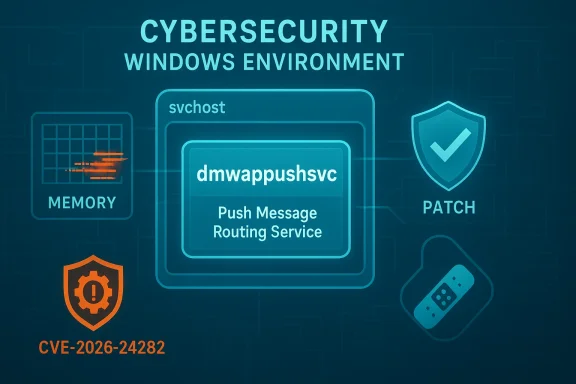
The affected component — commonly seen in Windows as the Device Management Wireless Application Protocol (WAP) Push Message Routing Service (dmwappushsvc) — acts as an on‑device router and queue for WAP and management messages used by device management stacks such as Intune and other MDM systems. Microsoft’s documentation identifies the service as responsible for receiving, categorizing and handing off management messages to internal OS components; it runs as a LocalSystem‑level service and is therefore an attractive target for local abuse.
CVE‑2026‑24282 was published alongside Microsoft’s March 2026 security updates and is described in vendor trackers as an out‑of‑bounds read that permits a locally authorized attacker to read data beyond a bounds check and thus disclose sensitive memory contents. Public vulnerability aggregators and Patch Tuesday community trackers list the bug as an information disclosure with a CVSS v3.1 score in the mid‑range (reported as 5.5) and note that patches are available for affected Windows builds.
This advisory sits in a broader context: Windows’ push/notification and device‑management stacks have produced several privilege‑escalation and information‑disclosure advisories over the past two years. That history informs the operational risk: even when a single bug is “only” an info‑s tokens, session keys, or other secrets that turn a low‑privilege local foothold into lateral access or full compromise.
Because the service is often present and enabled on devices managed via Intune or similar systems, it exists on a broad base of enterprise endpoints. Disabling it is not generally recommended because it breaks device management and synchronization; Microsoft documentation explicitly warns against disabling this service as a mitigation for unrelated issues. That means administrators must rely on vendor fixes and layered defenses rather than service removal.
CVE‑2026‑24282 is not a showstopper on its own — it’s an information‑disclosure bug — but it is one of those deceptively small defects that can materially lower the cost and time of more damaging intrusions when attackers already have a foothold. The right response is straightforward and non‑glamorous: inventory, patch, monitor, and be prepared to rotate secrets if you detect suspicious activity. That combination is what defeats chained attacks that start from “just a leak.”
Source: MSRC Security Update Guide - Microsoft Security Response Center
 Background / Overview
The affected component — commonly seen in Windows as the Device Management Wireless Application Protocol (WAP) Push Message Routing Service (dmwappushsvc) — acts as an on‑device router and queue for WAP and management messages used by device management stacks such as Intune and other MDM systems. Microsoft’s documentation identifies the service as responsible for receiving, categorizing and handing off management messages to internal OS components; it runs as a LocalSystem‑level service and is therefore an attractive target for local abuse.CVE‑2026‑24282 was published alongside Microsoft’s March 2026 security updates and is described in vendor trackers as an out‑of‑bounds read that permits a locally authorized attacker to read data beyond a bounds check and thus disclose sensitive memory contents. Public vulnerability aggregators and Patch Tuesday community trackers list the bug as an information disclosure with a CVSS v3.1 score in the mid‑range (reported as 5.5) and note that patches are available for affected Windows builds.
This advisory sits in a broader context: Windows’ push/notification and device‑management stacks have produced several privilege‑escalation and information‑disclosure advisories over the past two years. That history informs the operational risk: even when a single bug is “only” an info‑s tokens, session keys, or other secrets that turn a low‑privilege local foothold into lateral access or full compromise.
What exactly is CVE‑2026‑24282?
The short technical summary
- Nature of the bug: Out‑of‑bounds read in the Push Message Routing Service.
- Primary impact: Information disclosure — a local attacker can read memory they shouldn’t be able to.
- Exploitation scope: Local (requires an authorized local user account), not a remote unauthenticated network vector.
- Severity (public tracker): CVSS v3.1 = 5.5 (Medium).
- Vendor action: Patches released in the March 2026 update cycle for supported Windows builds.
Why an out‑of‑bounds read matters
An out‑of‑bounds (OOB) read is a classical memory‑safety error where code reads data outside the range of an allocated buffer. OOB writes can often be exploited for code execution; OOB reads are usually information‑disclosure bugs — but information is valuable. Repeated, controlled reads can recover secrets such as authentication tokens, encryption keys, or session cookies that live in process heaps or stacks. In device‑management contexts, leaking an MDM token, certificate material, or ephemeral credentials can let an attacker move laterally or masquerade as a managed agent. Public triage for this CVE explicitly warns that repeated requests could expose session tokens or keys in memory, turning the disclosure into an enabler for more serious attacks.Push Message Routing Service: attack surface and risks
How dmwappushsvc fits into Windows
dmwappushsvc (also called WAP Push Message Routing Service or Device Management WAP Push Message Routing Service) is used by the OS to process inbound push messages and to orchestrate management syncs with MDM servers. It typically runs as LocalSystem in a shared svchost instance and interacts with networking, parsing, and authentication subsystems. That placement makes it powerful: it touches networking input, message parsing routines, and platform authentication tokens — precisely the elements an attacker would want to read from memory.Because the service is often present and enabled on devices managed via Intune or similar systems, it exists on a broad base of enterprise endpoints. Disabling it is not generally recommended because it breaks device management and synchronization; Microsoft documentation explicitly warns against disabling this service as a mitigation for unrelated issues. That means administrators must rely on vendor fixes and layered defenses rather than service removal.
Realistic attacker model
- Attacker precondition: Local account on the target host (this can be a low‑privilege standard user or an app sandbox).
- Goal: read memory exposed by the Push Message Routing Service to harvest secrets (tokens, ephemeral keys, cached credentials).
- Path: trigger crafted or malformed requests that cause the vulnerable code path to perform an OOB read, capturing leaked bytes and reconstructing secrets with repeated attempts.
- Why this matters operationally: Many enterprise endpoints have local attack vectors (malicious attachments, compromised browsers, supply‑chain trojans) that provide initial local code execution. An info‑disclosure such as CVE‑2026‑24282 is valuable to an attacker already resident on a host because it widens credential access and persistence options. Observers in community triage already warned that repeated reads could reveal session tokens that facilitate credential theft and lateral movement.
Technical analysis and verification
What the public record confirms
- Microsoft (via its Security Update Guide entry) records the vulnerability as an issue affecting the Push Message Routing Service and has assigned CVE‑2026‑24282. The vendor’s entry is the canonical acknowledgement of the issue even if the short description is compact. (msrc.microsoft.com)
- Independent CVE aggregators and vulnerability feeds list the bug as an out‑of‑bounds read that results in local information disclosure and show a CVSS v3.1 base score of approximately 5.5; those feeds also indicate that updates were published as part of the March 2026 patch cycle. Those third‑party records are consistent and agree on the high‑level impact.
- The Push Message Routing Service (dmwappushsvc) is a privileged OS component used by MDM and device management channels, and Microsoft documentation explains why it should not be indiscriminately disabled. That confirms the operational importance of remediating the vulnerability through patches rather than blunt service removal.
What remains deliberately sparse or unverifiable
- Low‑level exploit details (exact memory offsets, the primitive required to pull contiguous secret bytes reliably, or a public proof‑of‑concept) are not present in vendor advisories or mainstream feeds at the time of this publication. That means defenders must assume plausible exploitation techniques exist even if a PoC has not been published. Public trackers explicitly note no proof‑of‑concept observed and no evidence of active exploitation at the time of disclosure, but that assessment can change quickly. Treat the absence of a PoC as absence of evidence, not evidence of absence.
- Vendor patch diffs and line‑level code changes for the Windows inbox binary handling the OOB read are not published in an easily consumable form; Microsoft’s interactive update guide provides the advisory record and package mapping but intentionally keeps some implementation details private. Where real‑time vulnerability triage is necessary, defenders must rely on vendor KB mappings, official updates, and their own patch testing labs. (msrc.microsoft.com)
Operational impact — who should care most?
- Enterprises using Intune or other MDM tooling: endpoints enrolled in device management are most likely to have dmwappushsvc active and reachable on the host; thus, these fleets should be prioritized for patching.
- Organizations with large numbers of standard‑user workstations where local compromise is a realistic threat: an attacker with low‑privilege local access can use an info‑disclosure to escalate laterally.
- Security teams relying solely on service disabling as a mitigation posture: dmwappushsvc is required for management workflows; disabling it will break Intune/MDM synchronizations and is not recommended as a general mitigation.
Detection, hunting, and mitigations
Immediate recommended actions (priority order)
- Patch now where possible — apply Microsoft’s March 2026 updates that include the fix for CVE‑2026‑24282. Prioritize endpoints enrolled in MDM and those with high‑value local data. Confirm package/K‑B mapping in your patch management console before broad rollout.
- Inventory and prioritize — run an audit to identify hosts where dmwappushsvc is enabled, where MDM agents are active, or where sensitive tokens and certificate stores are present. These hosts should move to the top of the remediation queue.
- Do not casually disable dmwappushsvc — Microsoft and product guidance emphasize that disabling the service disrupts management and sync processes. Use this only as a last resort in tightly controlled scenarios after validation that the management feature set can tolerate it.
- Hunt for anomalous read patterns and token theft — look for repeated or abnormal local calls to the Push Message Routing Service, processes performing repeated memory‑read operations, and EDR alerts associated with suspicious heap reads. Instrument EDR to flag anomalous repeated files/IPC calls directed at the service process. Community triage notes specifically warned that repeated requests could reveal session tokens.
- Credential rotation and token revocation — for high‑value machines or if you detect suspicious activity on a host, rotate any affected session tokens, refresh certificates and revoke compromised credentials. This is especially important where ephemeral tokens are used to authenticate to management endpoints.
Detection playbook (concise steps)
- Query endpoints for the service status and recent local calls: filter telemetry for processes interacting with dmwappushsvc.
- Search EDR logs for repeated process memory‑read patterns and for processes opening handles to the service process or its memory space.
- Monitor for anomalous MDM‑related network flows (unexpected uploads/downloads to Intune/MDM endpoints or abnormally timed syncs).
- If suspicious behavior is found, isolate the host, collect a volatile memory image for forensic analysis, rotate any tokens exposed to the host, and triage with your incident response runbook.
Attack chaining and worst‑case scenarios
An information‑disclosure bug like CVE‑2026‑24282 becomes materially more dangerous when combined with other local vulnerabilities:- A local code‑execution or sandbox‑escape bug gives an attacker the ability to run arbitrary code locally. If that attacker then uses CVE‑2026‑24282 to read a service process’s memory and extract credentials or tokens, they can move laterally or escalate privileges by abusing those secrets.
- Prior advisories in the push/notification domain have shifted from information disclosure to full elevation‑of‑privilege chains; defenders should therefore plan for the possibility that a sophisticated actor could combine this information leak with even a moderate flaw to achieve SYSTEM‑level control. Historical triage and public analysis of Windows push/notification vulnerabilities supports this chain‑reaction concern.
Why the public description may seem short — and how to treat it
Microsoft’s Security Update Guide frequently provides compact descriptions and package mappings; this is deliberate: vendor advisories balance disclosing enough for defenders to act against giving exploitable details that help attackers. That practice creates a common operational tension for defensive teams: you must assume the worst from a compact advisory and patch/monitor accordingly, rather than waiting for full exploit write‑ups. Several security vendors and community triage threads echo that posture and recommend immediate remediation, especially for components handling authentication tokens and device‑management material. (msrc.microsoft.com)Practical checklist for Windows admins
- Identify all endpoints where dmwappushsvc is present and enabled.
- Validate the March 2026 Microsoft updates in a test ring and schedule a staged rollout to production.
- Prioritize machines enrolled in MDM, machines with privileged service accounts, and endpoints with access to sensitive corporate resources.
- Tune EDR to alert on repeated memory reads, unusual svchost behavior, and unexpected inter‑process handles to dmwappushsvc.
- Prepare an incident response path for token/certificate rotation in case of confirmed token leakage.
- Communicate to end users the importance of applying updates; educate help‑desk staff about the dependency between device management and the Push Message Routing Service so they don’t inadvertently disable required services.
Critical appraisal — strengths and gaps in public information
- Strengths: Microsoft has acknowledged the vulnerability in its update guide and shipped fixes in the March 2026 cycle, which is the most important action for defenders. Multiple independent aggregators and community trackers corroborate the high‑level impact (OOB read → info disclosure) and the CVSS rating, which helps triage prioritization. (msrc.microsoft.com)
- Gaps and risks: The vendor’s public advisory is intentionally concise; there is no published proof‑of‑concept or exploit recipe in the public record at the time of writing. That leaves defenders without low‑level IOCs they could use to detect exploitation. Also, because the affected service is an OS inbox component required by Intune/MDM, disabling it is not a safe, broad mitigation; that increases the operational burden on patching and monitoring. (msrc.microsoft.com)
- Attackability caveat: The reported exploitability requires local access — which lowers the bar for attackers once they have an initial foothold. In practice, attackers frequently combine local exploits with info‑disclosure flaws, elevating the real‑world risk beyond the nominal CVSS score. Community assessments have highlighted this same escalation pattern in previous push/notification vulnerabilities.
Final recommendations (clear and actionable)
- Treat CVE‑2026‑24282 as a priority patching item for devices enrolled in MDM and for endpoints where local compromise risk exists. Implement the vendor updates in a staged, tested rollout as soon as organizational change control allows.
- Do not rely on service disablement as a routine mitigation. Disabling dmwappushsvc can break device management and is discouraged without a compensating operational plan. Where disabling is considered, perform a controlled risk assessment and test the management impact.
- Enhance detection: tune EDR and SIEM to flag repeated or abnormal memory‑read patterns, unexpected handles opened into the push service, and unusual MDM sync traffic. Prepare token/certificate rotation runbooks and prioritize hosts that perform management roles.
- Assume chaining: operate under the defensible assumption that an information leak can be combined with other local bugs. Strengthen endpoint hardening, enforce least privilege, and accelerate patching windows for high‑risk groups.
CVE‑2026‑24282 is not a showstopper on its own — it’s an information‑disclosure bug — but it is one of those deceptively small defects that can materially lower the cost and time of more damaging intrusions when attackers already have a foothold. The right response is straightforward and non‑glamorous: inventory, patch, monitor, and be prepared to rotate secrets if you detect suspicious activity. That combination is what defeats chained attacks that start from “just a leak.”
Source: MSRC Security Update Guide - Microsoft Security Response Center
