

Microsoft’s advisory entry for CVE‑2026‑24302 identifies an elevation‑of‑privilege weakness affecting Azure Arc / Azure Connected Machine (azcmagent) components, but public technical details remain intentionally sparse; defenders must therefore treat the advisory as urgent while mapping the CVE to the vendor’s KB/package mapping and verified agent builds before applying remediation at scale. ([msrc.microsoft.csoft.com/update-guide/vulnerability/CVE-2026-24302/))
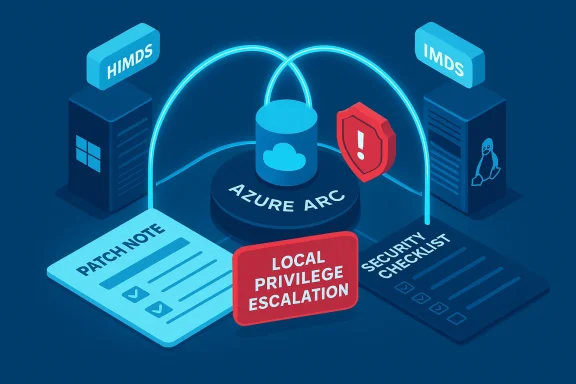
Azure Arc’s Connected Machine agent (commonly referred to as azcmagent) is the local bridge that links on‑premises and hybrid servers to the Azure control plane. The agent provides identity, telemetry, configuration, extension management and a local metadata endpoint (HIMDS) used by other services and workloads. Because the agent and its helper services run with elevated privileges on hosts, a local bug that escalates privileges can be weaponized beyond the host to affect tenant resources—this “cross‑plane amplification” is the central risk with agent EoP (Elevation‑of‑Privilege) issues.
Microsoft’s Security Response Center (MSRC) publishes CVE‑level entries in the Security Update Guide and, for cloud‑adjacent components, often attaches a vulnerability confidence / maturity metric that describes how certain the vendor is about the technical details and exploitability. When that metric indicates partial or tentative details, public advisories may withhold low‑level exploit primitives while still publishing the remediation mapping version). Defenders should treat the MSRC Update Guide as authoritative for the canonical CVE→KB→package mapping. (msrc.microsoft.com)
Caveat: Until MSRC or the vendor publishes a full technical write‑up attributing a precise root cause to CVE‑2026‑24302, specific exploit mechanics remain unverified in public materials and should be treated with caution. Always cross‑check MSRC’s KB→package mapping before assuming a particular root cause.
If you manage Arc fleets: start withof bastions, runners and hosts with machine‑assigned identities; confirm the vendor mapping in MSRC;patch windows; and deploy compensating controls while validating the fixes. The combination of cd rapid, prioritized action is the right balance of urgency and prudence for this class of vulnerability.
Appendix — Quick action checklist for administrators
Source: MSRC Security Update Guide - Microsoft Security Response Center
 Background / Overview
Azure Arc’s Connected Machine agent (commonly referred to as azcmagent) is the local bridge that links on‑premises and hybrid servers to the Azure control plane. The agent provides identity, telemetry, configuration, extension management and a local metadata endpoint (HIMDS) used by other services and workloads. Because the agent and its helper services run with elevated privileges on hosts, a local bug that escalates privileges can be weaponized beyond the host to affect tenant resources—this “cross‑plane amplification” is the central risk with agent EoP (Elevation‑of‑Privilege) issues. Microsoft’s Security Response Center (MSRC) publishes CVE‑level entries in the Security Update Guide and, for cloud‑adjacent components, often attaches a vulnerability confidence / maturity metric that describes how certain the vendor is about the technical details and exploitability. When that metric indicates partial or tentative details, public advisories may withhold low‑level exploit primitives while still publishing the remediation mapping version). Defenders should treat the MSRC Update Guide as authoritative for the canonical CVE→KB→package mapping. (msrc.microsoft.com)
What CVE‑2026‑24302 appears to be (concise summary)
- Affected component: Azure Arc / Azure Connected Machine Agent (azcmagent) and/or Azure Arc installer/extension components on Windows and Linux hosts.
- Vulnerability class: Elevation of Privilege (local) — exploitation typically requires local code execution or the ability to run a non‑privileged process on the host.
- Primary impact: Local privilege escalation to SYSTEM/root on the host and the potential to abuse machine‑assigned identities, local metadata (HIMDS/IMDS), or extension management to call Azure APIs and access tenant resources.
- Exploitability: Public advisory text may not it; vendor confidence metrics in MSRC indicate how much technical detail is confirmed. Treat the issue as operationally urgent even if a public PoC is not yet available.
Why agent EoPs are uniquely dangerous
- Privileged local services: azcmagent and associated services run as SYSTEM/root and perform sensitive tasks—installing exteguration, and relaying management plane commands. A local SYSTEM compromise unlocks high‑value operations.
- Local identity endpoints: HIMDS/IMDS variants provide machine‑assigned tokens to local processes. With SYSTEM privileges an attacker can request and harvest tokens usable against A(ARM), Key Vault, and storage APIs—turning a host compromise into tenant compromise.
- Fleet footprint and operational blast radius: Arc agents commonly run on bastions, jumpboxes, CI/CD runners, and build agents. A single exploited host can be used extension hijacking, or management‑plane persistence at scale.
Vendor confidence and public disclosure: how to read the MSRC entry
Microsoft’s MSRC entries for cloud/agent components sometimes include a short “confidence” or “maturity” indicator that helps defenders judge how complete the public technical narrative is. The metric effectively communicates:- Whether the vendor has confirmed the vulnerability and root cause.
- Whether the vendor is certain about exploitability (e.g., easily reproducible vs. theoretical).
- Whether the vendor is withholding exploit details to prevent abuse until patches are widespread.
Technical analysis: likely root causes and attack surface (what we can infer)
Microsoft’s public advisories for azcmagent issues across recent months reveal a set of recurring implementation patterns that frequently cause EoP issues:- Improper access control and authorization gaps in local management APIs.
- TOCTOU (time‑of‑check vs time‑of‑use) race conditions in installer or GPO‑driven install flows.
- Use of world‑writable temporary directories for privileged operations in installer scripts.
- Weak binding of tokens (PoP/Proof‑of‑Possession flows) and insufficient nonce/replay enforcement in SSO integrations.
- Memory or serialization bugs in local IPC subsystems that run with elevated privileges.
Caveat: Until MSRC or the vendor publishes a full technical write‑up attributing a precise root cause to CVE‑2026‑24302, specific exploit mechanics remain unverified in public materials and should be treated with caution. Always cross‑check MSRC’s KB→package mapping before assuming a particular root cause.
Realistic exploitation chain (attack walk‑through)
The typical, plausible chain an attacker would use for an azcmagent EoP:- Gain a low‑privilege foothold on an Arc‑connected host (phishing, malicious installer, compromised CI runner, or lateral movement).
- Exploit a local EoP in azcmagent or installer scripts to escalate to SYSTEM/root on the host.
- Use SYSTEM to query HIMDS/IMDS or to manipulate extension management to request machine‑assigned tokens or install malicious extensions.
- Use those tokens or extensions to call Azure APIs, read secrets, modify resources,plane persistence.
- Optionally, use management APIs to move laterally to other Arc‑managed hosts or create virtual accounts that obscure attribution.
What is verifiable now — and what is not
- Verifiable: Microsoft’s security guidance emphasizes mapping CVEs to KB/package mappings and treating agent EoPs as high‑impact due to cross‑plane amplification. Several vendor release notes and community trackers document azcmagent fixes and versioned agent releases.
- Partially verifiable: Community writeups and third‑party advisories demonstrate concrete exploitation techniques for related CVEs (e.g., installer TOCTOU, writable temp directory operations), but whether those exact mechanics apply to CVE‑2026‑24302 deponfirmed root cause in MSRC.
- Unverifiable from public materials: If MSRC’grained exploit primitives (common practice), then full exploit code and some root‑cause details will not be public. Treat any suggested PoC seen in forums or GitHub as unverified until cross‑checked with vendor disclosures.
Detection, hunting and telemetry recommendations
Detection and early containment are essential because of the higher operational impact. Recommended hunting signals:- Unusual or repeated requests to HIMDS/IMDS endpoints from unexpected local processes or service accounts.
- Extension installs or updates initiated outside scheows, especially if accompanied by new binaries or suspicious paths.
- New scheduled tasks or services created by nonstandard installers or with unexpected command lines.
- Azcmagent / himds / extension manager logs indicating failed/abnormal requests, repeated nonces, or malformed PoP exchangeof local processes to SYSTEM/root, or unexpected use of MSI/installer repair flows.
- Inventory: Use configuration management and the azcmagent tooling (e.g., azcmagent show / package managers) to identify all machines with Arc agents and the installed agent/extension versions. Prioritize bastions, CI runners, and hosts with machine identities.
- Log collection: Ensure atension manager logs are collected centrally with high‑fidelity timestamps. Look for anomalous token requests and extension installs.
- Token monitoring: Monitor for unexpected ARM, Key Vault or storage API activity originating from machine identities owned by Arc hosts. Use conditional access and logging to detect unusual patterns.
- Behavioral detection: Create rules that flag newly created system services, newly registered local certificates used by management services, or ies if your telemetry allows it.
Immediate remediation checklist (operational playbook)
When MSRC lists a high‑impact EoP for an agent, use this prioritized checklist:- Verify MSRC mapping: Confirm the CVE→KB→package mapping in Miate Guide and record the fixed package version(s) you must deploy. Do not rely on CVE string alone for automated patching—map to the vendor’s fixed builds. (msrc.microsoft.com)
- Patch high‑value stions, jumpboxes, CI/CD runners, build agents, and hosts with machine‑assigned identities to the fixed agent/extension versions. Confirm successful deployment before wider rollout.
- If patching will be delayed: apply compens—restrict access to management API ports (for example Windows Admin Center / WAC port 6516) to the Azure Portal gateway and known admin IP ranges; tighten JIT NSG rules; remove broad tempimit local admin scope: Enforce least privilege on local hosts—remove unnecessary members from local Administrators, and adopt Just‑In‑Time / Just‑Enough administration models. Harden build for CI/CD.
- Validate and verify: After patching, validate the installed agent/extension version on each host against the vendor’s fixed release and audit logs for suspicious pre‑patch activity.
- Rotate keys and secrets as needed: If y or extension tampering, rotate machine identities/keys and audit service principal credentials used to manage Arc hosts.
- Incident response readiness: Prepare containment playbooks that assume attacker access to HIMDS/IMDS and the ability to request tokens. The priority should be isolation, forensic collection, and rotation of compromised mac
Deployment and patching pitfalls to avoid
- Don’t patch only by CVE string. Community feeds show “CVE fragmentation” across Azure advisories—multiple CVE numbers can be associated with related agent and installer issues, which can cause teams to patch the wrong packas KB/package mapping to the agent build on disk.
- Don’t assume an agent upgrade automatically fixed every related vulnerability—validate the exact agent version string ador’s fixed release notes. Version formatting differences (for example 0.70.0.0 vs 0.70.00) may cause mismatches in validators.
- Don’t expose management APIs broadly during mitigation windows. JIT NSG openings and temporary portal sessions are practical exploitation enablers; scope them tightly.
Cross‑reference: independent corroboration and notable writeups
- Microsoft Learn / Azure Arc agent release notes document agent builds, security fixes and HIMDS behavior changes—these release notes are the authoritative place to confirm whether a particular agent build includes mitigations. Use them to map installed agent versions to vendor‑fixed builds.
- Independent labs and community advisories (reversec Labs, industry trackers) have published detailed writeups of installer‑related EoP issues and TOCTOU/race condition findings in Arc installers and GPO flows. These writeups illustrate the class of flaws commonly observed and practical mitigation steps. Cross‑reference such reports with MSRC to ensure you patch the correct packages.
- Community forums and vendor‑agnostic operational posts (security mailing lists, trusted forums) emphasize the operational guidance repeated here: inventory first, map CVE→KB→package, patch bastions and htities, and apply containment until verification. Those operational playbooks are consistent across multiple analysts and community trackers.
Risk assessment: who should worry most, and why
- High‑risk: Organizations that run Arc agents on bastions, jump boxes, CI/CD runners, build agents, machine‑assigned identities or access to high‑value resources (Key Vault, Storage, ARM). A single exploited host here can become a pivot for tenant compromise.
- Moderate‑risk: Small fleets where azcmagent is installed but where least‑privilege controls and limited machine identities are enforced. These environments still require patching h‑value token targets.
- Lower‑risk: Hosts where azcmagent is not installed or where the agent runs in strictly isolated, ephemeral contexts without machine identities. Even so, inventory confirmation is essential because misclassification is common.
Longer‑term recommendations (beyond immediate patching)
- Harden installer flows and GPO scripts: Remove privileged file operations from world‑writable folders and avoid TOCTOU race conditions in deployment scripts. Enforce atomic install semantics and safe temporary directories.
- Segregate management functions: Where possible, segment roles and separate the hardened, dedicated hosts with minimal exposure. Avoid running build agents and bastions with broad machine privileges on the same host class.
- Improve telemetry and token visibility: Invest in telemetry that can map which machine identities are being used and by which process. Enhanced logging of HIMDS/IMDS requests, PoP validations, and nonce reuse will materially speed detection of post‑exploitation token theft.
- Adopt attack‑surface minimization: Reduce the number of hosts with persistent machine identities; favor ephemeral workloads or short‑lived identities where feasible. Combine with robust rotation and automated secret management.
Conclusion: urgency, prudence, and verification
CVE‑202ell‑established class of risks in the Azure Arc / azcmagent ecosystem: local elevation‑of‑privilege issues that carry management‑plane consequences. The vendor’s MSRC advisory and its confidence metric should be read carefully—operate on the assumption that the vulnerability is real and high‑impact, but validate every remediation against the MSRC KB→package mapping and the exact agent build installebefore mass deployment. Inventory, patch critical hosts first, tighten network exposure for management API ports, and hunt for signs of token misuse and unauthorized extension activity. (msrc.microsoft.com)If you manage Arc fleets: start withof bastions, runners and hosts with machine‑assigned identities; confirm the vendor mapping in MSRC;patch windows; and deploy compensating controls while validating the fixes. The combination of cd rapid, prioritized action is the right balance of urgency and prudence for this class of vulnerability.
Appendix — Quick action checklist for administrators
- Confirm the CVE→KB→package mapping in Microsoft’s Security Update Guide and note the fixed agent/extension versions. (msrc.microsoft.com)
- Inventory Arc/azcmagent hosts and identify bastions, jumpboxes, CI/CD runners, and hosts with machine identities.
- Patch high‑value hosts first and validate installed versions against the vendor fixed builds.
- If you cannot patch immediately, restrict management API ports and tighten JIT NSG rules.
- Collect and centralize azcmagent/himds/extension manager logs; hunt for anomalous token and extension activity.
Source: MSRC Security Update Guide - Microsoft Security Response Center
