

Microsoft’s advisory for CVE-2026-24304 identifies an elevation-of-privilege vulnerability in Azure Resource Manager that carries outsized operational risk because of the component’s role in the Azure management plane, but public technical detail is intentionally limited and the vendor’s confidence metric indicates the degree to which the issue and its specifics are confirmed. ([msrc.microsoft.microsoft.com/update-guide/vulnerability/CVE-2026-24304/)
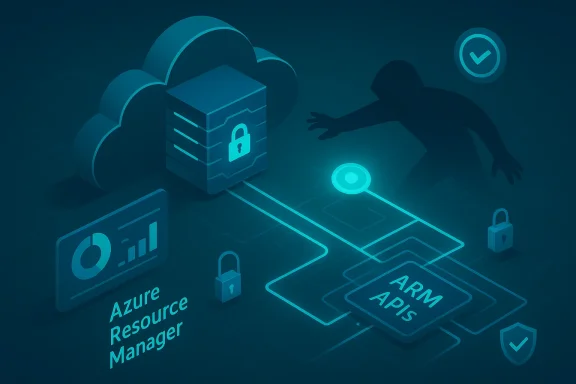
Azure Resource Manager (ARM) is the control plane that authorizes and processes management operations across subscriptions, resource groups, and individual resources. A local or management-plane flaw that permits privilege escalation inside components that interact with ARM can be converted quickly into a tenant-level compromise: an attacker who gains elevated rights on a management endpoint may be able to obtain machine-assigned tokens, install or hijack management extensions, and call Azure APIs to enumerate, modify, or destroy resources. This operational amplification — from a single host or service to the cloud tenant — is the central risk vector for ARM-adjacent elevation-of-privilege vulnerabilities.
Microsoft’s Security Update Guide (MSRC) uses an advisory entry model for CVEs that often includes a confidence/maturity metric describing the vendor’s level of certainty about the vulnerability’s existence and the technical details being published. For cloud and management-plane advisories, MSRC entries are often deliberately concise: they show the classification, affected components, and remediation/KPIs while withholding low-level exploit details to reduce the risk of immediate weaponization. That practice increases the importance of reading MSRC advisories and mapping CVE identifiers to exact KB/patch builds or updated agent versions rather than relying on a single CVE string from third-party tracker
Community feeds have also documented “CVE fragmentation” where multiple, sometimes inconsistent CVE labels are applied to closely related Azure agent or extension issues; that can create operational confusion and risks when automated patching systems act on CVE strings alone. The pragmatic operational fix is to map MSRC KB entries and package versions into your patching and detection pipelines rather than relying on a single CVE label.
Caveats and unverifiable points:
page, for operations teams)
Source: MSRC Security Update Guide - Microsoft Security Response Center
 Background
Azure Resource Manager (ARM) is the control plane that authorizes and processes management operations across subscriptions, resource groups, and individual resources. A local or management-plane flaw that permits privilege escalation inside components that interact with ARM can be converted quickly into a tenant-level compromise: an attacker who gains elevated rights on a management endpoint may be able to obtain machine-assigned tokens, install or hijack management extensions, and call Azure APIs to enumerate, modify, or destroy resources. This operational amplification — from a single host or service to the cloud tenant — is the central risk vector for ARM-adjacent elevation-of-privilege vulnerabilities.Microsoft’s Security Update Guide (MSRC) uses an advisory entry model for CVEs that often includes a confidence/maturity metric describing the vendor’s level of certainty about the vulnerability’s existence and the technical details being published. For cloud and management-plane advisories, MSRC entries are often deliberately concise: they show the classification, affected components, and remediation/KPIs while withholding low-level exploit details to reduce the risk of immediate weaponization. That practice increases the importance of reading MSRC advisories and mapping CVE identifiers to exact KB/patch builds or updated agent versions rather than relying on a single CVE string from third-party tracker
What MSRC says (and what it deliberately does not)
- MSRC lists CVE-2026-24304 under the Azure Resource Manager family and classifies it as an Elevation of Privilege (EoP) vulnerability. The advisory entry surface provides the vendor’s confidence metric and (where present) lists the fixed package or mitigation steps.
- The public advisory typically does not include exploit PoC code, trace-level bug root causes, or step-by-step exploitation mechanics for cloud-adjacent services — instead it focuses on the remediation mapping that security teams need to act. This is consistent with MSRC’s long-standing disclosure posture for management-plane flaws.
- Because MSRC pages are rendered client-side, static scraping may return only a shell page; organizations should treat the MSRC entry as the authoritative record and use the portal’s interactive fields (KB mappings, fixed versions, and rollout notes) as the canonical source for remediation.
Why ARM elevation-of-privilege matters more than a typical host EoP
- Bridge to the control plane:nt for management operations. An attacker who gains elevated rights inside an ARM-facing service or extension can request tokens or invoke APIs that operate across resources or subscriptions. This transforms a host-level compromise into a tenant-level incident.
- Token and identity amplification: Many managementproviders interact with the local metadata or identity endpoints to obtain machine-assigned identities. SYSTEM/root on a host or a compromised management endpoint can be used to harvest tokens usable across ARM, Key Vault, and large fleet footprint:** Management agents and components are deployed widely across hybrid estates — bastions, jump boxes, CI/CD runners and Arc-managed hosts. This increases the blast radius if an exploit is weaponized.
- **Stealth and audiat leverages legitimate management flows (extension installs, remote-run commands through ARM) can blend into normal telemetry unless defenders correlate control-plane and host-level logs carefully.
Technical status and verification — what is confirmed and what is not
Confirmed:- MSRC has recorded CVE-2026-24304 and classified it as an elevation-of-privilege issue affecting ARM. The advisory entry exists in the vendor’s Security Update Guide.
- MSRC’s advisory model includes a confidence/maturity metric that communicates how certain Microsoft is about the factual and technical details in cloud-adjacent advisories. That metric influences how urgently teams should act and how much technical detail will be published.
- Historically, similar ARM- and agent-adjacent EoP vulnerabilities have been used to obtain machine-assigned tokens and to perform management-plane actions; multiple vendor advisories and community trackers corroborate this attack pattern. For example, prior Azure agent and extension CVEs show the same cross‑plane amplification pattern and the same operational mitigations (patch mapping, inventory-first triage, and compensating network controls).
- The MSRC entry for CVE-2026-24304 may not include a public proof-of-concept or low-level exploit details. The precise root-cause primitive (race condition, improper use, memory corruption, etc. may not be published in the vendor’s summary. Where the advisory is terse, any technical exploitation narrative beyond the vendor’s statement should be treated as a hypothesis until corroborated by independent technical write-ups or patch diffs. ([msrc.microsoft.com](Security Update Guide - Microsoft Security Response Center absence of a public PoC or full bug write-up does not imply low risk. Historically, privilege-escalation bugs that bridge to management planes are attractive targets and can be weaponized quickly once sufficient technical detail becomes available. Teams should act on the vendor’s remediation mapping rather than waiting for third-party write-ups.
Practical impact scenarios (attack chains defenders must prioritize)
- Local compromise to token theft
- An attacker gains a local foothold (malicious container, compromised CI job, or an unpatched local user account).
- The attacker triggers the ARM EoP to escalate to SYSTEM/root on a management host or agent.
- Using SYSTEM privileges, the attacker requests machine-assigned tokens (IMDS/HIMDS variants) and uses them to call ARM APIs and harvest secrets or create persistent resources.
- Extension/agent hijack and persistence
- EoP enables an attacker to install or manipulate an extension (agent) that runs in the management plane.
- The attacker uses that extension to persist across reboots and spread to other Arc-managed hosts or VMs, making remediation significantly harder.
- Tenant-level lateral movement
- With management-plane access, the attacker can create or impersonate service principals (depending on tenant RBAC) and execute cross-subscription actions, magnifying blast radius.
Immediate, prioritized mitigation checklist
Follow this prioritized sequence — these are operational actions to reduce exposure while you confirm vendor KB mappings and deploy the official fixes.- Inventory and prioritize
- Inventory every resource that uses ARM-connected agents, the Azure Connected Machine Agent (azcmagent), Windows Admin Center extensions, Azure Bastion, and any other management-plane agent that interacts with ARM.
- Prioritize bastions, jump boxes, CI/CD shared runners, and hosts with machine-assigned identities.
- Confirm MSRC KB↔package mapping
- Open the Microsoft Security Update Guide entry for CVE-2026-24304 and map the CVE to the exact KB number, agent build, or extension version Microsoft lists as fixed. Treat MSRC as canonical for patch identity.
- Patch first, verify second
- Apply the vendor-supplied patch to affected components as soon as you can test safely. If Microsoft lists a fixed agent version, upgrade to that exact build in your test environment first, then roll out to production.
- Validate the fixed build by checking package hashes or the vendor’s release notes before mass deployment.
- Apply compensating controls if patching will be delayed
- Restrict network access to management endpoints (use NSGs, firewall rules, and Just-In-Time access to limit who can reach management ports).
- Harden RBAC: reduce long-lived management privileges, enable Privileged Identity Management (PIM) where possible, and remove unnecessary Owner/Contributor rights from ambiguous service principals.
- Limit local administrative accounts and enforce Just‑Enough‑Administration (JEA) patterns on management hosts.
- Strengthen telemetry and hunting
- Enable EDR telemetry on management hosts, log IMDS/HIMDS calls, and alert on unusual token request patterns or extension-inrelate Azure Activity Logs (control plane) with host EDR signals to spot management-plane misuse that mimics normal admin actions.
- Application control and path hardening
- Enforce application control (WDAC/AppLocker) in high-value environments to prevent unauthorized code execule paths — one of the most effective mitigations against follow-on payloads.
- Patch pipeline hygiene
- Change automated patching rules to require vendor KB confirmation not just a CVE string from third-party feeds; CVE fragmentation can lead to incorrect patch choices. Microsoft’s update guide is the authoritative record for mapping CVE → KB → package.
Detection guidance — concrete signals to watch for
- Unexpected or frequent calls to local metadata endpoints (IMDS/HIMDS) from non-system processes.
- Sudden creation or assignment of managed identities, service principals, or virtual accounts associated with management actions.
- Extension or agent installs immediately after a local process escalation (check installer/repair flows and MSI logs).
- Correlated control-plane operations that originate from a single host’s token usage (e.g., mass resource reads/exports, unusual role assignments).
ancestry changes on management hosts, especially processes that spawn from user-writable paths or non-signed binaries.
How to validate you are patched (operational checks)
- Confirm the exact fixed package or KB on MSRC’s advisory page and the vendor-specified version string. Do not rely solely on CVE string matches from aggregators.
- On each host, verify the installed agent or extension build matches the fixed version (check package metadata, MSI product codes, or the Linux package manager’s version strings).
- Validate post-patch behavior: ensure that the processes that used to run as elevated system components are now patched and that previously observable attack primitives (if publicly disclosed by Microsoft) are no longer present.
- Re-run containment tests: simulate the attack chain in a test lab (air-gapped from production) only if Microsoft or reputable third parties publish exploit mechanics; otherwise, focus on patch verification and telemetry validation.
Broader ecosystem context — why this is not an isolated incident
Azure management-plane and agent vulnerabilities have been a recurring class across 2024–2026. Independent vulnerability trackers and vendor advisories show a pattern: local EoP bugs in agents or management extensions, followed by rapid remediation and a vendor confidence signal that varies by case. Notable examples include recent Azure CLI and agent-related EoPs cataloged by NVD and security vendors; these incidents reinforce the need for inventory-first remediation and vendor-mapped patching. (nvd.nist.govCommunity feeds have also documented “CVE fragmentation” where multiple, sometimes inconsistent CVE labels are applied to closely related Azure agent or extension issues; that can create operational confusion and risks when automated patching systems act on CVE strings alone. The pragmatic operational fix is to map MSRC KB entries and package versions into your patching and detection pipelines rather than relying on a single CVE label.
Strengths and limitations of the vendor approach
Strengths:- Microsoft’s MSRC process provides authoritative KB↔CVE mappings and a concise advisory that allows large customers to prioritize rapidly.
- The vendor confidence/maturity metric is a useful signal for defenders: it communicates whether Microsoft has fully validated exploit mechanics, partial indications, or is still investigating — helping teams prioritize scarce resource
- Concise advisories and withheld exploit detail require defenders to act on limited public information; teams that wait for full technical write-ups expose themselves to potential exploitation windows.
- CVE fragmentation across feeds and third parties can cause incorrect patch selection if teams rely on CVE alone without confirming vendor KB mappings. Automated patch rules that simply match CVE strings are at risk of missing the correct package or agent build.
- Management-plane telemetry gaps make detection difficult unless teams proactively enable EDR/IMDS logging and correlate control-plane and host-level telemetry.
Recommended long-term hardening (beyond immediate patching)
- Enforce least privilege: remove unnecessary owner/contributor roles and use PIM and conditional access to reduce the power of compromised identities.
- Zero-trust network design for management endpoints: segment management plane traffic, enforce strict NSG rules, and consider private link / service endpoints for management traffic where possible.
- Harden agent/extension deployment practices: minimize the number of hosts with machine-assigned identities, require multi-factor approval for extension and extension-install operations, and restrict extension installation to vetted central pipelines.
- Continuous validation: implement a patch verification process that ties package hashes to KB entries and performs continuous compliance scanning against MSRC-authoritative mappings.
- Threat modeling and red-team exercises: simulate EoP chains that cross from host to control plane and test your detection and containment workflows end-to-end.
What to tell your leadership and incident response teams
- The vendor (Microsoft) has published CVE-2026-24304 and classed it as an elevation-of-privilege issue affecting Azure Resource Manager. Treat this as a high-priority remediation item for management-pl
- Immediate actions: inventory affected assets, verify MSRC KB→package mapping, apply the vendor patches or mitigations, and enable compensating network and telemetry controls if patches cannot be applied immediately.
- Communication points: explain the cross-plane risk succinctly — a host-level privilege escalation can be used to harvest machine tokens and perform management-plane actions that affect the entire tenant. That framing helps justify prioritized maintenance windows for bastions and shared runners.
Final assessment and cautionary notes
CVE-2026-24304 exemplifies the class of manageme-privilege vulnerabilities that are operationally urgent because they let local attackers amplify a host compromise into cloud-level control. Microsoft’s Security Update Guide entry is the canonical source for remediation, and the vendor’s confidence metric is a practical signal for defenders to calibrate urgency. Because public technintentionally limited, the defensible operational posture is clear: inventory first, confirm KB mappings, patch promptly, and apply compensating network and telemetry controls until the vendor’s fix is validateCaveats and unverifiable points:
- If you need low-level exploit mechanics for forensic detection, be aware that those details may not be published with the initial MSRC advisory; treat such technicaarties as provisional unless corroborated by Microsoft’s KB/patch diffs or multiple independent technical write-ups.
- Given the operational danger of incorrect remediation, do not rely on lone for automated patch actions; map advisories to vendor KBs and package versions as the single source of truth.
page, for operations teams)
- Open MSRC entry for CVE-2026-24304 and record the KB/package mapping.
- Inventory management-plane agents and hosts; prioritize bastions, jump boxes, CI/CD runners, and Arc/azcmagent deployments.
- Schedule and test vendor-lerify version strings/hashes.
- Restrict network access to management endpoints and enable Just‑In‑Time access.
- Harden telemetry: log IMDS/HIMDS calls, detect unusual token usage, and correlate control-plane logs with host EDR.
Source: MSRC Security Update Guide - Microsoft Security Response Center
