

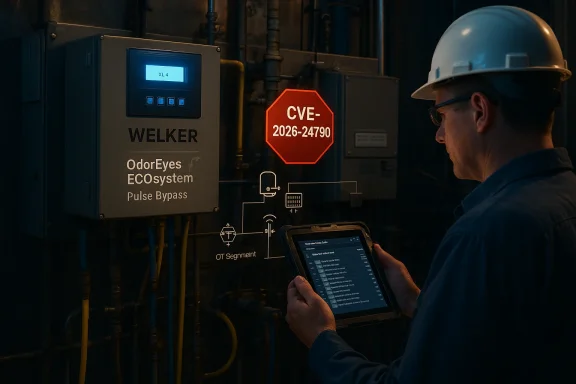
A high‑severity industrial control systems advisory published on February 19, 2026, warns that Welker’s OdorEyes ECOsystem Pulse Bypass System with the XL4 controller is vulnerable to an unauthenticated control‑function flaw (tracked as CVE‑2026‑24790) that could let a remote actor manipulate the device’s underlying PLC logic and trigger an over‑ or under‑odorization event. The vulnerability is rated CVSS 3.1 8.2 (High) and is described as Missing Authentication for Critical Function (CWE‑306) — a textbook failure for devices that sit at the safety‑perimeter of gas distribution and industrial odorization operations. The vendor did not respond to coordinated disclosure attempts, and operators responsible for gas odorization, distribution stations, and related critical‑infrastructure systems should treat this as an actionable operational risk as of February 19, 2026.
Background / Overview
The Welker OdorEyes ECOsystem family is a widely used odorization platform for natural gas, renewable natural gas (RNG), biogas, and industrial gas streams. These systems rely on precise injection of odorant compounds to meet regulatory and safety requirements: enough odorant to make gas leaks detectable by smell, but not so much that it creates nuisance complaints, process interference, or chemical over‑exposure concerns.The recently disclosed issue affects the ECOsystem Pulse Bypass System when operated with the XL4 controller. According to the advisory, the underlying PLC can be remotely influenced without proper safeguards or authentication, and the controller exposes functions that should require authentication but currently do not. The practical outcome: an attacker with network access could change dosing logic, stop injection, or force excessive odorant injection — each scenario capable of producing immediate operational, safety, regulatory, and reputational consequences.
Why this matters now: these devices are deployed across multiple critical infrastructure sectors — energy (gas distribution and pipeline), chemical processing, food and agriculture (where odorization may be used in biogas handling), and critical manufacturing. The advisory explicitly notes global deployment and the product’s U.S. headquarters, increasing the likelihood that both domestic and international operators are affected.
The technical core: Missing authentication on a control interface
What “Missing Authentication for Critical Function” really means
Missing authentication for critical function (CWE‑306) indicates that the device exposes a function that must be restricted to authorized users — for example, changing controller setpoints, switching operational modes, or altering injection timing — but it either accepts unauthenticated requests or exposes an interface without credentials. In industrial controllers, this is as dangerous as an open valve in a chemical plant: unauthorized commands can directly change the physical process.On the OdorEyes XL4 system, the advisory indicates the PLC beneath the controller can be remotely influenced. That implies one or more of the following architectural failures:
- Control APIs, command sockets, or telnet/serial bridges that accept unauthenticated commands.
- Management or maintenance services accessible over networks without proper access controls.
- Lack of role‑based access control (RBAC) or failure to require credentials for critical command paths.
Attack surface and likely vectors
The advisory ties the flaw to remote influence, which suggests the attack surface includes:- Any network interface exposed to enterprise or vendor networks.
- Remote maintenance channels (VPNs, vendor remote access, or third‑party service tunnels).
- Poorly segmented OT (operational technology) networks where devices share connectivity with IT assets or internet‑facing systems.
Operational impacts: Why over‑ or under‑odorization is a real safety risk
Odorization of natural gas is a primary human‑detectable safety control: mercaptans and other odorants give otherwise odorless gas a warning scent. Tampering with dosing leads directly to three operational risk categories:- Safety risk: Under‑odorization reduces leak detectability, increasing the risk of undetected gas accumulation and catastrophic ignition. This is especially critical in densely populated or enclosed facilities.
- Health & compliance risk: Over‑odorization can lead to odor complaints, occupant irritation, respiratory complaints, and possible regulatory violations for over‑treatment of gas streams or environmental release thresholds.
- Process reliability and financial risk: Incorrect dosing can foul downstream sensors, affect combustion processes, or cause unnecessary plant shutdowns. Remediation costs, incident investigations, and regulatory penalties can be substantial.
Disclosure timeline and vendor coordination (what operators need to know)
- February 19, 2026 — advisory published (initial release date listed in the advisory).
- The advisory identifies the affected product family and the CVE identifier CVE‑2026‑24790 and reports the vendor did not respond to coordination attempts.
- The advisory also confirms no known public exploitation targeting this vulnerability had been reported to the issuing agency as of the advisory date.
Immediate actions for operators (an operational playbook)
If you manage or depend on OdorEyes ECOsystem Pulse Bypass systems with XL4 controllers, begin with the following prioritized steps. These are organized so you can move from rapid, low‑impact mitigations to longer‑term remediation.- Inventory — Within 24 hours
- Identify every OdorEyes ECOsystem and XL4 controller on your networks, including field units, redundant skids, and portable units used for commissioning or maintenance.
- Document network connectivity (IP addresses, subnets), firmware/controller versions, serial numbers, and physical locations.
- Isolate — Immediate where possible
- Remove any direct internet access to controllers. If a device is currently internet‑accessible, block that traffic at the firewall or drop it to a denylist.
- Place controllers on segmented OT VLANs with strictly controlled ingress/egress rules. Deny any east‑west traffic that is not operationally necessary.
- Harden remote access — Immediate to short term
- Disable vendor remote access or third‑party tunnels until they can be validated and secured.
- If remote access is necessary, require a hardened VPN with multifactor authentication and restrict source IP addresses to known management hosts.
- Implement detection and monitoring — 24–72 hours
- Enable and centralize logging from controllers, PLCs, and associated HMIs. Monitor for anomalous configuration changes, controller mode switches, or unexpected injection setpoint changes.
- Add process anomaly detection: sudden drops or spikes in odorant pump activity, diverging injector flow vs. expected flow profiles, and unusual alarm patterns.
- Safety interlocks and manual fallback — Implement immediately if practicable
- Where safety allows, enforce manual override and physical interlocks that prevent remote commands from directly enabling dosing changes without a human‑in‑the‑loop confirmation.
- Ensure on‑site personnel are trained to perform emergency manual odorant control and that they can rapidly verify sensor readings.
- Communication and reporting — As soon as controls are enacted
- Inform stakeholders (control center, operations, safety, compliance) of the advisory, the steps taken, and what to watch for.
- Report suspected incidents or anomalous behavior to your national CERT/contact (follow established internal escalation paths) and keep documentation for regulators.
- Vendor engagement and patch tracking — Ongoing
- Continue to monitor vendor channels for firmware updates or security bulletins. If Welker provides a remediation, prioritize its testing and deployment in a controlled update window.
- If the vendor remains unresponsive, document outreach attempts and rely on compensating controls until a vendor remediation is available.
Detection guidance: what to log and how to hunt
Operational detection is critical because adversaries will try to hide control manipulation as routine events. Create capability to detect:- Unexpected configuration changes to controller parameters (time stamps, user IDs, IP origins).
- Mode changes (automatic ↔ manual), remote program mode entries, or enabling/disabling of injection sequences.
- Discrepancies between the controller’s commanded output and independent process measurements (odorant pump runtime vs. flow meters, tank level changes inconsistent with usage).
- Suspicious network connections to controller management ports or service ports typically used for maintenance.
- Repeated failed or unauthenticated command attempts (indicative of scanning and probing).
Mitigation strategies where patches are not yet available
Because the vendor did not respond to coordinated disclosure at the time of the advisory, many operators will need to rely on mitigations rather than patches. Proven practices for ICS hardening include:- Segmentation: put controllers on isolated networks with one‑way flows or jump hosts for maintenance.
- Principle of least privilege: restrict what each management station can do; avoid shared admin accounts.
- Remove or disable unused services: close unused TCP/UDP ports, disable remote maintenance services if not explicitly required.
- Application allow‑listing on connected management hosts to prevent lateral abuse.
- Out‑of‑band management: use physical or out‑of‑band consoles for sensitive operations when possible.
- Safety system redundancy: use independent physical sensors and trip logic that are not solely reliant on the vulnerable controller for safety decisions.
Incident scenarios: how an adversary could abuse this flaw
Understanding likely attacker goals helps prioritize defenses. Consider these exploit scenarios:- Sabotage: An adversary with network access could force binary on/off toggles to stop odorant injection in areas to cause under‑odorization. The intent could be to create a safety incident or undermine public confidence.
- Persistent manipulation: Gradually altering dosing rates to be slightly below safe thresholds, avoiding immediate alarms while reducing leak detectability over time.
- Extortion or political posturing: Threaten to manipulate odorization unless demands are met; operators would be forced either to reveal network access status or accept operational risk.
- False alarms: Forcing over‑odorization can create nuisance poisoning complaints or trigger facility evacuations — both causing operational disruption and potential financial loss.
Controls and resilience: making odorization systems robust
To make odorization systems more resilient against both accidental misconfiguration and malicious interference, operators should adopt a layered set of controls:- Design redundancy into odorant injection systems (secondary dosing that cannot be changed via the same control path).
- Add independent odorant concentration sensing where possible, not just pump runtime monitoring.
- Ensure that emergency safety trips and leak detection subsystems are independent of the odorizer controller.
- Harden change‑control processes: require multi‑party approval and physical presence for critical setpoint changes.
- Institute frequent integrity checks of controller logic and program images against known good baselines.
Regulatory and public‑safety implications
Operators in regulated markets must consider reporting obligations and potential compliance impacts. Under many jurisdictions, gas distribution providers are required to maintain adequate odorization to meet safety standards. A failure to do so — even caused by a third‑party attack — can trigger regulatory action if evidence shows inadequate protective measures.Operators should:
- Maintain detailed incident logs and chain‑of‑custody for any suspected manipulation.
- Notify regulators per applicable rules, especially when public safety could be affected.
- Engage legal and communications teams early to manage disclosures and public messaging if an incident triggers customer or community impact.
For IT/OT teams: playbook for applying compensating controls
IT and OT security teams must coordinate closely. A short playbook:- Convene a cross‑functional incident assessment with OT operators, ICS engineers, IT security, and physical security.
- Immediately apply network isolation for affected devices and enforce firewall deny rules for any non‑operational traffic.
- Freeze remote maintenance access until privileged remote sessions can be audited and hardened.
- Implement stricter authentication for management stations, including MFA where vendor stacks allow.
- Audit current backups and program images; maintain an offline, verified backup of PLC logic and controller configurations.
- Run a risk prioritization to determine which units must be quickly replaced, which can be mitigated, and where manual operational controls must be enacted.
Longer‑term fixes and vendor expectations
Longer term, the industry must insist that controllers used in safety or primary detection roles adhere to secure‑by‑design principles:- Authenticated control APIs for all critical functions.
- Role‑based access control (RBAC) with strong passwords and MFA for administrative operations.
- Secure firmware update mechanisms with cryptographic signing and rollback protection.
- Minimal exposed services and hardened embedded OS configurations.
- Clear security documentation and a responsive vulnerability disclosure program from vendors.
Why logging, exercises, and tabletop drills matter now
Technical controls alone won’t stop every incident. Regular tabletop exercises that simulate an odorant dosing compromise help crews rehearse the operational procedures necessary to validate process safety independently of the controller. These exercises should include:- Rapid verification of odorant concentration using field sensors or manual sniff tests performed safely.
- Procedures to switch to manual dosing or to bring redundant systems online.
- Communications scripts for notifying regulators and the public should an incident require broader notification.
Risk assessment: who should worry most
Operators who should prioritize immediate action include:- Gas distribution utilities running OdorEyes ECOsystem or XL4 controllers at city gate or distribution points.
- Industrial sites and refineries that rely on piped odorization control tied into centralized SCADA or remote management services.
- Third‑party maintenance providers who may have VPNs, shared access, or remote sessions into client OT environments.
- Facilities where odorizer controllers are reachable from enterprise networks or where poor segmentation exists.
Closing analysis and takeaways
CVE‑2026‑24790 is a high‑impact, operationally sensitive vulnerability affecting equipment that sits at the boundary between digital control and human safety. The combination of a high CVSS score, an unauthenticated control interface, and deployment across critical infrastructure sectors creates a credible threat picture: adversaries exploiting this flaw could quietly degrade safety or cause disruptive over‑odorization events.The silver lining is that classic industrial security controls — segmentation, denylists, hardened remote access, independent safety interlocks, and active monitoring — materially reduce risk even when a vendor fix is not yet available. Operators who move quickly to inventory devices, isolate exposed units, and implement the recommended monitoring and containment steps will significantly reduce the chances of successful exploitation.
Finally, document everything: vendor outreach attempts, the compensating controls you applied, logs and forensic captures, and decision rationale. Whether the path forward is a vendor firmware release or a multi‑layered defense posture, meticulous records will be indispensable for incident response, regulatory review, and continuous improvement.
Operators: treat this advisory as an operational priority — inventory now, isolate where possible, and harden networks and remote access immediately. The cost of action is modest compared with the potential consequences of inaction.
Source: CISA Welker OdorEyes EcoSystem Pulse Bypass System with XL4 Controller | CISA
