

Background
The Intrado 911 Emergency Gateway sits in a part of the technology stack that most users never see but almost everyone depends on when something goes wrong. It is an on-site appliance designed to help enterprises manage E911 workflows, track device location, and support emergency call handling for IP-based phone systems. Intrado describes EGW as an appliance that automates and simplifies E911 management for enterprise IP-PBX environments, including location tracking for phones and remote location updates for teleworkers. That kind of functionality turns the gateway into a trusted control point, not just another box on the network.
That trust is exactly why the new advisory matters. A vulnerability in a management interface is never “just” a web bug when the target is a system that supports emergency communications. Attackers who compromise such a platform may gain the ability to alter records, disrupt location data, or interfere with the administrative workflows that keep 911 routing accurate. In a normal business application, those outcomes are bad. In an emergency-services context, they can become operationally dangerous.
CISA places the issue in the Emergency Services critical infrastructure sector, notes worldwide deployment, and identifies the company headquarters in the United States. That is a familiar pattern in ICS advisories, but the details matter because they signal broad exposure across both public safety and enterprise environments. The advisory also states that no known public exploitation had been reported to CISA at the time of publication, which is reassuring only in the narrow sense that defenders still have time to act. In security, not observed yet is not the same thing as not exploitable.
This is also not Intrado’s first security conversation with CISA. A separate 2024 advisory covered a severe SQL injection issue in the same EGW product family, including guidance to upgrade older revisions into the 5.5/5.6 branch to apply the fix. That historical context matters because it shows a product line that sits on a recurring security fault line: web-facing administration, privileged access, and operational trust. When the same platform keeps reappearing in advisories, defenders should assume the issue is more than an isolated coding slip.
The current disclosure also highlights how emergency-response technology increasingly behaves like enterprise software with all the usual baggage. It must handle remote access, device management, user provisioning, and location data, all while remaining resilient enough for life-safety use cases. That combination creates a difficult security profile: every convenience feature can become a liability if it is reachable without strong authorization. In other words, the product is not vulnerable because it is unusual; it is vulnerable because it is important.
What CISA Disclosed
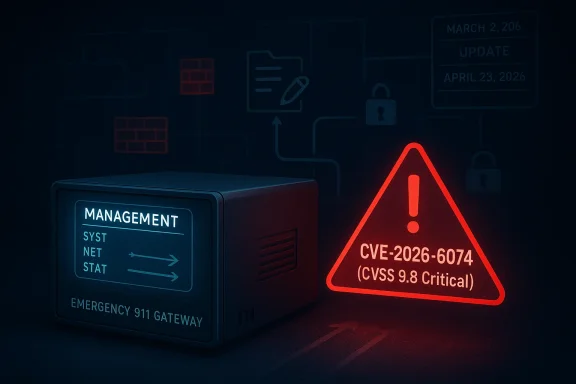
CISA’s April 23 advisory is concise but blunt. The vulnerability is a path traversal condition in Intrado 911 Emergency Gateway that could allow an attacker with existing network access to reach the management interface without authentication. The downstream impact is severe: successful exploitation could let an attacker read, modify, or delete files. The agency assigned the issue CVE-2026-6074 and rated it CVSS 3.1 9.8 Critical.
The affected product list is straightforward but important: Emergency Gateway 7.x, 6.x, and 5.x are all marked known affected in the advisory summary. That means this is not a narrowly scoped maintenance issue for one branch or a niche configuration. It touches multiple major product generations, which raises the odds that some organizations will discover they are running a vulnerable version only after an audit or incident review, not before.
The vulnerability in plain English
Path traversal is one of those bug classes that sounds old-fashioned until it lands in the wrong place. At its simplest, it means software fails to properly constrain file paths, allowing attackers to escape an intended directory and reach files or resources they should not be able to touch. In a management appliance, that can translate to configuration exposure, tampering, or deletion. In a life-safety system, the implications are more serious because the management plane is part of the service’s trust foundation.
The phrase “access the EGW management interface without authentication” is the part that should trigger the most concern. It means the issue is not limited to a post-login privilege abuse or a niche local file-read flaw. It suggests the traversal bug can be used as a shortcut into a protected administrative surface. Once that boundary falls, the attacker is no longer just poking at files; they may be standing inside the control room.
Why the CVSS score matters
A 9.8 score is more than a badge. It usually means the vulnerability is remotely reachable, requires no authentication, needs no user interaction, and can have severe confidentiality, integrity, and availability impact. CISA’s vector reflects exactly that profile, and the score should be treated as a strong signal for immediate remediation planning rather than routine patch scheduling.
That said, CVSS is not the whole story. In emergency communications, the operational context matters as much as the exploit mechanics. A vulnerability that enables file access might be “just” a data issue in another product, but here it may affect the configuration integrity of a gateway that supports 911 workflows. The difference is subtle on paper and enormous in practice.
Why Emergency Communications Software Is Different
Emergency communications systems have a built-in asymmetry: they are expected to be boring until the exact moment they become indispensable. That makes them ideal targets for attackers seeking leverage, because even a small disturbance can have outsized consequences. When a gateway governs location data, routing assistance, or management functions tied to 911 operations, a compromise can ripple beyond the host itself.
Unlike consumer software, emergency-infrastructure platforms are judged on resilience, not convenience. Administrators may accept a higher operational burden if the system helps meet compliance, call-routing, or support obligations. That tradeoff can be reasonable, but it also means security controls must be exceptionally disciplined. If the management interface is reachable and weakly protected, the entire trust model starts to wobble.
Operational trust and the management plane
The management plane is where defenders usually concentrate the most privilege and the least tolerance for error. That is true for routers, firewalls, hypervisors, and it is certainly true for emergency gateway appliances. If an attacker can enter that plane, they may not need to compromise the underlying operating system in a sophisticated way. They may only need to alter files or settings that the product itself trusts.
This is why path traversal in a management appliance often feels worse than the same bug in a consumer website. The attacker is not simply collecting a document or poking around a directory tree. They are trying to influence the device that decides who gets served, what location data is visible, and how emergency-related workflows behave. That is a much more consequential target surface.
Emergency services and blast radius
The advisory’s critical-infrastructure context changes the risk calculus. In ordinary enterprise software, a file read or file modification issue may lead to data theft or local persistence. In emergency services, the same bug can create operational confusion, false records, or broken administrative functions at the exact moment an organization needs confidence in its communications stack. That is the real hazard.
The broader lesson is that high-severity infrastructure bugs are not just about remote code execution headlines. They are about what happens when an attacker can change the state of a system that people trust during incidents. In that sense, even a “file-only” vulnerability can be the first domino in a much larger chain.
What Intrado and CISA Say to Do
Intrado says it developed and released a software update on March 2, 2026, and that it has contacted customers to coordinate patching. That is the most direct and practical remediation path, and CISA’s advisory points users to the vendor for questions through E911 Support. For defenders, the first priority is to verify whether the update has actually been applied to every relevant EGW instance.
CISA also repeats its standard ICS defensive guidance: minimize network exposure, put control-system devices behind firewalls, isolate them from business networks, and use VPNs carefully when remote access is required. Those recommendations are routine only in the sense that they are frequently repeated; they remain essential because they address the common deployment pattern that makes vulnerabilities exploitable in the first place.
Immediate defensive priorities
A sensible response should be operational, not theoretical. Organizations should identify every EGW deployment, determine which version branch it runs, confirm whether the March 2 update is installed, and assess whether the management interface is reachable from networks that do not need access. The most dangerous assumption is that “someone else already patched it.”
- Inventory every Emergency Gateway instance.
- Confirm whether each device runs 5.x, 6.x, or 7.x.
- Verify the March 2, 2026 patch is installed.
- Restrict management access to approved admin networks only.
- Review logs for unusual file access or configuration activity.
- Treat any exposed management interface as a priority risk.
Segmentation still matters
The advisory’s recommended practices are especially relevant because segmentation is one of the few controls that can reduce the reachable attack surface even before patching is complete. If an attacker needs to already be on an internal network to exploit the flaw, then network architecture becomes a security control rather than just an IT convenience. That is why CISA’s isolation guidance is more than boilerplate. It is the bridge between vulnerability disclosure and practical risk reduction.
It is also worth emphasizing that a VPN is not a silver bullet. VPNs can limit exposure, but they also create a trust path from a remote endpoint into a sensitive management network. If the endpoint is compromised or overprivileged, the tunnel simply delivers the attacker closer to the crown jewels. That is why CISA frames VPN use as part of a broader defense-in-depth posture, not a substitute for one.
Historical Pattern: Why This Advisory Feels Familiar
This advisory lands in a broader trend that defenders should not ignore. Critical infrastructure vendors keep surfacing with issues that are not exotic zero-days but familiar classes of weakness: path traversal, SQL injection, authentication failures, and privilege boundary mistakes. The recurring theme is not novelty; it is exposure. Products that are reachable, web-managed, and operationally trusted tend to collect the same kinds of flaws over time.
Intrado’s own earlier CISA advisory from June 2024 is a useful marker. That notice dealt with an unauthenticated blind time-based SQL injection in EGW, also with a critical score. When one product family appears in more than one serious advisory within a short span, it tells defenders to think beyond the patch of the day and consider the architecture of the platform itself.
Repetition is a signal
Repeated advisories often mean one of three things. The product may be widely deployed and therefore heavily scrutinized. The vendor may be responsibly disclosing and fixing issues as they are found. Or the security model may be complex enough that new bugs keep emerging in the same management surface. In reality, it is often a mix of all three.
For customers, the practical implication is simple: if EGW is important enough to your operations to keep installed, it is important enough to monitor like any other high-value infrastructure asset. That means patch validation, log review, network restriction, and vendor engagement should be recurring tasks, not one-time reactions.
Public safety systems attract attention
Systems linked to emergency services also carry a different level of scrutiny from adversaries. They may not be the highest-volume target category, but they are operationally meaningful and often deeply embedded in organizational workflows. That makes them attractive for both opportunistic attackers and more patient actors looking for leverage or disruption. The more essential the system, the more dangerous it becomes when trust breaks.
That same logic explains why advisory language in the ICS world tends to sound repetitive. Defenders keep hearing the same segmentation advice because attackers keep finding ways around weak network architecture. The message is not stale; it is stubbornly relevant.
Enterprise and Public-Safety Impact
For enterprises, the immediate concern is administrative integrity. EGW often sits in the path of E911 management, location updates, and device administration. If an attacker can read, modify, or delete files, they may be able to alter configuration data, interfere with support processes, or disrupt the information administrators rely on to keep emergency services functioning correctly. That is a business problem and a compliance problem before it is even a technical one.
For public-safety stakeholders, the issue is sharper. Emergency communications systems are not meant to be treated like general-purpose office software. The expectation is that they will remain dependable under pressure, and any vulnerability that undermines the management interface creates concern about trust, availability, and continuity. Even if the direct impact is “only” file manipulation, the potential knock-on effects can be operationally significant.
Enterprise impact
Many enterprise customers run E911 infrastructure through IT, telecom, and facilities teams that do not always share the same asset inventory. That split ownership can make patching slower and exposure harder to see. If the gateway is treated as a facilities appliance rather than a security asset, it may not receive the same review cadence as a domain controller or firewall.
The result is a familiar blind spot. A device can be mission-critical without being centrally governed. When that happens, a serious advisory can sit in plain view while no single team feels fully responsible for it. That is one reason emergency-communications infrastructure deserves the same lifecycle discipline as core network equipment.
Public-safety impact
Public-safety impact is not always immediate and visible. Sometimes the risk is degraded confidence in location data, delayed administrative actions, or a compromised management account that forces downtime during remediation. Those outcomes may not make headlines, but they can still complicate response readiness. That matters.
The more tightly a system is tied to emergency operations, the more dangerous maintenance disruptions become. Even a short maintenance window may require coordination, and a security incident can multiply that complexity. In practice, the real cost of compromise may be the loss of time when time is what emergency systems are supposed to preserve.
Why Path Traversal Still Matters
Some security teams still treat path traversal as a legacy bug class that only matters in old web apps. That is a mistake. Path traversal remains valuable to attackers because it can expose configuration files, credentials, tokens, and application state. When the bug exists in a management appliance, the prize is often larger and the trust boundary is tighter.
The reason it keeps working is straightforward: software still has to move between user input and file paths, and not every product constrains that movement correctly. Add privileged management functions, and the bug stops being merely a file-system issue. It becomes an administrative control issue.
How traversal becomes a control problem
An attacker who can move outside an intended directory may be able to access logs, configuration files, or other resources that should stay hidden. In a managed gateway, those files may reveal credentials, internal addresses, or operational settings. If the same flaw can also reach the management interface without authentication, the attacker may be able to do more than observe. They may be able to change state.
That is why “read, modify, or delete files” is such a loaded phrase in this context. It implies a direct path to integrity loss, and integrity loss in an emergency gateway is often more dangerous than a simple data leak. Data can be copied. Integrity, once lost, can cascade.
Why authentication bypass changes the picture
Path traversal alone can be serious. Path traversal that also grants unauthenticated access to an administrative interface is a different class of problem. It collapses the trust model and invites follow-on actions that the vendor likely assumed required login. That is the difference between a bug you can compartmentalize and a bug that can reshape the device’s behavior.
The attack narrative is therefore less about a clever exploit string and more about what happens when a system assumes the requester is legitimate. When that assumption fails inside a high-trust appliance, the consequences are outsized.
Strengths and Opportunities
There are still reasons to feel cautiously optimistic, even in a serious disclosure like this. The vendor says it has already released a fix, CISA has published a clear advisory, and the affected product range is specific enough that asset owners can begin targeted verification instead of hunting blindly. The situation is urgent, but it is also manageable if organizations move quickly and methodically.
- The vulnerability has a clear CVE and a clearly stated product scope.
- Intrado says a software update was released on March 2, 2026.
- CISA’s advisory gives defenders actionable segmentation guidance.
- The issue is narrow enough for asset teams to inventory and verify.
- The absence of reported public exploitation buys some limited response time.
- The advisory’s language makes the risk understandable to both security and operations teams.
- A focused patch campaign can materially reduce exposure fast.
Risks and Concerns
The biggest concern is that this is a management-plane vulnerability in a system tied to emergency communications, which means exposure is not just technical but operational. If the management interface is reachable in the wrong places, the device may be vulnerable even if the patch exists, because patching and exposure reduction are not the same thing.
- Management interfaces are often more reachable than teams realize.
- Older deployments may lag on patching, especially across branch sites.
- Emergency-services tooling can be owned by multiple teams, slowing response.
- A file-modification bug can still cause serious operational disruption.
- Internal network exposure may be enough for exploitation.
- Misconfigured remote access can make the issue easier to abuse.
- Organizations may underestimate the impact because the flaw is not remote code execution.
Looking Ahead
The next few weeks will likely determine whether this advisory becomes a routine patch cycle or a broader incident-response story. The strongest defenders will use the disclosure to improve asset visibility, review exposure paths, and confirm that emergency-communications equipment is governed like critical infrastructure rather than like ordinary IT gear. That mindset shift is often the difference between a quick mitigation and a prolonged cleanup.
The other thing to watch is whether additional details emerge about exploitation chains or configuration conditions that make the issue easier to abuse. Even when public exploitation is not yet reported, vulnerabilities of this kind tend to attract attention once they are mapped onto real-world deployment patterns. If the management interface is reachable from broad internal networks, the practical risk may be higher than the headline severity already suggests.
- Confirm every deployed EGW version and patch level.
- Restrict management access to tightly controlled admin networks.
- Review logs for file-access anomalies or unusual configuration changes.
- Coordinate with telecom, facilities, and security owners together.
- Validate that remote access paths are minimal and monitored.
- Reassess whether the device is more exposed than policy assumes.
Intrado’s EGW advisory is a reminder that the most consequential vulnerabilities are often the ones that land in trusted infrastructure, not the loudest consumer-facing products. When a flaw can quietly undermine the administrative backbone of emergency communications, the correct response is speed, discipline, and a willingness to revisit old assumptions about network trust. In the world of 911 support systems, the difference between “patched” and “protected” is often whether someone took segmentation, inventory, and access control seriously before the warning arrived.