

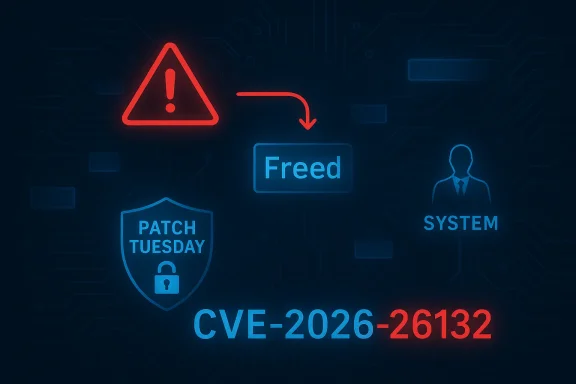
Microsoft has recorded CVE-2026-26132 as a Windows Kernel use‑after‑free vulnerability that can be triggered by an authorized local user to gain elevated privileges, and administrators should treat it as a high‑priority remediation item in this month’s Patch Tuesday release. (msrc.microsoft.com) (cvedetails.com)
Kernel‑mode elevation‑of‑privilege (EoP) bugs are among the most consequential defects an operating system can host. Because kernel components execute with the highest system privileges, a successful local exploit can take a foothold held by an unprivileged or low‑privileged account and convert it into full SYSTEM privileges. Over the last several years Microsoft has regularly cataloged kernel EoP issues and patched them during Patch Tuesday cycles; CVE‑2026‑26132 is the latest in that class and appears in Microsoft’s March 10, 2026 security rollup. (msrc.microsoft.com) (cybersecuritynews.com)
Microsoft’s vulnerability records include a confidence metric that describes how certain the vendor is about an issue’s existence and the credibility of the technical details disclosed. This metric is intentionally conservative: it ranges from tentative, incomplete disclosures to vendor‑confirmed, technically‑substantiated advisories. Administrators should treat high‑confidence items as vendor‑acknowledged and ready for operational action; lower‑confidence entries merit caution and monitoring until details solidify. (msrc.microsoft.com)
Microsoft’s advisory for CVE‑2026‑26132 does not, publicly, publish a step‑by‑step exploit trace or the precise kernel object affected; this is a deliberate vendor choice meant to balance transparency against the risk of easy weaponization. Independent trackers list the defect as a UAF in the Windows Kernel and map it to the March 10 updates, but low‑level exploit mechanics are withheld in the public advisory. That means defenders must act on the vendor‑acknowledged impact class rather than on reverse‑engineered exploit code. (msrc.microsoft.com)
Key actions for every organization:
CVE‑2026‑26132 is another reminder that kernel memory‑corruption vulnerabilities remain a strategic risk to every Windows estate. Patch decisively, monitor diligently, and assume that adversaries will treat any kernel EoP as both a useful tool and a priority target.
Source: MSRC Security Update Guide - Microsoft Security Response Center
 Background
Kernel‑mode elevation‑of‑privilege (EoP) bugs are among the most consequential defects an operating system can host. Because kernel components execute with the highest system privileges, a successful local exploit can take a foothold held by an unprivileged or low‑privileged account and convert it into full SYSTEM privileges. Over the last several years Microsoft has regularly cataloged kernel EoP issues and patched them during Patch Tuesday cycles; CVE‑2026‑26132 is the latest in that class and appears in Microsoft’s March 10, 2026 security rollup. (msrc.microsoft.com) (cybersecuritynews.com)Microsoft’s vulnerability records include a confidence metric that describes how certain the vendor is about an issue’s existence and the credibility of the technical details disclosed. This metric is intentionally conservative: it ranges from tentative, incomplete disclosures to vendor‑confirmed, technically‑substantiated advisories. Administrators should treat high‑confidence items as vendor‑acknowledged and ready for operational action; lower‑confidence entries merit caution and monitoring until details solidify. (msrc.microsoft.com)
What Microsoft and public trackers say (quick facts)
- CVE: CVE‑2026‑26132.
- Description: Use‑after‑free in the Windows Kernel that allows a local, authorized user to elevate privileges. (cvefeed.io)
- CWE: CWE‑416 (Use After Free). (cvedetails.com)
- CVSS v3.1 Base Score: 7.8 (High) — Attack Vector: Local; Privileges Required: Low; User Interaction: None. (cvedetails.com)
- Publication / Vendor entry: Microsoft Security Update Guide listing on March 10, 2026 (Patch Tuesday). (msrc.microsoft.com)
- Mitigation (vendor): Apply the Windows Kernel security updates released as part of the March 2026 updates. (cvefeed.io)
Technical analysis: what “use‑after‑free” means here
A use‑after‑free (UAF) occurs when software continues to reference memory that has already been freed. In kernel code, that stale pointer can be reallocated and manipulated by an attacker, or used to overwrite critical structures when the kernel later dereferences it. The consequence is arbitrary behavior inside the kernel address space — which can include corrupting function pointers, tampering with token structures, or redirecting execution flow to attacker‑controlled data. CWE‑416 classifies this weakness precisely because the root cause is reusing freed memory. (cvedetails.com)Microsoft’s advisory for CVE‑2026‑26132 does not, publicly, publish a step‑by‑step exploit trace or the precise kernel object affected; this is a deliberate vendor choice meant to balance transparency against the risk of easy weaponization. Independent trackers list the defect as a UAF in the Windows Kernel and map it to the March 10 updates, but low‑level exploit mechanics are withheld in the public advisory. That means defenders must act on the vendor‑acknowledged impact class rather than on reverse‑engineered exploit code. (msrc.microsoft.com)
Why kernel UAFs are attractive to attackers
- Kernel code runs as SYSTEM; a successful kernel write/read corruption often yields arbitrary kernel memory control.
- UAFs can be very reliable when memory allocation patterns are predictable — particularly on desktop systems with known drivers and deterministic workloads.
- Once local code execution at elevated privileges is obtained, attackers can disable controls, install persistent backdoors, and sidestep user‑mode mitigations. Historical cases (numerous Win32k and driver‑level bugs over the past five years) show kernel EoP flaws being weaponized quickly after public PoCs hit the internet.
Exploitability and attacker model
Microsoft and multiple industry trackers classify CVE‑2026‑26132 as a local vulnerability with low complexity and low privileges required. In plain terms:- An attacker must already have local code execution or a local authenticated account on the target host (for example, a standard user account). (cvedetails.com)
- No additional user interaction is required once the exploit is staged. (cvedetails.com)
- Because privileges required are low, an attacker who gains a foothold via phishing, credential theft, or a malicious installer could escalate to SYSTEM using this flaw as the privilege‑escalation step. (cybersecuritynews.com)
Operational impact — what this means for organizations
A single unpatched kernel EoP can turn a localized incident into a full system compromise. Practical consequences include:- Lateral movement: Threat actors with any local account on a machine can escalate and then use the system for domain reconnaissance and credential theft.
- Privilege persistence: Once at SYSTEM, an adversary can install kernel drivers or tamper with boot persistence mechanisms to survive reboots.
- EDR/AV evasion: Kernel‑level control can be used to tamper with endpoint telemetry or selectively disable defenses.
- Data exposure and ransomware: SYSTEM compromise on servers or privileged endpoints often precedes data exfiltration and ransomware deployment. Historical incident timelines repeatedly show privilege escalation as the critical pivot from initial access to high‑impact outcomes.
Immediate remediation checklist (prioritize and act)
Apply a structured, testable approach. The steps below are practical, sequenced, and drafted for enterprise scale.- Inventory and prioritize: Identify all Windows hosts and servers that show the March 10, 2026 updates as applicable in your environment. Use your patch management tool or vulnerability scanner; cross‑check findings against Microsoft’s Security Update Guide entries for the March 2026 rollup. (msrc.microsoft.com)
- Test in a controlled ring: Validate the March cumulative update on a representative set of endpoints (workstations, servers, and specialized devices) before broad deployment. Verify application compatibility and relevant line‑of‑business software.
- Patch rollout: Deploy patches through your standard channels (Windows Update for Business, WSUS, SCCM/Configuration Manager, or the Microsoft Update Catalog). Reboot hosts as required.
- Short‑term compensating controls where patching is delayed:
- Restrict local logon to trusted accounts only (GPO restrictions, privileged access workstations for admins).
- Limit use of local administrator accounts; enforce least privilege.
- Harden software inventory and block known malicious installers via allow‑lists.
- Endpoint detection rules and hunting: Create hunts for:
- Unexpected process injection or attempts to load unsigned drivers.
- Token duplication activities and suspicious calls to SeAssignPrimaryTokenPrivilege sequences.
- Kernel crash patterns or unexplained Blue Screens (WHEA/KMODE exceptions) in proximity to user actions.
- Telemetry validation: Ensure EDR agents are healthy and sending kernel‑level telemetry. If kernels can be compromised, immediate forensic snapshots (memory and disk images) should be collected from any suspected host.
- Post‑patch validation: After rolling out patches, re‑scan and confirm absence of the vulnerable CVE on all targeted machines. Maintain a remediation exception log for devices that cannot be patched immediately.
Detection guidance: what to look for in telemetry and logs
Short‑term, defenders should tune their detection and response tooling for common exploitation behaviors used in kernel privilege escalation chains:- Sudden creation or loading of kernel drivers by non‑administrative processes.
- Unexpected SeDebugPrivilege or token manipulation events.
- Process memory corruption symptoms and repeated crashes of system services after user‑level activity.
- Suspicious use of Native API functions that allocate/free kernel resources in rapid succession.
Risk assessment and timeline for defenders
- Likelihood of exploitation: Microsoft’s publication and classification (CVSS 7.8; Attack Vector: Local; Privileges Required: Low) indicate this is a realistic, practical elevation path for attackers who already possess local access. Several security vendors flagged Windows kernel EoP bugs in the March 2026 release as “more likely to be exploited,” elevating operational urgency. (cvedetails.com)
- Public PoC status: As of the vendor advisory and industry aggregation (March 10, 2026), public proof‑of‑concept exploit code for CVE‑2026‑26132 was not present on major public PoC repositories. However, the absence of a public PoC does not prevent targeted adversaries from developing a private exploit. Treat the lack of a public PoC as limited comfort, not as a safe condition. (cvefeed.io)
- Time‑to‑weaponization: Historically, once kernel fixes are published, skilled exploit developers can craft reliable local exploit chains within days to weeks—especially when the vulnerability class is UAF and the vendor’s advisory provides a clear impact outline. Prior Windows kernel EoP vulnerabilities have been weaponized rapidly in both criminal and state‑level campaigns. Operational teams should therefore fast‑track patching.
Practical constraints and potential risks to the patch process
- Compatibility concerns: Kernel updates occasionally surface driver or application incompatibilities on legacy systems. Test ring diligence reduces the risk of mass disruptions.
- Patch management scale: Large enterprises with thousands of endpoints must balance patch urgency against business continuity; staged rollouts with strict monitoring are the safest path.
- Shadow IT and unmanaged devices: Non‑managed endpoints can remain vulnerable longer; prioritize discovery and enforcement on networks.
- Detection gaps: Some EDR agents have historically struggled to capture low‑level kernel exploitation artifacts if attackers target telemetry pipelines; verify EDR kernel sensor health and retention windows.
Why the Microsoft “confidence” metric matters for operators
Microsoft inclrSecurity Update Guide entries that describes how confident the vendor is that a listed vulnerability exists and how much detail will be published. This is operationally useful:- A confirmed or high‑confidence entry (vendor‑acknowledged) should be treated as definitive and prioritized for remediation. (msrc.microsoft.com)
- A lower‑confidence entry (preliminary report or partial corroboration) may require closer monitoring but still deserves inventory and compensating controls until clarified. (msrc.microsoft.com)
Community context and patch‑management hygiene
Windows and security communities have been active in documenting March 2026’s Patch Tuesday; forums and vendor blogs are already tracking affected components, hotfix rollups, and potential compatibility notes. Use community feeds to accelerate triage and to learn about vendor KB mappings from administrators who share successful deployment experiences — but verify any community‑sourced KB mappings against Microsoft’s Security Update Guide before production rollout. The WindowsForum monitoring snapshot in our community data shows multiple threads created around March 10 patches and kernel EoP issues, underscoring tight interest and rapid operational conversation among defenders.Long‑term mitigation strategy (beyond immediate patching)
- Move toward least‑privilege and isolation: Limit the number of accounts with local logon rights and use Privileged Access Workstations for administrators.
- Application allow‑listing: Reduce the chance that an attacker can drop and execute a local exploit binary.
- Kernel‑hardening features: Enable available Microsoft Exploit Protection settings and hardware‑backed mitigations where supported.
- Device posture controls: Maintain host configuration baselines and drift detection to catch unauthorized driver installs.
- Blue‑team readiness: Run tabletop exercises that simulate local privilege escalation scenarios, and ensure forensic playbooks cover kernel‑level evidence collection.
Final assessment and recommendations
CVE‑2026‑26132 is a vendor‑acknowledged, high‑severity kernel use‑after‑free that enables local elevation of privilege. The publicly available metadata — including the CVSS 3.1 vector and Microsoft’s Security Update Guide mapping into the March 10, 2026 rollup — supports a conservative, high‑urgency operational posture: prioritize inventory, test quickly, and deploy the vendor updates to all affected systems without undue delay. (cvedetails.com)Key actions for every organization:
- Immediately inventory all Windows hosts and identify the update(s) Microsoft published on March 10, 2026 that remediate kernel EoP entries. (msrc.microsoft.com)
- Test and roll out March 2026 cumulative updates quickly, with staged verification and attention to drivers and business‑critical workloads.
- Strengthen short‑term compensating controls (restrict local logon, apply allow‑lists) while patches are deployed.
- Tune detection and hunting for kernel exploitation indicators; capture forensic artifacts on any anomalous host.
CVE‑2026‑26132 is another reminder that kernel memory‑corruption vulnerabilities remain a strategic risk to every Windows estate. Patch decisively, monitor diligently, and assume that adversaries will treat any kernel EoP as both a useful tool and a priority target.
Source: MSRC Security Update Guide - Microsoft Security Response Center
