

CVE-2026-43303 is a Linux kernel use-after-free vulnerability published by NVD on May 8, 2026, sourced from kernel.org, affecting kernel versions from 5.18 through pre-fixed stable releases and rated High by kernel.org under CVSS 3.1. The bug sits in the memory allocator, not in a flashy network daemon, which makes it easy to underread and hard to ignore. It is a local flaw, but local kernel flaws are exactly where container hosts, developer workstations, WSL-heavy fleets, and cloud images tend to blur the neat boundary between “just a crash” and “this is now an operations problem.” The practical question is not whether every Windows shop suddenly became a Linux shop; it is whether modern Windows estates have more Linux kernels in them than their patch dashboards admit.
The fix behind CVE-2026-43303 is deceptively modest: clear
In Linux,
CVE-2026-43303 breaks that bargain. Several subsystems, including SLUB, shmem, and TTM, can use
The failure path identified in the CVE lands in swap. The swap subsystem uses
That is the essence of the bug: not a missing bounds check at an obvious input boundary, but a stale metadata value crossing subsystem boundaries until another subsystem treats it as live structure. It is the kind of flaw that rewards attackers and reliability engineers for the same reason. The failure is buried, stateful, and dependent on allocator history.
Local kernel bugs matter because the kernel is the security boundary beneath nearly every higher-level isolation mechanism. Containers are not virtual machines. WSL distributions are not separate hardware. Multi-user Linux boxes, build runners, GPU workstations, Kubernetes nodes, and cloud instances all depend on the kernel to keep ordinary users and processes ordinary.
The description published with the CVE emphasizes a crash, and administrators should resist leaping from “use-after-free” to “guaranteed root exploit.” A KASAN trace is proof of memory unsafety, not proof of a polished exploit chain. Still, the CVSS vector’s impact fields are set to High for confidentiality, integrity, and availability, which reflects the security model’s discomfort with use-after-free in kernel memory management.
The awkward middle ground is where this CVE lives. It is not an internet-facing panic button, but it is also not a tidy denial-of-service bug to file away under “wait for the next monthly image.” Kernel memory bugs have a long history of starting life as weird crashes and ending life as privilege-escalation primitives after exploit developers discover how to shape heap layout, allocation order, and reachable call paths.
That does not mean every vulnerable system is immediately exploitable. It does mean defenders should treat the bug as a kernel integrity issue, not merely a swap subsystem annoyance. The vulnerable assumption is global: freed pages should not carry stale subsystem metadata into their next allocation.
This is where kernel CVEs frustrate scanners and humans alike. A vendor kernel can carry a version number that looks old while containing a backported fix. Another system can advertise a newer-looking kernel and still be waiting on a downstream package. Version comparison alone is often a poor substitute for checking the distribution advisory, package changelog, or vendor security tracker.
Amazon Linux, for example, listed Amazon Linux 2 kernel lines as not affected while showing Amazon Linux 2023 kernel tracks in a pending-fix state when the advisory data surfaced. Tenable’s plugin framed some Linux and Unix hosts as having packages affected where the vendor indicates no supplied patch is available. That apparent contradiction is not unusual; vulnerability tools often synthesize upstream CVEs, vendor advisories, and local package evidence at different speeds.
The same caution applies to desktop and server distributions. Ubuntu, Debian, Red Hat, SUSE, Arch, and other Linux ecosystems each route kernel CVEs through their own triage and packaging model. One shop’s “affected kernel” may already be fixed by a vendor patch with no upstream version bump that satisfies a naïve scanner. Another shop’s custom kernel may be exposed even if the base distribution has moved on.
Administrators should therefore treat the CPE list as a starting map, not a final inventory. The important operational act is to identify running kernels, match them against vendor-fixed packages, and reboot into the fixed kernel. Installing the package is necessary; running it is what changes the system.
WSL is the obvious bridge. WSL 2 uses a real Linux kernel inside a lightweight virtual machine, and many developer fleets now rely on it for daily work. A vulnerable WSL kernel does not automatically mean a compromise of the Windows host, but it does mean the Linux environment has a kernel security boundary worth patching like any other. Developers who install random toolchains, test containers, run local databases, and pull public code are not operating in a risk-free sandbox just because the taskbar says Windows.
The server-side bridge is even stronger. Microsoft-heavy organizations increasingly run Linux workloads in Azure, Kubernetes, appliance VMs, and cross-platform CI/CD systems. The identity plane may be Microsoft, the endpoint tooling may be Microsoft Defender, and the ticketing workflow may be built around Patch Tuesday, but the vulnerable kernel may still be Linux. CVE-2026-43303 is a reminder that security ownership follows the workload, not the brand of the admin console.
There is also a monitoring angle. Many Windows estates now ingest Linux telemetry into the same SIEM, vulnerability management, and endpoint platforms used for Windows hosts. If those platforms lean heavily on NVD scoring and CPE matching, they can lag vendor reality or produce noisy discrepancies. CVE-2026-43303’s partial enrichment state and vendor-specific differences are exactly the kind of case where a dashboard can be technically correct and operationally incomplete.
The result is a familiar hybrid problem. The people responsible for remediation may not be kernel specialists, while the kernel specialists may not own the enterprise patch calendar. That gap is where local vulnerabilities linger.
That distinction matters. For years, many vulnerability workflows treated NVD as the normalized center of the universe. But the modern CVE ecosystem is too fast, too vendor-specific, and too overloaded for any single enrichment pipeline to be treated as the only source of truth. CNA scoring, vendor advisories, distribution trackers, scanner plugins, and exploit intelligence all arrive on their own clocks.
Kernel CVEs make this especially visible. The upstream project can fix a flaw in stable branches, distributions can backport it differently, and vulnerability scanners can report against package metadata rather than actual running kernel state. Meanwhile, public databases can lag on CPEs, omit vendor nuance, or show “N/A” for fields that risk engines desperately want to turn into a number.
For defenders, the right response is not to discard NVD. It is to demote NVD from oracle to input. The CVE record tells us the bug exists, how the upstream community describes it, how it is classified, and what broad version spans may be implicated. It does not tell every organization whether every deployed kernel is vulnerable, patched, rebooted, exposed to untrusted local users, or shielded by compensating controls.
The most mature vulnerability programs already operate this way. They correlate upstream advisories with vendor packages, asset role, exploitability, privileges required, and business context. CVE-2026-43303 is a clean example of why that work matters: the same CVE can be urgent on a shared build host, lower priority on a single-purpose locked-down appliance, and complicated on a cloud image awaiting vendor release.
CI/CD systems deserve special attention. They routinely execute code from branches, dependencies, tests, package scripts, and build containers. Even when those jobs run with nominally low privilege, the host kernel remains the ultimate boundary. A local kernel use-after-free with low attack complexity belongs high on the list for build infrastructure, particularly if runners are reused across projects or tenants.
Container hosts are another natural concern. Containers depend on namespace and cgroup isolation enforced by the host kernel. If an attacker can reach a kernel bug from inside a container, the container boundary may become part of the exploit surface rather than a defense. The CVE description does not by itself establish container escape, but the class and location of the flaw are enough to justify quick patching on hosts that run untrusted or semi-trusted containers.
Swap configuration also complicates intuition. Because the observed crash path involves swapoff and swap count continuation handling, administrators might wonder whether disabling swap eliminates risk. That would be too neat. The bug is stale page metadata in allocator handling, and swap is the subsystem where the bad assumption was observed. Configuration may affect reachability, but it is not a substitute for the allocator fix.
GPU and desktop-adjacent Linux systems should not be ignored either. The mention of TTM, a memory manager used in graphics contexts, is a reminder that modern kernel memory paths are shared across server, desktop, virtualization, and accelerator workloads. The bug is not a “Linux desktop only” issue, but neither is it confined to headless servers.
That is elegant, but it also tells us something about the vulnerability’s nature. The bug was not that swap alone made a bad decision. Swap trusted a condition that the rest of the kernel was supposed to uphold. When the allocator allowed stale
High-order pages are larger contiguous allocations made up of multiple base pages. Splitting them creates head and tail pages with metadata relationships that are easy to get subtly wrong. The stale state landing on tail pages is the sort of detail that rarely matters until it matters enormously. Kernel security is full of these edge cases: a lifetime rule here, a field reuse there, an implicit zeroing assumption somewhere else.
The broader lesson is that kernel hardening often happens by making assumptions explicit at choke points. Clear the metadata when freeing. Poison lists when invalid. Validate state before traversing. These mechanisms can look redundant until a bug demonstrates that redundancy is how complex systems survive.
For performance-minded readers, any allocator change raises the natural question of overhead. Clearing a field in the free path is not the same as zeroing whole pages, and the patch’s presence in stable branches suggests maintainers judged the tradeoff acceptable. The cost of not enforcing the invariant is a use-after-free in core memory management, and that is not a bargain any serious kernel wants to make.
The first check is inventory. Identify systems running Linux kernels in the affected upstream ranges, then separate them by vendor and support channel. Do not stop at obvious servers. Include WSL kernels, hypervisor guests, cloud images, Kubernetes nodes, self-hosted runners, appliance VMs, and lab machines that may have escaped normal patch governance.
The second check is provenance. If a system runs a distribution kernel, use the distribution’s advisory and package metadata. If it runs a cloud-provider kernel, use the cloud provider’s advisory. If it runs a custom kernel, the team that built it owns the answer and should verify whether the relevant stable patch is included. Custom kernels are where upstream CVE language and enterprise risk dashboards most often talk past each other.
The third check is runtime state. After patching, confirm the booted kernel version and build, not merely the installed package list. Long-lived Linux servers are notorious for accumulating patched kernels on disk while continuing to run vulnerable ones in memory. A vulnerability scan that only sees packages may say “fixed” before the system has actually crossed the security boundary.
Finally, prioritize by local-code exposure. A lightly used internal VM with no untrusted users is not the same as a shared container host or build runner. CVSS gives a baseline, not a maintenance window. Systems that let less-trusted users or jobs execute code should move first.
That can look like tool failure, but often it is tool compression. A vulnerability scanner has to reduce a messy supply chain into a yes, no, or maybe. Kernel maintenance does not always fit that model. Backports break simple version logic, vendors patch before public scanners catch up, and custom images can carry a mix of upstream and downstream changes no public database fully understands.
The right operational habit is to preserve disagreement long enough to resolve it, not to average it away. If one tool says a host is vulnerable and the vendor advisory says the package is fixed, check the package changelog and running kernel. If NVD lacks a final score but the CNA score is High, do not wait for the missing field before triaging. If a cloud image says “pending fix,” do not assume the base distribution’s status applies.
This is particularly important for Windows-centric security operations centers that have expanded into Linux coverage. Teams accustomed to Microsoft’s relatively centralized update model may expect one authoritative patch status. Linux security maintenance is federated. That is a strength, but it demands more source-aware triage.
The scanner is still valuable. It finds forgotten systems, highlights package drift, and gives security teams a common work queue. But for a kernel CVE, the scanner should start the investigation rather than end it.
This is not alarmism. Many local kernel vulnerabilities begin as crash reports, sanitizer findings, or weird subsystem failures. Exploitability depends on shaping kernel memory in ways that are not always obvious from the original bug report. A crash in a poisoned list traversal may remain a denial of service, or it may become part of a more controlled memory corruption technique when paired with heap grooming and reachable primitives.
The CVSS score already bakes in a serious impact assumption. It marks confidentiality, integrity, and availability impacts as High, even though the access vector is local. That combination should trigger attention on any system where local access is broad, automated, or exposed indirectly through application workloads.
The absence of user interaction in the vector also matters. This is not a bug that requires tricking a logged-in user into opening a file. It is a kernel behavior reachable by local activity. For build systems, shared hosts, and container platforms, local activity is the whole business model.
There is still room for rational prioritization. Internet-facing remote-code-execution bugs in widely deployed services can outrank a local kernel flaw. But “local” should not push this to the bottom of the queue. In modern infrastructure, local execution is often the first prize an attacker wins on the way to the kernel.
WSL 2’s Linux kernel is serviced differently from a distribution’s userland packages. Updating Ubuntu or Debian packages inside WSL is not the same as updating the WSL kernel supplied through Microsoft’s mechanisms. An organization that standardizes on WSL for development should know how its WSL kernel is updated, how quickly those updates are applied, and whether endpoint management can verify the result.
The realistic risk is not that CVE-2026-43303 instantly turns every WSL shell into a Windows host compromise. Virtualization boundaries still matter. The risk is that sensitive development workflows increasingly run inside Linux environments that are easy to forget during patch planning. Source code, credentials, SSH keys, package tokens, cloud CLIs, and build artifacts often live within reach of those environments.
If an attacker has code execution inside a vulnerable WSL Linux environment, a local kernel bug could undermine isolation inside that Linux VM and potentially expose secrets or tamper with developer workflows. Whether it crosses into Windows host compromise is a separate and higher bar. But security programs should not require host escape before taking WSL kernel hygiene seriously.
The same principle applies to Linux VMs on Hyper-V. Virtualization is a boundary, not an excuse to ignore guest kernels. A compromised guest can still steal guest-resident secrets, attack internal networks, manipulate builds, or become a foothold for lateral movement.
The most concrete takeaway is that the fix is known and small, but the affected surface is broad enough to justify deliberate inventory. This is especially true in organizations where Linux appears as an embedded dependency of Windows-centered workflows. WSL, containers, cloud agents, build hosts, and appliance images can all create Linux kernel exposure outside the traditional Linux server list.
Security teams should also resist overfitting on swap. The vulnerable crash path involves swapoff and swap count continuation metadata, but the root cause is stale page private state left by multiple subsystems and preserved through allocation and splitting behavior. Configuration workarounds may reduce certain paths, but they do not replace the kernel fix.
The patch should be handled as a kernel integrity update. That means planned reboots, runtime verification, and exception tracking for systems that cannot be restarted immediately. Exceptions should be tied to exposure and compensating controls, not to the comforting word “local.”
 A Small Field in
 struct page Becomes a Big Trust Boundary
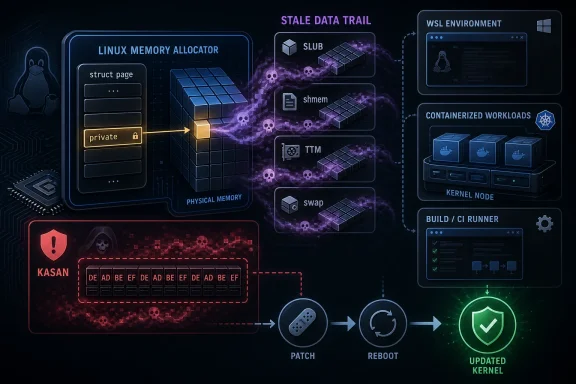
The fix behind CVE-2026-43303 is deceptively modest: clear page->private inside free_pages_prepare(). That sounds like housekeeping, the sort of allocator hygiene that rarely makes it out of a kernel mailing list and into an administrator’s week. But kernel bugs often become security bugs precisely when housekeeping becomes an implicit contract across subsystems.In Linux,
struct page is a compact bookkeeping structure used to describe physical memory pages. Many kernel subsystems borrow fields inside it for their own purposes, and page->private is one of those multipurpose pieces of state. That reuse is powerful, but it also creates a brittle bargain: when one subsystem is finished with a page, the next subsystem must not inherit stale assumptions.CVE-2026-43303 breaks that bargain. Several subsystems, including SLUB, shmem, and TTM, can use
page->private without clearing it before the page goes back to the allocator. Later, when those pages are allocated as high-order pages and split, the tail pages can retain old page->private values. What should have been fresh memory metadata becomes a kind of ghost state from a previous life.The failure path identified in the CVE lands in swap. The swap subsystem uses
page->private to track swap count continuations and assumes newly allocated pages start with page->private == 0. If a stale value is still there, swap code can believe a continuation list exists and walk through uninitialized list pointers. The crash signature includes KASAN warning about a wild memory access near the familiar poison-pattern region beginning with 0xdead, followed by a fault in __do_sys_swapoff.That is the essence of the bug: not a missing bounds check at an obvious input boundary, but a stale metadata value crossing subsystem boundaries until another subsystem treats it as live structure. It is the kind of flaw that rewards attackers and reliability engineers for the same reason. The failure is buried, stateful, and dependent on allocator history.
The Severity Score Says “Local,” But the Kernel Says “Privileged Ground”
Kernel.org rates the issue 7.8 High with the vectorAV:L/AC:L/PR:L/UI:N/S:U/C:H/I:H/A:H. The key phrase is local access with low complexity and low privileges. That means this is not a remote worm-class bug; an attacker needs some foothold on the machine. But on systems that run untrusted users, CI jobs, containers, shells, or developer workloads, “local” is not the comfort word it used to be.Local kernel bugs matter because the kernel is the security boundary beneath nearly every higher-level isolation mechanism. Containers are not virtual machines. WSL distributions are not separate hardware. Multi-user Linux boxes, build runners, GPU workstations, Kubernetes nodes, and cloud instances all depend on the kernel to keep ordinary users and processes ordinary.
The description published with the CVE emphasizes a crash, and administrators should resist leaping from “use-after-free” to “guaranteed root exploit.” A KASAN trace is proof of memory unsafety, not proof of a polished exploit chain. Still, the CVSS vector’s impact fields are set to High for confidentiality, integrity, and availability, which reflects the security model’s discomfort with use-after-free in kernel memory management.
The awkward middle ground is where this CVE lives. It is not an internet-facing panic button, but it is also not a tidy denial-of-service bug to file away under “wait for the next monthly image.” Kernel memory bugs have a long history of starting life as weird crashes and ending life as privilege-escalation primitives after exploit developers discover how to shape heap layout, allocation order, and reachable call paths.
That does not mean every vulnerable system is immediately exploitable. It does mean defenders should treat the bug as a kernel integrity issue, not merely a swap subsystem annoyance. The vulnerable assumption is global: freed pages should not carry stale subsystem metadata into their next allocation.
The Affected-Version Story Is Messier Than the One-Line Fix
The NVD change history lists affected Linux kernel configurations including 5.18 release candidates, 5.18 itself, versions from 5.18.1 up to but excluding 6.18.16, and versions from 6.19 up to but excluding 6.19.6. That is a wide range on paper, but the real exposure for most organizations depends less on upstream version strings than on distribution backports.This is where kernel CVEs frustrate scanners and humans alike. A vendor kernel can carry a version number that looks old while containing a backported fix. Another system can advertise a newer-looking kernel and still be waiting on a downstream package. Version comparison alone is often a poor substitute for checking the distribution advisory, package changelog, or vendor security tracker.
Amazon Linux, for example, listed Amazon Linux 2 kernel lines as not affected while showing Amazon Linux 2023 kernel tracks in a pending-fix state when the advisory data surfaced. Tenable’s plugin framed some Linux and Unix hosts as having packages affected where the vendor indicates no supplied patch is available. That apparent contradiction is not unusual; vulnerability tools often synthesize upstream CVEs, vendor advisories, and local package evidence at different speeds.
The same caution applies to desktop and server distributions. Ubuntu, Debian, Red Hat, SUSE, Arch, and other Linux ecosystems each route kernel CVEs through their own triage and packaging model. One shop’s “affected kernel” may already be fixed by a vendor patch with no upstream version bump that satisfies a naïve scanner. Another shop’s custom kernel may be exposed even if the base distribution has moved on.
Administrators should therefore treat the CPE list as a starting map, not a final inventory. The important operational act is to identify running kernels, match them against vendor-fixed packages, and reboot into the fixed kernel. Installing the package is necessary; running it is what changes the system.
Why This Linux Bug Belongs on a Windows Site
For a Windows-focused audience, a Linux memory-management CVE might sound like news from the other side of the fence. That fence is mostly gone. Windows shops routinely run Linux in WSL, Hyper-V guests, AKS nodes, container build systems, GitHub or self-hosted runners, network appliances, storage systems, and cloud images managed by the same teams that patch Windows Server and Entra-connected clients.WSL is the obvious bridge. WSL 2 uses a real Linux kernel inside a lightweight virtual machine, and many developer fleets now rely on it for daily work. A vulnerable WSL kernel does not automatically mean a compromise of the Windows host, but it does mean the Linux environment has a kernel security boundary worth patching like any other. Developers who install random toolchains, test containers, run local databases, and pull public code are not operating in a risk-free sandbox just because the taskbar says Windows.
The server-side bridge is even stronger. Microsoft-heavy organizations increasingly run Linux workloads in Azure, Kubernetes, appliance VMs, and cross-platform CI/CD systems. The identity plane may be Microsoft, the endpoint tooling may be Microsoft Defender, and the ticketing workflow may be built around Patch Tuesday, but the vulnerable kernel may still be Linux. CVE-2026-43303 is a reminder that security ownership follows the workload, not the brand of the admin console.
There is also a monitoring angle. Many Windows estates now ingest Linux telemetry into the same SIEM, vulnerability management, and endpoint platforms used for Windows hosts. If those platforms lean heavily on NVD scoring and CPE matching, they can lag vendor reality or produce noisy discrepancies. CVE-2026-43303’s partial enrichment state and vendor-specific differences are exactly the kind of case where a dashboard can be technically correct and operationally incomplete.
The result is a familiar hybrid problem. The people responsible for remediation may not be kernel specialists, while the kernel specialists may not own the enterprise patch calendar. That gap is where local vulnerabilities linger.
The NVD Record Is Useful, But It Is Not the Whole Truth
NVD’s entry for CVE-2026-43303 is both helpful and revealing. It records the kernel.org description, the CWE-416 use-after-free classification, the kernel.org CVSS score, and the affected CPE ranges added during NIST analysis. It also states that NVD had not provided its own CVSS assessment at the time reflected in the record.That distinction matters. For years, many vulnerability workflows treated NVD as the normalized center of the universe. But the modern CVE ecosystem is too fast, too vendor-specific, and too overloaded for any single enrichment pipeline to be treated as the only source of truth. CNA scoring, vendor advisories, distribution trackers, scanner plugins, and exploit intelligence all arrive on their own clocks.
Kernel CVEs make this especially visible. The upstream project can fix a flaw in stable branches, distributions can backport it differently, and vulnerability scanners can report against package metadata rather than actual running kernel state. Meanwhile, public databases can lag on CPEs, omit vendor nuance, or show “N/A” for fields that risk engines desperately want to turn into a number.
For defenders, the right response is not to discard NVD. It is to demote NVD from oracle to input. The CVE record tells us the bug exists, how the upstream community describes it, how it is classified, and what broad version spans may be implicated. It does not tell every organization whether every deployed kernel is vulnerable, patched, rebooted, exposed to untrusted local users, or shielded by compensating controls.
The most mature vulnerability programs already operate this way. They correlate upstream advisories with vendor packages, asset role, exploitability, privileges required, and business context. CVE-2026-43303 is a clean example of why that work matters: the same CVE can be urgent on a shared build host, lower priority on a single-purpose locked-down appliance, and complicated on a cloud image awaiting vendor release.
The Real Risk Is in Shared Machines and Automation Hosts
The most exposed systems are not necessarily the most glamorous ones. A developer laptop running WSL, a self-hosted CI runner, a shared research workstation, a container host for internal tools, or a build machine that executes third-party code may be a more plausible target than a hardened production database with no shell access. The bug requires local privileges, so the question becomes: who or what gets to run code locally?CI/CD systems deserve special attention. They routinely execute code from branches, dependencies, tests, package scripts, and build containers. Even when those jobs run with nominally low privilege, the host kernel remains the ultimate boundary. A local kernel use-after-free with low attack complexity belongs high on the list for build infrastructure, particularly if runners are reused across projects or tenants.
Container hosts are another natural concern. Containers depend on namespace and cgroup isolation enforced by the host kernel. If an attacker can reach a kernel bug from inside a container, the container boundary may become part of the exploit surface rather than a defense. The CVE description does not by itself establish container escape, but the class and location of the flaw are enough to justify quick patching on hosts that run untrusted or semi-trusted containers.
Swap configuration also complicates intuition. Because the observed crash path involves swapoff and swap count continuation handling, administrators might wonder whether disabling swap eliminates risk. That would be too neat. The bug is stale page metadata in allocator handling, and swap is the subsystem where the bad assumption was observed. Configuration may affect reachability, but it is not a substitute for the allocator fix.
GPU and desktop-adjacent Linux systems should not be ignored either. The mention of TTM, a memory manager used in graphics contexts, is a reminder that modern kernel memory paths are shared across server, desktop, virtualization, and accelerator workloads. The bug is not a “Linux desktop only” issue, but neither is it confined to headless servers.
A One-Line Fix Carries a Kernel-Wide Message
The patch clearspage->private in free_pages_prepare(), which is the kind of centralized fix kernel maintainers prefer when multiple callers can leave state behind. Rather than trying to audit every subsystem that might use the field and forget to scrub it, the allocator resets the field as pages are prepared for freeing. It makes the allocator enforce the invariant that freshly allocated pages should not carry stale private data.That is elegant, but it also tells us something about the vulnerability’s nature. The bug was not that swap alone made a bad decision. Swap trusted a condition that the rest of the kernel was supposed to uphold. When the allocator allowed stale
page->private values to survive into tail pages after high-order allocations were split, that trust became unsafe.High-order pages are larger contiguous allocations made up of multiple base pages. Splitting them creates head and tail pages with metadata relationships that are easy to get subtly wrong. The stale state landing on tail pages is the sort of detail that rarely matters until it matters enormously. Kernel security is full of these edge cases: a lifetime rule here, a field reuse there, an implicit zeroing assumption somewhere else.
The broader lesson is that kernel hardening often happens by making assumptions explicit at choke points. Clear the metadata when freeing. Poison lists when invalid. Validate state before traversing. These mechanisms can look redundant until a bug demonstrates that redundancy is how complex systems survive.
For performance-minded readers, any allocator change raises the natural question of overhead. Clearing a field in the free path is not the same as zeroing whole pages, and the patch’s presence in stable branches suggests maintainers judged the tradeoff acceptable. The cost of not enforcing the invariant is a use-after-free in core memory management, and that is not a bargain any serious kernel wants to make.
Patch Management Still Ends With a Reboot
For administrators, the remediation path is conceptually simple and operationally annoying: install the fixed kernel from the distribution or vendor, then reboot into it. Linux patching has improved enormously, and live patching can reduce downtime for selected fixes, but the default truth remains that a new kernel package does not protect a machine still running the old kernel.The first check is inventory. Identify systems running Linux kernels in the affected upstream ranges, then separate them by vendor and support channel. Do not stop at obvious servers. Include WSL kernels, hypervisor guests, cloud images, Kubernetes nodes, self-hosted runners, appliance VMs, and lab machines that may have escaped normal patch governance.
The second check is provenance. If a system runs a distribution kernel, use the distribution’s advisory and package metadata. If it runs a cloud-provider kernel, use the cloud provider’s advisory. If it runs a custom kernel, the team that built it owns the answer and should verify whether the relevant stable patch is included. Custom kernels are where upstream CVE language and enterprise risk dashboards most often talk past each other.
The third check is runtime state. After patching, confirm the booted kernel version and build, not merely the installed package list. Long-lived Linux servers are notorious for accumulating patched kernels on disk while continuing to run vulnerable ones in memory. A vulnerability scan that only sees packages may say “fixed” before the system has actually crossed the security boundary.
Finally, prioritize by local-code exposure. A lightly used internal VM with no untrusted users is not the same as a shared container host or build runner. CVSS gives a baseline, not a maintenance window. Systems that let less-trusted users or jobs execute code should move first.
Vulnerability Scanners Will Disagree, and That Is Not Always a Bug
CVE-2026-43303 is almost designed to make scanners disagree. NVD lists affected CPEs. Kernel.org provides a CVSS vector and stable patches. Cloud and distribution vendors may classify their products as not affected, pending, fixed, or not yet triaged depending on their kernel branch and backport status. Scanner plugins may report “unpatched” based on vendor feeds, package evidence, or conservative matching.That can look like tool failure, but often it is tool compression. A vulnerability scanner has to reduce a messy supply chain into a yes, no, or maybe. Kernel maintenance does not always fit that model. Backports break simple version logic, vendors patch before public scanners catch up, and custom images can carry a mix of upstream and downstream changes no public database fully understands.
The right operational habit is to preserve disagreement long enough to resolve it, not to average it away. If one tool says a host is vulnerable and the vendor advisory says the package is fixed, check the package changelog and running kernel. If NVD lacks a final score but the CNA score is High, do not wait for the missing field before triaging. If a cloud image says “pending fix,” do not assume the base distribution’s status applies.
This is particularly important for Windows-centric security operations centers that have expanded into Linux coverage. Teams accustomed to Microsoft’s relatively centralized update model may expect one authoritative patch status. Linux security maintenance is federated. That is a strength, but it demands more source-aware triage.
The scanner is still valuable. It finds forgotten systems, highlights package drift, and gives security teams a common work queue. But for a kernel CVE, the scanner should start the investigation rather than end it.
The Exploit Question Should Not Delay the Maintenance Window
Security teams often ask the same question first: is there a public exploit? For CVE-2026-43303, the more useful question is whether the affected hosts allow local code execution by users, jobs, containers, or automation that the organization would not fully trust with kernel privileges. If the answer is yes, the patch belongs on an accelerated path even without a public exploit.This is not alarmism. Many local kernel vulnerabilities begin as crash reports, sanitizer findings, or weird subsystem failures. Exploitability depends on shaping kernel memory in ways that are not always obvious from the original bug report. A crash in a poisoned list traversal may remain a denial of service, or it may become part of a more controlled memory corruption technique when paired with heap grooming and reachable primitives.
The CVSS score already bakes in a serious impact assumption. It marks confidentiality, integrity, and availability impacts as High, even though the access vector is local. That combination should trigger attention on any system where local access is broad, automated, or exposed indirectly through application workloads.
The absence of user interaction in the vector also matters. This is not a bug that requires tricking a logged-in user into opening a file. It is a kernel behavior reachable by local activity. For build systems, shared hosts, and container platforms, local activity is the whole business model.
There is still room for rational prioritization. Internet-facing remote-code-execution bugs in widely deployed services can outrank a local kernel flaw. But “local” should not push this to the bottom of the queue. In modern infrastructure, local execution is often the first prize an attacker wins on the way to the kernel.
The WSL Angle Is About Boundaries, Not Panic
WSL deserves a separate note because it sits at the cultural intersection of this issue. Many Windows users think of WSL as a developer convenience rather than as an operating system environment with its own kernel lifecycle. That mental model is understandable and incomplete.WSL 2’s Linux kernel is serviced differently from a distribution’s userland packages. Updating Ubuntu or Debian packages inside WSL is not the same as updating the WSL kernel supplied through Microsoft’s mechanisms. An organization that standardizes on WSL for development should know how its WSL kernel is updated, how quickly those updates are applied, and whether endpoint management can verify the result.
The realistic risk is not that CVE-2026-43303 instantly turns every WSL shell into a Windows host compromise. Virtualization boundaries still matter. The risk is that sensitive development workflows increasingly run inside Linux environments that are easy to forget during patch planning. Source code, credentials, SSH keys, package tokens, cloud CLIs, and build artifacts often live within reach of those environments.
If an attacker has code execution inside a vulnerable WSL Linux environment, a local kernel bug could undermine isolation inside that Linux VM and potentially expose secrets or tamper with developer workflows. Whether it crosses into Windows host compromise is a separate and higher bar. But security programs should not require host escape before taking WSL kernel hygiene seriously.
The same principle applies to Linux VMs on Hyper-V. Virtualization is a boundary, not an excuse to ignore guest kernels. A compromised guest can still steal guest-resident secrets, attack internal networks, manipulate builds, or become a foothold for lateral movement.
The Most Useful Response Is Boring and Precise
There is a temptation with kernel CVEs to go either too abstract or too dramatic. The abstract version says “apply vendor updates” and moves on. The dramatic version treats every use-after-free as an imminent fleetwide catastrophe. CVE-2026-43303 calls for a better middle: boring, precise remediation based on where local code actually runs.The most concrete takeaway is that the fix is known and small, but the affected surface is broad enough to justify deliberate inventory. This is especially true in organizations where Linux appears as an embedded dependency of Windows-centered workflows. WSL, containers, cloud agents, build hosts, and appliance images can all create Linux kernel exposure outside the traditional Linux server list.
Security teams should also resist overfitting on swap. The vulnerable crash path involves swapoff and swap count continuation metadata, but the root cause is stale page private state left by multiple subsystems and preserved through allocation and splitting behavior. Configuration workarounds may reduce certain paths, but they do not replace the kernel fix.
The patch should be handled as a kernel integrity update. That means planned reboots, runtime verification, and exception tracking for systems that cannot be restarted immediately. Exceptions should be tied to exposure and compensating controls, not to the comforting word “local.”
The Patch Is Small; the Inventory Lesson Is Not
CVE-2026-43303 is not the loudest Linux kernel vulnerability imaginable, but it is a sharp test of whether an organization knows where its Linux kernels are and who owns them. The following points are the operational center of gravity:- CVE-2026-43303 is a High-severity local Linux kernel use-after-free caused by stale
page->privatevalues surviving across page free, allocation, and split operations. - The published fix clears
page->privateinfree_pages_prepare(), enforcing a cleaner allocator invariant across subsystems that reuse the field. - The most urgent systems are those that allow local code execution by less-trusted users, containers, build jobs, CI workflows, or developer tooling.
- Version strings alone are not enough because distribution and cloud vendors may backport fixes without matching upstream kernel version boundaries.
- Installing a fixed kernel package is not sufficient until the system has rebooted or otherwise verified that the fixed kernel is the one actually running.
- Windows-oriented teams should include WSL 2 kernels, Linux VMs, Kubernetes nodes, appliance images, and self-hosted runners in their remediation inventory.
References
- Primary source: NVD / Linux Kernel
Published: 2026-05-22T01:48:02-07:00
NVD - CVE-2026-43303
 nvd.nist.gov
- Security advisory: MSRC
Published: 2026-05-22T01:48:02-07:00
Original feed URL
Security Update Guide - Microsoft Security Response Center
 msrc.microsoft.com
- Related coverage: zero.redgem.net
exploit - zero redgem
Security news and updates tagged with exploit. Stay informed with the latest security vulnerabilities and threats.zero.redgem.net - Related coverage: cve.imfht.com
CVE-2026-43304: libceph: define and enforce CEPH_MAX_KEY_LEN - Vulnerability Platform
[CRITICAL 9.8] Overview A security vulnerability exists in the module of the Linux kernel, primarily involving a lack of validity verification for key length when de cve.imfht.com
- Related coverage: labs.cloudsecurityalliance.org
NVD Enrichment Triage: Enterprise Vulnerability Programs Must Adapt
PDF documentlabs.cloudsecurityalliance.org
