

Microsoft’s CVE-2026-26177 entry is exactly the kind of Windows security advisory that defenders need to read twice: it is an elevation-of-privilege issue in the Ancillary Function Driver for WinSock layer, and Microsoft’s own confidence metric is designed to tell you how certain the company is that the vulnerability really exists and how credible the technical details are. In practical terms, that means this is not just a naming exercise; it is Microsoft signaling that the issue is worth tracking, patching, and possibly prioritizing even if every exploit detail is not public. The broader significance is familiar to anyone who has watched Windows kernel security for years: a kernel-adjacent bug can turn a low-privilege foothold into full system control. ndows Ancillary Function Driver for WinSock has been a recurring security hotspot for years, and CVE-2026-26177 fits a long pattern of local privilege-escalation bugs in foundational networking code. Microsoft’s security records for AFD.sys have repeatedly described issues that allow an authenticated local attacker to gain higher privileges, which is why this component remains one of the most watched parts of the Windows kernel attack surface. The important point is not that every AFD bug is identical, but that the driver sits close enough to the kernel and networking stack to make even seemingly modest logic flaws highly consequential.
That history matterhould view AFD.sys not as an isolated component but as part of the Windows trust chain. When Microsoft flags an EoP issue here, the real-world risk is often post-compromise expansion rather than initial access. In other words, an attacker may first need a local foothold, but once they have it, a flaw like this can help them pivot to SYSTEM, disable defenses, dump credentials, or stage lateral movement.
Microsoft’s confidence metric, as descrierpt, is also important because it reflects more than a simple yes/no vulnerability label. It captures the level of certainty in the existence of the flaw and the credibility of the technical details available to Microsoft. That means a CVE can be operationally serious even when the public record is thin; certainty and disclosure depth are related, but not the same thing.
For administrators, the practical lesson is straightforward: as a validated security event, not as a theoretical note. Even when Microsoft withholds full root-cause detail, the company is still telling the market that the issue is real enough to ship a patch and track as a vulnerability. That is typically enough to move the item into patch-priority territory, especially on endpoints where untrusted code execution, macro abuse, service compromise, or credential theft can create a local escalation opportunity.
AFD.sys is a kernel-mode driver that implemior for Windows networking, so it occupies a sensitive position between user-mode applications and the operating system core. Components like this tend to be security magnets because they have to process inputs that originate from many different sources and still preserve hard privilege boundaries. The more general the interface, the more opportunities there are for edge-case memory handling mistakes, access-control oversights, or race conditions.
The repeated appearance of AFD-related vulnerabilities across Microsoft advisories suggests a structura primitives are hard to secure perfectly. That does not mean Windows is uniquely weak; rather, it means the attack surface is inherently rich and high value. Kernel drivers must balance performance, compatibility, and deep system access, and each of those goals can increase the consequences of a defect. A single bad assumption at the boundary can be enough to cross the privilege line.
A second reason these bugs matter is their defense impact. Attackers often do not need remote exploitability when they can chain a local bug afteedentials, malicious software installation, or a service-account compromise. That makes local EoP vulnerabilities a critical bridge in the attack lifecycle, especially in enterprise environments where multiple actors and services share the same machine.
For this kind of advisory, the metric can be read as a proxy for maturity of disclosure. A high-confidence entry usually suggests Microsoft has enough internal validation, repro evidence,sis to stand behind the claim. A lower-confidence or less-detailed entry does not mean “fake”; it means the technical specifics may be incomplete, under review, or not fully published yet. That distinction matters because operational risk is driven by certainty, not just verbosity.
This also shapes how security teams should communicate risk upstairs. The right message is not “we know everything,” but “Microsoft has validated enough to publish a CVE, and the component involved is one of Windows’ most sensitiming helps management understand why a bug with limited public detail still deserves a fast response window.
The most obvious risk is credential theft after privilege escalation. Once an attacker can reach elevated context, they may be able to access secrets stored in memory, tamper with security tools, or extract tokens used by management software. That is especially problemat IT administrators, developers with elevated rights, or helpdesk staff who have broad access to internal infrastructure. The higher the local trust level, the more valuable the escalation becomes.
Security teams also need to think in terms of exposure strata. VDI hosts, jump boxes, admin workstations, application servers, and developer endpoints are all differently exposed to local attacker footholds. The same CVE can have very different urgency depending on whether the machine is Internet-facing, domain-by application control and device hardening.
The consumer impact is strongest where users run with excessive rights. Many Windows home users still use administrator accounts for daily work, and that lowers the bar for post-compromise abuse. Even when the vulnerability itself requires local access, the combination of social engineering, download abuse, and privilege escalation can be enough to turno a full-machine compromise.
That complexity also explains why Microsoft’s advisories often provide just enough detail for defenders and not enough for adversaries. The vendor needs to preserve security through remediation while avoiding unnecessary exploit guidance. For security teams, this means understanding the shape of the bug is often as important as knowing the exact code path.
The wider lesson is that Windasingly about layered defense rather than any single control. Attack surface reduction, application control, least privilege, memory protections, and timely patching all matter. When one layer fails, the next one has to absorb the hit.
Next, identify your highest-risk endpoints. Administrative workstations, privileged jump hosts, domain-connected developer machines, and shared remote-access systems should rise to the top of the queue. Those systems are most likely to provide the local foothold and privilege-rich environment that an attacker would want.
Another opportunity is to use the event as a forcing function for privilege review. If a local EoP bug matters most on machines with elevated users, then the best long-term mitigation is reducing how many users and devices have that level of trust. Security wins are often organizational, not just technical.
A second concern is operational complacency. Teams sometimes treat local privilege escalation as “only” post-compromise and therefore lower urgency than remote code execution. That framing is dangerous because local escalation is often what converts a routine intrusion into a major incident. The phrase “local” should never be mistaken for “low risk.”
Security teams should also watch for third-party analysis that may later explain the confidence metric, root cause, or exploitation mechanics in more detail. That kind of follow-on research often appears after patch release and can change how defenders tune detection, segmentation, or hardening. For now, the right approach is to treat Microsoft’s advisory as sufficiently credible to act on, while keeping an eye out for additional technical clarification.
Source: MSRC Security Update Guide - Microsoft Security Response Center
That history matterhould view AFD.sys not as an isolated component but as part of the Windows trust chain. When Microsoft flags an EoP issue here, the real-world risk is often post-compromise expansion rather than initial access. In other words, an attacker may first need a local foothold, but once they have it, a flaw like this can help them pivot to SYSTEM, disable defenses, dump credentials, or stage lateral movement.
Microsoft’s confidence metric, as descrierpt, is also important because it reflects more than a simple yes/no vulnerability label. It captures the level of certainty in the existence of the flaw and the credibility of the technical details available to Microsoft. That means a CVE can be operationally serious even when the public record is thin; certainty and disclosure depth are related, but not the same thing.
For administrators, the practical lesson is straightforward: as a validated security event, not as a theoretical note. Even when Microsoft withholds full root-cause detail, the company is still telling the market that the issue is real enough to ship a patch and track as a vulnerability. That is typically enough to move the item into patch-priority territory, especially on endpoints where untrusted code execution, macro abuse, service compromise, or credential theft can create a local escalation opportunity.
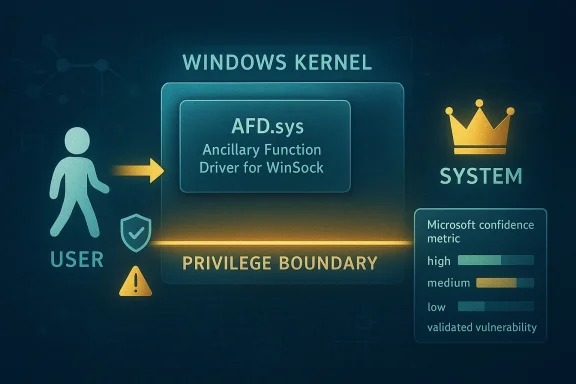 Why AFD.sys Keeps Reappearing
AFD.sys is a kernel-mode driver that implemior for Windows networking, so it occupies a sensitive position between user-mode applications and the operating system core. Components like this tend to be security magnets because they have to process inputs that originate from many different sources and still preserve hard privilege boundaries. The more general the interface, the more opportunities there are for edge-case memory handling mistakes, access-control oversights, or race conditions.The repeated appearance of AFD-related vulnerabilities across Microsoft advisories suggests a structura primitives are hard to secure perfectly. That does not mean Windows is uniquely weak; rather, it means the attack surface is inherently rich and high value. Kernel drivers must balance performance, compatibility, and deep system access, and each of those goals can increase the consequences of a defect. A single bad assumption at the boundary can be enough to cross the privilege line.
Why kernel drivers are so dangerous
Kernel drivers do not just crash systems when they fail; they can become privilege-law in a component like AFD.sys may allow an attacker to corrupt memory, bypass checks, or manipulate trusted structures in ways that are extremely difficult for application-layer controls to stop. Once the attacker is in kernel-adjacent territory, endpoint protection becomes more about response than prevention.A second reason these bugs matter is their defense impact. Attackers often do not need remote exploitability when they can chain a local bug afteedentials, malicious software installation, or a service-account compromise. That makes local EoP vulnerabilities a critical bridge in the attack lifecycle, especially in enterprise environments where multiple actors and services share the same machine.
- Kernel components are high-value targets because they run with elevated trust.
- Driver bugs can turn ordinary user access into full system compromise.
- Local is often the bridge between foothold and persistence.
- Defensive tools may detect abuse late if the attacker stays inside trusted code paths.
- Patching kernel flaws reduces the blast radius of unrelated compromises.
What Microsoft’s Confidence Metric Really Signals
The confidence metric described in the CVE-2026-26177 text is not just a scoring curiosity; it is a useful operational signal. Microsoft is effectively telling defenders how sure it is that the vulnerability exists and how strong the evidence is behind the advisory entry. That is especially important when public technical details are sparse, because security teams must decide whether to act on vendor acknowledgment, exploit chatter, or independent reverse engineering.For this kind of advisory, the metric can be read as a proxy for maturity of disclosure. A high-confidence entry usually suggests Microsoft has enough internal validation, repro evidence,sis to stand behind the claim. A lower-confidence or less-detailed entry does not mean “fake”; it means the technical specifics may be incomplete, under review, or not fully published yet. That distinction matters because operational risk is driven by certainty, not just verbosity.
Confidence vs. exploitability
A high-confidence bug is not automatically widely exploited, and a low-detail bug is not automatically low-risk. The real question for defenders is whether the advisory poinack surface in their environment and whether a patched build is already available. In practice, the lack of detail often makes patching more urgent, not less, because the internal mechanics are hidden precisely where attackers may try to spend time.This also shapes how security teams should communicate risk upstairs. The right message is not “we know everything,” but “Microsoft has validated enough to publish a CVE, and the component involved is one of Windows’ most sensitiming helps management understand why a bug with limited public detail still deserves a fast response window.
- Confidence metrics help separate confirmed issues from speculative analysis.
- Sparse public detail does not reduce the need to patch.
- Vendor validation is often the most important signal available early on.
- Security teams should treat kernel-dtly high-value.
- Internal priority should be driven by impact and exposure, not only by exploit news.
Enterprise Impact
In enterprise environments, the significance of CVE-2026-26177 is amplified by scale and privilege concentration. A local elevation-of-privilege vulnerability becomes much more dangerous when it exists on machines that host sensitive data, run admin tools, or serve as stepping stones into broader network segments. Endpoint compromise is rarely the end of the story; it is often the beginning of a longer intrusion chain.The most obvious risk is credential theft after privilege escalation. Once an attacker can reach elevated context, they may be able to access secrets stored in memory, tamper with security tools, or extract tokens used by management software. That is especially problemat IT administrators, developers with elevated rights, or helpdesk staff who have broad access to internal infrastructure. The higher the local trust level, the more valuable the escalation becomes.
Where the enterprise pain lands
The operational burden is not just the patch itself but the inventory work around it. Large estates often have mixed build levels, multiple hardware generations, and delayed maintenance windows, all of which can complicate a straightforward Windows updatelity in a common kernel driver therefore creates both technical urgency and administrative friction.Security teams also need to think in terms of exposure strata. VDI hosts, jump boxes, admin workstations, application servers, and developer endpoints are all differently exposed to local attacker footholds. The same CVE can have very different urgency depending on whether the machine is Internet-facing, domain-by application control and device hardening.
- Domain admin workstations deserve the fastest remediation.
- Shared servers should be prioritized because multiple users may have foothold paths.
- VDI and jump hosts are especially sensitive because they concentrate privileged activity.
- Systems with weak application control are more likely to turn a foothold into an exploit chan should include connectivity and service regression testing.
Consumer Impact
Consumers are less likely to be targeted by a dedicated AFD.sys escalation chain than enterprises, but that does not make the issue irrelevant. Home systems can still be compromised by malware, malicious downloads, browser-based attacks that leave a local payload, or bundled installers that create the initial foothold needed for privilege escalation. Once a local attacker lands, an EoP bug can help them disable security software or deepen persistence.The consumer impact is strongest where users run with excessive rights. Many Windows home users still use administrator accounts for daily work, and that lowers the bar for post-compromise abuse. Even when the vulnerability itself requires local access, the combination of social engineering, download abuse, and privilege escalation can be enough to turno a full-machine compromise.
Practical consumer risk
Consumers should think less about the CVE name and more about the threat chain. A malicious attachment, fake software installer, cracked utility, or remote-support scam can create the foothold that a local elevation bug needs. The value of patching here is not abstract security hygiene; it is shrinking the room an attacker has after the first miregular Windows Update discipline still matters. Most home users will never investigate a CVE directly, but they benefit from the same principle that protects enterprises: reduce the number of code paths an attacker can abuse after entry. A patched kernel driver is one fewer rung on the escalation ladder.- Keep Windows fully updated through automatic patching.
- Avoid running dministrator account.
- Be skeptical of cracked software and bundled installers.
- Treat browser downloads and email attachments as potential footholds.
- Use reputable endpoint security, but do not assume it can stop kernel abuse.
How This Fits the Broader Windows Security Pattern
CVE-2026-26177 should not be reosoft has spent years shipping repeated fixes across Windows subsystems that sit close to the kernel, from storage drivers to graphics components to accessibility and networking services. The pattern shows a platform with immense complexity and enormous backward-compatibility demands, which is exactly what makes monthly patch cycles so important.That complexity also explains why Microsoft’s advisories often provide just enough detail for defenders and not enough for adversaries. The vendor needs to preserve security through remediation while avoiding unnecessary exploit guidance. For security teams, this means understanding the shape of the bug is often as important as knowing the exact code path.
A recurring local-escalation theme
Local privilege escalation remains o post-compromise objectives because it turns partial access into total control. Once an attacker reaches a user context, the next step is often a driver, service, or broker bug that can elevate them. AFD.sys keeps appearing because networking is universal, kernel-resident, and difficult to simplify without breaking compatibility.The wider lesson is that Windasingly about layered defense rather than any single control. Attack surface reduction, application control, least privilege, memory protections, and timely patching all matter. When one layer fails, the next one has to absorb the hit.
- Windows security depends on layered controls, not one magic fix.
- Kernel drivers remain some of the most sensitive code in the platform.
- Monthly patching is still one of the few controls tates.
- Compatibility pressure makes these flaws hard to eliminate permanently.
- Attackers value local EoP bugs because they convert small wins into major breaches.
What Administrators Should Do Now
The most important operational step is simple: confirm that your Windows update fix for CVE-2026-26177 and that deployment is moving according to policy. Because AFD.sys sits in a core path, patch management teams should not assume the issue is confined to a niche product line or a single Windows edition. The safer assumption is that any affected Windows system with the driver in place deserves attention.Next, identify your highest-risk endpoints. Administrative workstations, privileged jump hosts, domain-connected developer machines, and shared remote-access systems should rise to the top of the queue. Those systems are most likely to provide the local foothold and privilege-rich environment that an attacker would want.
A practical response checklist
- Verify the Microsoft advisory entry and map it to your internal patch baseline.
- Confirm which Windows builds in your fleet include the vulnerable AFD.sys coe privileged workstations and servers that expose high-value credentials.
- Test the update in a controlled ring to catch compatibility regressions.
- Accelerate deployment on endpoints with weak application control or broader user access.
- Review logs for suspicious local privilege activity around the patch window.
- Validate the fix across pilot, broad, and high-risk rings.
- Check whether automation tools or imaging baselines need updating.
- Watch for systems that repeatedly fail to install the update.
- Coordinate with helpdesk and endpoint teams before enforcement deadlines.
- Reassess admin-rights sprawl while the patch cycle is active.
Strengths and Opportunities
Microsoft’s handling of CVE-2026-26177 has a few clear strengths, even with the limited public detail, and defenders can use the disclosure as a prompt to improve broader hygiene. The strongesta kernel-driver advisory is easy to map to a concrete patching action, which makes it less ambiguous than many modern security issues. That clarity can help organizations tighten their overall vulnerability response process.Another opportunity is to use the event as a forcing function for privilege review. If a local EoP bug matters most on machines with elevated users, then the best long-term mitigation is reducing how many users and devices have that level of trust. Security wins are often organizational, not just technical.
- The advisory is actionable even without public exploit code.
- Patch deployment can be tied to existing Windows maintenance rings.
- Privilege-review work can reduce exposure beyond this one CVE.
- Kernel-driver bugs often justify better endpoint segmentation.
- The evene of least privilege and admin separation.
- Security teams can sharpen their risk communication around confidence metrics.
- This is a good candidate for post-patch hunting and control validation.
Risks and Concerns
The main risk is that attackers may already be looking at the same driver surface Micren when public exploit details are absent, a kernel EoP advisory can quickly become a target for reverse engineering, especially if the patch lands before full disclosure. That gap is where defenders can be most vulnerable, because their patch windows and the attacker research cycle may overlap.A second concern is operational complacency. Teams sometimes treat local privilege escalation as “only” post-compromise and therefore lower urgency than remote code execution. That framing is dangerous because local escalation is often what converts a routine intrusion into a major incident. The phrase “local” should never be mistaken for “low risk.”
- Attackers may reverse-engineer the patch before defenders finish deployment.
- Local footholds from phishing or malware can be enough to weaponize the bug.
- Admin-heavy workstations are especially exposed to privilege escalation abuse.
- Delayed patching extends the uomised endpoint.
- Sparse public detail can create a false sense of uncertainty or delay.
- Overreliance on EDR may miss kernel-level abuse until the attacker is already elevated.
- Mixed estate complexity can slow rollout and leave gaps.
Looking Ahead
The next few patch cycles will tell us whether CVE-2026-26177 is part of a broader cluster of solated event. If the pattern from past Windows advisories is any guide, defenders should expect continued attention on kernel-side networking code, because that is where Microsoft’s risk and compatibility tradeoffs are hardest to balance. The exact exploitability of this CVE may remain partially hidden, but the operational lesson is already plain: core drivers deserve fast remediation.Security teams should also watch for third-party analysis that may later explain the confidence metric, root cause, or exploitation mechanics in more detail. That kind of follow-on research often appears after patch release and can change how defenders tune detection, segmentation, or hardening. For now, the right approach is to treat Microsoft’s advisory as sufficiently credible to act on, while keeping an eye out for additional technical clarification.
- Confirm patch deployment across all Windows build rings.
- Monitor for independent analysis of AFD.sys exploitability.
- Recheck admin-rights policy on workstations and jump hosts.
- Validate endpoint detectilege-escalation behavior.
- Prepare incident-response playbooks for local-to-SYSTEM escalation paths.
Source: MSRC Security Update Guide - Microsoft Security Response Center
